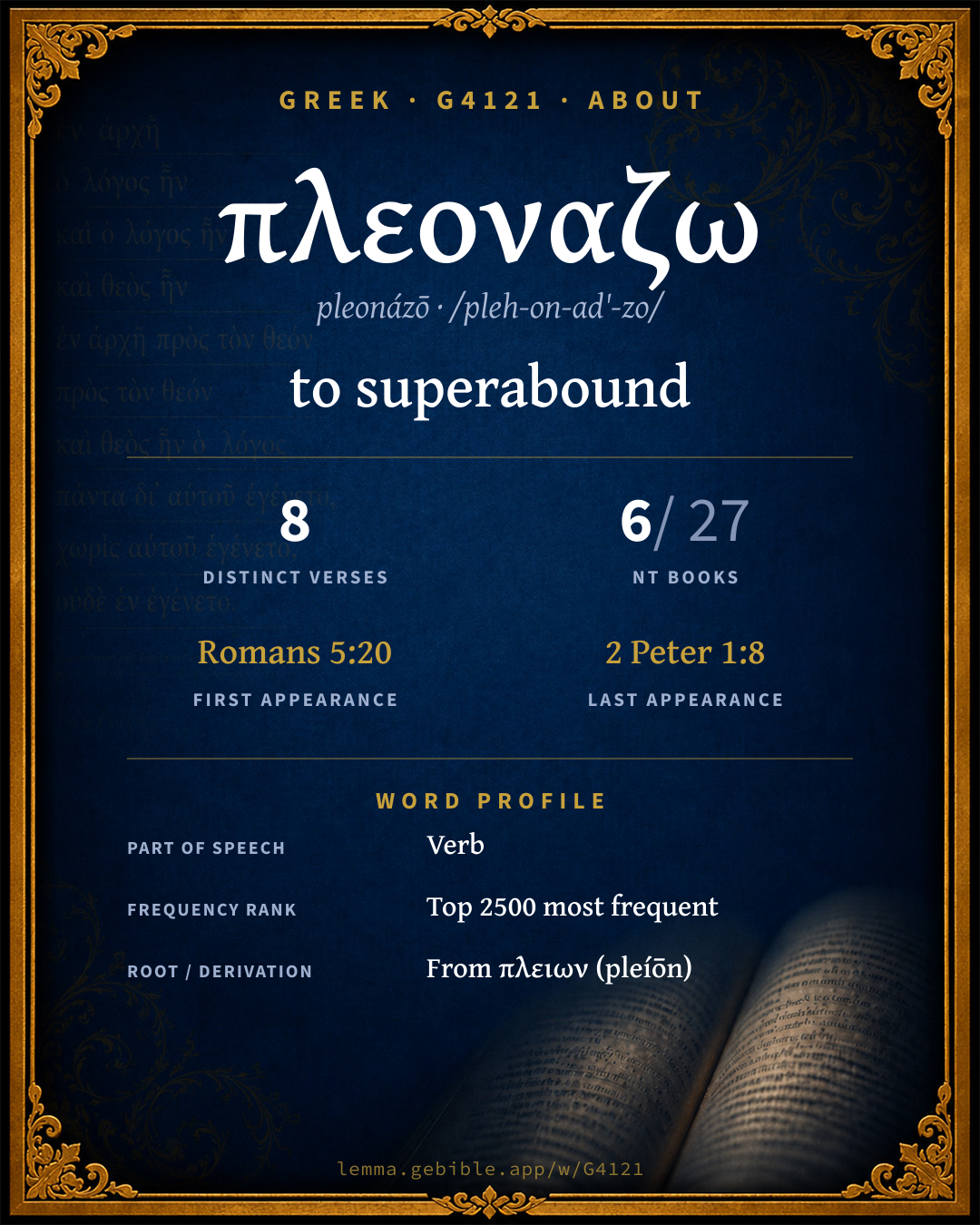
πλεονάζω
to superabound
‘to superabound’ is one of 2 main senses fuller range ↓
Full lexicon entry — Thayer's Greek Lexicon
From Thayer's Greek Lexicon
Where this word appears
Grammar key — what these labels mean
Part of speech
- Verb
- An action or state-of-being word.
Tense
- Aorist
- Action viewed as a simple whole, without regard to duration — often past (perfective aspect).
- Present
- Ongoing or general action in present time (imperfective aspect).
Voice
- Active
- The subject performs the action.
Mood
- Indicative
- States a fact or asks a factual question (the mood of reality).
- Subjunctive
- Expresses probability, purpose, or possibility (the mood of contingency).
- Optative
- Expresses a wish or a remote possibility.
- Participle
- A verbal adjective (“writing,” “having written”).
Case
- Nominative
- The case of the subject (and the predicate nominative).
- Accusative
- The case of the direct object and of extent.
Person
- 3rd person
- The one spoken about (“he / she / it / they”).
Gender
- Feminine
- Grammatically feminine.
- Masculine
- Grammatically masculine.
- Neuter
- Grammatically neuter.
Number
- Singular
- One.
- Plural
- More than one.
Every verse where G4121 appears in the Book of 2 Peter — 1 distinct verse. Click any verse to open its interlinear word-by-word view. Verse text shown in the World English Bible for context — . Each verse’s Greek form is shown with its reference; the English is not keyword-highlighted, since the data carries no word-level English alignment. Use “Compare translations” on any verse to read it across multiple English versions. This concordance covers the Greek New Testament; Septuagint (Greek Old Testament) occurrences of this word are not indexed here.
2 Peter
About this entry
At a glance — auto-summarized from this page’s data, not written by a person. Every figure links to its source below. This summary describes the numbers; it doesn’t interpret them.
At its core, πλεοναζω (pleonázō) means “to superabound.” First canonically at Romans 5:20, it enters the text early. It appears 8 verses across 6 books of the Greek New Testament, among its uncommon vocabulary. The word gravitates to Romans (25%), then 2 Corinthians and Philippians. Catalogued under 2 senses, its meaning is not single-sense. Dig into 8-verse concordance and the renderings breakdown below.
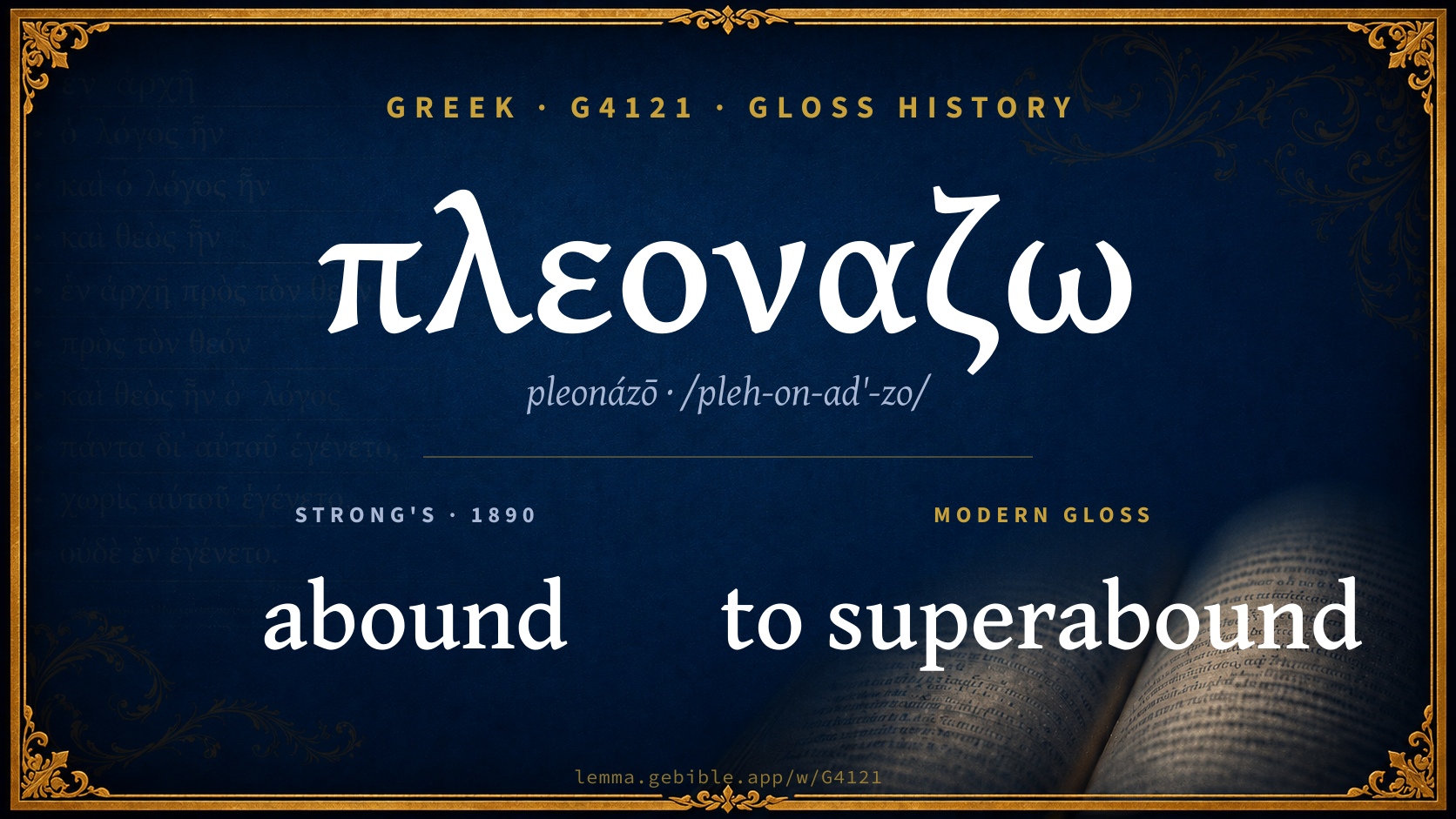
Gloss history
Strong's 1890 vs modern scholarship
About this word
Strong's G4121 catalogs a Greek word from the Greek New Testament.
These counts are not copied from any lexicon or concordance. They are computed here, from the morphology-tagged Greek New Testament. What Lemma adds →
- 8
- distinct verses
- The word appears in 8 distinct verses.
- 6 / 27
- NT books
- The word appears in 6 of 27 New Testament books.
- #1,140
- by frequency
- Top 2500 most frequent Greek words (rank 1,140 of 5,347 Greek words by occurrence).
View all 8 occurrences in the concordance →
Most concentrated in
- Romans 2 verses 25%
- 2 Corinthians 2 verses 25%
- Philippians 1 verse 13%
By section of the New Testament
By traditional corpus
Conventional, traditional groupings — biblical authorship is debated, so this is a traditional corpus grouping, not an authorship claim. Some books belong to more than one corpus (Luke is in both the Gospels and the Lukan corpus, and so on), so these shares overlap and need not total 100%. Each figure is a share of the word’s 8 distinct verses.
- Pauline corpus 7 verses · 88%
- General (Catholic) Epistles 1 verse · 13%
How translations render this word
Counts come from each version’s own published word-to-Strong’s tagging or interlinear alignment — an approximate guide to how each version renders this word, not a word-level alignment the data otherwise carries. Because each total is that version’s own tagged count, the per-version totals vary from one another and need not match the appearance or distinct-verse counts above. These counts may also differ from a printed concordance because Lemma counts each distinctly tagged rendering and does not collapse phrase taggings into a single head-word total. This is a fixed set of word-tagged versions (KJV, ASV, BSB, ULT) and does not change with the reading translation you choose elsewhere. Each version’s license is shown beside its name below (and on Sources).
- King James Version: May abound 2×
- American Standard Version: Abound 1×, Abounded 1×, Aboundeth 1×
- Berean Standard Bible: Cause you to increase 1×, Continue to grow 1×, Had no excess 1×
- unfoldingWord Literal Text: Is increasing 2×, Might increase 2×
King James Version Public Domain
Renders G4121 across 11 tagged occurrences — most commonly:
Plus 9 renderings that appear only once — usually multi-word phrases or single function words the recovered tagging swept in, not distinct renderings.
American Standard Version Public Domain
Renders G4121 across 11 tagged occurrences — most commonly:
Berean Standard Bible Public Domain
Renders G4121 across 9 tagged occurrences — most commonly:
unfoldingWord Literal Text CC BY-SA 4.0
Renders G4121 across 12 tagged occurrences — most commonly:
Plus 8 renderings that appear only once — usually multi-word phrases or single function words the recovered tagging swept in, not distinct renderings.
Senses in Thayer's
The 2 senses Thayer's distinguishes for this word, in lexicon order (not ranked by frequency or importance). The full entry — with sub-senses — is in the Lexicon Entry tab.
- of things
- to make to increase: one in a thing
Word origin
Derived from πλειων (pleíōn) (G4119) — greater.
From G4119 ; to do make or be more that is increase (transitively or intransitively); by extension to superabound : - abound abundant make to increase have over.
— Strong’s Exhaustive Concordance (1890), public domain.
Forms in the corpus
The 6 distinct written forms G4121 takes in the Greek New Testament, most frequent first — each parse links to that tense’s occurrences in the concordance.
| Form | Parsing | Example | Uses |
|---|---|---|---|
| πλεονάζοντα pleonázonta | Verb, Present, Active, Participle, Accusative, Singular, Masculine | Philippians 4:17 | 2 |
| πλεονάσῃ pleonásē | Verb, Aorist, Active, Subjunctive, 3rd person, Singular | Romans 5:20 | 2 |
| ἐπλεόνασεν epleónasen | Verb, Aorist, Active, Indicative, 3rd person, Singular | Romans 5:20 | 2 |
| πλεονάζει pleonázei | Verb, Present, Active, Indicative, 3rd person, Singular | 2 Thessalonians 1:3 | 1 |
| πλεονάσαι pleonásai | Verb, Aorist, Active, Optative, 3rd person, Singular | 1 Thessalonians 3:12 | 1 |
| πλεονάσασα pleonásasa | Verb, Aorist, Active, Participle, Nominative, Singular, Feminine | 2 Corinthians 4:15 | 1 |
Same root — word family
Other Thayer's entries built from the same root as G4121, grouped by Strong’s listed origin. These share a root / origin per the lexicon — not necessarily a shared meaning. Each links to that word’s own entry.
Derives from
Shares the same root
Compare all same-root words → They share a root, not necessarily a meaning.
Septuagint usage
The same Greek word πλεοναζω appears 20 times in the Greek Old Testament (Septuagint), across 19 verses in 9 books.
- 20
- LXX occurrences
- Tagged occurrences of this Greek word in the Septuagint.
- 19
- verses
- Distinct Septuagint verses containing this word.
- 9 / 39
- OT books
- The word appears in 9 of the 39 Old Testament books.
Sample Septuagint occurrences
- Exodus 16:18 πλεονάζω
- Numbers 3:46 πλεονάζω
- 2 Samuel 18:8 πλεονάζω
- 1 Chronicles 4:27 πλεονάζω
- 2 Chronicles 24:11 πλεονάζω
- Psalms 49:19 πλεονάζω
- Proverbs 15:6 πλεονάζω
- Jeremiah 37:19 πλεονάζω
- Ezekiel 23:32 πλεονάζω
Septuagint occurrences (same lexeme)
Every verse where the same Strong’s number (G4121) appears in the Greek Septuagint. Verse text shown in the World English Bible for context; the Greek form is the matched word — the English is not keyword-highlighted.
- Exodus 16:18 πλεονάζω When they measured it with an omer, he who gathered much had nothing over, and he who gathered little had no lack. They gathered every man according to his eating.
- Exodus 16:23 πλεονάζω He said to them, "This is that which Yahweh has spoken, 'Tomorrow is a solemn rest, a holy Sabbath to Yahweh. Bake that which you want to bake, and boil that which you want to boil; and all that remains over lay up for yourselves to be kept until the morning."
- Exodus 26:12 πλεονάζω The overhanging part that remains of the curtains of the tent, the half curtain that remains, shall hang over the back of the tent.
- Numbers 3:46 πλεονάζω For the redemption of the two hundred seventy-three of the firstborn of the children of Israel, who exceed the number of the Levites,
- Numbers 3:48 πλεονάζω and you shall give the money, with which the remainder of them is redeemed, to Aaron and to his sons."
- Numbers 3:49 πλεονάζω Moses took the redemption money from those who exceeded the number of those who were redeemed by the Levites;
- Numbers 3:51 πλεονάζω and Moses gave the redemption money to Aaron and to his sons, according to the word of Yahweh, as Yahweh commanded Moses.
- Numbers 9:22 πλεονάζω Whether it was two days, or a month, or a year that the cloud stayed on the tabernacle, remaining on it, the children of Israel remained encamped, and didn't travel; but when it was taken up, they traveled.
- Numbers 26:54 πλεονάζω To the more you shall give the more inheritance, and to the fewer you shall give the less inheritance: to everyone according to those who were numbered of him shall his inheritance be given.
- 2 Samuel 18:8 πλεονάζω For the battle was there spread over the surface of all the country; and the forest devoured more people that day than the sword devoured.
- 1 Chronicles 4:27 πλεονάζω Shimei had sixteen sons and six daughters; but his brothers didn't have many children, neither did all their family multiply like the children of Judah.
- 1 Chronicles 5:23 πλεονάζω The children of the half-tribe of Manasseh lived in the land: they increased from Bashan to Baal Hermon and Senir and Mount Hermon.
- 2 Chronicles 24:11 πλεονάζω It was so, that whenever the chest was brought to the king's officers by the hand of the Levites, and when they saw that there was much money, the king's scribe and the chief priest's officer came and emptied the chest, and took it, and carried it to its place again. Thus they did day by day, and gathered money in abundance.
- 2 Chronicles 31:5 πλεονάζω As soon as the commandment came abroad, the children of Israel gave in abundance the first fruits of grain, new wine, and oil, and honey, and of all the increase of the field; and the tithe of all things brought they in abundantly.
- Psalms 49:19 πλεονάζω He shall go to the generation of his fathers. They shall never see the light.
- Psalms 70:21 πλεονάζω
- Proverbs 15:6 πλεονάζω In the house of the righteous is much treasure, But the income of the wicked brings trouble.
- Jeremiah 37:19 πλεονάζω Where now are your prophets who prophesied to you, saying, The king of Babylon shall not come against you, nor against this land?
- Ezekiel 23:32 πλεονάζω Thus says the Lord Yahweh: You shall drink of your sister's cup, which is deep and large; you shall ridiculed and had in derision; it contains much.
These are occurrences of the same Greek lexeme (G4121) in the Septuagint — not a translation of any one Hebrew word. The store carries no word-level Hebrew↔Greek alignment, so no Hebrew original is asserted here. Counts come from the recovered LXX Strong's tagging — high-frequency vocabulary is well covered, while rare or late forms may be untagged — so they reflect tagged occurrences and may slightly undercount.