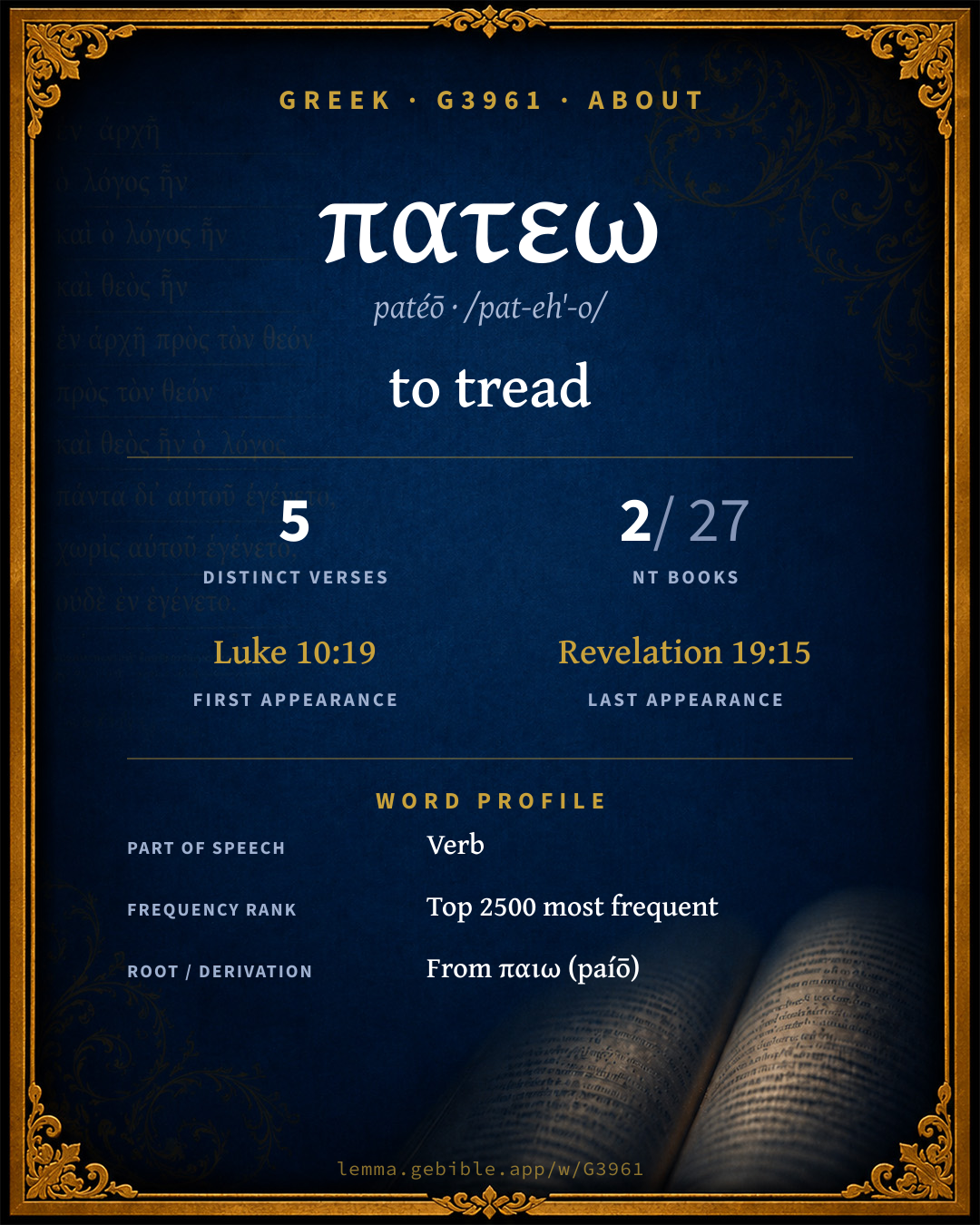
πατέω
to tread
‘to tread’ is one of 3 main senses fuller range ↓
Full lexicon entry — Thayer's Greek Lexicon
From Thayer's Greek Lexicon
Where this word appears
See every Aorist-tense verb in the Greek New Testament →
Grammar key — what these labels mean
Part of speech
- Verb
- An action or state-of-being word.
Tense
- Aorist
- Action viewed as a simple whole, without regard to duration — often past (perfective aspect).
- Future
- Action expected in future time.
- Present
- Ongoing or general action in present time (imperfective aspect).
Voice
- Passive
- The subject receives the action.
- Active
- The subject performs the action.
Mood
- Indicative
- States a fact or asks a factual question (the mood of reality).
- Infinitive
- A verbal noun (“to write”), unmarked for person or number.
- Participle
- A verbal adjective (“writing,” “having written”).
Case
- Nominative
- The case of the subject (and the predicate nominative).
Person
- 3rd person
- The one spoken about (“he / she / it / they”).
Gender
- Feminine
- Grammatically feminine.
Number
- Singular
- One.
- Plural
- More than one.
1 verse where G3961 appears in the Present tense in the Book of Revelation. Filtered view — show all forms. Click any verse to open its interlinear word-by-word view. Verse text shown in the World English Bible for context — . Each verse’s Greek form is shown with its reference; the English is not keyword-highlighted, since the data carries no word-level English alignment. Use “Compare translations” on any verse to read it across multiple English versions. This concordance covers the Greek New Testament; Septuagint (Greek Old Testament) occurrences of this word are not indexed here.
Revelation
About this entry
At a glance — auto-summarized from this page’s data, not written by a person. Every figure links to its source below. This summary describes the numbers; it doesn’t interpret them.
“to tread” is the headline sense of the Greek verb πατεω (patéō). With only 5 verses it sits in the long tail of Greek New Testament vocabulary. More than half of its appearances fall in Revelation. Scripture first uses it in Luke 10:19. Catalogued under 3 senses, its meaning is not single-sense. See the sense tree, 5-verse concordance, and the renderings breakdown below.
Gloss history
Strong's 1890 vs modern scholarship
About this word
Strong's G3961 catalogs a Greek word from the Greek New Testament.
These counts are not copied from any lexicon or concordance. They are computed here, from the morphology-tagged Greek New Testament. What Lemma adds →
- 5
- distinct verses
- The word appears in 5 distinct verses.
- 2 / 27
- NT books
- The word appears in 2 of 27 New Testament books.
- #1,648
- by frequency
- Top 2500 most frequent Greek words (rank 1,648 of 5,347 Greek words by occurrence).
View all 5 occurrences in the concordance →
Most concentrated in
- Revelation 3 verses 60%
- Luke 2 verses 40%
By section of the New Testament
By traditional corpus
Conventional, traditional groupings — biblical authorship is debated, so this is a traditional corpus grouping, not an authorship claim. Some books belong to more than one corpus (Luke is in both the Gospels and the Lukan corpus, and so on), so these shares overlap and need not total 100%. Each figure is a share of the word’s 5 distinct verses.
- Johannine 3 verses · 60%
- Revelation 3 verses · 60%
- Gospels 2 verses · 40%
- Lukan (Luke–Acts) 2 verses · 40%
How translations render this word
Counts come from each version’s own published word-to-Strong’s tagging or interlinear alignment — an approximate guide to how each version renders this word, not a word-level alignment the data otherwise carries. Because each total is that version’s own tagged count, the per-version totals vary from one another and need not match the appearance or distinct-verse counts above. These counts may also differ from a printed concordance because Lemma counts each distinctly tagged rendering and does not collapse phrase taggings into a single head-word total. This is a fixed set of word-tagged versions (KJV, ASV, BSB, ULT) and does not change with the reading translation you choose elsewhere. Each version’s license is shown beside its name below (and on Sources).
- King James Version: Shall they tread under foot 1×, Tread 1×, Treadeth 1×
- American Standard Version: Shall they tread under foot 1×, Tread 1×, Treadeth 1×
- Berean Standard Bible: They will trample 1×, Tread 1×, Treads 1×
- unfoldingWord Literal Text: They will trample 1×, Trampled 1×, Tramples 1×
King James Version Public Domain
Renders G3961 across 5 tagged occurrences — most commonly:
American Standard Version Public Domain
Renders G3961 across 5 tagged occurrences — most commonly:
Berean Standard Bible Public Domain
Renders G3961 across 5 tagged occurrences — most commonly:
unfoldingWord Literal Text CC BY-SA 4.0
Renders G3961 across 5 tagged occurrences — most commonly:
Senses in Thayer's
The 3 senses Thayer's distinguishes for this word, in lexicon order (not ranked by frequency or importance). The full entry — with sub-senses — is in the Lexicon Entry tab.
- to trample, crush with the feet
- to advance by setting foot upon…
- to tread under foot…
Word origin
Derived from παιω (paíō) (G3817) — to strike.
From a derivative probably of G3817 (meaning a path); to trample (literally or figuratively): - tread (down under foot).
— Strong’s Exhaustive Concordance (1890), public domain.
Forms in the corpus
The 5 distinct written forms G3961 takes in the Greek New Testament, most frequent first — each parse links to that tense’s occurrences in the concordance.
| Form | Parsing | Example | Uses |
|---|---|---|---|
| πατήσουσιν patḗsousin | Verb, Future, Active, Indicative, 3rd person, Plural | Revelation 11:2 | 1 |
| πατεῖ pateî | Verb, Present, Active, Indicative, 3rd person, Singular | Revelation 19:15 | 1 |
| πατεῖν pateîn | Verb, Present, Active, Infinitive | Luke 10:19 | 1 |
| πατουμένη patouménē | Verb, Present, Passive, Participle, Nominative, Singular, Feminine | Luke 21:24 | 1 |
| ἐπατήθη epatḗthē | Verb, Aorist, Passive, Indicative, 3rd person, Singular | Revelation 14:20 | 1 |
Same root — word family
Other Thayer's entries built from the same root as G3961, grouped by Strong’s listed origin. These share a root / origin per the lexicon — not necessarily a shared meaning. Each links to that word’s own entry.
Derives from
Shares the same root
Compare all same-root words → They share a root, not necessarily a meaning.
Septuagint usage
The same Greek word πατεω appears 17 times in the Greek Old Testament (Septuagint), across 17 verses in 10 books.
- 17
- LXX occurrences
- Tagged occurrences of this Greek word in the Septuagint.
- 17
- verses
- Distinct Septuagint verses containing this word.
- 10 / 39
- OT books
- The word appears in 10 of the 39 Old Testament books.
Sample Septuagint occurrences
- Deuteronomy 11:24 πατέω
- Judges 9:27 πατέω
- Ezra 23:15 πατέω
- Job 22:15 πατέω
- Isaiah 1:12 πατέω
- Jeremiah 31:33 πατέω
- Lamentations 1:15 πατέω
- Joel 4:13 πατέω
- Amos 2:7 πατέω
- Zechariah 10:5 πατέω
Septuagint occurrences (same lexeme)
Every verse where the same Strong’s number (G3961) appears in the Greek Septuagint. Verse text shown in the World English Bible for context; the Greek form is the matched word — the English is not keyword-highlighted.
- Deuteronomy 11:24 πατέω Every place whereon the sole of your foot shall tread shall be yours: from the wilderness, and Lebanon, from the river, the river Euphrates, even to the hinder sea shall be your border.
- Judges 9:27 πατέω They went out into the field, and gathered their vineyards, and trod [the grapes], and held festival, and went into the house of their god, and did eat and drink, and cursed Abimelech.
- Ezra 23:15 πατέω
- Job 22:15 πατέω Will you keep the old way Which wicked men have trodden,
- Job 28:8 πατέω The proud animals have not trodden it, Nor has the fierce lion passed by there.
- Isaiah 1:12 πατέω When you come to appear before me, Who has required this at your hand, to trample my courts?
- Isaiah 16:10 πατέω Gladness is taken away, and joy out of the fruitful field; and in the vineyards there shall be no singing, neither joyful noise: nobody shall tread out wine in the presses; I have made the [vintage] shout to cease.
- Isaiah 25:10 πατέω For in this mountain will the hand of Yahweh rest; and Moab shall be trodden down in his place, even as straw is trodden down in the water of the dung-hill.
- Isaiah 26:6 πατέω The foot shall tread it down; even the feet of the poor, and the steps of the needy.
- Isaiah 32:20 πατέω Blessed are you who sow beside all waters, who send forth the feet of the ox and the donkey.
- Isaiah 42:5 πατέω Thus says God Yahweh, he who created the heavens, and stretched them forth; he who spread abroad the earth and that which comes out of it; he who gives breath to the people on it, and spirit to those who walk therein:
- Isaiah 42:16 πατέω I will bring the blind by a way that they don't know; in paths that they don't know will I lead them; I will make darkness light before them, and crooked places straight. These things will I do, and I will not forsake them.
- Jeremiah 31:33 πατέω But this is the covenant that I will make with the house of Israel after those days, says Yahweh: I will put my law in their inward parts, and in their heart will I write it; and I will be their God, and they shall be my people:
- Lamentations 1:15 πατέω The Lord has set at nothing all my mighty men in the midst of me; He has called a solemn assembly against me to crush my young men: The Lord has trodden as in a winepress the virgin daughter of Judah.
- Joel 4:13 πατέω
- Amos 2:7 πατέω They trample on the dust of the earth on the head of the poor, And deny justice to the oppressed; And a man and his father use the same maiden, to profane my holy name;
- Zechariah 10:5 πατέω They shall be as mighty men, Treading down muddy streets in the battle; And they shall fight, because Yahweh is with them; And the riders on horses will be confounded.
These are occurrences of the same Greek lexeme (G3961) in the Septuagint — not a translation of any one Hebrew word. The store carries no word-level Hebrew↔Greek alignment, so no Hebrew original is asserted here. Counts come from the recovered LXX Strong's tagging — high-frequency vocabulary is well covered, while rare or late forms may be untagged — so they reflect tagged occurrences and may slightly undercount.