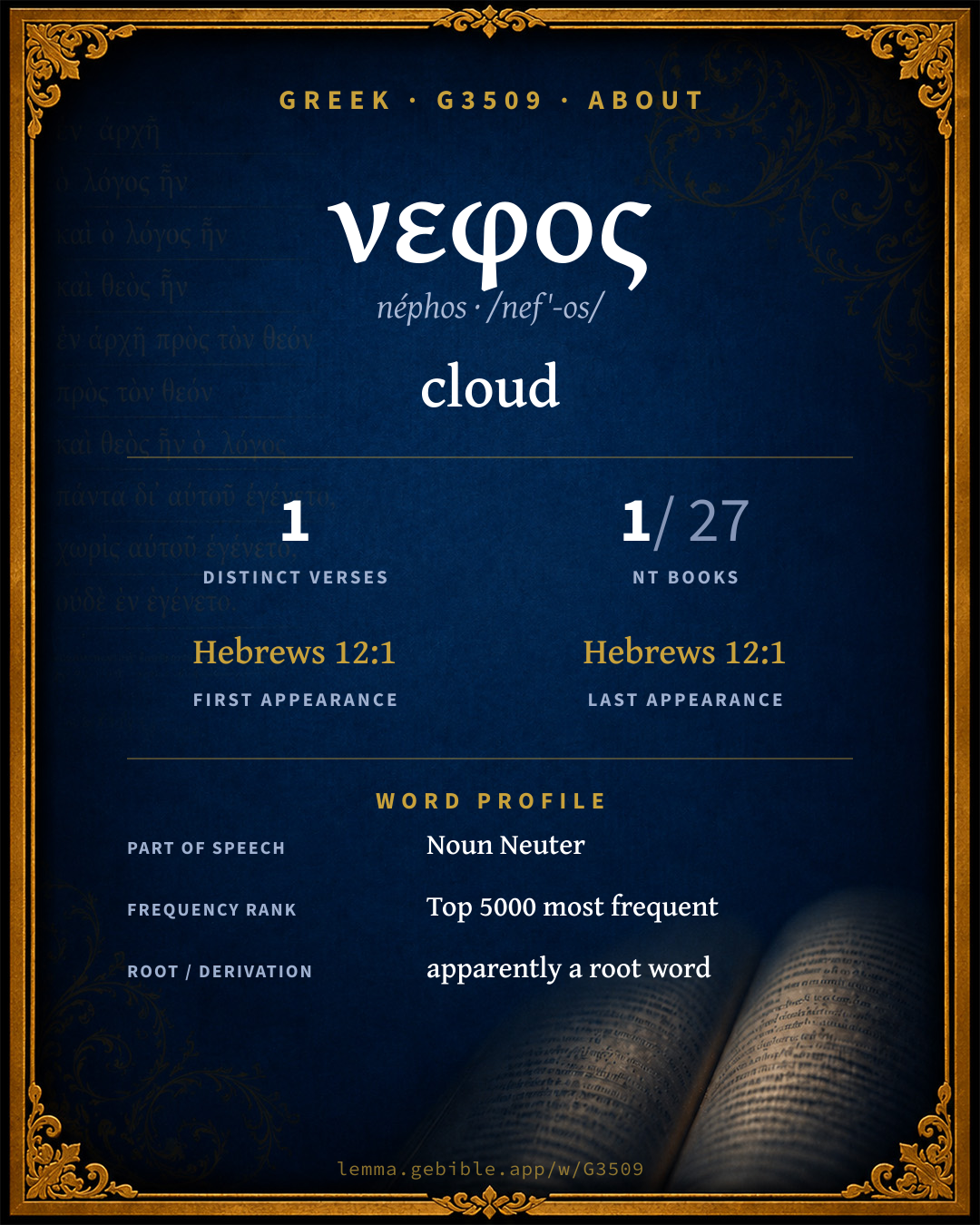
νέφος
cloud
Full lexicon entry — Thayer's Greek Lexicon
From Thayer's Greek Lexicon
Where this word appears
Grammar key — what these labels mean
Part of speech
- Noun
- A naming word — a person, place, thing, or idea.
Case
- Accusative
- The case of the direct object and of extent.
Gender
- Neuter
- Grammatically neuter.
Number
- Singular
- One.
Every verse where G3509 appears — 1 distinct verse across 1 book. Click any verse to open its interlinear word-by-word view. Verse text shown in the World English Bible for context — . Each verse’s Greek form is shown with its reference; the English is not keyword-highlighted, since the data carries no word-level English alignment. Use “Compare translations” on any verse to read it across multiple English versions. This concordance covers the Greek New Testament; Septuagint (Greek Old Testament) occurrences of this word are not indexed here.
Hebrews 1 verse
About this entry
At a glance — auto-summarized from this page’s data, not written by a person. Every figure links to its source below. This summary describes the numbers; it doesn’t interpret them.
“cloud” is the headline sense of the Greek noun νεφος (néphos). A scarce word — 1 verse in all of the Greek New Testament. It clusters heavily in Hebrews, which alone accounts for 100% of its uses. Scripture uses it exactly once, at Hebrews 12:1. It clusters with γνοφος, ζοφος and νεφελη under a shared root. The sections below give every sense, occurrence, and version rendering.
Gloss history
Strong's 1890 vs modern scholarship
About this word
Strong's G3509 catalogs a Greek word from the Greek New Testament.
These counts are not copied from any lexicon or concordance. They are computed here, from the morphology-tagged Greek New Testament. What Lemma adds →
- 1
- distinct verses
- The word appears in 1 distinct verse.
- 1 / 27
- NT books
- The word appears in 1 of 27 New Testament books.
- #3,503
- by frequency
- Top 5000 most frequent Greek words (rank 3,503 of 5,347 Greek words by occurrence).
View all 1 occurrence in the concordance →
Most concentrated in
- Hebrews 1 verse 100%
By section of the New Testament
By traditional corpus
Conventional, traditional groupings — biblical authorship is debated, so this is a traditional corpus grouping, not an authorship claim. Some books belong to more than one corpus (Luke is in both the Gospels and the Lukan corpus, and so on), so these shares overlap and need not total 100%. Each figure is a share of the word’s 1 distinct verse.
- Hebrews 1 verse · 100%
How translations render this word
Counts come from each version’s own published word-to-Strong’s tagging or interlinear alignment — an approximate guide to how each version renders this word, not a word-level alignment the data otherwise carries. Because each total is that version’s own tagged count, the per-version totals vary from one another and need not match the appearance or distinct-verse counts above. These counts may also differ from a printed concordance because Lemma counts each distinctly tagged rendering and does not collapse phrase taggings into a single head-word total. This is a fixed set of word-tagged versions (KJV, ASV, BSB, ULT) and does not change with the reading translation you choose elsewhere. Each version’s license is shown beside its name below (and on Sources).
- King James Version: Cloud 1×
- American Standard Version: Cloud 1×
- Berean Standard Bible: Cloud 1×
- unfoldingWord Literal Text: Cloud 1×
King James Version Public Domain
Renders G3509 across 1 tagged occurrence — most commonly:
American Standard Version Public Domain
Renders G3509 across 1 tagged occurrence — most commonly:
Berean Standard Bible Public Domain
Renders G3509 across 1 tagged occurrence — most commonly:
unfoldingWord Literal Text CC BY-SA 4.0
Renders G3509 across 1 tagged occurrence — most commonly:
Senses in Thayer's
The 1 sense Thayer's distinguishes for this word, in lexicon order (not ranked by frequency or importance). The full entry — with sub-senses — is in the Lexicon Entry tab.
- a cloud, a large dense multitude, a throng
Word origin
Origin: apparently a root word
Apparently a primary word; a cloud : - cloud.
— Strong’s Exhaustive Concordance (1890), public domain.
Same root — word family
Other Thayer's entries built from the same root as G3509, grouped by Strong’s listed origin. These share a root / origin per the lexicon — not necessarily a shared meaning. Each links to that word’s own entry.
Derived from this word
Compare all same-root words → They share a root, not necessarily a meaning.
Septuagint usage
The same Greek word νεφος appears 25 times in the Greek Old Testament (Septuagint), across 25 verses in 4 books.
- 25
- LXX occurrences
- Tagged occurrences of this Greek word in the Septuagint.
- 25
- verses
- Distinct Septuagint verses containing this word.
- 4 / 39
- OT books
- The word appears in 4 of the 39 Old Testament books.
Sample Septuagint occurrences
- Job 7:9 νέφος
- Psalms 103:3 νέφος
- Proverbs 3:20 νέφος
- Ecclesiastes 11:3 νέφος
Septuagint occurrences (same lexeme)
Every verse where the same Strong’s number (G3509) appears in the Greek Septuagint. Verse text shown in the World English Bible for context; the Greek form is the matched word — the English is not keyword-highlighted.
- Job 7:9 νέφος As the cloud is consumed and vanishes away, So he who goes down to Sheol shall come up no more.
- Job 20:6 νέφος Though his height mount up to the heavens, And his head reach to the clouds,
- Job 22:14 νέφος Thick clouds are a covering to him, so that he doesn't see. He walks on the vault of the sky.'
- Job 26:8 νέφος He binds up the waters in his thick clouds, And the cloud is not burst under them.
- Job 26:9 νέφος He encloses the face of his throne, And spreads his cloud on it.
- Job 30:15 νέφος Terrors are turned on me. They chase my honor as the wind. My welfare has passed away as a cloud.
- Job 35:5 νέφος Look to the heavens, and see. See the skies, which are higher than you.
- Job 36:28 νέφος Which the skies pour down And drop on man abundantly.
- Job 37:11 νέφος Yes, he loads the thick cloud with moisture. He spreads abroad the cloud of his lightning.
- Job 37:16 νέφος Do you know the workings of the clouds, The wondrous works of him who is perfect in knowledge?
- Job 37:21 νέφος Now men don't see the light which is bright in the skies, But the wind passes, and clears them.
- Job 37:22 νέφος Out of the north comes golden splendor; With God is awesome majesty.
- Job 38:1 νέφος Then Yahweh answered Job out of the whirlwind,
- Job 38:9 νέφος When I made clouds the garment of it, Thick darkness a swaddling-band for it,
- Job 38:34 νέφος "Can you lift up your voice to the clouds, That abundance of waters may cover you?
- Job 38:37 νέφος Who can number the clouds by wisdom? Or who can pour out the bottles of the sky,
- Job 40:6 νέφος Then Yahweh answered Job out of the whirlwind,
- Psalms 103:3 νέφος Who forgives all your sins; Who heals all your diseases;
- Proverbs 3:20 νέφος By his knowledge, the depths were broken up, And the skies drop down the dew.
- Proverbs 8:28 νέφος When he established the clouds above, When the springs of the deep became strong,
- Proverbs 16:11 νέφος Honest balances and scales are Yahweh's; All the weights in the bag are his work.
- Proverbs 25:14 νέφος As clouds and wind without rain, So is he who boasts of gifts deceptively.
- Proverbs 25:23 νέφος The north wind brings forth rain: So a backbiting tongue brings an angry face.
- Ecclesiastes 11:3 νέφος If the clouds are full of rain, they empty themselves on the earth; And if a tree falls toward the south, or toward the north, In the place where the tree falls, there shall it be.
- Ecclesiastes 12:2 νέφος Before the sun, the light, the moon, and the stars are darkened, And the clouds return after the rain;
These are occurrences of the same Greek lexeme (G3509) in the Septuagint — not a translation of any one Hebrew word. The store carries no word-level Hebrew↔Greek alignment, so no Hebrew original is asserted here. Counts come from the recovered LXX Strong's tagging — high-frequency vocabulary is well covered, while rare or late forms may be untagged — so they reflect tagged occurrences and may slightly undercount.