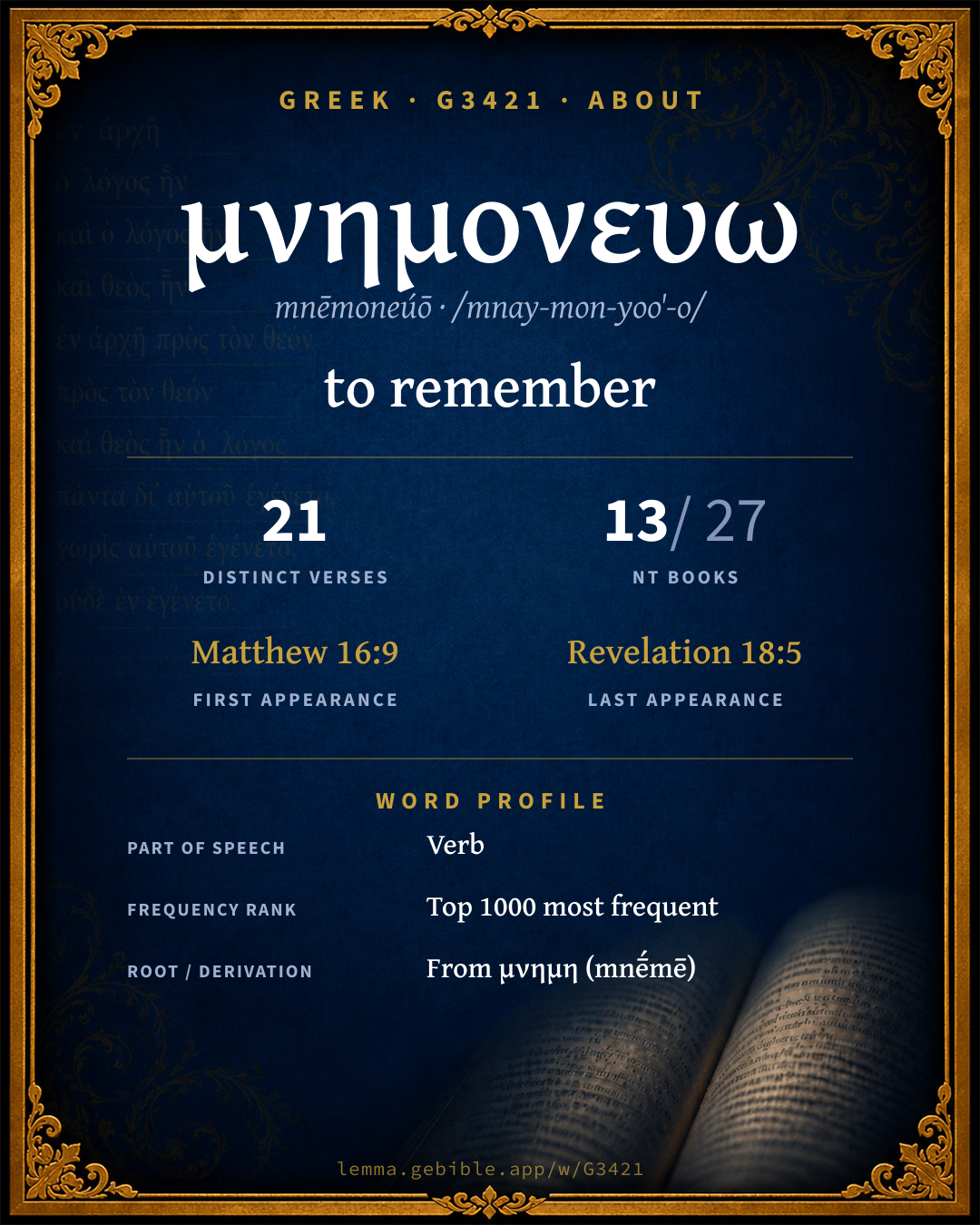
μνημονεύω
to remember
‘to remember’ is one of 2 main senses fuller range ↓
Full lexicon entry — Thayer's Greek Lexicon
From Thayer's Greek Lexicon
Where this word appears
Grammar key — what these labels mean
Part of speech
- Verb
- An action or state-of-being word.
Tense
- Present
- Ongoing or general action in present time (imperfective aspect).
- Aorist
- Action viewed as a simple whole, without regard to duration — often past (perfective aspect).
Voice
- Active
- The subject performs the action.
Mood
- Imperative
- Expresses a command or request.
- Indicative
- States a fact or asks a factual question (the mood of reality).
- Participle
- A verbal adjective (“writing,” “having written”).
- Infinitive
- A verbal noun (“to write”), unmarked for person or number.
- Subjunctive
- Expresses probability, purpose, or possibility (the mood of contingency).
Case
- Nominative
- The case of the subject (and the predicate nominative).
Person
- 2nd person
- The one addressed (“you”).
- 3rd person
- The one spoken about (“he / she / it / they”).
- 1st person
- The speaker (“I / we”).
Gender
- Masculine
- Grammatically masculine.
Number
- Plural
- More than one.
- Singular
- One.
Every verse where G3421 appears in the Book of 2 Thessalonians — 1 distinct verse. Click any verse to open its interlinear word-by-word view. Verse text shown in the World English Bible for context — . Each verse’s Greek form is shown with its reference; the English is not keyword-highlighted, since the data carries no word-level English alignment. Use “Compare translations” on any verse to read it across multiple English versions. This concordance covers the Greek New Testament; Septuagint (Greek Old Testament) occurrences of this word are not indexed here.
2 Thessalonians
About this entry
At a glance — auto-summarized from this page’s data, not written by a person. Every figure links to its source below. This summary describes the numbers; it doesn’t interpret them.
The Greek verb μνημονευω centers on the idea of “to remember.” Its earliest occurrence is Matthew 16:9. Spanning 21 verses in 13 books, it ranks among the uncommon words of the Greek New Testament. Lexicons map it across 2 senses. Related forms include μνημη, μνημειον and μνημοσυνον. For the data behind this summary, explore the sense tree and the renderings breakdown below.
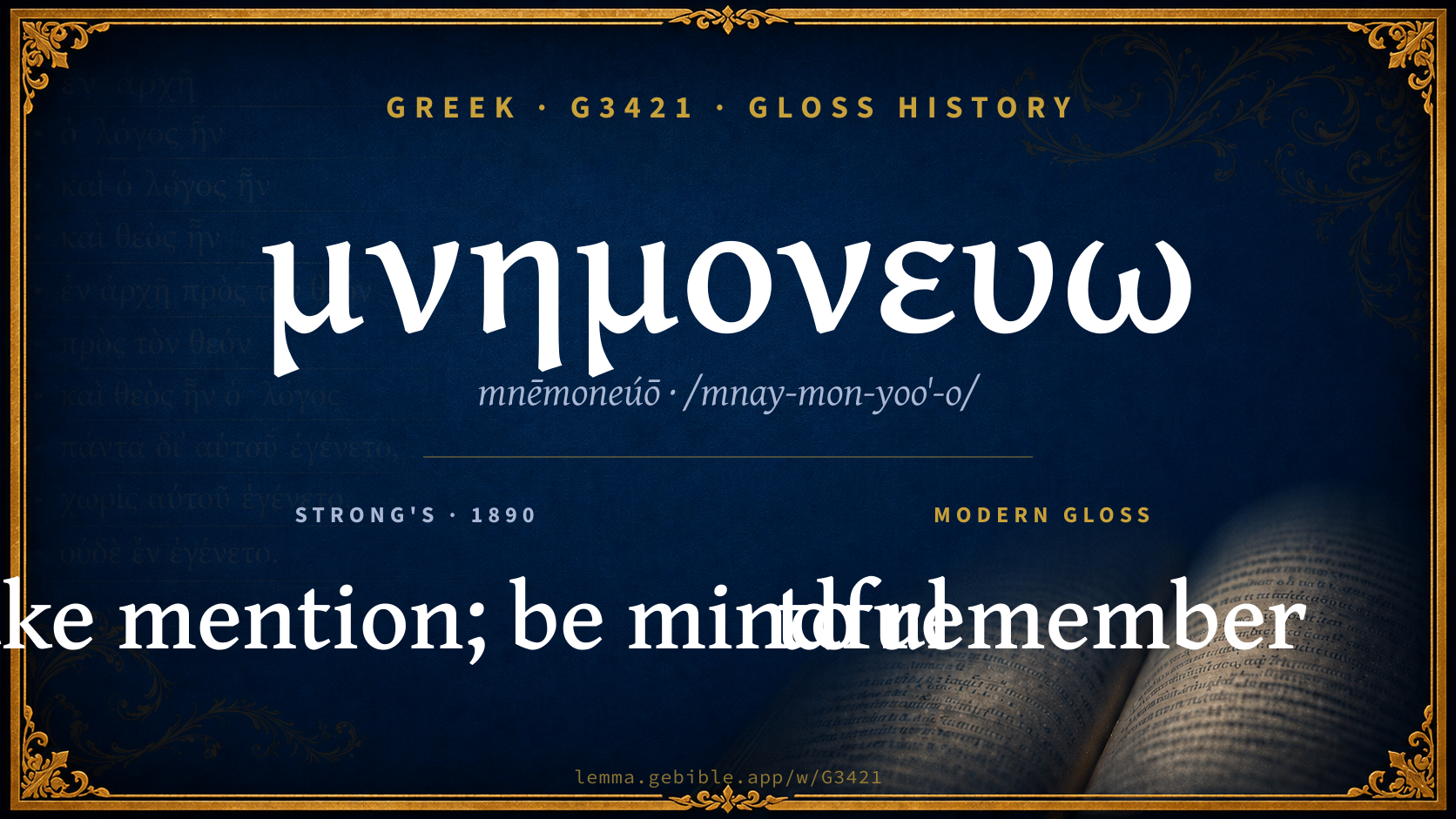
Gloss history
Strong's 1890 vs modern scholarship
About this word
Strong's G3421 catalogs a Greek word from the Greek New Testament.
These counts are not copied from any lexicon or concordance. They are computed here, from the morphology-tagged Greek New Testament. What Lemma adds →
- 21
- distinct verses
- The word appears in 21 distinct verses.
- 13 / 27
- NT books
- The word appears in 13 of 27 New Testament books.
- #607
- by frequency
- Top 1000 most frequent Greek words (rank 607 of 5,347 Greek words by occurrence).
View all 21 occurrences in the concordance →
Most concentrated in
- John 3 verses 14%
- Hebrews 3 verses 14%
- Revelation 3 verses 14%
By section of the New Testament
By traditional corpus
Conventional, traditional groupings — biblical authorship is debated, so this is a traditional corpus grouping, not an authorship claim. Some books belong to more than one corpus (Luke is in both the Gospels and the Lukan corpus, and so on), so these shares overlap and need not total 100%. Each figure is a share of the word’s 21 distinct verses.
- Pauline corpus 7 verses · 33%
- Gospels 6 verses · 29%
- Johannine 6 verses · 29%
- Lukan (Luke–Acts) 3 verses · 14%
- Hebrews 3 verses · 14%
- Revelation 3 verses · 14%
How translations render this word
Counts come from each version’s own published word-to-Strong’s tagging or interlinear alignment — an approximate guide to how each version renders this word, not a word-level alignment the data otherwise carries. Because each total is that version’s own tagged count, the per-version totals vary from one another and need not match the appearance or distinct-verse counts above. These counts may also differ from a printed concordance because Lemma counts each distinctly tagged rendering and does not collapse phrase taggings into a single head-word total. This is a fixed set of word-tagged versions (KJV, ASV, BSB, ULT) and does not change with the reading translation you choose elsewhere. Each version’s license is shown beside its name below (and on Sources).
- King James Version: Remember 12×
- American Standard Version: Remember 10×
- Berean Standard Bible: Remember 9×, Do you not remember 3×
- unfoldingWord Literal Text: Remember 12×, Do you 2×, Remembering 2×
King James Version Public Domain
Renders G3421 across 22 tagged occurrences — most commonly:
Plus 10 renderings that appear only once — usually multi-word phrases or single function words the recovered tagging swept in, not distinct renderings.
American Standard Version Public Domain
Renders G3421 across 20 tagged occurrences — most commonly:
Plus 10 renderings that appear only once — usually multi-word phrases or single function words the recovered tagging swept in, not distinct renderings.
Berean Standard Bible Public Domain
Renders G3421 across 21 tagged occurrences — most commonly:
Plus 9 renderings that appear only once — usually multi-word phrases or single function words the recovered tagging swept in, not distinct renderings.
unfoldingWord Literal Text CC BY-SA 4.0
Renders G3421 across 24 tagged occurrences — most commonly:
Plus 8 renderings that appear only once — usually multi-word phrases or single function words the recovered tagging swept in, not distinct renderings.
Senses in Thayer's
The 2 senses Thayer's distinguishes for this word, in lexicon order (not ranked by frequency or importance). The full entry — with sub-senses — is in the Lexicon Entry tab.
- to be mindful of, to remember, to call to mind
- to make mention of
Word origin
Derived from μνημη (mnḗmē) (G3420) — memory.
From a derivative of G3420 ; to exercise memory that is recollect ; by implication to punish ; also to rehearse : - make mention be mindful remember.
— Strong’s Exhaustive Concordance (1890), public domain.
Forms in the corpus
The 12 distinct written forms G3421 takes in the Greek New Testament, most frequent first — each parse links to that tense’s occurrences in the concordance.
Same root — word family
Other Thayer's entries built from the same root as G3421, grouped by Strong’s listed origin. These share a root / origin per the lexicon — not necessarily a shared meaning. Each links to that word’s own entry.
Derives from
Shares the same root
Derived from this word
Compare all same-root words → They share a root, not necessarily a meaning.
Septuagint usage
The same Greek word μνημονευω appears 10 times in the Greek Old Testament (Septuagint), across 10 verses in 8 books.
- 10
- LXX occurrences
- Tagged occurrences of this Greek word in the Septuagint.
- 10
- verses
- Distinct Septuagint verses containing this word.
- 8 / 39
- OT books
- The word appears in 8 of the 39 Old Testament books.
Sample Septuagint occurrences
- Exodus 13:3 μνημονεύω
- 2 Samuel 14:11 μνημονεύω
- 2 Kings 9:25 μνημονεύω
- 1 Chronicles 16:12 μνημονεύω
- Esther 2:1 μνημονεύω
- Psalms 6:6 μνημονεύω
- Proverbs 8:21 μνημονεύω
- Isaiah 43:18 μνημονεύω
Septuagint occurrences (same lexeme)
Every verse where the same Strong’s number (G3421) appears in the Greek Septuagint. Verse text shown in the World English Bible for context; the Greek form is the matched word — the English is not keyword-highlighted.
- Exodus 13:3 μνημονεύω Moses said to the people, "Remember this day, in which you came out from Egypt, out of the house of bondage; for by strength of hand Yahweh brought you out from this place. No leavened bread shall be eaten.
- 2 Samuel 14:11 μνημονεύω Then said she, Please let the king remember Yahweh your God, that the avenger of blood destroy not any more, lest they destroy my son. He said, As Yahweh lives, there shall not one hair of your son fall to the earth.
- 2 Kings 9:25 μνημονεύω Then said [Jehu] to Bidkar his captain, Take up, and cast him in the portion of the field of Naboth the Jezreelite; for remember how that, when I and you rode together after Ahab his father, Yahweh laid this burden on him:
- 1 Chronicles 16:12 μνημονεύω Remember his marvelous works that he has done, His wonders, and the judgments of his mouth,
- 1 Chronicles 16:15 μνημονεύω Remember his covenant forever, The word which he commanded to a thousand generations,
- Esther 2:1 μνημονεύω After these things, when the wrath of king Ahasuerus was pacified, he remembered Vashti, and what she had done, and what was decreed against her.
- Psalms 6:6 μνημονεύω I am weary with my groaning; Every night I flood my bed; I drench my couch with my tears.
- Psalms 62:7 μνημονεύω With God is my salvation and my honor. The rock of my strength, and my refuge, is in God.
- Proverbs 8:21 μνημονεύω That I may give wealth to those who love me. I fill their treasuries.
- Isaiah 43:18 μνημονεύω Don't remember the former things, neither consider the things of old.
These are occurrences of the same Greek lexeme (G3421) in the Septuagint — not a translation of any one Hebrew word. The store carries no word-level Hebrew↔Greek alignment, so no Hebrew original is asserted here. Counts come from the recovered LXX Strong's tagging — high-frequency vocabulary is well covered, while rare or late forms may be untagged — so they reflect tagged occurrences and may slightly undercount.