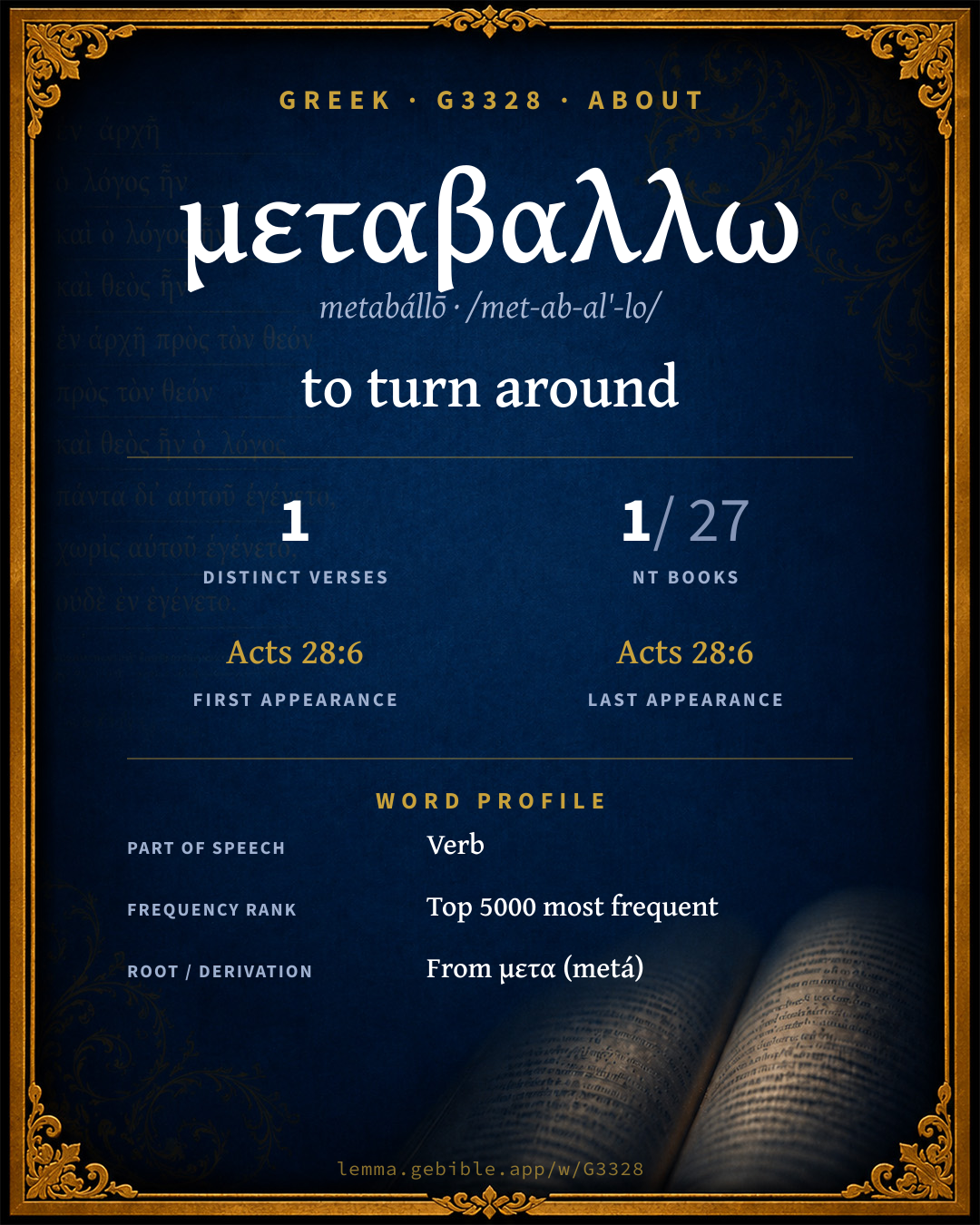
μεταβάλλω
to turn around
‘to turn around’ is one of 3 main senses fuller range ↓
Full lexicon entry — Thayer's Greek Lexicon
From Thayer's Greek Lexicon
Where this word appears
Grammar key — what these labels mean
Part of speech
- Verb
- An action or state-of-being word.
Tense
- Present
- Ongoing or general action in present time (imperfective aspect).
Voice
- Middle
- The subject acts on or for itself, or with special interest in the action.
Mood
- Participle
- A verbal adjective (“writing,” “having written”).
Case
- Nominative
- The case of the subject (and the predicate nominative).
Gender
- Masculine
- Grammatically masculine.
Number
- Plural
- More than one.
Every verse where G3328 appears — 1 distinct verse across 1 book. Click any verse to open its interlinear word-by-word view. Verse text shown in the World English Bible for context — . Each verse’s Greek form is shown with its reference; the English is not keyword-highlighted, since the data carries no word-level English alignment. Use “Compare translations” on any verse to read it across multiple English versions. This concordance covers the Greek New Testament; Septuagint (Greek Old Testament) occurrences of this word are not indexed here.
Acts 1 verse
About this entry
At a glance — auto-summarized from this page’s data, not written by a person. Every figure links to its source below. This summary describes the numbers; it doesn’t interpret them.
μεταβαλλω — transliterated metabállō — is a Greek verb carrying the sense “to turn around.” A scarce word — 1 verse in all of the Greek New Testament. More than three-quarters of its appearances fall in Acts. A true hapax — its single appearance is Acts 28:6. Thayer's distinguishes 3 senses for it. See the sense tree, 1-verse concordance, and the renderings breakdown below.
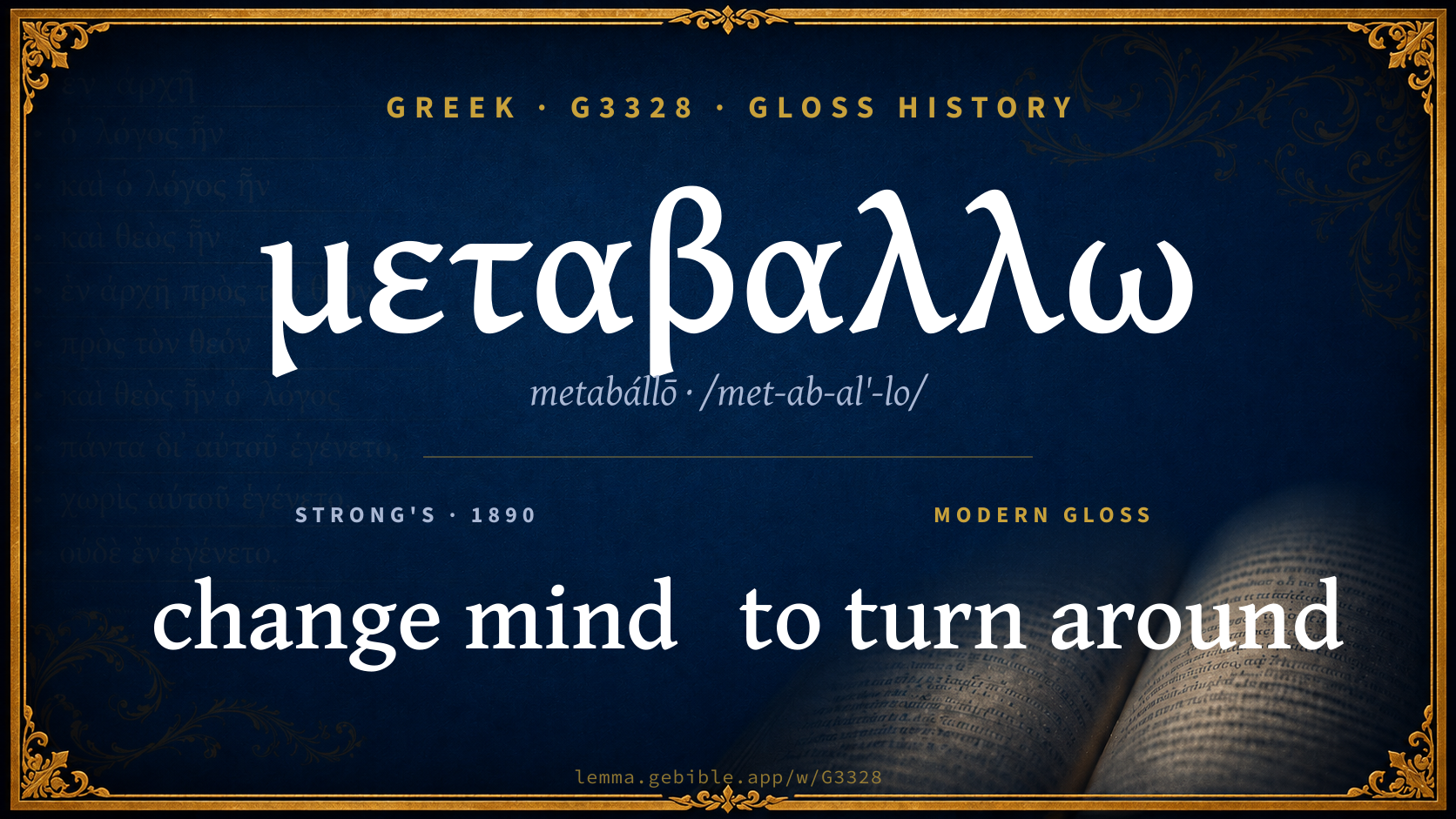
Gloss history
Strong's 1890 vs modern scholarship
About this word
Strong's G3328 catalogs a Greek word from the Greek New Testament.
These counts are not copied from any lexicon or concordance. They are computed here, from the morphology-tagged Greek New Testament. What Lemma adds →
- 1
- distinct verses
- The word appears in 1 distinct verse.
- 1 / 27
- NT books
- The word appears in 1 of 27 New Testament books.
- #3,503
- by frequency
- Top 5000 most frequent Greek words (rank 3,503 of 5,347 Greek words by occurrence).
View all 1 occurrence in the concordance →
Most concentrated in
- Acts 1 verse 100%
By section of the New Testament
By traditional corpus
Conventional, traditional groupings — biblical authorship is debated, so this is a traditional corpus grouping, not an authorship claim. Some books belong to more than one corpus (Luke is in both the Gospels and the Lukan corpus, and so on), so these shares overlap and need not total 100%. Each figure is a share of the word’s 1 distinct verse.
- Lukan (Luke–Acts) 1 verse · 100%
How translations render this word
Counts come from each version’s own published word-to-Strong’s tagging or interlinear alignment — an approximate guide to how each version renders this word, not a word-level alignment the data otherwise carries. Because each total is that version’s own tagged count, the per-version totals vary from one another and need not match the appearance or distinct-verse counts above. These counts may also differ from a printed concordance because Lemma counts each distinctly tagged rendering and does not collapse phrase taggings into a single head-word total. This is a fixed set of word-tagged versions (KJV, ASV, BSB, ULT) and does not change with the reading translation you choose elsewhere. Each version’s license is shown beside its name below (and on Sources).
- King James Version: They changed their minds 1×
- American Standard Version: They changed their minds 1×
- Berean Standard Bible: They changed their minds 1×
- unfoldingWord Literal Text: Turning themselves around 1×
King James Version Public Domain
Renders G3328 across 1 tagged occurrence — most commonly:
American Standard Version Public Domain
Renders G3328 across 1 tagged occurrence — most commonly:
Berean Standard Bible Public Domain
Renders G3328 across 1 tagged occurrence — most commonly:
unfoldingWord Literal Text CC BY-SA 4.0
Renders G3328 across 1 tagged occurrence — most commonly:
Senses in Thayer's
The 3 senses Thayer's distinguishes for this word, in lexicon order (not ranked by frequency or importance). The full entry — with sub-senses — is in the Lexicon Entry tab.
- to turn around, to turn about
- to turn one's self about, or transform one's self
- to change one's opinion
Word origin
Derived from μετα (metá) (G3326) — with.
Same root — word family
Other Thayer's entries built from the same root as G3328, grouped by Strong’s listed origin. These share a root / origin per the lexicon — not necessarily a shared meaning. Each links to that word’s own entry.
Derives from
Shares the same root
- μεθερμηνευω methermēneúō G3177 to interpret
- μεθιστημι methístēmi G3179 to transfer
- μεθοδεια methodeía G3180 deceit
- μεθοριος methórios G3181 border
- μεσος mésos G3319 middle
- μεταβαινω metabaínō G3327 to pass over
- μεταγω metágō G3329 to transfer
- μεταδιδωμι metadídōmi G3330 to impart
- μεταιρω metaírō G3332 to remove
- μετακαλεω metakaléō G3333 to summon
- μετακινεω metakinéō G3334 to move away
- μεταλαμβανω metalambánō G3335 to partake
- μεταλλασσω metallássō G3337 to exchange
- μεταμελλομαι metaméllomai G3338 it is a care
- μεταμορφοω metamorphóō G3339 to transform
- μετανοεω metanoéō G3340 to repent
- μεταξυ metaxý G3342 between
- μεταπεμπω metapémpō G3343 to send for
- μεταστρεφω metastréphō G3344 to turn around
- μετασχηματιζω metaschēmatízō G3345 to transform
- μετατιθημι metatíthēmi G3346 to transpose
- μετεπειτα metépeita G3347 afterwards
- μετεχω metéchō G3348 to partake
- μετεωριζω meteōrízō G3349 to be puffed up
+2 more words share this root (not shown).
Compare all same-root words → Showing 4 of 28 — not the complete family. They share a root, not necessarily a meaning.
Septuagint usage
The same Greek word μεταβαλλω appears 22 times in the Greek Old Testament (Septuagint), across 22 verses in 6 books.
- 22
- LXX occurrences
- Tagged occurrences of this Greek word in the Septuagint.
- 22
- verses
- Distinct Septuagint verses containing this word.
- 6 / 39
- OT books
- The word appears in 6 of the 39 Old Testament books.
Sample Septuagint occurrences
- Exodus 7:17 μεταβάλλω
- Leviticus 13:3 μεταβάλλω
- Joshua 7:8 μεταβάλλω
- Job 10:8 μεταβάλλω
- Isaiah 13:8 μεταβάλλω
- Habakkuk 1:11 μεταβάλλω
Septuagint occurrences (same lexeme)
Every verse where the same Strong’s number (G3328) appears in the Greek Septuagint. Verse text shown in the World English Bible for context; the Greek form is the matched word — the English is not keyword-highlighted.
- Exodus 7:17 μεταβάλλω Thus says Yahweh, "In this you shall know that I am Yahweh. Behold, I will strike with the rod that is in my hand on the waters which are in the river, and they shall be turned to blood.
- Exodus 7:20 μεταβάλλω Moses and Aaron did so, as Yahweh commanded; and he lifted up the rod, and struck the waters that were in the river, in the sight of Pharaoh, and in the sight of his servants; and all the waters that were in the river were turned to blood.
- Exodus 10:19 μεταβάλλω Yahweh turned an exceeding strong west wind, which took up the locusts, and drove them into the Red Sea. There remained not one locust in all the borders of Egypt.
- Leviticus 13:3 μεταβάλλω and the priest shall examine the plague in the skin of the body: and if the hair in the plague has turned white, and the appearance of the plague is deeper than the body's skin, it is the plague of leprosy; and the priest shall examine him, and pronounce him unclean.
- Leviticus 13:4 μεταβάλλω If the bright spot is white in the skin of his body, and the appearance of it isn't deeper than the skin, and the hair of it hasn't turned white, then the priest shall isolate the infected person for seven days.
- Leviticus 13:7 μεταβάλλω But if the scab spreads on the skin, after he has shown himself to the priest for his cleansing, he shall show himself to the priest again.
- Leviticus 13:10 μεταβάλλω and the priest shall examine him. Behold, if there is a white rising in the skin, and it has turned the hair white, and there is raw flesh in the rising,
- Leviticus 13:13 μεταβάλλω then the priest shall examine him; and, behold, if the leprosy has covered all his flesh, he shall pronounce him clean of the plague. It has all turned white: he is clean.
- Leviticus 13:16 μεταβάλλω Or if the raw flesh turns again, and is changed to white, then he shall come to the priest;
- Leviticus 13:17 μεταβάλλω and the priest shall examine him; and, behold, if the plague has turned white, then the priest shall pronounce him clean of the plague. He is clean.
- Leviticus 13:20 μεταβάλλω and the priest shall examine it; and, behold, if the appearance of it is lower than the skin, and the hair of it has turned white, then the priest shall pronounce him unclean. It is the plague of leprosy. It has broken out in the boil.
- Leviticus 13:25 μεταβάλλω then the priest shall examine it; and, behold, if the hair in the bright spot has turned white, and the appearance of it is deeper than the skin; it is leprosy. It has broken out in the burning, and the priest shall pronounce him unclean. It is the plague of leprosy.
- Leviticus 13:55 μεταβάλλω Then the priest shall examine it, after the plague is washed; and, behold, if the plague hasn't changed its color, and the plague hasn't spread, it is unclean; you shall burn it in the fire. It is a mildewed spot, whether the bareness is inside or outside.
- Joshua 7:8 μεταβάλλω Oh, Lord, what shall I say, after that Israel has turned their backs before their enemies!
- Joshua 8:21 μεταβάλλω When Joshua and all Israel saw that the ambush had taken the city, and that the smoke of the city ascended, then they turned again, and killed the men of Ai.
- Job 10:8 μεταβάλλω 'Your hands have framed me and fashioned me altogether; Yet you destroy me.
- Job 10:16 μεταβάλλω If my head is held high, you hunt me like a lion. Again you show yourself powerful to me.
- Job 11:19 μεταβάλλω Also you shall lie down, and none shall make you afraid; Yes, many shall court your favor.
- Isaiah 13:8 μεταβάλλω and they shall be dismayed; pangs and sorrows shall take hold [of them]; they shall be in pain as a woman in travail: they shall look in amazement one at another; their faces [shall be] faces of flame.
- Isaiah 29:22 μεταβάλλω Therefore thus says Yahweh, who redeemed Abraham, concerning the house of Jacob: Jacob shall not now be ashamed, neither shall his face now wax pale.
- Isaiah 60:5 μεταβάλλω Then you shall see and be radiant, and your heart shall thrill and be enlarged; because the abundance of the sea shall be turned to you, the wealth of the nations shall come to you.
- Habakkuk 1:11 μεταβάλλω Then he sweeps by like the wind, and goes on. He is indeed guilty, whose strength is his god."
These are occurrences of the same Greek lexeme (G3328) in the Septuagint — not a translation of any one Hebrew word. The store carries no word-level Hebrew↔Greek alignment, so no Hebrew original is asserted here. Counts come from the recovered LXX Strong's tagging — high-frequency vocabulary is well covered, while rare or late forms may be untagged — so they reflect tagged occurrences and may slightly undercount.