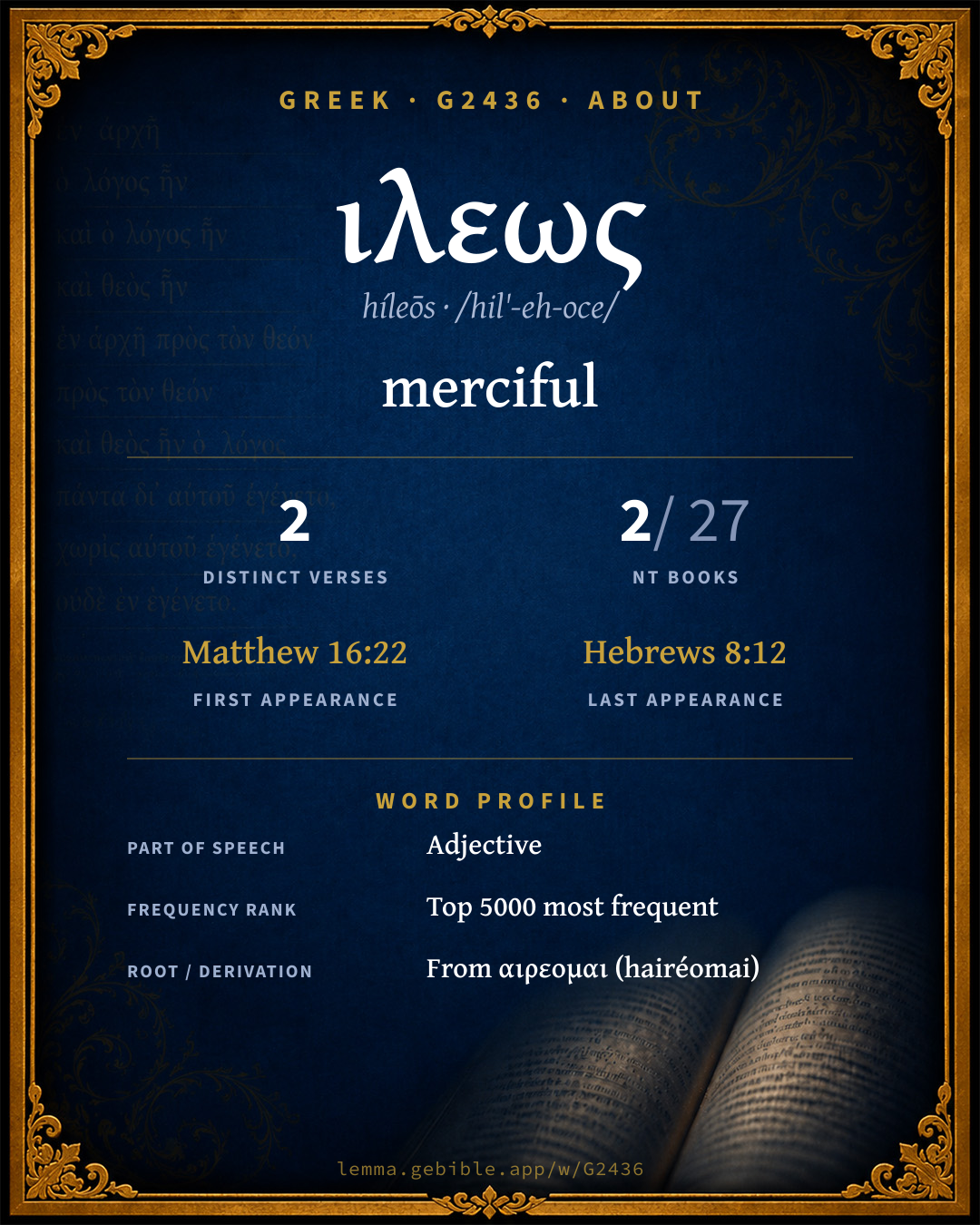
ἵλεως
merciful
Full lexicon entry — Thayer's Greek Lexicon
From Thayer's Greek Lexicon
Where this word appears
Grammar key — what these labels mean
Part of speech
- Adjective
- A word that describes or qualifies a noun.
Case
- Nominative
- The case of the subject (and the predicate nominative).
Gender
- Masculine
- Grammatically masculine.
Number
- Singular
- One.
Every verse where G2436 appears in the Book of Matthew — 1 distinct verse. Click any verse to open its interlinear word-by-word view. Verse text shown in the World English Bible for context — . Each verse’s Greek form is shown with its reference; the English is not keyword-highlighted, since the data carries no word-level English alignment. Use “Compare translations” on any verse to read it across multiple English versions. This concordance covers the Greek New Testament; Septuagint (Greek Old Testament) occurrences of this word are not indexed here.
Matthew
About this entry
At a glance — auto-summarized from this page’s data, not written by a person. Every figure links to its source below. This summary describes the numbers; it doesn’t interpret them.
At its core, ιλεως (híleōs) means “merciful.” It is rare — just 2 verses in the entire Greek New Testament. Its uses cluster heavily in Matthew (50% of all occurrences). It first appears in Matthew 16:22. Sharing its root, it stands alongside αιρεομαι, αιρεσις and αιρετιζω. Each statement above links to its evidence; the full detail follows below.
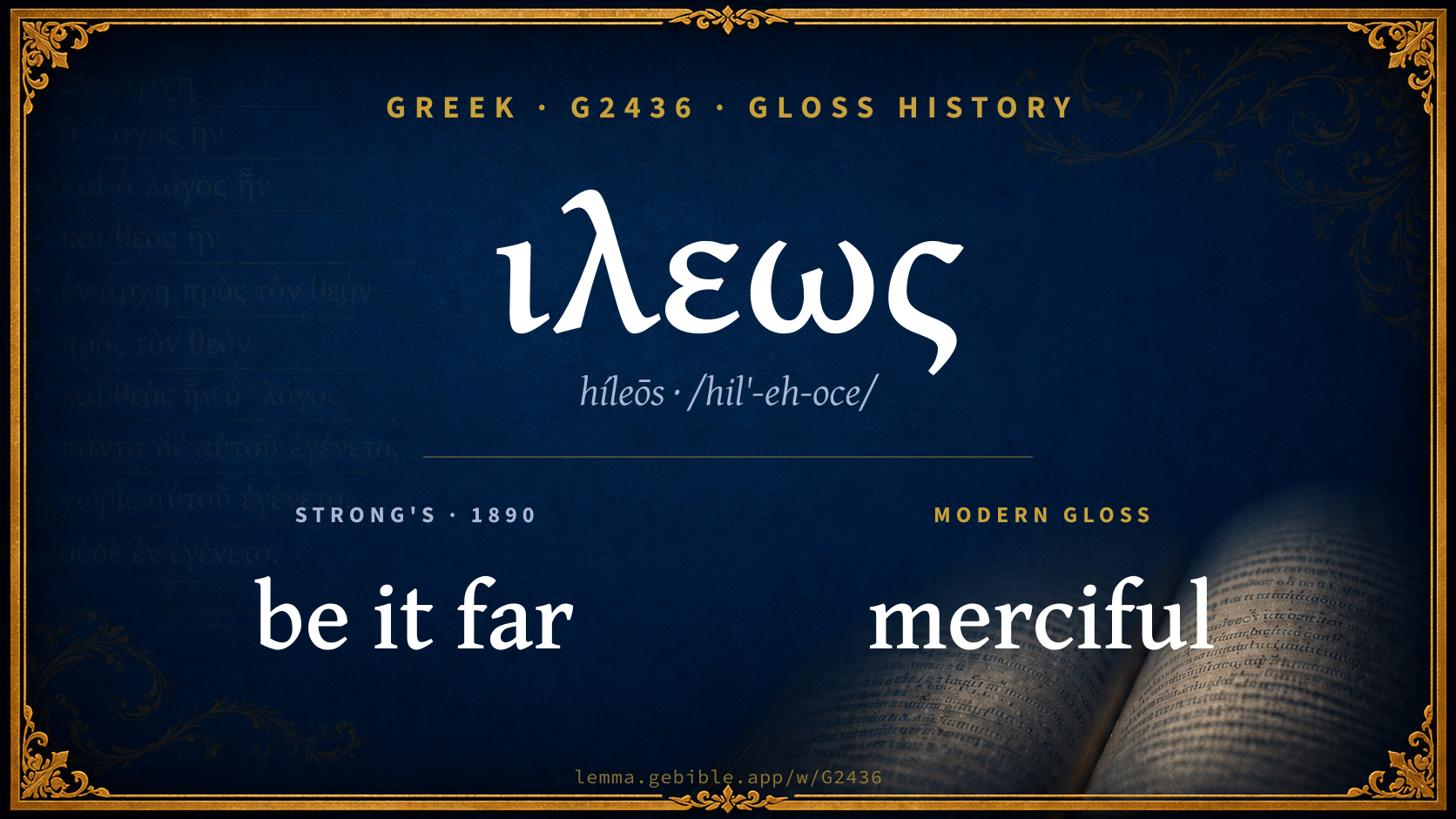
Gloss history
Strong's 1890 vs modern scholarship
About this word
Strong's G2436 catalogs a Greek word from the Greek New Testament.
These counts are not copied from any lexicon or concordance. They are computed here, from the morphology-tagged Greek New Testament. What Lemma adds →
- 2
- distinct verses
- The word appears in 2 distinct verses.
- 2 / 27
- NT books
- The word appears in 2 of 27 New Testament books.
- #2,678
- by frequency
- Top 5000 most frequent Greek words (rank 2,678 of 5,347 Greek words by occurrence).
View all 2 occurrences in the concordance →
By traditional corpus
Conventional, traditional groupings — biblical authorship is debated, so this is a traditional corpus grouping, not an authorship claim. Some books belong to more than one corpus (Luke is in both the Gospels and the Lukan corpus, and so on), so these shares overlap and need not total 100%. Each figure is a share of the word’s 2 distinct verses.
- Gospels 1 verse · 50%
- Hebrews 1 verse · 50%
How translations render this word
Counts come from each version’s own published word-to-Strong’s tagging or interlinear alignment — an approximate guide to how each version renders this word, not a word-level alignment the data otherwise carries. Because each total is that version’s own tagged count, the per-version totals vary from one another and need not match the appearance or distinct-verse counts above. These counts may also differ from a printed concordance because Lemma counts each distinctly tagged rendering and does not collapse phrase taggings into a single head-word total. This is a fixed set of word-tagged versions (KJV, ASV, BSB, ULT) and does not change with the reading translation you choose elsewhere. Each version’s license is shown beside its name below (and on Sources).
- King James Version: Be it far 1×, Merciful 1×
- American Standard Version: Be it far 1×, Merciful 1×
- Berean Standard Bible: Far be it 1×, Forgive 1×
- unfoldingWord Literal Text: Merciful 2×
King James Version Public Domain
Renders G2436 across 2 tagged occurrences — most commonly:
American Standard Version Public Domain
Renders G2436 across 2 tagged occurrences — most commonly:
Berean Standard Bible Public Domain
Renders G2436 across 2 tagged occurrences — most commonly:
unfoldingWord Literal Text CC BY-SA 4.0
Renders G2436 across 2 tagged occurrences — most commonly:
Senses in Thayer's
The 1 sense Thayer's distinguishes for this word, in lexicon order (not ranked by frequency or importance). The full entry — with sub-senses — is in the Lexicon Entry tab.
- propitious, merciful
Word origin
Derived from αιρεομαι (hairéomai) (G138) — to choose.
Perhaps from the alternate form of G138 ; cheerful (as attractive ) that is propitious ; adverbially (by hebraism) God be gracious! that is (in averting some calamity) far be it : - be it far merciful.
— Strong’s Exhaustive Concordance (1890), public domain.
Forms in the corpus
The 2 distinct written forms G2436 takes in the Greek New Testament, most frequent first — each parse links to that case’s occurrences in the concordance.
| Form | Parsing | Example | Uses |
|---|---|---|---|
| ἵλεως híleōs | Adjective, Nominative, Singular, Masculine, Attic form | Hebrews 8:12 | 1 |
| ἵλεώς híleṓs | Adjective, Nominative, Singular, Masculine, Attic form | Matthew 16:22 | 1 |
Same root — word family
Other Thayer's entries built from the same root as G2436, grouped by Strong’s listed origin. These share a root / origin per the lexicon — not necessarily a shared meaning. Each links to that word’s own entry.
Derives from
Shares the same root
- αιρεσις haíresis G139 choice
- αιρετιζω hairetízō G140 to choose
- αλωσις hálōsis G259 capture
- αρπαζω harpázō G726 to seize
- ελκυω helkýō G1670 to draw
- ηλιος hḗlios G2246 sun
- θελω thélō G2309 to will
- σεληνη selḗnē G4582 moon
- σπειρα speîra G4686 cohort
- συλαω syláō G4813 to rob
- συρω sýrō G4951 to drag
- τιλλω tíllō G5089 to pluck
Derived from this word
Compare all same-root words → Showing 4 of 16 — not the complete family. They share a root, not necessarily a meaning.
Septuagint usage
The same Greek word ιλεως appears 25 times in the Greek Old Testament (Septuagint), across 24 verses in 10 books.
- 25
- LXX occurrences
- Tagged occurrences of this Greek word in the Septuagint.
- 24
- verses
- Distinct Septuagint verses containing this word.
- 10 / 39
- OT books
- The word appears in 10 of the 39 Old Testament books.
Sample Septuagint occurrences
- Genesis 43:23 ἵλεως
- Exodus 32:12 ἵλεως
- Numbers 14:19 ἵλεως
- Deuteronomy 21:8 ἵλεως
- 2 Samuel 20:20 ἵλεως
- 1 Kings 8:30 ἵλεως
- 1 Chronicles 11:19 ἵλεως
- 2 Chronicles 6:21 ἵλεως
- Jeremiah 5:1 ἵλεως
- Amos 7:2 ἵλεως
Septuagint occurrences (same lexeme)
Every verse where the same Strong’s number (G2436) appears in the Greek Septuagint. Verse text shown in the World English Bible for context; the Greek form is the matched word — the English is not keyword-highlighted.
- Genesis 43:23 ἵλεως He said, "Peace be to you. Don't be afraid. Your God, and the God of your father, has given you treasure in your sacks. I received your money." He brought Simeon out to them.
- Exodus 32:12 ἵλεως Why should the Egyptians speak, saying, 'He brought them forth for evil, to kill them in the mountains, and to consume them from the surface of the earth?' Turn from your fierce wrath, and repent of this evil against your people.
- Numbers 14:19 ἵλεως Pardon, Please, the iniquity of this people according to the greatness of your loving kindness, and according as you have forgiven this people, from Egypt even until now.
- Numbers 14:20 ἵλεως Yahweh said, I have pardoned according to your word:
- Deuteronomy 21:8 ἵλεως Forgive, Yahweh, your people Israel, whom you have redeemed, and don't allow innocent blood [to remain] in the midst of your people Israel. The blood shall be forgiven them.
- 2 Samuel 20:20 ἵλεωςἵλεώς Joab answered, Far be it, far be it from me, that I should swallow up or destroy.
- 2 Samuel 23:17 ἵλεως He said, Be it far from me, Yahweh, that I should do this: [shall I drink] the blood of the men who went in jeopardy of their lives? therefore he would not drink it. These things did the three mighty men.
- 1 Kings 8:30 ἵλεως Listen you to the supplication of your servant, and of your people Israel, when they shall pray toward this place: yes, hear in heaven, your dwelling-place; and when you hear, forgive.
- 1 Kings 8:34 ἵλεως then hear you in heaven, and forgive the sin of your people Israel, and bring them again to the land which you gave to their fathers.
- 1 Kings 8:36 ἵλεως then hear in heaven, and forgive the sin of your servants, and of your people Israel, when you teach them the good way in which they should walk; and send rain on your land, which you have given to your people for an inheritance.
- 1 Kings 8:39 ἵλεως then hear in heaven, your dwelling-place, and forgive, and do, and render to every man according to all his ways, whose heart you know; (for you, even you only, know the hearts of all the children of men;)
- 1 Kings 8:50 ἵλεως and forgive your people who have sinned against you, and all their transgressions in which they have transgressed against you; and give them compassion before those who carried them captive, that they may have compassion on them
- 1 Chronicles 11:19 ἵλεως and said, My God forbid it me, that I should do this: shall I drink the blood of these men who have put their lives in jeopardy? for with [the jeopardy of] their lives they brought it. Therefore he would not drink it. These things did the three mighty men.
- 2 Chronicles 6:21 ἵλεως Listen you to the petitions of your servant, and of your people Israel, when they shall pray toward this place: yes, hear from your dwelling-place, even from heaven; and when you hear, forgive.
- 2 Chronicles 6:25 ἵλεως then hear from heaven, and forgive the sin of your people Israel, and bring them again to the land which you gave to them and to their fathers.
- 2 Chronicles 6:27 ἵλεως then hear in heaven, and forgive the sin of your servants, and of your people Israel, when you teach them the good way in which they should walk; and send rain on your land, which you have given to your people for an inheritance.
- 2 Chronicles 6:39 ἵλεως then hear from heaven, even from your dwelling-place, their prayer and their petitions, and maintain their cause, and forgive your people who have sinned against you.
- 2 Chronicles 7:14 ἵλεως if my people, who are called by my name, shall humble themselves, and pray, and seek my face, and turn from their wicked ways; then will I hear from heaven, and will forgive their sin, and will heal their land.
- Jeremiah 5:1 ἵλεως Run you back and forth through the streets of Jerusalem, and see now, and know, and seek in the broad places of it, if you can find a man, if there are any who does justly, who seeks truth; and I will pardon her.
- Jeremiah 5:7 ἵλεως How can I pardon you? your children have forsaken me, and sworn by them that are no gods: when I had fed them to the full, they committed adultery, and assembled themselves in troops at the prostitutes' houses.
- Jeremiah 27:20 ἵλεως which Nebuchadnezzar king of Babylon didn't take, when he carried away captive Jeconiah the son of Jehoiakim, king of Judah, from Jerusalem to Babylon, and all the nobles of Judah and Jerusalem;
- Jeremiah 38:34 ἵλεως
- Jeremiah 43:3 ἵλεως but Baruch the son of Neriah sets you on against us, to deliver us into the hand of the Chaldeans, that they may put us to death, and carry us away captive to Babylon.
- Amos 7:2 ἵλεως It happened that, when they made an end of eating the grass of the land, then I said, "Lord Yahweh, forgive, I beg you! How could Jacob stand? For he is small."
These are occurrences of the same Greek lexeme (G2436) in the Septuagint — not a translation of any one Hebrew word. The store carries no word-level Hebrew↔Greek alignment, so no Hebrew original is asserted here. Counts come from the recovered LXX Strong's tagging — high-frequency vocabulary is well covered, while rare or late forms may be untagged — so they reflect tagged occurrences and may slightly undercount.