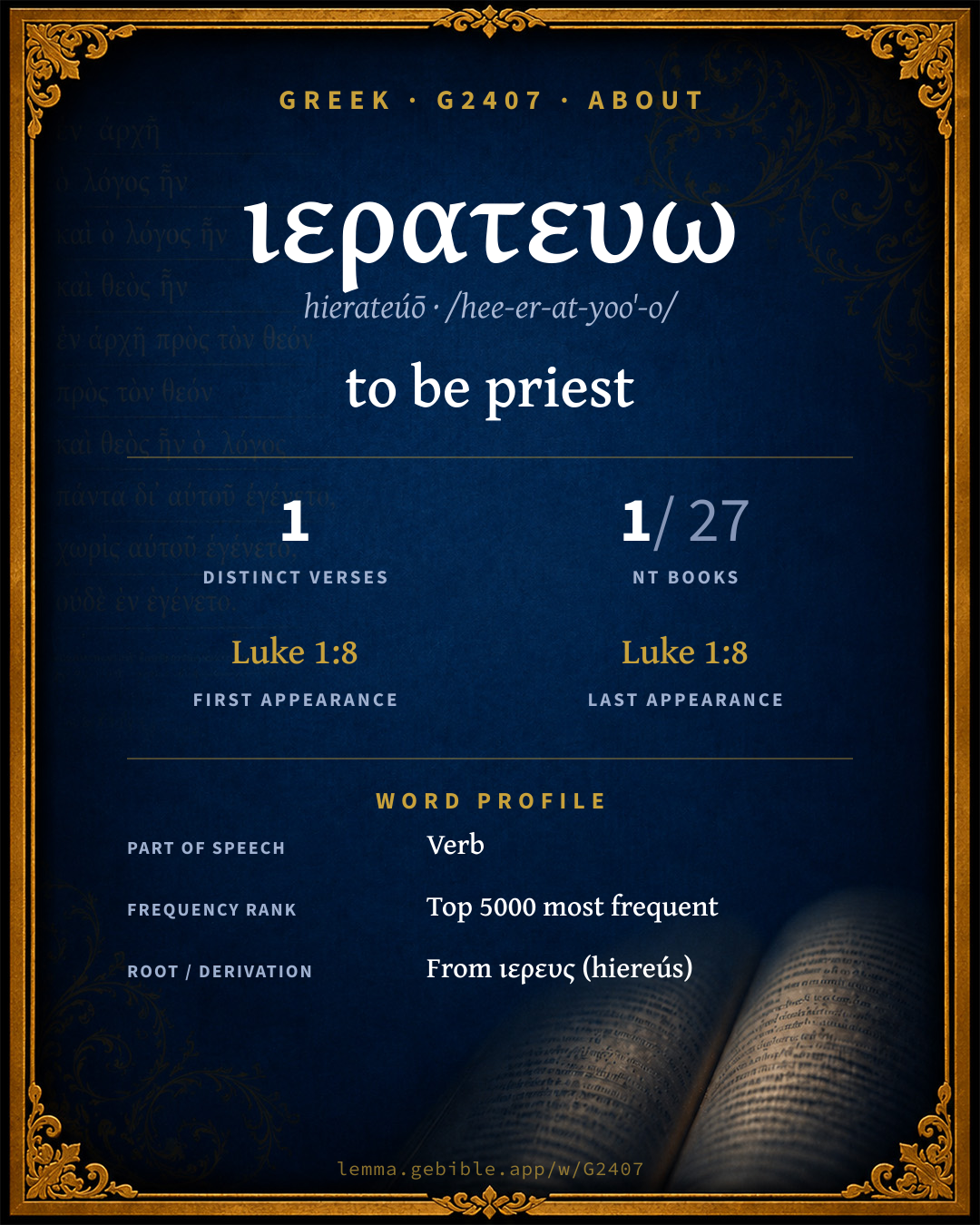
ἱερατεύω
to be priest
Full lexicon entry — Thayer's Greek Lexicon
From Thayer's Greek Lexicon
Where this word appears
Grammar key — what these labels mean
Part of speech
- Verb
- An action or state-of-being word.
Tense
- Present
- Ongoing or general action in present time (imperfective aspect).
Voice
- Active
- The subject performs the action.
Mood
- Infinitive
- A verbal noun (“to write”), unmarked for person or number.
Every verse where G2407 appears — 1 distinct verse across 1 book. Click any verse to open its interlinear word-by-word view. Verse text shown in the World English Bible for context — . Each verse’s Greek form is shown with its reference; the English is not keyword-highlighted, since the data carries no word-level English alignment. Use “Compare translations” on any verse to read it across multiple English versions. This concordance covers the Greek New Testament; Septuagint (Greek Old Testament) occurrences of this word are not indexed here.
Luke 1 verse
About this entry
At a glance — auto-summarized from this page’s data, not written by a person. Every figure links to its source below. This summary describes the numbers; it doesn’t interpret them.
ιερατευω — transliterated hierateúō — is a Greek verb carrying the sense “to be priest.” A scarce word — 1 verse in all of the Greek New Testament. More than three-quarters of its appearances fall in Luke. Found nowhere else but Luke 1:8. It shares a root with ιερευς, ιερατεια and ιερατευμα. Each statement above links to its evidence; the full detail follows below.
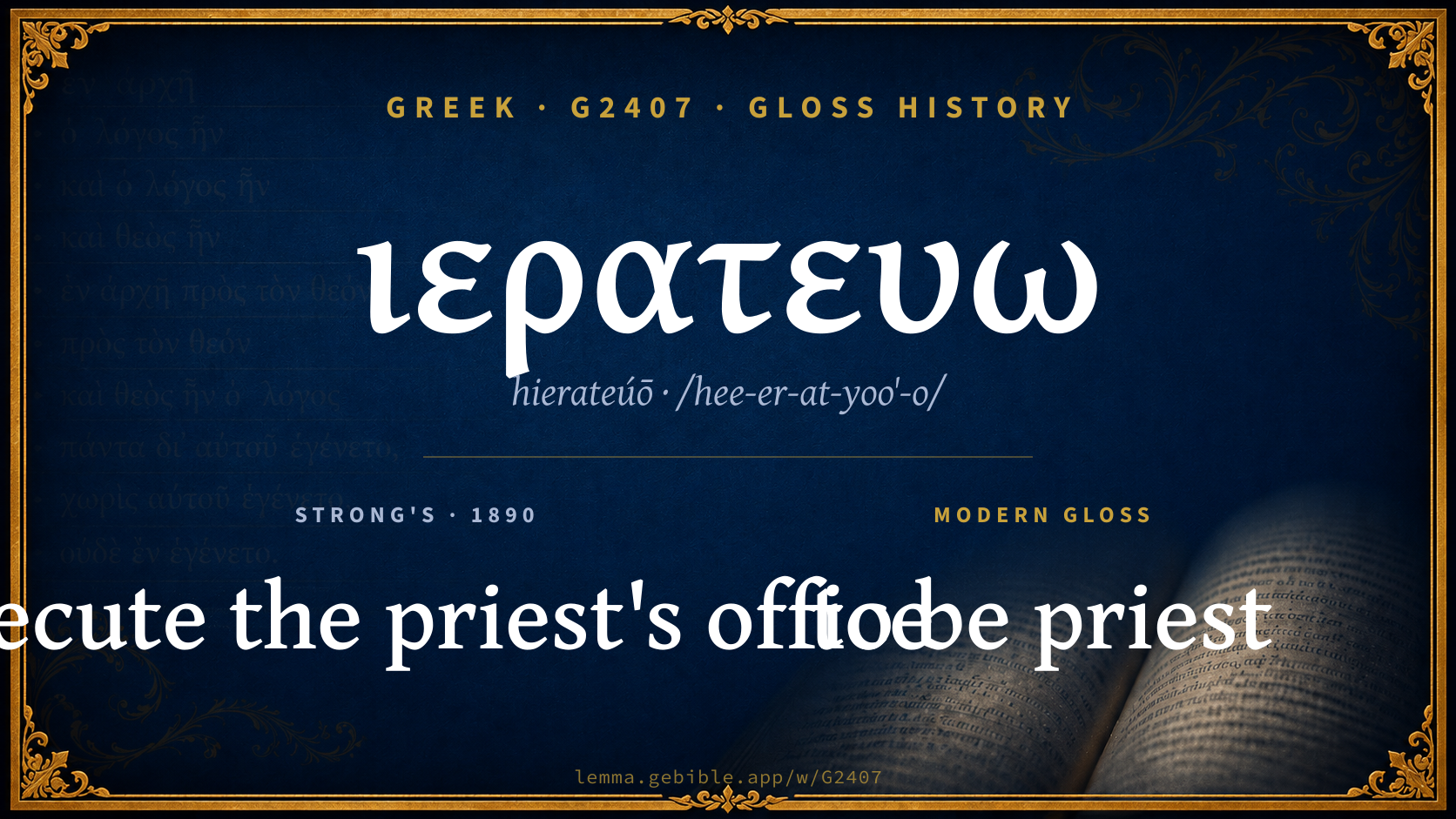
Gloss history
Strong's 1890 vs modern scholarship
About this word
Strong's G2407 catalogs a Greek word from the Greek New Testament.
These counts are not copied from any lexicon or concordance. They are computed here, from the morphology-tagged Greek New Testament. What Lemma adds →
- 1
- distinct verses
- The word appears in 1 distinct verse.
- 1 / 27
- NT books
- The word appears in 1 of 27 New Testament books.
- #3,503
- by frequency
- Top 5000 most frequent Greek words (rank 3,503 of 5,347 Greek words by occurrence).
View all 1 occurrence in the concordance →
Most concentrated in
- Luke 1 verse 100%
By section of the New Testament
By traditional corpus
Conventional, traditional groupings — biblical authorship is debated, so this is a traditional corpus grouping, not an authorship claim. Some books belong to more than one corpus (Luke is in both the Gospels and the Lukan corpus, and so on), so these shares overlap and need not total 100%. Each figure is a share of the word’s 1 distinct verse.
- Gospels 1 verse · 100%
- Lukan (Luke–Acts) 1 verse · 100%
How translations render this word
Counts come from each version’s own published word-to-Strong’s tagging or interlinear alignment — an approximate guide to how each version renders this word, not a word-level alignment the data otherwise carries. Because each total is that version’s own tagged count, the per-version totals vary from one another and need not match the appearance or distinct-verse counts above. These counts may also differ from a printed concordance because Lemma counts each distinctly tagged rendering and does not collapse phrase taggings into a single head-word total. This is a fixed set of word-tagged versions (KJV, ASV, BSB, ULT) and does not change with the reading translation you choose elsewhere. Each version’s license is shown beside its name below (and on Sources).
- King James Version: Executed the priest's office 1×
- American Standard Version: Executed the priest 1×
- Berean Standard Bible: Was serving as priest 1×
- unfoldingWord Literal Text: Performing as priest 1×
King James Version Public Domain
Renders G2407 across 1 tagged occurrence — most commonly:
American Standard Version Public Domain
Renders G2407 across 1 tagged occurrence — most commonly:
Berean Standard Bible Public Domain
Renders G2407 across 1 tagged occurrence — most commonly:
unfoldingWord Literal Text CC BY-SA 4.0
Renders G2407 across 1 tagged occurrence — most commonly:
Senses in Thayer's
The 1 sense Thayer's distinguishes for this word, in lexicon order (not ranked by frequency or importance). The full entry — with sub-senses — is in the Lexicon Entry tab.
- to be a priest, discharge the office of a priest, to be busied in sacred duties
Word origin
Derived from ιερευς (hiereús) (G2409) — priest.
Prolongation from G2409 ; to be a priest that is perform his functions : - execute the priest´ s office.
— Strong’s Exhaustive Concordance (1890), public domain.
Same root — word family
Other Thayer's entries built from the same root as G2407, grouped by Strong’s listed origin. These share a root / origin per the lexicon — not necessarily a shared meaning. Each links to that word’s own entry.
Derives from
Derived from this word
Compare all same-root words → They share a root, not necessarily a meaning.
Septuagint usage
The same Greek word ιερατευω appears 23 times in the Greek Old Testament (Septuagint), across 23 verses in 10 books.
- 23
- LXX occurrences
- Tagged occurrences of this Greek word in the Septuagint.
- 23
- verses
- Distinct Septuagint verses containing this word.
- 10 / 39
- OT books
- The word appears in 10 of the 39 Old Testament books.
Sample Septuagint occurrences
- Exodus 28:1 ἱερατεύω
- Leviticus 7:35 ἱερατεύω
- Numbers 3:3 ἱερατεύω
- Deuteronomy 10:6 ἱερατεύω
- Joshua 24:33 ἱερατεύω
- 1 Samuel 2:28 ἱερατεύω
- 1 Chronicles 5:36 ἱερατεύω
- 2 Chronicles 31:19 ἱερατεύω
- Ezekiel 44:13 ἱερατεύω
- Hosea 4:6 ἱερατεύω
Septuagint occurrences (same lexeme)
Every verse where the same Strong’s number (G2407) appears in the Greek Septuagint. Verse text shown in the World English Bible for context; the Greek form is the matched word — the English is not keyword-highlighted.
- Exodus 28:1 ἱερατεύω "Bring Aaron your brother, and his sons with him, near to you from among the children of Israel, that he may minister to me in the priest's office, even Aaron, Nadab and Abihu, Eleazar and Ithamar, Aaron's sons.
- Exodus 28:3 ἱερατεύω You shall speak to all who are wise-hearted, whom I have filled with the spirit of wisdom, that they make Aaron's garments to sanctify him, that he may minister to me in the priest's office.
- Exodus 28:4 ἱερατεύω These are the garments which they shall make: a breastplate, and an ephod, and a robe, and a coat of checker work, a turban, and a sash: and they shall make holy garments for Aaron your brother, and his sons, that he may minister to me in the priest's office.
- Exodus 28:41 ἱερατεύω You shall put them on Aaron your brother, and on his sons with him, and shall anoint them, and consecrate them, and sanctify them, that they may minister to me in the priest's office.
- Exodus 29:1 ἱερατεύω "This is the thing that you shall do to them to make them holy, to minister to me in the priest's office: take one young bull and two rams without blemish,
- Exodus 29:44 ἱερατεύω I will sanctify the tent of meeting and the altar: Aaron also and his sons I will sanctify, to minister to me in the priest's office.
- Exodus 30:30 ἱερατεύω You shall anoint Aaron and his sons, and sanctify them, that they may minister to me in the priest's office.
- Exodus 31:10 ἱερατεύω the finely worked garments--the holy garments for Aaron the priest--the garments of his sons to minister in the priest's office,
- Exodus 40:13 ἱερατεύω You shall put on Aaron the holy garments; and you shall anoint him, and sanctify him, that he may minister to me in the priest's office.
- Exodus 40:15 ἱερατεύω You shall anoint them, as you anointed their father, that they may minister to me in the priest's office. Their anointing shall be to them for an everlasting priesthood throughout their generations.
- Leviticus 7:35 ἱερατεύω This is the anointing portion of Aaron, and the anointing portion of his sons, out of the offerings of Yahweh made by fire, in the day when he presented them to minister to Yahweh in the priest's office;
- Leviticus 16:32 ἱερατεύω The priest, who is anointed and who is consecrated to be priest in his father's place, shall make the atonement, and shall put on the linen garments, even the holy garments.
- Numbers 3:3 ἱερατεύω These are the names of the sons of Aaron, the priests who were anointed, whom he consecrated to minister in the priest's office.
- Numbers 3:4 ἱερατεύω Nadab and Abihu died before Yahweh, when they offered strange fire before Yahweh, in the wilderness of Sinai, and they had no children. Eleazar and Ithamar ministered in the priest's office in the presence of Aaron their father.
- Numbers 16:10 ἱερατεύω and that he has brought you near, and all your brothers the sons of Levi with you? and seek you the priesthood also?
- Deuteronomy 10:6 ἱερατεύω (The children of Israel traveled from Beeroth Bene Jaakan to Moserah. There Aaron died, and there he was buried; and Eleazar his son ministered in the priest's office in his place.
- Joshua 24:33 ἱερατεύω Eleazar the son of Aaron died; and they buried him in the hill of Phinehas his son, which was given him in the hill-country of Ephraim.
- 1 Samuel 2:28 ἱερατεύω and did I choose him out of all the tribes of Israel to be my priest, to go up to my altar, to burn incense, to wear an ephod before me? and did I give to the house of your father all the offerings of the children of Israel made by fire?
- 1 Chronicles 5:36 ἱερατεύω
- 1 Chronicles 24:2 ἱερατεύω But Nadab and Abihu died before their father, and had no children: therefore Eleazar and Ithamar executed the priest's office.
- 2 Chronicles 31:19 ἱερατεύω Also for the sons of Aaron the priests, who were in the fields of the suburbs of their cities, in every city, there were men who were mentioned by name, to give portions to all the males among the priests, and to all who were reckoned by genealogy among the Levites.
- Ezekiel 44:13 ἱερατεύω They shall not come near to me, to execute the office of priest to me, nor to come near to any of my holy things, to the things that are most holy; but they shall bear their shame, and their abominations which they have committed.
- Hosea 4:6 ἱερατεύω My people are destroyed for lack of knowledge. Because you have rejected knowledge, I will also reject you, That you may be no priest to me. Because you have your God's law, I will also forget your children.
These are occurrences of the same Greek lexeme (G2407) in the Septuagint — not a translation of any one Hebrew word. The store carries no word-level Hebrew↔Greek alignment, so no Hebrew original is asserted here. Counts come from the recovered LXX Strong's tagging — high-frequency vocabulary is well covered, while rare or late forms may be untagged — so they reflect tagged occurrences and may slightly undercount.