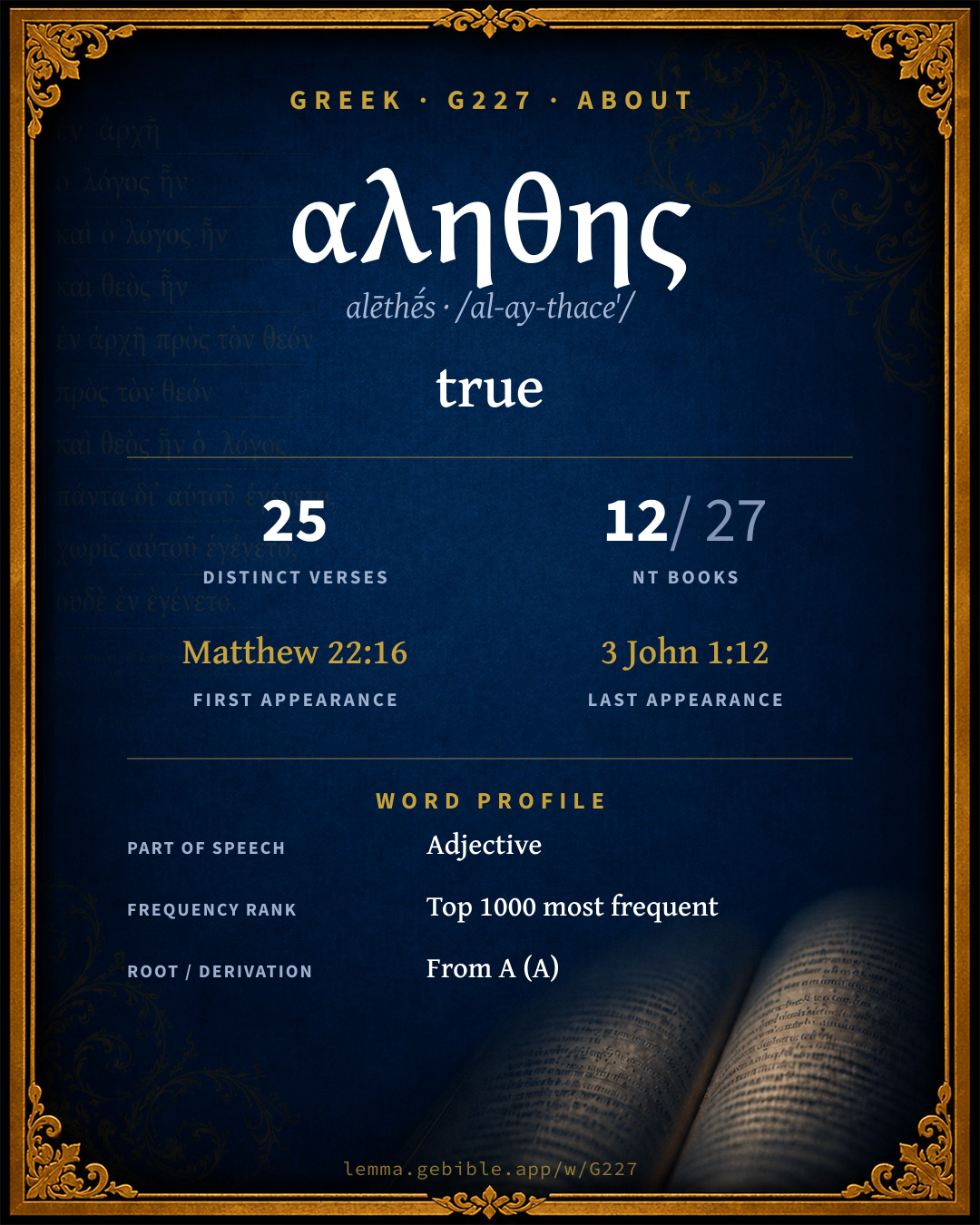
ἀληθής
true
‘true’ is one of 2 main senses fuller range ↓
Full lexicon entry — Thayer's Greek Lexicon
From Thayer's Greek Lexicon
Where this word appears
Grammar key — what these labels mean
Part of speech
- Adjective
- A word that describes or qualifies a noun.
Case
- Nominative
- The case of the subject (and the predicate nominative).
- Accusative
- The case of the direct object and of extent.
- Genitive
- The case of source, possession, or “of” — answers “whose / from what.”
Gender
- Feminine
- Grammatically feminine.
- Masculine
- Grammatically masculine.
- Neuter
- Grammatically neuter.
Number
- Singular
- One.
- Plural
- More than one.
Every verse where G227 appears in the Book of Acts — 1 distinct verse. Click any verse to open its interlinear word-by-word view. Verse text shown in the World English Bible for context — . Each verse’s Greek form is shown with its reference; the English is not keyword-highlighted, since the data carries no word-level English alignment. Use “Compare translations” on any verse to read it across multiple English versions. This concordance covers the Greek New Testament; Septuagint (Greek Old Testament) occurrences of this word are not indexed here.
Acts
About this entry
At a glance — auto-summarized from this page’s data, not written by a person. Every figure links to its source below. This summary describes the numbers; it doesn’t interpret them.
αληθης — transliterated alēthḗs — is a Greek adjective carrying the sense “true.” Its uses cluster heavily in John (52% of all occurrences). Spanning 25 verses in 12 books, it ranks among the uncommon words of the Greek New Testament. Its earliest occurrence is Matthew 22:16. Thayer's distinguishes 2 senses for it. Each statement above links to its evidence; the full detail follows below.
Gloss history
Strong's 1890 vs modern scholarship
About this word
Strong's G227 catalogs a Greek word from the Greek New Testament.
These counts are not copied from any lexicon or concordance. They are computed here, from the morphology-tagged Greek New Testament. What Lemma adds →
- 25
- distinct verses
- The word appears in 25 distinct verses.
- 12 / 27
- NT books
- The word appears in 12 of 27 New Testament books.
- #513
- by frequency
- Top 1000 most frequent Greek words (rank 513 of 5,347 Greek words by occurrence).
View all 25 occurrences in the concordance →
By section of the New Testament
By traditional corpus
Conventional, traditional groupings — biblical authorship is debated, so this is a traditional corpus grouping, not an authorship claim. Some books belong to more than one corpus (Luke is in both the Gospels and the Lukan corpus, and so on), so these shares overlap and need not total 100%. Each figure is a share of the word’s 25 distinct verses.
- Johannine 16 verses · 64%
- Gospels 15 verses · 60%
- General (Catholic) Epistles 5 verses · 20%
- Pauline corpus 4 verses · 16%
- Lukan (Luke–Acts) 1 verse · 4%
How translations render this word
Counts come from each version’s own published word-to-Strong’s tagging or interlinear alignment — an approximate guide to how each version renders this word, not a word-level alignment the data otherwise carries. Because each total is that version’s own tagged count, the per-version totals vary from one another and need not match the appearance or distinct-verse counts above. These counts may also differ from a printed concordance because Lemma counts each distinctly tagged rendering and does not collapse phrase taggings into a single head-word total. This is a fixed set of word-tagged versions (KJV, ASV, BSB, ULT) and does not change with the reading translation you choose elsewhere. Each version’s license is shown beside its name below (and on Sources).
- King James Version: True 23×
- American Standard Version: True 22×
- Berean Standard Bible: True 10×, Valid 5×, Real 3×
- unfoldingWord Literal Text: True 21×, Truthful 2×
King James Version Public Domain
Renders G227 across 25 tagged occurrences — most commonly:
Plus 2 renderings that appear only once — usually multi-word phrases or single function words the recovered tagging swept in, not distinct renderings.
American Standard Version Public Domain
Renders G227 across 24 tagged occurrences — most commonly:
Plus 2 renderings that appear only once — usually multi-word phrases or single function words the recovered tagging swept in, not distinct renderings.
Berean Standard Bible Public Domain
Renders G227 across 26 tagged occurrences — most commonly:
Plus 4 renderings that appear only once — usually multi-word phrases or single function words the recovered tagging swept in, not distinct renderings.
unfoldingWord Literal Text CC BY-SA 4.0
Renders G227 across 26 tagged occurrences — most commonly:
Plus 3 renderings that appear only once — usually multi-word phrases or single function words the recovered tagging swept in, not distinct renderings.
Senses in Thayer's
The 2 senses Thayer's distinguishes for this word, in lexicon order (not ranked by frequency or importance). The full entry — with sub-senses — is in the Lexicon Entry tab.
- true
- loving the truth, speaking the truth, truthful
Word origin
Derived from Α (A) (G1) — alpha.
Forms in the corpus
The 7 distinct written forms G227 takes in the Greek New Testament, most frequent first — each parse links to that case’s occurrences in the concordance.
| Form | Parsing | Example | Uses |
|---|---|---|---|
| ἀληθής alēthḗs | Adjective, Nominative, Singular, Feminine | John 5:31 | 13 |
| ἀληθῆ alēthē̂ | Adjective, Nominative, Plural, Neuter | John 10:41 | 4 |
| ἀληθὴς alēthḕs | Adjective, Nominative, Singular, Masculine | Matthew 22:16 | 3 |
| ἀληθὲς alēthès | Adjective, Accusative, Singular, Neuter | John 4:18 | 2 |
| ἀληθές alēthés | Adjective, Nominative, Singular, Neuter | Acts 12:9 | 2 |
| ἀληθεῖς alētheîs | Adjective, Nominative, Plural, Masculine | 2 Corinthians 6:8 | 1 |
| ἀληθοῦς alēthoûs | Adjective, Genitive, Singular, Feminine | 2 Peter 2:22 | 1 |
Same root — word family
Other Thayer's entries built from the same root as G227, grouped by Strong’s listed origin. These share a root / origin per the lexicon — not necessarily a shared meaning. Each links to that word’s own entry.
Derives from
Shares the same root
- αβαρης abarḗs G4 light
- αβυσσος ábyssos G12 abyss
- αγαμος ágamos G22 unmarried
- αγενεαλογητος agenealógētos G35 without genealogy
- αγενης agenḗs G36 ignoble
- αγναφος ágnaphos G46 unprocessed
- αγνοεω agnoéō G50 to be ignorant
- αγνωσια agnōsía G56 ignorance
- αγνωστος ágnōstos G57 unknown
- αγραμματος agrámmatos G62 unlearned
- αγρυπνεω agrypnéō G69 to watch
- αδαπανος adápanos G77 free
- αδελφος adelphós G80 brother
- αδηλος ádēlos G82 obscure
- αδης háidēs G86 hell
- αδιακριτος adiákritos G87 clear
- αδιαλειπτος adiáleiptos G88 continual
- αδικος ádikos G94 unjust
- αδοκιμος adókimos G96 unapproved
- αδολος ádolos G97 guileless
- αδυνατος adýnatos G102 weak
- αζυμος ázymos G106 unleavened
- αθανασια athanasía G110 immortal
- αθεμιτος athémitos G111 unlawful
+149 more words share this root (not shown).
Derived from this word
- αληθεια alḗtheia G225 truth
- αληθευω alētheúō G226 to speak truth
- αληθινος alēthinós G228 genuine
- αληθως alēthōs G230 truly
Proper names from this root
People and places named from this root — a name, not an additional meaning of the word.
Compare all same-root words → Showing 4 of 180 — not the complete family. 1 of the same-root words is a proper name (a person or place). They share a root, not necessarily a meaning.
Septuagint usage
The same Greek word αληθης appears 12 times in the Greek Old Testament (Septuagint), across 12 verses in 7 books.
- 12
- LXX occurrences
- Tagged occurrences of this Greek word in the Septuagint.
- 12
- verses
- Distinct Septuagint verses containing this word.
- 7 / 39
- OT books
- The word appears in 7 of the 39 Old Testament books.
Sample Septuagint occurrences
- Genesis 41:32 ἀληθής
- Deuteronomy 13:15 ἀληθής
- Ezra 17:2 ἀληθής
- Job 5:12 ἀληθής
- Proverbs 1:3 ἀληθής
- Isaiah 41:26 ἀληθής
- Daniel 10:1 ἀληθής
Septuagint occurrences (same lexeme)
Every verse where the same Strong’s number (G227) appears in the Greek Septuagint. Verse text shown in the World English Bible for context; the Greek form is the matched word — the English is not keyword-highlighted.
- Genesis 41:32 ἀληθής The dream was doubled to Pharaoh, because the thing is established by God, and God will shortly bring it to pass.
- Deuteronomy 13:15 ἀληθής you shall surely strike the inhabitants of that city with the edge of the sword, destroying it utterly, and all that is therein and the cattle of it, with the edge of the sword.
- Ezra 17:2 ἀληθής
- Job 5:12 ἀληθής He frustrates the devices of the crafty, So that their hands can't perform their enterprise.
- Job 17:10 ἀληθής But as for you all, come on now again; I shall not find a wise man among you.
- Job 42:7 ἀληθής It was so, that after Yahweh had spoken these words to Job, Yahweh said to Eliphaz the Temanite, "My wrath is kindled against you, and against your two friends; for you have not spoken of me the thing that is right, as my servant Job has.
- Job 42:8 ἀληθής Now therefore, take to yourselves seven bulls and seven rams, and go to my servant Job, and offer up for yourselves a burnt offering; and my servant Job shall pray for you, for I will accept him, that I not deal with you according to your folly. For you have not spoken of me the thing that is right, as my servant Job has."
- Proverbs 1:3 ἀληθής To receive instruction in wise dealing, In righteousness, justice, and equity;
- Proverbs 22:21 ἀληθής To teach you truth, reliable words, To give sound answers to the ones who sent you?
- Isaiah 41:26 ἀληθής Who has declared it from the beginning, that we may know? and before, that we may say, [He is] right? yes, there is none who declares, yes, there is none who shows, yes, there is none who hears your words.
- Isaiah 43:9 ἀληθής Let all the nations be gathered together, and let the peoples be assembled: who among them can declare this, and show us former things? let them bring their witnesses, that they may be justified; or let them hear, and say, It is truth.
- Daniel 10:1 ἀληθής In the third year of Cyrus king of Persia a thing was revealed to Daniel, whose name was called Belteshazzar; and the thing was true, even a great warfare: and he understood the thing, and had understanding of the vision.
These are occurrences of the same Greek lexeme (G227) in the Septuagint — not a translation of any one Hebrew word. The store carries no word-level Hebrew↔Greek alignment, so no Hebrew original is asserted here. Counts come from the recovered LXX Strong's tagging — high-frequency vocabulary is well covered, while rare or late forms may be untagged — so they reflect tagged occurrences and may slightly undercount.