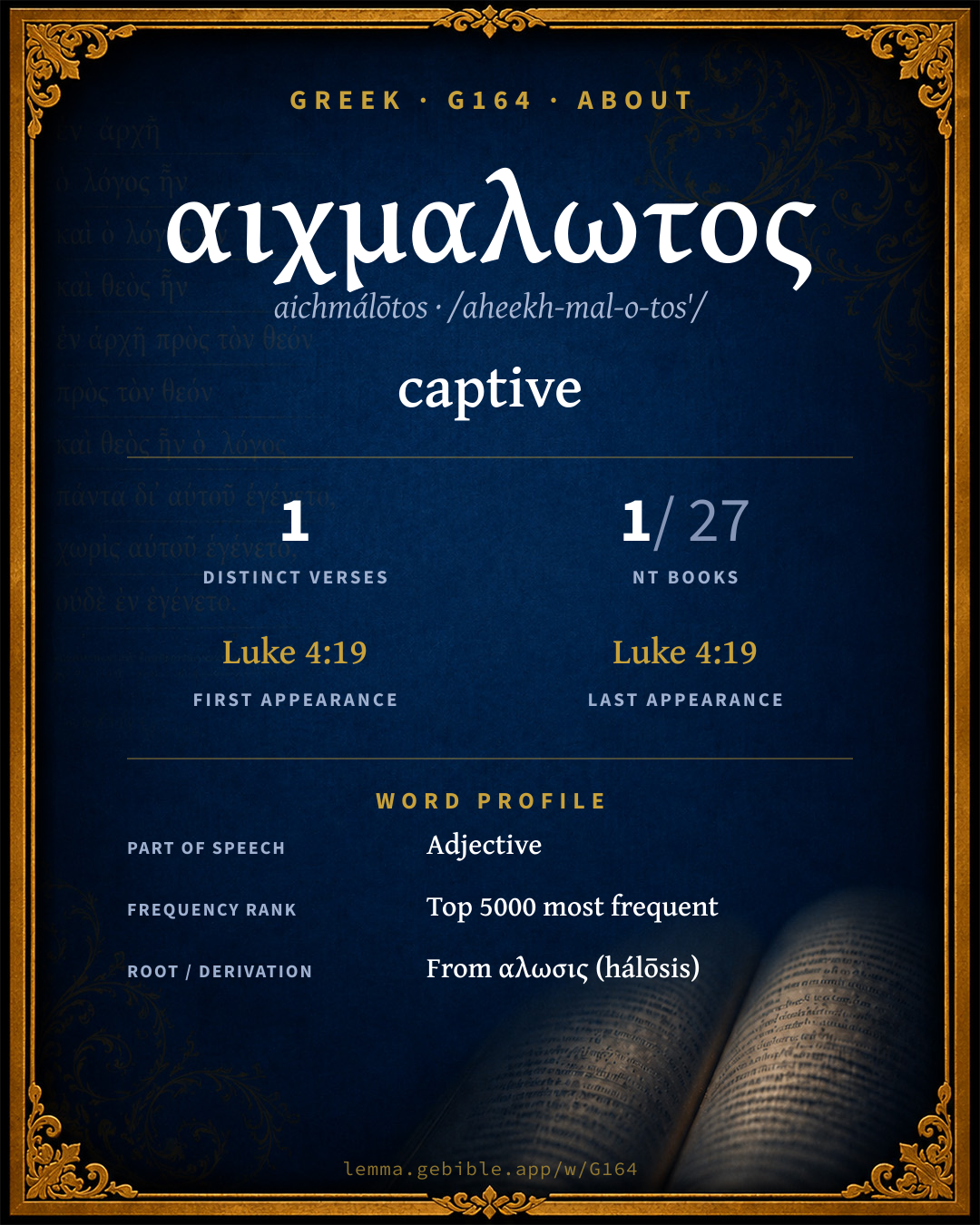
αἰχμαλωτός
captive
Full lexicon entry — Thayer's Greek Lexicon
From Thayer's Greek Lexicon
Where this word appears
Grammar key — what these labels mean
Part of speech
- Noun
- A naming word — a person, place, thing, or idea.
Case
- Dative
- The case of the indirect object, means, or location — “to / for / with / in.”
Gender
- Masculine
- Grammatically masculine.
Number
- Plural
- More than one.
Every verse where G164 appears — 1 distinct verse across 1 book. Click any verse to open its interlinear word-by-word view. Verse text shown in the World English Bible for context — . Each verse’s Greek form is shown with its reference; the English is not keyword-highlighted, since the data carries no word-level English alignment. Use “Compare translations” on any verse to read it across multiple English versions. This concordance covers the Greek New Testament; Septuagint (Greek Old Testament) occurrences of this word are not indexed here.
Luke 1 verse
About this entry
At a glance — auto-summarized from this page’s data, not written by a person. Every figure links to its source below. This summary describes the numbers; it doesn’t interpret them.
“captive” is the headline sense of the Greek adjective αιχμαλωτος (aichmálōtos). It occurs a mere 1 verse across Scripture. More than three-quarters of its appearances fall in Luke. It occurs only once, in Luke 4:19. It shares a root with αλωσις, αιχμαλωσια and αιχμαλωτευω. See the sense tree, 1-verse concordance, and the renderings breakdown below.
Gloss history
Strong's 1890 vs modern scholarship
About this word
Strong's G164 catalogs a Greek word from the Greek New Testament.
These counts are not copied from any lexicon or concordance. They are computed here, from the morphology-tagged Greek New Testament. What Lemma adds →
- 1
- distinct verses
- The word appears in 1 distinct verse.
- 1 / 27
- NT books
- The word appears in 1 of 27 New Testament books.
- #3,503
- by frequency
- Top 5000 most frequent Greek words (rank 3,503 of 5,347 Greek words by occurrence).
View all 1 occurrence in the concordance →
Most concentrated in
- Luke 1 verse 100%
By section of the New Testament
By traditional corpus
Conventional, traditional groupings — biblical authorship is debated, so this is a traditional corpus grouping, not an authorship claim. Some books belong to more than one corpus (Luke is in both the Gospels and the Lukan corpus, and so on), so these shares overlap and need not total 100%. Each figure is a share of the word’s 1 distinct verse.
- Gospels 1 verse · 100%
- Lukan (Luke–Acts) 1 verse · 100%
How translations render this word
Counts come from each version’s own published word-to-Strong’s tagging or interlinear alignment — an approximate guide to how each version renders this word, not a word-level alignment the data otherwise carries. Because each total is that version’s own tagged count, the per-version totals vary from one another and need not match the appearance or distinct-verse counts above. These counts may also differ from a printed concordance because Lemma counts each distinctly tagged rendering and does not collapse phrase taggings into a single head-word total. This is a fixed set of word-tagged versions (KJV, ASV, BSB, ULT) and does not change with the reading translation you choose elsewhere. Each version’s license is shown beside its name below (and on Sources).
- King James Version: Captives 1×
- American Standard Version: Captives 1×
- Berean Standard Bible: Captives 1×
- unfoldingWord Literal Text: Captives 1×
King James Version Public Domain
Renders G164 across 1 tagged occurrence — most commonly:
American Standard Version Public Domain
Renders G164 across 1 tagged occurrence — most commonly:
Berean Standard Bible Public Domain
Renders G164 across 1 tagged occurrence — most commonly:
unfoldingWord Literal Text CC BY-SA 4.0
Renders G164 across 1 tagged occurrence — most commonly:
Senses in Thayer's
The 1 sense Thayer's distinguishes for this word, in lexicon order (not ranked by frequency or importance). The full entry — with sub-senses — is in the Lexicon Entry tab.
- a captive
Word origin
Derived from αλωσις (hálōsis) (G259) — capture.
From αἰχμή aichmē (a spear ) and a derivative of the same as G259 ; properly a prisoner of war that is (generally) a captive : - captive.
— Strong’s Exhaustive Concordance (1890), public domain.
Same root — word family
Other Thayer's entries built from the same root as G164, grouped by Strong’s listed origin. These share a root / origin per the lexicon — not necessarily a shared meaning. Each links to that word’s own entry.
Derives from
Derived from this word
- αιχμαλωσια aichmalōsía G161 captivity
- αιχμαλωτευω aichmalōteúō G162 to capture
- αιχμαλωτιζω aichmalōtízō G163 to captivate
Compare all same-root words → Showing 4 of 5 — not the complete family. They share a root, not necessarily a meaning.
Septuagint usage
The same Greek word αιχμαλωτος appears 19 times in the Greek Old Testament (Septuagint), across 19 verses in 8 books.
- 19
- LXX occurrences
- Tagged occurrences of this Greek word in the Septuagint.
- 19
- verses
- Distinct Septuagint verses containing this word.
- 8 / 39
- OT books
- The word appears in 8 of the 39 Old Testament books.
Sample Septuagint occurrences
- Exodus 22:9 αἰχμάλωτος
- Numbers 21:29 αἰχμάλωτος
- Esther 2:6 αἰχμάλωτος
- Job 12:17 αἰχμάλωτος
- Isaiah 5:13 αἰχμάλωτος
- Ezekiel 12:4 αἰχμάλωτος
- Amos 6:7 αἰχμάλωτος
- Nahum 3:10 αἰχμάλωτος
Septuagint occurrences (same lexeme)
Every verse where the same Strong’s number (G164) appears in the Greek Septuagint. Verse text shown in the World English Bible for context; the Greek form is the matched word — the English is not keyword-highlighted.
- Exodus 22:9 αἰχμάλωτος For every matter of trespass, whether it be for ox, for donkey, for sheep, for clothing, or for any kind of lost thing, about which one says, 'This is mine,' the cause of both parties shall come before God. He whom God condemns shall pay double to his neighbor.
- Exodus 22:13 αἰχμάλωτος If it is torn in pieces, let him bring it for evidence. He shall not make good that which was torn.
- Numbers 21:29 αἰχμάλωτος Woe to you, Moab! You are undone, people of Chemosh: He has given his sons as fugitives, His daughters into captivity, To Sihon king of the Amorites.
- Esther 2:6 αἰχμάλωτος who had been carried away from Jerusalem with the captives who had been carried away with Jeconiah king of Judah, whom Nebuchadnezzar the king of Babylon had carried away.
- Job 12:17 αἰχμάλωτος He leads counselors away stripped. He makes judges fools.
- Job 12:19 αἰχμάλωτος He leads priests away stripped, And overthrows the mighty.
- Job 41:24 αἰχμάλωτος His heart is as firm as a stone, Yes, firm as the lower millstone.
- Isaiah 5:13 αἰχμάλωτος Therefore my people go into captivity for lack of knowledge; Their honorable men are famished, And their multitudes are parched with thirst.
- Isaiah 14:2 αἰχμάλωτος The peoples shall take them, and bring them to their place; and the house of Israel shall possess them in the land of Yahweh for servants and for handmaids: and they shall take them captive whose captives they were; and they shall rule over their oppressors.
- Isaiah 23:1 αἰχμάλωτος The burden of Tyre. Howl, you ships of Tarshish; for it is laid waste, so that there is no house, no entering in: from the land of Kittim it is revealed to them.
- Isaiah 46:2 αἰχμάλωτος They stoop, they bow down together; they could not deliver the burden, but themselves are gone into captivity.
- Isaiah 52:2 αἰχμάλωτος Shake yourself from the dust; arise, sit [on your throne], Jerusalem: loose yourself from the bonds of your neck, captive daughter of Zion.
- Isaiah 61:1 αἰχμάλωτος The Spirit of the Lord Yahweh is on me; because Yahweh has anointed me to preach good news to the humble; he has sent me to bind up the broken-hearted, to proclaim liberty to the captives, and the opening [of the prison] to those who are bound;
- Ezekiel 12:4 αἰχμάλωτος You shall bring forth your stuff by day in their sight, as stuff for removing; and you shall go forth yourself at even in their sight, as when men go forth into exile.
- Ezekiel 30:18 αἰχμάλωτος At Tehaphnehes also the day shall withdraw itself, when I shall break there the yokes of Egypt, and the pride of her power shall cease in her: as for her, a cloud shall cover her, and her daughters shall go into captivity.
- Amos 6:7 αἰχμάλωτος Therefore they will now go captive with the first who go captive; And the feasting and lounging will end.
- Amos 7:11 αἰχμάλωτος For Amos says, 'Jeroboam will die by the sword, and Israel shall surely be led away captive out of his land.'"
- Amos 7:17 αἰχμάλωτος Therefore thus says Yahweh: 'Your wife shall be a prostitute in the city, and your sons and your daughters shall fall by the sword, and your land shall be divided by line; and you yourself shall die in a land that is unclean, and Israel shall surely be led away captive out of his land.'"
- Nahum 3:10 αἰχμάλωτος Yet was she carried away. She went into captivity. Her young children also were dashed in pieces at the head of all the streets, and they cast lots for her honorable men, and all her great men were bound in chains.
These are occurrences of the same Greek lexeme (G164) in the Septuagint — not a translation of any one Hebrew word. The store carries no word-level Hebrew↔Greek alignment, so no Hebrew original is asserted here. Counts come from the recovered LXX Strong's tagging — high-frequency vocabulary is well covered, while rare or late forms may be untagged — so they reflect tagged occurrences and may slightly undercount.