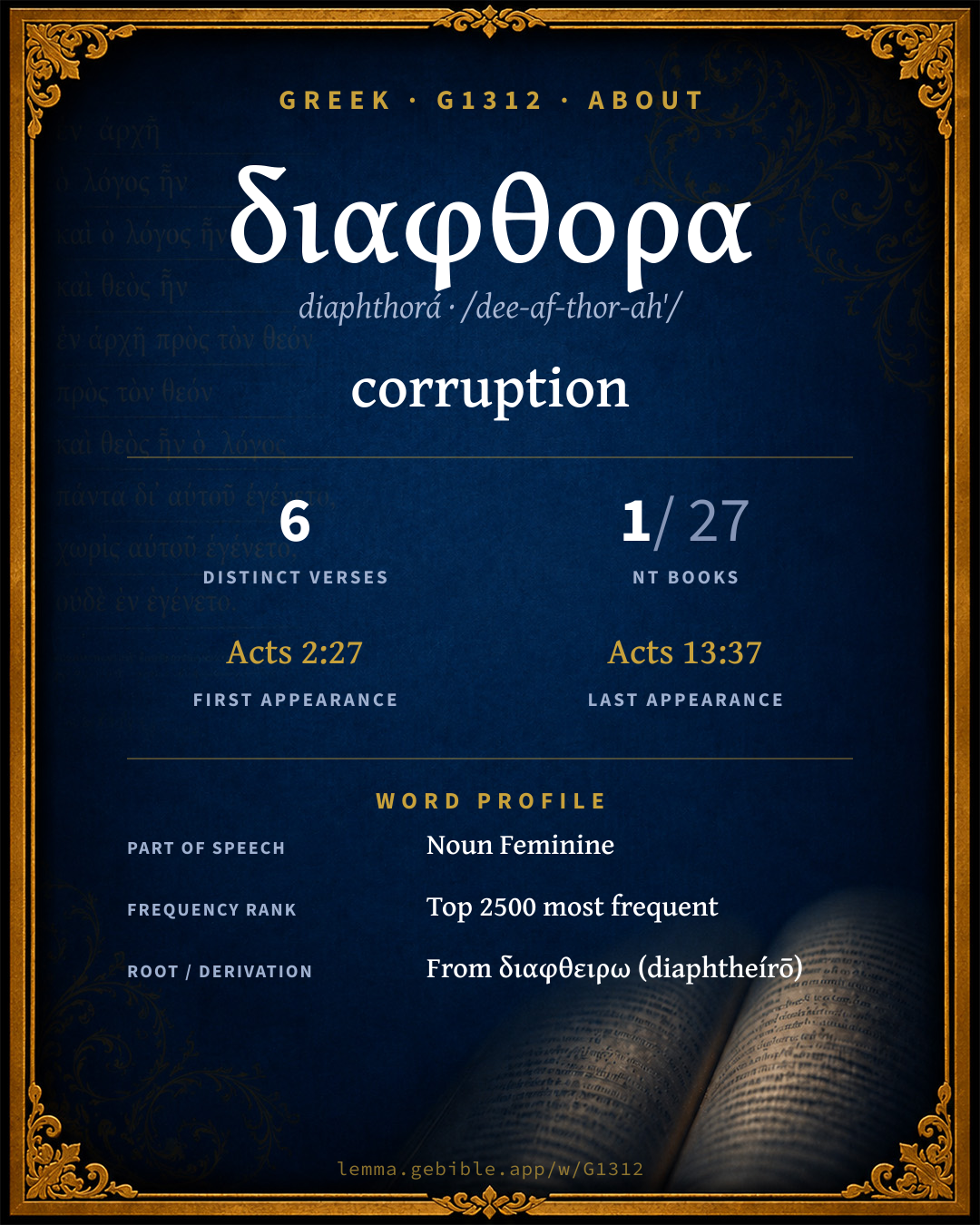
διαφθορά
corruption
‘corruption’ is one of 2 main senses fuller range ↓
Full lexicon entry — Thayer's Greek Lexicon
From Thayer's Greek Lexicon
Where this word appears
Grammar key — what these labels mean
Part of speech
- Noun
- A naming word — a person, place, thing, or idea.
Case
- Accusative
- The case of the direct object and of extent.
Gender
- Feminine
- Grammatically feminine.
Number
- Singular
- One.
Every verse where G1312 appears — 6 distinct verses across 1 book. Click any verse to open its interlinear word-by-word view. Verse text shown in the World English Bible for context — . Each verse’s Greek form is shown with its reference; the English is not keyword-highlighted, since the data carries no word-level English alignment. Use “Compare translations” on any verse to read it across multiple English versions. This concordance covers the Greek New Testament; Septuagint (Greek Old Testament) occurrences of this word are not indexed here.
Acts 6 verses
- Acts 2:27 διαφθοράν n acc sg fem Because you will not leave my soul in Hades, Neither will you allow your Holy One to see decay.
- Acts 2:31 διαφθοράν n acc sg fem he foreseeing this spoke about the resurrection of the Christ, that neither was his soul left in Hades, nor did his flesh see decay.
- Acts 13:34 διαφθοράν n acc sg fem "Concerning that he raised him up from the dead, now no more to return to corruption, he has spoken thus: 'I will give you the holy and sure blessings of David.'
- Acts 13:35 διαφθοράν n acc sg fem Therefore he says also in another psalm, 'You will not allow your Holy One to see decay.'
- Acts 13:36 διαφθοράν n acc sg fem For David, after he had in his own generation served the counsel of God, fell asleep, and was laid with his fathers, and saw decay.
- Acts 13:37 διαφθοράν n acc sg fem But he whom God raised up saw no decay.
About this entry
At a glance — auto-summarized from this page’s data, not written by a person. Every figure links to its source below. This summary describes the numbers; it doesn’t interpret them.
διαφθορα — transliterated diaphthorá — is a Greek noun carrying the sense “corruption.” More than three-quarters of its appearances fall in Acts. It appears 6 verses across 1 book of the Greek New Testament, among its uncommon vocabulary. Its lexical range runs to 2 senses. Where the King James Version says “corruption,” newer translations reach for “decay” (Berean Standard Bible); the renderings breakdown has the detail. Each statement above links to its evidence; the full detail follows below.
Gloss history
Strong's 1890 vs modern scholarship
About this word
Strong's G1312 catalogs a Greek word from the Greek New Testament.
These counts are not copied from any lexicon or concordance. They are computed here, from the morphology-tagged Greek New Testament. What Lemma adds →
- 6
- distinct verses
- The word appears in 6 distinct verses.
- 1 / 27
- NT books
- The word appears in 1 of 27 New Testament books.
- #1,476
- by frequency
- Top 2500 most frequent Greek words (rank 1,476 of 5,347 Greek words by occurrence).
View all 6 occurrences in the concordance →
Most concentrated in
- Acts 6 verses 100%
By section of the New Testament
By traditional corpus
Conventional, traditional groupings — biblical authorship is debated, so this is a traditional corpus grouping, not an authorship claim. Some books belong to more than one corpus (Luke is in both the Gospels and the Lukan corpus, and so on), so these shares overlap and need not total 100%. Each figure is a share of the word’s 6 distinct verses.
- Lukan (Luke–Acts) 6 verses · 100%
How translations render this word
Counts come from each version’s own published word-to-Strong’s tagging or interlinear alignment — an approximate guide to how each version renders this word, not a word-level alignment the data otherwise carries. Because each total is that version’s own tagged count, the per-version totals vary from one another and need not match the appearance or distinct-verse counts above. These counts may also differ from a printed concordance because Lemma counts each distinctly tagged rendering and does not collapse phrase taggings into a single head-word total. This is a fixed set of word-tagged versions (KJV, ASV, BSB, ULT) and does not change with the reading translation you choose elsewhere. Each version’s license is shown beside its name below (and on Sources).
- King James Version: Corruption 6×
- American Standard Version: Corruption 5×
- Berean Standard Bible: Decay 6×
- unfoldingWord Literal Text: Decay 6×
King James Version Public Domain
Renders G1312 across 6 tagged occurrences — most commonly:
American Standard Version Public Domain
Renders G1312 across 5 tagged occurrences — most commonly:
Berean Standard Bible Public Domain
Renders G1312 across 6 tagged occurrences — most commonly:
unfoldingWord Literal Text CC BY-SA 4.0
Renders G1312 across 6 tagged occurrences — most commonly:
Senses in Thayer's
The 2 senses Thayer's distinguishes for this word, in lexicon order (not ranked by frequency or importance). The full entry — with sub-senses — is in the Lexicon Entry tab.
- corruption, destruction
- in the NT that destruction which is effected by the decay of the body after death
Word origin
Derived from διαφθειρω (diaphtheírō) (G1311) — to corrupt.
From G1311 ; decay : - corruption.
— Strong’s Exhaustive Concordance (1890), public domain.
Septuagint usage
The same Greek word διαφθορα appears 19 times in the Greek Old Testament (Septuagint), across 19 verses in 8 books.
- 19
- LXX occurrences
- Tagged occurrences of this Greek word in the Septuagint.
- 19
- verses
- Distinct Septuagint verses containing this word.
- 8 / 39
- OT books
- The word appears in 8 of the 39 Old Testament books.
Sample Septuagint occurrences
- Job 33:28 διαφθορά
- Psalms 9:16 διαφθορά
- Proverbs 28:10 διαφθορά
- Jeremiah 13:14 διαφθορά
- Lamentations 4:20 διαφθορά
- Ezekiel 19:4 διαφθορά
- Hosea 11:4 διαφθορά
- Zephaniah 3:6 διαφθορά
Septuagint occurrences (same lexeme)
Every verse where the same Strong’s number (G1312) appears in the Greek Septuagint. Verse text shown in the World English Bible for context; the Greek form is the matched word — the English is not keyword-highlighted.
- Job 33:28 διαφθορά He has redeemed my soul from going into the pit, My life shall see the light.'
- Psalms 9:16 διαφθορά Yahweh has made himself known. He has executed judgment. The wicked is snared by the work of his own hands. Meditation. Selah.
- Psalms 15:10 διαφθορά
- Psalms 29:10 διαφθορά Yahweh sat enthroned at the Flood. Yes, Yahweh sits as King forever.
- Psalms 34:7 διαφθορά The angel of Yahweh encamps round about those who fear him, And delivers them.
- Psalms 54:24 διαφθορά
- Psalms 106:20 διαφθορά Thus they exchanged their glory For an image of a bull that eats grass.
- Psalms 139:12 διαφθορά Even the darkness doesn't hide from you, But the night shines as the day. The darkness is like light to you.
- Proverbs 28:10 διαφθορά Whoever causes the upright to go astray in an evil way, He will fall into his own trap; But the blameless will inherit good.
- Jeremiah 13:14 διαφθορά I will dash them one against another, even the fathers and the sons together, says Yahweh: I will not pity, nor spare, nor have compassion, that I should not destroy them.
- Jeremiah 15:3 διαφθορά I will appoint over them four kinds, says Yahweh: the sword to kill, and the dogs to tear, and the birds of the sky, and the animals of the earth, to devour and to destroy.
- Jeremiah 28:8 διαφθορά The prophets who have been before me and before you of old prophesied against many countries, and against great kingdoms, of war, and of evil, and of pestilence.
- Lamentations 4:20 διαφθορά The breath of our nostrils, the anointed of Yahweh, was taken in their pits; Of whom we said, Under his shadow we shall live among the nations.
- Ezekiel 19:4 διαφθορά The nations also heard of him; he was taken in their pit; and they brought him with hooks to the land of Egypt.
- Ezekiel 19:8 διαφθορά Then the nations set against him on every side from the provinces; and they spread their net over him; he was taken in their pit.
- Ezekiel 21:36 διαφθορά
- Hosea 11:4 διαφθορά I drew them with cords of a man, with ties of love; And I was to them like those who lift up the yoke on their necks; And I bent down to him and I fed him.
- Hosea 13:9 διαφθορά You are destroyed, Israel, because you are against me, Against your help.
- Zephaniah 3:6 διαφθορά I have cut off nations. Their battlements are desolate. I have made their streets waste, so that no one passes by. Their cities are destroyed, so that there is no man, so that there is no inhabitant.
These are occurrences of the same Greek lexeme (G1312) in the Septuagint — not a translation of any one Hebrew word. The store carries no word-level Hebrew↔Greek alignment, so no Hebrew original is asserted here. Counts come from the recovered LXX Strong's tagging — high-frequency vocabulary is well covered, while rare or late forms may be untagged — so they reflect tagged occurrences and may slightly undercount.