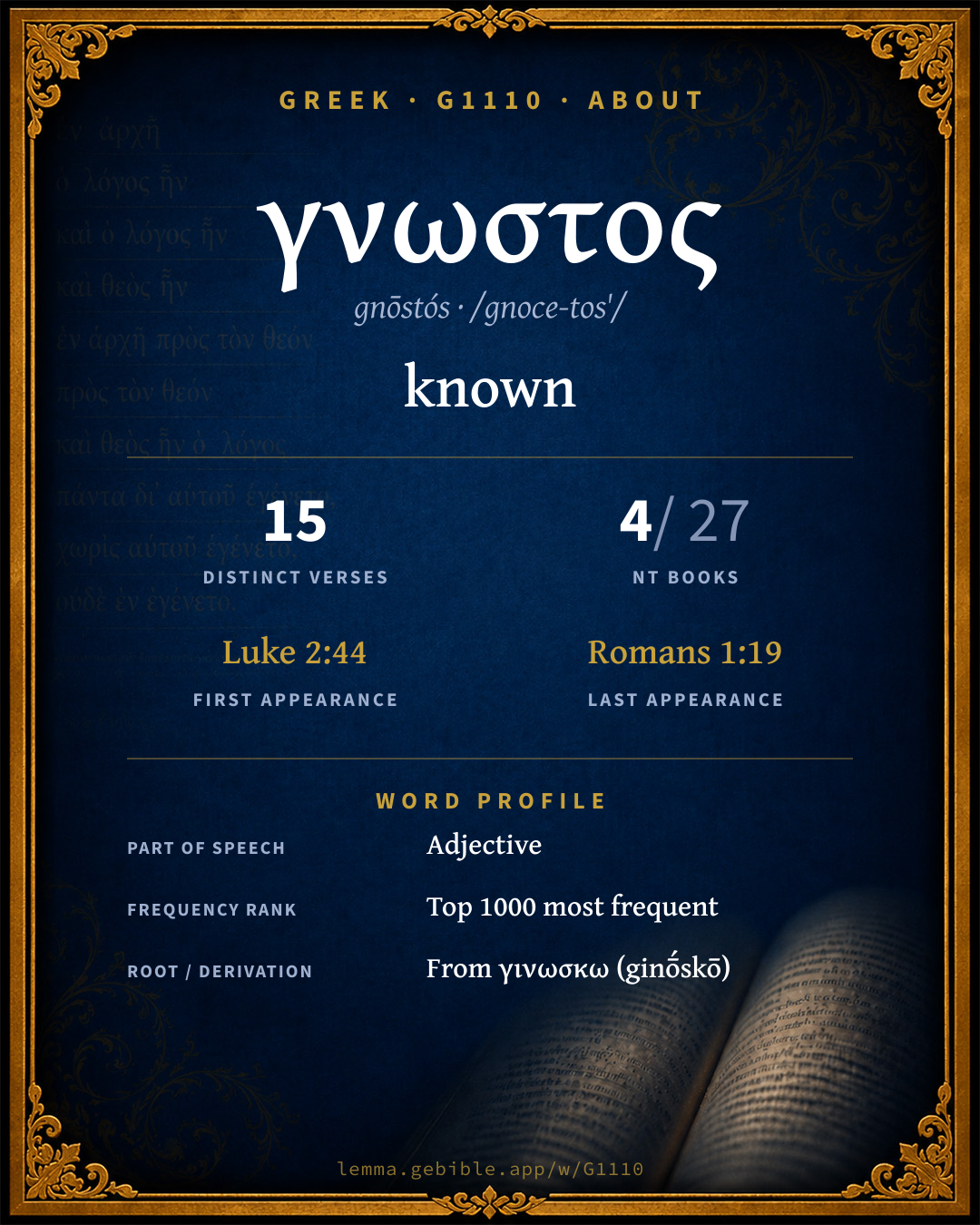
γνωστός
known
Full lexicon entry — Thayer's Greek Lexicon
From Thayer's Greek Lexicon
Where this word appears
See every Nominative-case word in the Greek New Testament →
Grammar key — what these labels mean
Part of speech
- Adjective
- A word that describes or qualifies a noun.
Case
- Nominative
- The case of the subject (and the predicate nominative).
- Accusative
- The case of the direct object and of extent.
- Dative
- The case of the indirect object, means, or location — “to / for / with / in.”
Gender
- Neuter
- Grammatically neuter.
- Masculine
- Grammatically masculine.
Number
- Singular
- One.
- Plural
- More than one.
Every verse where G1110 appears in the Book of Acts — 10 distinct verses. Click any verse to open its interlinear word-by-word view. Verse text shown in the World English Bible for context — . Each verse’s Greek form is shown with its reference; the English is not keyword-highlighted, since the data carries no word-level English alignment. Use “Compare translations” on any verse to read it across multiple English versions. This concordance covers the Greek New Testament; Septuagint (Greek Old Testament) occurrences of this word are not indexed here.
Acts
- Acts 1:19 γνωστὸν adj nom sg neut It became known to everyone who lived in Jerusalem that in their language that field was called 'Akeldama,' that is, 'The field of blood.'
- Acts 2:14 γνωστὸν adj nom sg neut But Peter, standing up with the eleven, lifted up his voice, and spoke out to them, "You men of Judea, and all you who dwell at Jerusalem, let this be known to you, and listen to my words.
- Acts 4:10 γνωστὸν adj nom sg neut be it known to you all, and to all the people of Israel, that in the name of Jesus Christ of Nazareth, whom you crucified, whom God raised from the dead, in him does this man stand here before you whole.
- Acts 4:16 γνωστὸν adj nom sg neut saying, "What shall we do to these men? Because indeed a notable miracle has been done through them, as can be plainly seen by all who dwell in Jerusalem, and we can't deny it.
- Acts 9:42 γνωστὸν adj nom sg neut And it became known throughout all Joppa, and many believed in the Lord.
- Acts 13:38 γνωστὸν adj nom sg neut Be it known to you therefore, brothers, that through this man is proclaimed to you remission of sins,
- Acts 15:18 γνωστὰ adj acc pl neut All his works are known to God from eternity.'
- Acts 19:17 γνωστὸν adj nom sg neut This became known to all, both Jews and Greeks, who lived at Ephesus. Fear fell on them all, and the name of the Lord Jesus was magnified.
- Acts 28:22 γνωστὸν adj nom sg neut But we desire to hear from you what you think. For, as concerning this sect, it is known to us that everywhere it is spoken against."
- Acts 28:28 γνωστὸν adj nom sg neut "Be it known therefore to you, that the salvation of God is sent to the Gentiles. They will also listen."
About this entry
At a glance — auto-summarized from this page’s data, not written by a person. Every figure links to its source below. This summary describes the numbers; it doesn’t interpret them.
At its core, γνωστος (gnōstós) means “known.” Its uses cluster heavily in Acts (67% of all occurrences). Spanning 15 verses in 4 books, it ranks among the uncommon words of the Greek New Testament. It first appears in Luke 2:44. Sharing its root, it stands alongside γινωσκω, γνωμη and γνωριζω. Each statement above links to its evidence; the full detail follows below.
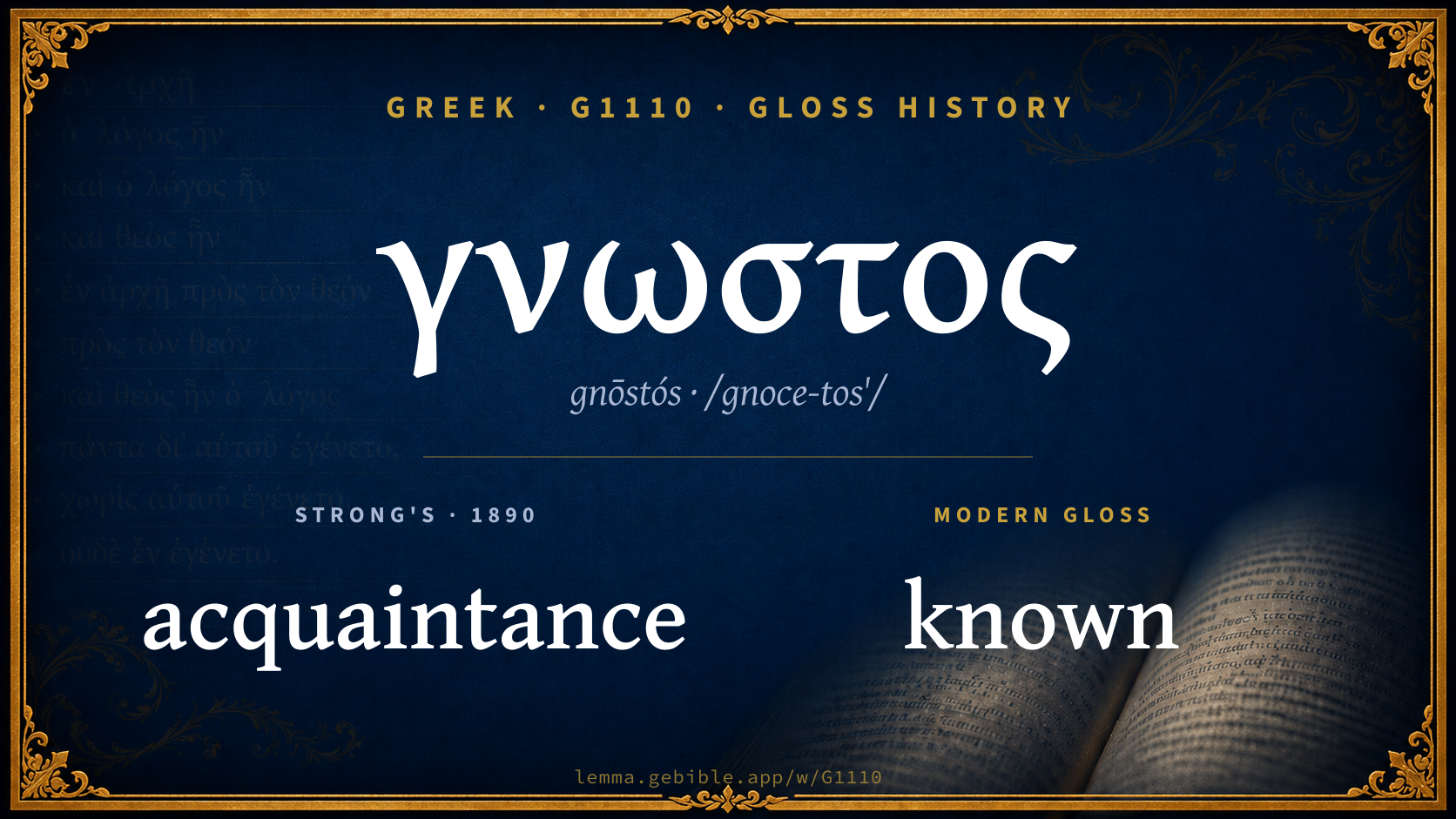
Gloss history
Strong's 1890 vs modern scholarship
About this word
Strong's G1110 catalogs a Greek word from the Greek New Testament.
These counts are not copied from any lexicon or concordance. They are computed here, from the morphology-tagged Greek New Testament. What Lemma adds →
- 15
- distinct verses
- The word appears in 15 distinct verses.
- 4 / 27
- NT books
- The word appears in 4 of 27 New Testament books.
- #768
- by frequency
- Top 1000 most frequent Greek words (rank 768 of 5,347 Greek words by occurrence).
View all 15 occurrences in the concordance →
By section of the New Testament
By traditional corpus
Conventional, traditional groupings — biblical authorship is debated, so this is a traditional corpus grouping, not an authorship claim. Some books belong to more than one corpus (Luke is in both the Gospels and the Lukan corpus, and so on), so these shares overlap and need not total 100%. Each figure is a share of the word’s 15 distinct verses.
- Lukan (Luke–Acts) 12 verses · 80%
- Gospels 4 verses · 27%
- Johannine 2 verses · 13%
- Pauline corpus 1 verse · 7%
How translations render this word
Counts come from each version’s own published word-to-Strong’s tagging or interlinear alignment — an approximate guide to how each version renders this word, not a word-level alignment the data otherwise carries. Because each total is that version’s own tagged count, the per-version totals vary from one another and need not match the appearance or distinct-verse counts above. These counts may also differ from a printed concordance because Lemma counts each distinctly tagged rendering and does not collapse phrase taggings into a single head-word total. This is a fixed set of word-tagged versions (KJV, ASV, BSB, ULT) and does not change with the reading translation you choose elsewhere. Each version’s license is shown beside its name below (and on Sources).
- King James Version: Known 10×, Acquaintance 2×
- American Standard Version: Known 10×, Acquaintance 2×, Is known 2×
- Berean Standard Bible: Known 9×
- unfoldingWord Literal Text: Known 12×
King James Version Public Domain
Renders G1110 across 14 tagged occurrences — most commonly:
Plus 2 renderings that appear only once — usually multi-word phrases or single function words the recovered tagging swept in, not distinct renderings. Not rendered by a distinct English word in 1 further occurrence.
American Standard Version Public Domain
Renders G1110 across 15 tagged occurrences — most commonly:
Plus 1 rendering that appears only once — usually multi-word phrases or single function words the recovered tagging swept in, not distinct renderings.
Berean Standard Bible Public Domain
Renders G1110 across 15 tagged occurrences — most commonly:
Plus 6 renderings that appear only once — usually multi-word phrases or single function words the recovered tagging swept in, not distinct renderings.
unfoldingWord Literal Text CC BY-SA 4.0
Renders G1110 across 15 tagged occurrences — most commonly:
Plus 3 renderings that appear only once — usually multi-word phrases or single function words the recovered tagging swept in, not distinct renderings.
Senses in Thayer's
The 1 sense Thayer's distinguishes for this word, in lexicon order (not ranked by frequency or importance). The full entry — with sub-senses — is in the Lexicon Entry tab.
- known, notable
Word origin
Derived from γινωσκω (ginṓskō) (G1097) — to know.
From G1097 ; well known : - acquaintance (which may be) known notable.
— Strong’s Exhaustive Concordance (1890), public domain.
Forms in the corpus
The 5 distinct written forms G1110 takes in the Greek New Testament, most frequent first — each parse links to that case’s occurrences in the concordance.
| Form | Parsing | Example | Uses |
|---|---|---|---|
| γνωστὸν gnōstòn | Adjective, Nominative, Singular, Neuter | Acts 1:19 | 10 |
| γνωστὸς gnōstòs | Adjective, Nominative, Singular, Masculine | John 18:15 | 2 |
| γνωστοὶ gnōstoì | Adjective, Nominative, Plural, Masculine | Luke 23:49 | 1 |
| γνωστοῖς gnōstoîs | Adjective, Dative, Plural, Masculine | Luke 2:44 | 1 |
| γνωστὰ gnōstà | Adjective, Accusative, Plural, Neuter | Acts 15:18 | 1 |
Same root — word family
Other Thayer's entries built from the same root as G1110, grouped by Strong’s listed origin. These share a root / origin per the lexicon — not necessarily a shared meaning. Each links to that word’s own entry.
Derives from
Shares the same root
- γνωμη gnṓmē G1106 mind
- γνωριζω gnōrízō G1107 to make known
- γνωσις gnōsis G1108 knowledge
- γνωστης gnṓstēs G1109 expert
- νους noûs G3563 mind
- ονομα ónoma G3686 name
Compare all same-root words → Showing 4 of 8 — not the complete family. They share a root, not necessarily a meaning.
Septuagint usage
The same Greek word γνωστος appears 15 times in the Greek Old Testament (Septuagint), across 15 verses in 8 books.
- 15
- LXX occurrences
- Tagged occurrences of this Greek word in the Septuagint.
- 15
- verses
- Distinct Septuagint verses containing this word.
- 8 / 39
- OT books
- The word appears in 8 of the 39 Old Testament books.
Sample Septuagint occurrences
- Genesis 2:9 γνωστός
- Exodus 33:16 γνωστός
- 2 Kings 10:11 γνωστός
- Ezra 4:12 γνωστός
- Psalms 30:12 γνωστός
- Isaiah 19:21 γνωστός
- Ezekiel 36:32 γνωστός
- Zechariah 14:7 γνωστός
Septuagint occurrences (same lexeme)
Every verse where the same Strong’s number (G1110) appears in the Greek Septuagint. Verse text shown in the World English Bible for context; the Greek form is the matched word — the English is not keyword-highlighted.
- Genesis 2:9 γνωστός Out of the ground Yahweh God made every tree to grow that is pleasant to the sight, and good for food; the tree of life also in the midst of the garden, and the tree of the knowledge of good and evil.
- Exodus 33:16 γνωστός For how would people know that I have found favor in your sight, I and your people? Isn't it in that you go with us, so that we are separated, I and your people, from all the people who are on the surface of the earth?"
- 2 Kings 10:11 γνωστός So Jehu struck all that remained of the house of Ahab in Jezreel, and all his great men, and his familiar friends, and his priests, until he left him none remaining.
- Ezra 4:12 γνωστός Be it known to the king, that the Jews who came up from you are come to us to Jerusalem; they are building the rebellious and the bad city, and have finished the walls, and repaired the foundations.
- Ezra 4:13 γνωστός Be it known now to the king that if this city is built, and the walls finished, they will not pay tribute, custom, or toll, and in the end it will be hurtful to the kings.
- Ezra 5:8 γνωστός Be it known to the king, that we went into the province of Judah, to the house of the great God, which is built with great stones, and timber is laid in the walls; and this work goes on with diligence and prospers in their hands.
- Ezra 15:10 γνωστός
- Psalms 30:12 γνωστός To the end that my heart may sing praise to you, and not be silent. Yahweh my God, I will give thanks to you forever!
- Psalms 54:14 γνωστός
- Psalms 75:2 γνωστός When I choose the appointed time, I will judge blamelessly.
- Psalms 87:9 γνωστός
- Psalms 87:19 γνωστός
- Isaiah 19:21 γνωστός Yahweh shall be known to Egypt, and the Egyptians shall know Yahweh in that day; yes, they shall worship with sacrifice and offering, and shall vow a vow to Yahweh, and shall perform it.
- Ezekiel 36:32 γνωστός Nor for your sake do I [this], says the Lord Yahweh, be it known to you: be ashamed and confounded for your ways, house of Israel.
- Zechariah 14:7 γνωστός It will be a unique day which is known to Yahweh; not day, and not night; but it will come to pass, that at evening time there will be light.
These are occurrences of the same Greek lexeme (G1110) in the Septuagint — not a translation of any one Hebrew word. The store carries no word-level Hebrew↔Greek alignment, so no Hebrew original is asserted here. Counts come from the recovered LXX Strong's tagging — high-frequency vocabulary is well covered, while rare or late forms may be untagged — so they reflect tagged occurrences and may slightly undercount.