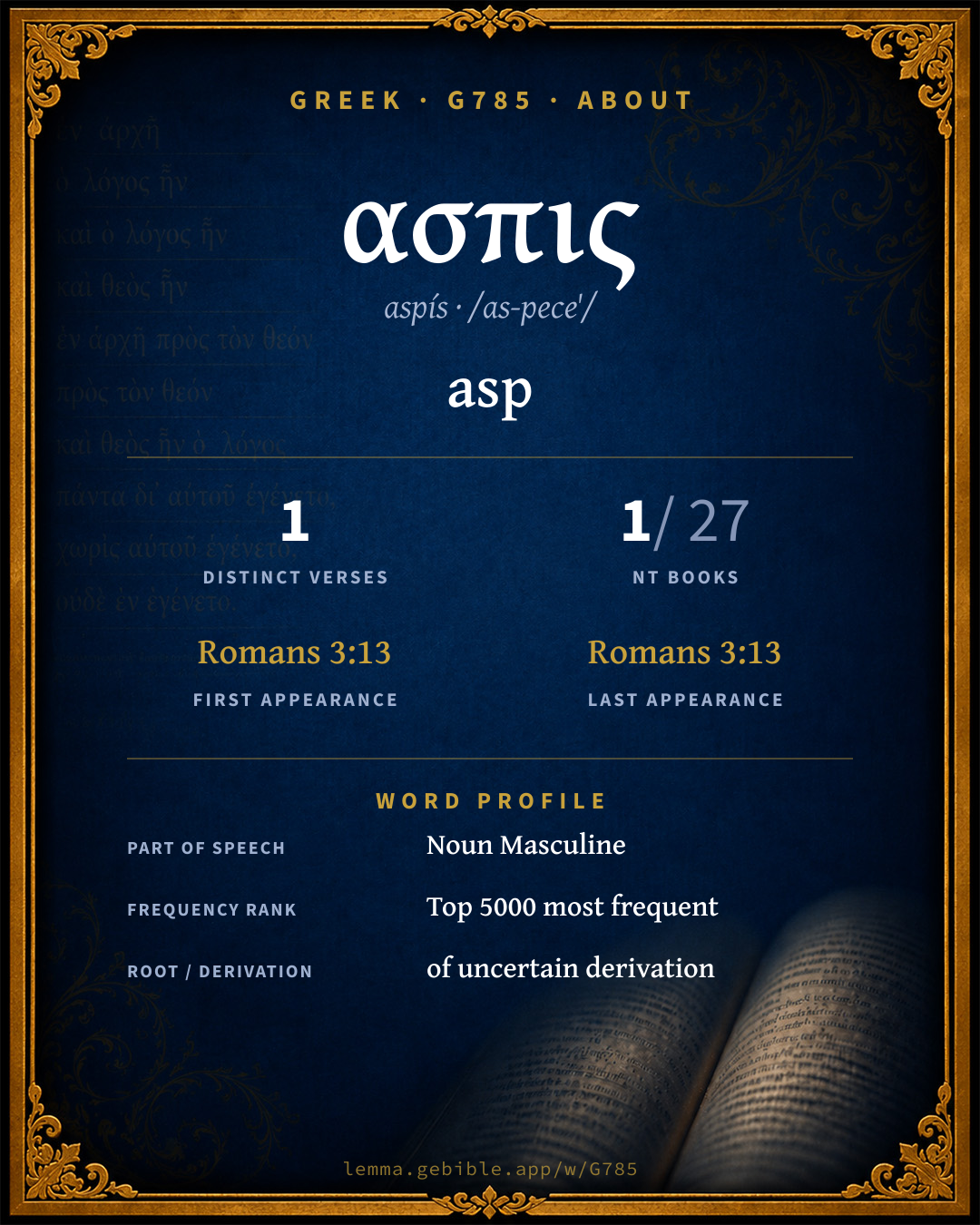
ἀσπίς
asp
Full lexicon entry — Thayer's Greek Lexicon
From Thayer's Greek Lexicon
Where this word appears
Grammar key — what these labels mean
Part of speech
- Noun
- A naming word — a person, place, thing, or idea.
Case
- Genitive
- The case of source, possession, or “of” — answers “whose / from what.”
Gender
- Feminine
- Grammatically feminine.
Number
- Plural
- More than one.
Every verse where G785 appears — 1 distinct verse across 1 book. Click any verse to open its interlinear word-by-word view. Verse text shown in the World English Bible for context — . Each verse’s Greek form is shown with its reference; the English is not keyword-highlighted, since the data carries no word-level English alignment. Use “Compare translations” on any verse to read it across multiple English versions. This concordance covers the Greek New Testament; Septuagint (Greek Old Testament) occurrences of this word are not indexed here.
Romans 1 verse
About this entry
At a glance — auto-summarized from this page’s data, not written by a person. Every figure links to its source below. This summary describes the numbers; it doesn’t interpret them.
At its core, ασπις (aspís) means “asp.” The Greek New Testament uses it only 1 verse. The word gravitates to Romans (100%). Its lone occurrence is Romans 3:13. Dig into 1-verse concordance and the renderings breakdown below.
Gloss history
Strong's 1890 vs modern scholarship
About this word
Strong's G785 catalogs a Greek word from the Greek New Testament.
These counts are not copied from any lexicon or concordance. They are computed here, from the morphology-tagged Greek New Testament. What Lemma adds →
- 1
- distinct verses
- The word appears in 1 distinct verse.
- 1 / 27
- NT books
- The word appears in 1 of 27 New Testament books.
- #3,503
- by frequency
- Top 5000 most frequent Greek words (rank 3,503 of 5,347 Greek words by occurrence).
View all 1 occurrence in the concordance →
Most concentrated in
- Romans 1 verse 100%
By section of the New Testament
By traditional corpus
Conventional, traditional groupings — biblical authorship is debated, so this is a traditional corpus grouping, not an authorship claim. Some books belong to more than one corpus (Luke is in both the Gospels and the Lukan corpus, and so on), so these shares overlap and need not total 100%. Each figure is a share of the word’s 1 distinct verse.
- Pauline corpus 1 verse · 100%
How translations render this word
Counts come from each version’s own published word-to-Strong’s tagging or interlinear alignment — an approximate guide to how each version renders this word, not a word-level alignment the data otherwise carries. Because each total is that version’s own tagged count, the per-version totals vary from one another and need not match the appearance or distinct-verse counts above. These counts may also differ from a printed concordance because Lemma counts each distinctly tagged rendering and does not collapse phrase taggings into a single head-word total. This is a fixed set of word-tagged versions (KJV, ASV, BSB, ULT) and does not change with the reading translation you choose elsewhere. Each version’s license is shown beside its name below (and on Sources).
- King James Version: Asps 1×
- American Standard Version: Asps 1×
- Berean Standard Bible: Vipers 1×
- unfoldingWord Literal Text: Asps 1×
King James Version Public Domain
Renders G785 across 1 tagged occurrence — most commonly:
American Standard Version Public Domain
Renders G785 across 1 tagged occurrence — most commonly:
Berean Standard Bible Public Domain
Renders G785 across 1 tagged occurrence — most commonly:
unfoldingWord Literal Text CC BY-SA 4.0
Renders G785 across 1 tagged occurrence — most commonly:
Senses in Thayer's
The 1 sense Thayer's distinguishes for this word, in lexicon order (not ranked by frequency or importance). The full entry — with sub-senses — is in the Lexicon Entry tab.
- an asp, a small and most venomous serpent, the bite of which is fatal unless the bitten part be immediately cut away
Word origin
Origin: of uncertain derivation
Of uncertain derivation; a buckler (or round shield); used of a serpent (as coiling itself) probably the asp : - asp.
— Strong’s Exhaustive Concordance (1890), public domain.
Septuagint usage
The same Greek word ασπις appears 20 times in the Greek Old Testament (Septuagint), across 17 verses in 8 books.
- 20
- LXX occurrences
- Tagged occurrences of this Greek word in the Septuagint.
- 17
- verses
- Distinct Septuagint verses containing this word.
- 8 / 39
- OT books
- The word appears in 8 of the 39 Old Testament books.
Sample Septuagint occurrences
- Deuteronomy 32:33 ἀσπίς
- 1 Samuel 17:6 ἀσπίς
- 1 Chronicles 5:18 ἀσπίς
- 2 Chronicles 9:16 ἀσπίς
- Job 15:26 ἀσπίς
- Psalms 13:3 ἀσπίς
- Isaiah 11:8 ἀσπίς
- Jeremiah 26:3 ἀσπίς
Septuagint occurrences (same lexeme)
Every verse where the same Strong’s number (G785) appears in the Greek Septuagint. Verse text shown in the World English Bible for context; the Greek form is the matched word — the English is not keyword-highlighted.
- Deuteronomy 32:33 ἀσπίς Their wine is the poison of serpents, The cruel venom of asps.
- 1 Samuel 17:6 ἀσπίς He had brass shin-armor on his legs, and a javelin of brass between his shoulders.
- 1 Samuel 17:25 ἀσπίς The men of Israel said, Have you seen this man who is come up? surely to defy Israel is he come up: and it shall be, that the man who kills him, the king will enrich him with great riches, and will give him his daughter, and make his father's house free in Israel.
- 1 Chronicles 5:18 ἀσπίς The sons of Reuben, and the Gadites, and the half-tribe of Manasseh, of valiant men, men able to bear buckler and sword, and to shoot with bow, and skillful in war, were forty-four thousand seven hundred and sixty, that were able to go forth to war.
- 2 Chronicles 9:16 ἀσπίς [he made] three hundred shields of beaten gold; three hundred [shekels] of gold went to one shield: and the king put them in the house of the forest of Lebanon.
- Job 15:26 ἀσπίς He runs at him with a stiff neck, With the thick shields of his bucklers;
- Job 20:14 ἀσπίς Yet his food in his bowels is turned. It is cobra venom within him.
- Job 41:7 ἀσπίς Can you fill his skin with barbed irons, Or his head with fish-spears?
- Psalms 13:3 ἀσπίς Behold, and answer me, Yahweh, my God. Give light to my eyes, lest I sleep in death;
- Psalms 57:5 ἀσπίς Be exalted, God, above the heavens! Let your glory be above all the earth!
- Psalms 90:13 ἀσπίς Relent, Yahweh! How long? Have compassion on your servants!
- Psalms 139:4 ἀσπίς For there is not a word on my tongue, But, behold, Yahweh, you know it altogether.
- Isaiah 11:8 ἀσπίς The sucking child shall play on the hole of the asp, and the weaned child shall put his hand on the adder's den.
- Isaiah 14:29 ἀσπίς Don't rejoice, O Philistia, all of you, because the rod that struck you is broken; for out of the serpent's root shall come forth an adder, and his fruit shall be a fiery flying serpent.
- Isaiah 30:6 ἀσπίς The burden of the animals of the South. Through the land of trouble and anguish, from whence come the lioness and the lion, the viper and fiery flying serpent, they carry their riches on the shoulders of young donkeys, and their treasures on the humps of camels, to a people that shall not profit [them].
- Isaiah 59:5 ἀσπίς They hatch adders' eggs, and weave the spider's web: he who eats of their eggs dies; and that which is crushed breaks out into a viper.
- Jeremiah 26:3 ἀσπίς It may be they will listen, and turn every man from his evil way; that I may repent me of the evil which I purpose to do to them because of the evil of their doings.
These are occurrences of the same Greek lexeme (G785) in the Septuagint — not a translation of any one Hebrew word. The store carries no word-level Hebrew↔Greek alignment, so no Hebrew original is asserted here. Counts come from the recovered LXX Strong's tagging — high-frequency vocabulary is well covered, while rare or late forms may be untagged — so they reflect tagged occurrences and may slightly undercount.