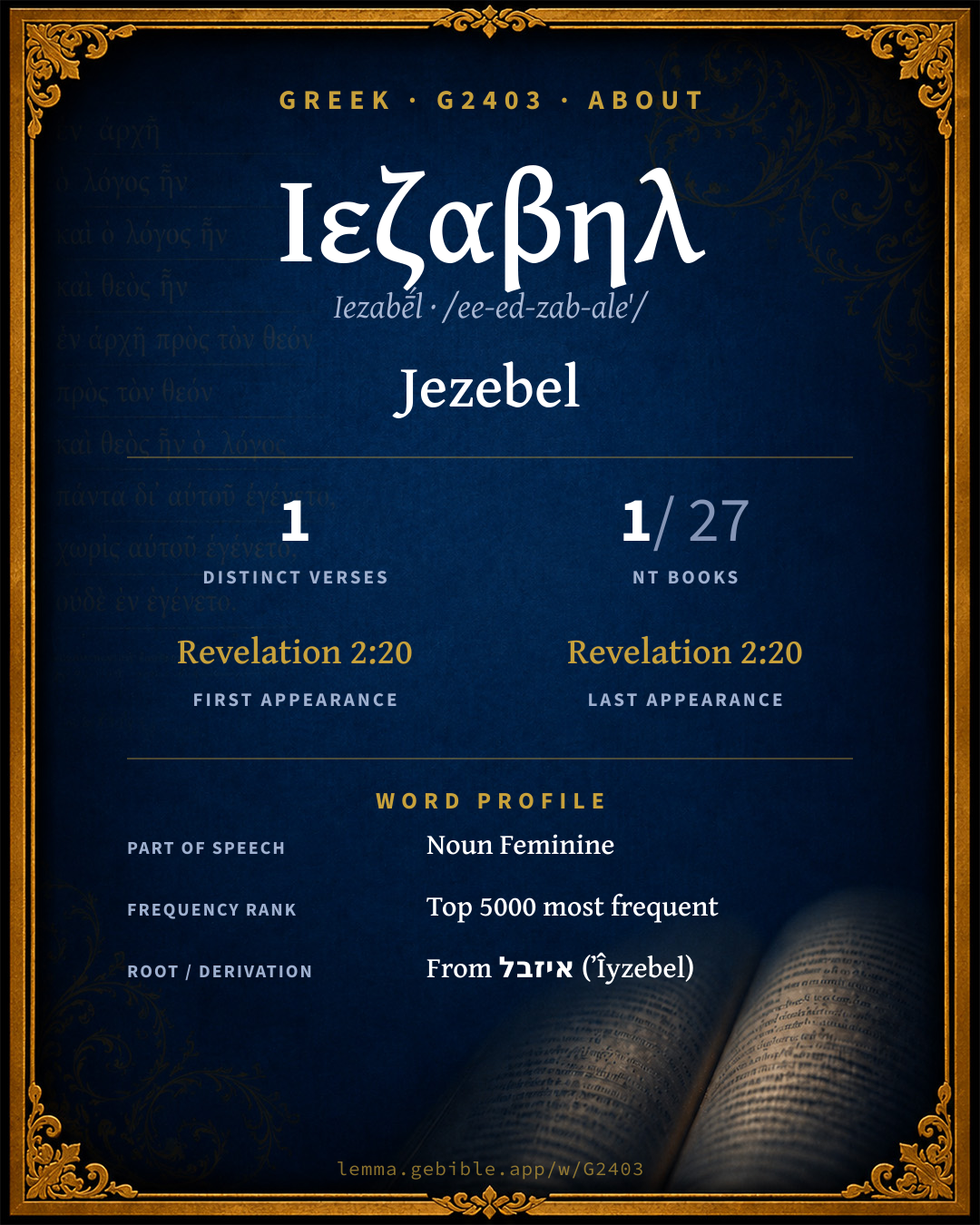
Ἰεζαβήλ
Jezebel
Thayer's lists 3 entries for ‘Jezebel’ fuller range ↓
Full lexicon entry — Thayer's Greek Lexicon
From Thayer's Greek Lexicon
Where this word appears
Every verse where G2403 appears — 1 distinct verse across 1 book. Click any verse to open its interlinear word-by-word view. Verse text shown in the World English Bible for context — . Each verse’s Greek form is shown with its reference; the English is not keyword-highlighted, since the data carries no word-level English alignment. Use “Compare translations” on any verse to read it across multiple English versions. This concordance covers the Greek New Testament; Septuagint (Greek Old Testament) occurrences of this word are not indexed here.
Revelation 1 verse
About this entry
At a glance — auto-summarized from this page’s data, not written by a person. Every figure links to its source below. This summary describes the numbers; it doesn’t interpret them.
“Jezebel” is the headline sense of the Greek name Ιεζαβηλ (Iezabḗl). It is rare — just 1 verse in the entire Greek New Testament. It clusters heavily in Revelation, which alone accounts for 100% of its uses. Its lone occurrence is Revelation 2:20. See 1-verse concordance and the renderings breakdown below.
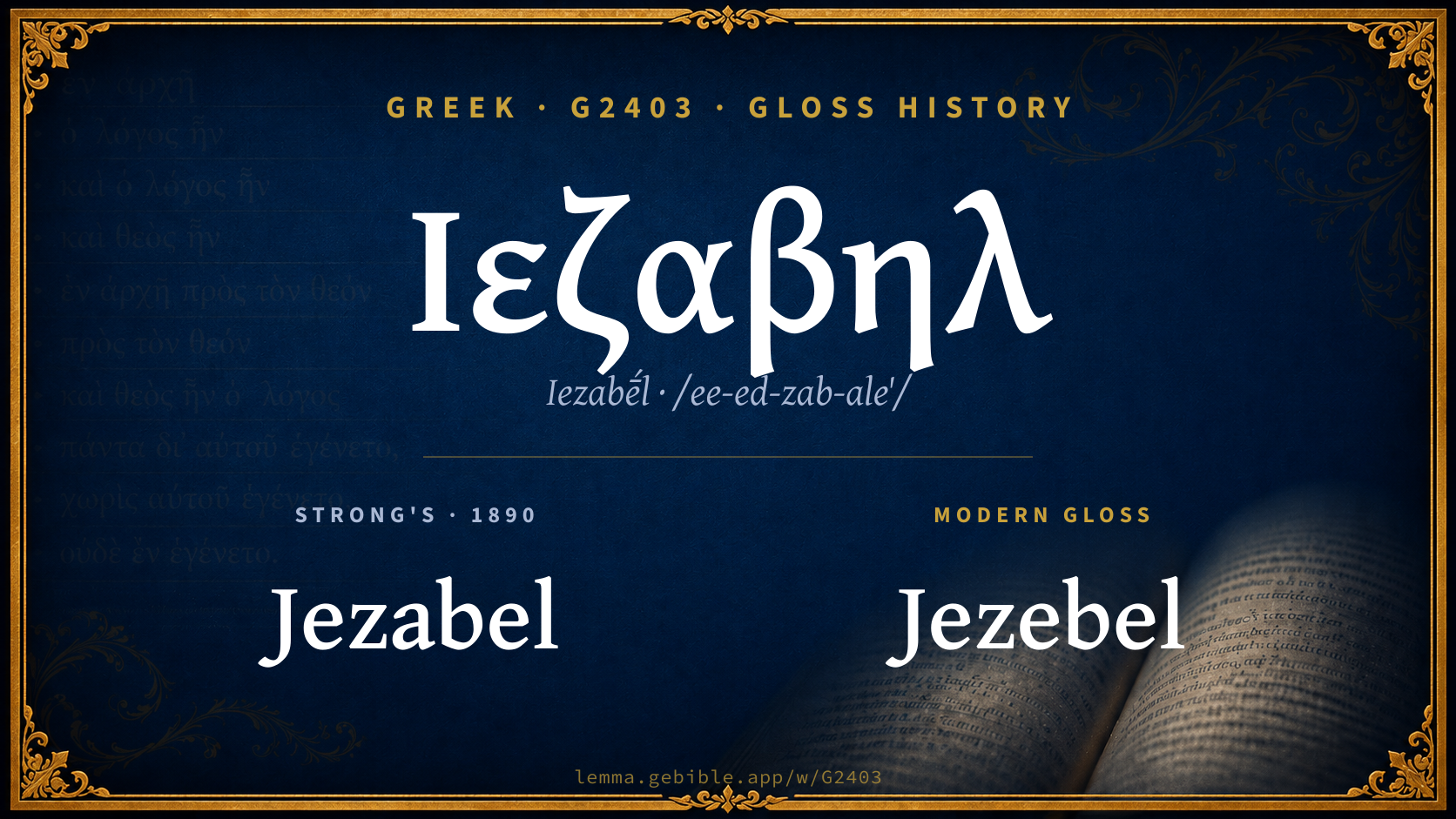
Gloss history
Strong's 1890 vs modern scholarship
About this word
Strong's G2403 catalogs a Greek word from the Greek New Testament.
These counts are not copied from any lexicon or concordance. They are computed here, from the morphology-tagged Greek New Testament. What Lemma adds →
- 1
- distinct verses
- The word appears in 1 distinct verse.
- 1 / 27
- NT books
- The word appears in 1 of 27 New Testament books.
- #3,503
- by frequency
- Top 5000 most frequent Greek words (rank 3,503 of 5,347 Greek words by occurrence).
View all 1 occurrence in the concordance →
Most concentrated in
- Revelation 1 verse 100%
By section of the New Testament
By traditional corpus
Conventional, traditional groupings — biblical authorship is debated, so this is a traditional corpus grouping, not an authorship claim. Some books belong to more than one corpus (Luke is in both the Gospels and the Lukan corpus, and so on), so these shares overlap and need not total 100%. Each figure is a share of the word’s 1 distinct verse.
- Johannine 1 verse · 100%
- Revelation 1 verse · 100%
How translations render this word
Counts come from each version’s own published word-to-Strong’s tagging or interlinear alignment — an approximate guide to how each version renders this word, not a word-level alignment the data otherwise carries. Because each total is that version’s own tagged count, the per-version totals vary from one another and need not match the appearance or distinct-verse counts above. These counts may also differ from a printed concordance because Lemma counts each distinctly tagged rendering and does not collapse phrase taggings into a single head-word total. This is a fixed set of word-tagged versions (KJV, ASV, BSB, ULT) and does not change with the reading translation you choose elsewhere. Each version’s license is shown beside its name below (and on Sources).
- King James Version: Jezebel 1×
- American Standard Version: Jezebel 1×
- Berean Standard Bible: Jezebel 1×
- unfoldingWord Literal Text: Jezebel 1×
King James Version Public Domain
Renders G2403 across 1 tagged occurrence — most commonly:
American Standard Version Public Domain
Renders G2403 across 1 tagged occurrence — most commonly:
Berean Standard Bible Public Domain
Renders G2403 across 1 tagged occurrence — most commonly:
unfoldingWord Literal Text CC BY-SA 4.0
Renders G2403 across 1 tagged occurrence — most commonly:
Senses in Thayer's
The 3 senses Thayer's distinguishes for this word, in lexicon order (not ranked by frequency or importance). The full entry — with sub-senses — is in the Lexicon Entry tab.
- Jezebel = "chaste"
- wife of Ahab, an impious and cruel queen who protected idolatry and persecuted the prophets
- the symbolic name of a woman who pretended to be a prophetess…
Word origin
Derived from איזבל (ʼÎyzebel) (H348) — Jezebel.
Of hebrew origin [ H348 ]; Jezabel (that is Jezebel ) a Tyrian woman (used as a synonym of a termagant or false teacher): - Jezabel.
— Strong’s Exhaustive Concordance (1890), public domain.
Bible dictionary
Public-domain dictionary articles matched to this entry by name (Jezebel). A biblical name can be shared by more than one person or place, so an article may treat several.
Easton's Bible Dictionary · M. G. Easton, 1897
Chaste, the daughter of Ethbaal, the king of the Zidonians, and the wife of Ahab, the king of Israel (1 Kings 16:31). This was the "first time that a king of Israel had allied himself by marriage with a heathen princess; and the alliance was in this case of a peculiarly disastrous kind. Jezebel has stamped her name on history as the representative of all that is designing, crafty, malicious, revengeful, and cruel. She is the first great instigator of persecution against the saints of God. Guided by no principle, restrained by no fear of either God or man, passionate in her attachment to her heathen worship, she spared no pains to maintain idolatry around her in all its splendour. Four hundred and fifty prophets ministered under her care to Baal, besides four hundred prophets of the groves [R.V., 'prophets of the Asherah'], which ate at her table (1 Kings 18:19). The idolatry, too, was of the most debased and sensual kind." Her conduct was in many respects very disastrous to the kingdom both of Israel and Judah (21:1-29). At length she came to an untimely end. As Jehu rode into the gates of Jezreel, she looked out at the window of the palace, and said, "Had Zimri peace, who slew his master?" He looked up and called to her chamberlains, who instantly threw her from the window, so that she was dashed in pieces on the street, and his horses trod her under their feet. She was immediately consumed by the dogs of the street (2 Kings 9:7-37), according to the word of Elijah the Tishbite (1 Kings 21:19).
Her name afterwards came to be used as the synonym for a wicked woman (Rev. 2: 20).
It may be noted that she is said to have been the grand-aunt of Dido, the founder of Carthage.
Smith's Bible Dictionary · William Smith, 1863
(chaste), wife of Ahab king of Israel. (B.C. 883.) She was a Phoenician princess, daughter of Ethbaal king of the Zidonians. In her hands her husband became a mere puppet. (1 Kings 21:25) The first effect of her influence was the immediate establishment of the Phoenician worship on a grand scale in the court of Ahab. At her table were supported no less than 450 prophets of Baal and 400 of Eastward. (1 Kings 16:31,21; 18:19) The prophets of Jehovah were attacked by her orders and put to the sword. (1 Kings 18:13; 2 Kings 9:7) At last the people, at the instigation of Elijah, rose against her ministers and slaughtered them at the foot of Carmel. When she found her husband east down by his disappointment at being thwarted by Naboth, (1 Kings 21:7) she wrote a warrant in Ahab's name, and sealed it with his seal. To her, and not to Ahab, was sent the announcement that the royal wishes were accomplished, (1 Kings 21:14) and on her accordingly fell the prophet's curse, as well as on her husband, (1 Kings 21:23) a curse fulfilled so literally by Jehu, whose chariot-horses trampled out her life. The body was left in that open space called in modern eastern language "the mounds," where offal is thrown from the city walls. (2 Kings 9:30-37)
Hitchcock's Bible Names Dictionary · Roswell D. Hitchcock, 1869
chaste
Classic public-domain reference works; full attribution on Sources.