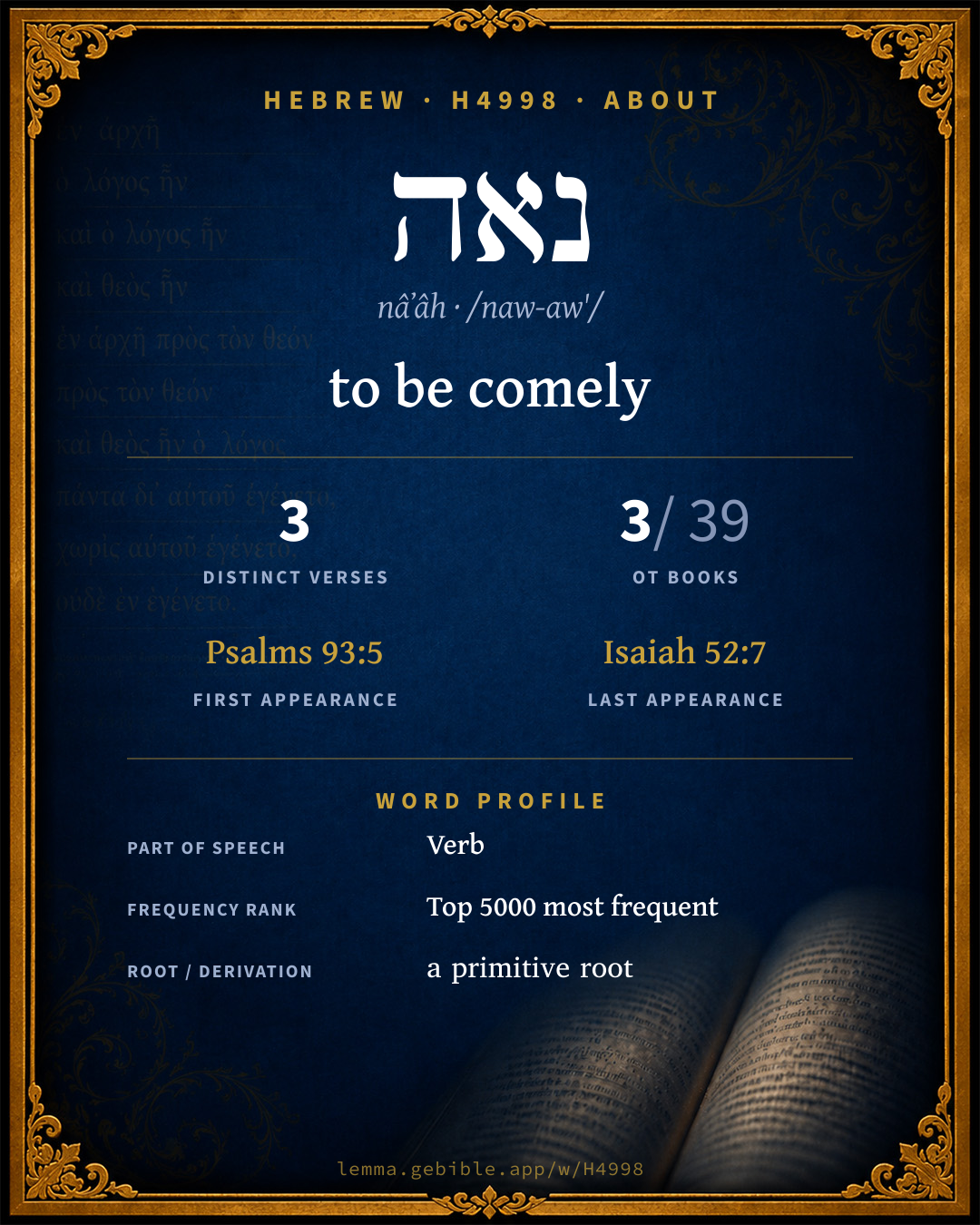
נָאָה
to be comely
also: be beautiful, be befitting fuller range ↓
Full lexicon entry — Brown-Driver-Briggs (BDB)
From Brown-Driver-Briggs (BDB)
Where this word appears
See every Qal verb in the Hebrew Bible →
Grammar key — what these labels mean
Part of speech
- Verb
- An action or state-of-being word.
Stem
- Qal
- The basic, simple active stem — the plain form of the verb (“he wrote”).
- Niphal
- Usually the simple passive or reflexive of the Qal (“he was written”).
Form
- Perfect
- A completed action or state — Hebrew marks aspect (completeness) more than strict tense (“he wrote”).
Person
- 3rd Person
- The one spoken about (“he / she / it / they”).
Gender
- Common
- Either gender — not distinguished for this form.
- Masculine
- Grammatically masculine.
Number
- Plural
- More than one (in Hebrew, generally three or more).
- Singular
- One.
Grammatical forms
- Verb, Qal, Perfect, 3rd Person, Common, Plural 2 times (67%)
- Verb, Niphal, Perfect, 3rd Person, Masculine, Singular 1 time (33%)
Parsed forms decoded from the imported morphology (morphhb / Westminster Leningrad Codex — WLC text public domain, morphhb tagging CC BY 4.0), counted across 3 parsed occurrences — not distinct verses.
Every verse where H4998 appears — 3 distinct verses across 3 books. Click any verse to open its interlinear word-by-word view. Verse text shown in the World English Bible for context — . Each verse’s Hebrew form is shown with its reference; the English is not keyword-highlighted, since the data carries no word-level English alignment. Use “Compare translations” on any verse to read it across multiple English versions. This concordance covers the Hebrew Bible; Septuagint (Greek Old Testament) occurrences are not indexed here.
Psalms 1 verse
Song of Solomon 1 verse
Isaiah 1 verse
About this entry
At a glance — auto-summarized from this page’s data, not written by a person. Every figure links to its source below. This summary describes the numbers; it doesn’t interpret them.
נאה (nâʼâh) is a Hebrew verb most often rendered “to be comely.” The Hebrew Bible uses it only 3 verses. Psalms dominates its distribution — 1 of 3 verses. It first appears in Psalms 93:5. Beyond its headline sense, its full sense range takes in “be beautiful” and “be befitting”. For the data behind this summary, explore the sense tree and the renderings breakdown below.
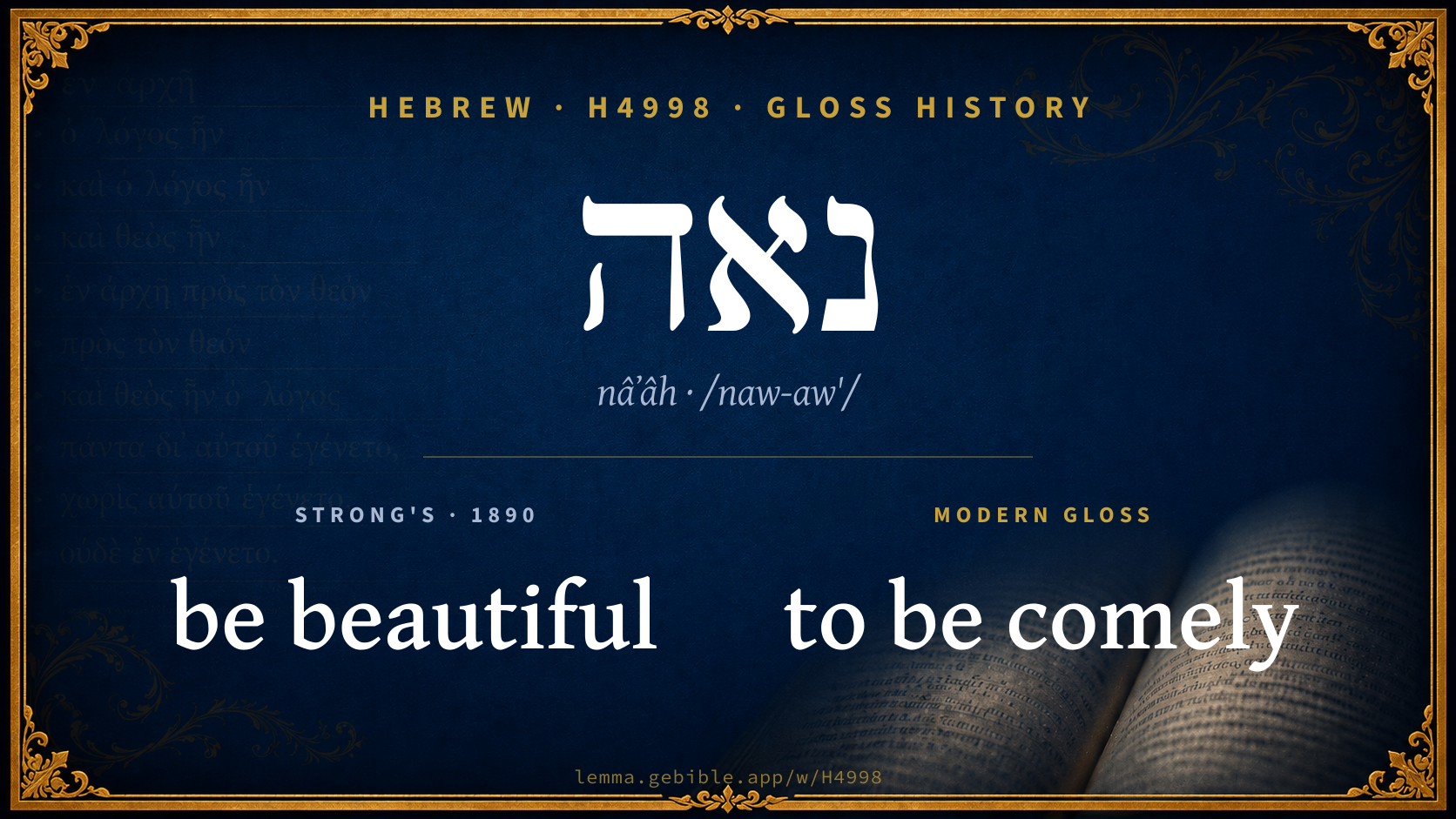
Gloss history
Strong's 1890 vs modern scholarship
About this word
Strong's H4998 catalogs a Hebrew word from the Hebrew Old Testament.
These counts are not copied from any lexicon or concordance. They are computed here, from the morphology-tagged Hebrew Old Testament. What Lemma adds →
- 3
- distinct verses
- The word appears in 3 distinct verses.
- 3 / 39
- OT books
- The word appears in 3 of 39 Old Testament books.
- #4,179
- by frequency
- Top 5000 most frequent Hebrew words (rank 4,179 of 8,640 Hebrew words by occurrence).
View all 3 occurrences in the concordance →
Most concentrated in
- Psalms 1 verse 33%
- Song of Solomon 1 verse 33%
- Isaiah 1 verse 33%
By section of the Old Testament
By traditional corpus
Conventional, traditional groupings — biblical authorship is debated, so this is a traditional corpus grouping, not an authorship claim. Each share is this word’s portion of its verses in that division of the Hebrew canon. Each figure is a share of the word’s 3 distinct verses.
- Writings (Ketuvim) 2 verses · 67%
- Prophets (Nevi'im) 1 verse · 33%
How translations render this word
Counts come from each version’s own published word-to-Strong’s tagging or interlinear alignment — an approximate guide to how each version renders this word, not a word-level alignment the data otherwise carries. Because each total is that version’s own tagged count, the per-version totals vary from one another and need not match the appearance or distinct-verse counts above. These counts may also differ from a printed concordance because Lemma counts each distinctly tagged rendering and does not collapse phrase taggings into a single head-word total. This is a fixed set of word-tagged versions (KJV, ASV, BSB, ULT) and does not change with the reading translation you choose elsewhere. Each version’s license is shown beside its name below (and on Sources).
- King James Version: Are comely 1×, Becometh 1×, How beautiful 1×
- American Standard Version: Are comely 1×, Becometh 1×, How beautiful 1×
- Berean Standard Bible: Adorns 1×, Are beautiful 1×, Beautiful 1×
- unfoldingWord Literal Text: Adorns 1×, Are beautiful 1×, Beautiful 1×
King James Version Public Domain
Renders H4998 across 3 tagged occurrences — most commonly:
American Standard Version Public Domain
Renders H4998 across 3 tagged occurrences — most commonly:
Berean Standard Bible Public Domain
Renders H4998 across 3 tagged occurrences — most commonly:
unfoldingWord Literal Text CC BY-SA 4.0
Renders H4998 across 3 tagged occurrences — most commonly:
Senses in the full BDB
What do BDB’s symbols mean?
BDB uses these scholarly abbreviations:
| Symbol | Meaning |
|---|---|
| 𝔊 | the Septuagint (the ancient Greek translation, LXX) |
| 𝔙 | the Vulgate (the Latin translation) |
| 𝔖 | the Syriac version (the Peshitta) |
| 𝔗 | the Targum (the Aramaic translation) |
| ψ | the Psalms |
| √ | root (the underlying root or stem) |
| ‖ | parallel passage (a synonymous or contrasted parallel) |
| † | the dagger: every passage where the word occurs is cited |
The 2 senses and sub-senses the full Brown-Driver-Briggs lexicon distinguishes for this word, in lexicon order (not ranked by frequency), with BDB’s own verbatim wording and sub-sense lettering. Shown in Hebrew script with BDB’s own scholarly abbreviations. The condensed entry is in the Lexicon Entry tab. See also the Forms in the corpus table below.
- 1. be comely; of feet of messenger, (fig.) Is 52:7; of cheeks Ct 1:10. e.g. Isaiah 52:7
- 2. be befitting: לְבֵיתְךָ נ׳־קֹדֶשׁ ψ 93:5. e.g. Psalms 93:5
Senses from the full Brown-Driver-Briggs lexicon (Brown, Driver, Briggs; Oxford 1906 — public domain), digitized via Sefaria, supplemented by the OpenScriptures HebrewLexicon (CC BY 4.0). Full attribution on Sources.
Word origin
vb. only Piʿlel be comely, befitting (Thes Ol§ 251 a, 187 a Sta§ 416 b Ges§ 73. 2. R.4 SS Bae ψ 33:1 > AE Ki HartmPlurilit.-bildungen (1875) 13 ff. NöZMG xxx, 1876, 185 Now Hup ψ 31:1, 93:5 Buhl Niph. √ I. אוה desire, i.e. desirable, beautiful; NH נאה Pi. Hithp.; 𝔗 נוֹאִי beauty);—Piʿlel Pf. נַאֲוָה ψ 93:5 (so van d. H Ginsb; Mass Baer Dead loc. נָֽאֲוָה = נָאוָה v. נָאוֶה adj., but v Sta§ 155 b. n); נָאווּ Is 52:7 Ct 1:10 (on form cf. Gesl.c.);—
— Brown-Driver-Briggs (Oxford 1906, public domain), digitized via Sefaria, supplemented by the OpenScriptures HebrewLexicon (CC BY 4.0). See Sources.
Origin: a primitive root
Jastrow Dictionary
A second Hebrew/Aramaic lexicon for comparison, covering Aramaic and post-biblical (Talmudic, Targumic, Midrashic) usage that the biblical-Hebrew BDB does not. Matched by lemma rather than by Strong’s number, so a lemma may carry more than one Jastrow headword (shown separately below), and the entries cover usage well beyond the Bible.
נָאֶה
- (b. h.; = נאוה, v. אוּת) suited, becoming; handsome. Tanḥ. B’shall. 11 נ׳ שירה וכ׳ it is meet to sing unto the Lord. Sabb. 133ᵇ; Naz. 2ᵇ סוכה נ׳ a handsome Succah; a. fr.—Ib. I, 1, v. נָוֶה.—Pl. נָאִים, נָאִין; נָאוֹת. Sifra Aḥăré, end (ref. to Lev. XVIII, 26 ושמרתם אתם) אתם נ׳ שומרים וכ׳ you are the proper persons to guard them (the laws of chastity), because you opened (were the first to observe) them. Tanḥ. Masʿé 4 הם נ׳ ולבושיהם נ׳ הם נ׳ לארץ וכ׳ they are handsome, and their garments are becoming, they are suited to the land, and the land to them. Ned. IX, 10 בנות ישראל נ׳ הן אלא וכ׳ the daughters of Israel are good-looking, but misery disfigures them. Sabb. l. c. Sifré Deut. 320 (ref. to Deut. XXXII, 19) ממה שהם נ׳ לו וכ׳ because they are pleasing to him (he calling them sons and daughters), they are bold before him. Tosef. Sot. II, 3 יולדת נ׳ she will bear handsome children; Y. ib. III, 18ᵈ bot. נָעִים; a. fr.—נָאוֹת f. pl. (noun) beauties. Lam. R. to II, 2 (ref. to נאות, ib.) כל נְאוֹתָיו של יצקב all the beauties (excellent men) of Jacob. Yalk. Ex. 244 (ref. to ואנוהו, Ex. XV, 2) אגיד נאותיו ושבחו של וכ׳ I will tell the excellencies and praises of &c.; ib. אדבר בנאותיו ושבחיו; Mekh. B’shall., Shir., s. 3 בנבואתו שבחו (corr. acc.); Yalk. Cant. 988 בנויתיו ובשבחו, read: בנוֹיוֹתָיו, v. נוֹי. Treat. Sof’rim III, 13 היבות בנאות שלו speak much of his excellencies. Lam. R. introd. end, v. קִינָה; a. fr.—נָאֶה (adv.) becomingly, well. Tosef. Yeb. VIII, 4, a. e. נ׳ דירש preaches well, ונ׳ מקיים and acts in conformity (with his words). e.g. Leviticus 18:26
נָאָה
- v. preced.) marked off, distinguished place. — Pl. constr. נְאוֹת. Deut. R. s. 7 end בנ׳ דשאים של באר in the grass-covered oases around the well.
נָאָה ²
- to be becoming &c., v. נאי.
נאי
- to be becoming, handsome.
- to beautify, decorate. Succ. 10ᵃ לנָאוֹתָהּ to decorate it (the Succah); a. e.
- 1. to adorn one’s self. Naz. 2ᵇ (ref. to ואנוהו, Ex. XV, 2) אֶנָּאֶה לפניו וכ׳ I will adorn myself before him with good deeds; Sabb. 133ᵇ הִתְנָאֶה וכ׳ adorn thyself before him &c. R. Hash. 26ᵃ חוטא בל יִתְנָאֶה a sinner must not adorn himself (when appearing before the Lord to ask forgiveness). Gen. R. s. 16 (play on נִינְוֵה) שהם מִתְנָאוֹת מישראל (not מתגאות) they (the goverments) adorn themselves with what they take from Israel; a. e.—V. נָוָה I.—2) (cmp. הָנָה Nif., a. אוּת) to be pleased, to enjoy, make use. R. Hash. 11ᵃ beautiful trees להִתְנָאוֹת בהן בני אדם (Ms. M. לֵיהָנוֹת מהן) for men to enjoy their beauty. Snh. 21ᵇ שלא יתנאה בשל וכ׳ that he make no use of a copy that his fathers have written; (Tosef. ib. IV, 7 שלא יהא ניאות). e.g. Exodus 15:2
A Dictionary of the Targumim, the Talmud Babli and Yerushalmi, and the Midrashic Literature (Marcus Jastrow; London, Luzac, 1903) — Public Domain. Digitized via Sefaria. Digitized via Sefaria. Full attribution on Sources.
Forms in the corpus
The 3 distinct written forms H4998 takes in the Hebrew Bible, most frequent first — each parse links to that stem’s occurrences in the concordance. Hebrew forms include their vowel points and cantillation, so a single lemma takes many written forms.
| Form | Parsing | Example | Uses |
|---|---|---|---|
| נַאֲוָה | Verb, Niphal, Perfect, 3rd Person, Masculine, Singular | Psalms 93:5 | 1 |
| נָאו֤וּ | Verb, Qal, Perfect, 3rd Person, Common, Plural | Song of Solomon 1:10 | 1 |
| נָּאו֨וּ | Verb, Qal, Perfect, 3rd Person, Common, Plural | Isaiah 52:7 | 1 |
Same root — word family
Other BDB entries built from the same root as H4998, grouped by Strong’s listed origin. These share a root / origin per the lexicon — not necessarily a shared meaning. Each links to that word’s own entry.
Derived from this word
Compare all same-root words → They share a root, not necessarily a meaning.
Septuagint verse parallels
This word appears in 3 verses that also exist in the Greek Old Testament (Septuagint), out of the 3 Hebrew verses it occurs in. You can read those verses in Greek by switching the Old Testament edition to the Septuagint.
Read these verses in the Septuagint
This is a verse-level parallel only — the same verses exist in both the Hebrew and Greek Old Testaments. No word-level Hebrew↔Greek correspondence is claimed: the data carries no such alignment, so no Greek word is shown as this Hebrew word’s translation. Coverage is not total — the Septuagint omits the deuterocanon and renumbers the Psalms, so some Hebrew verses have no direct Greek parallel.