
Isaiah 3:19

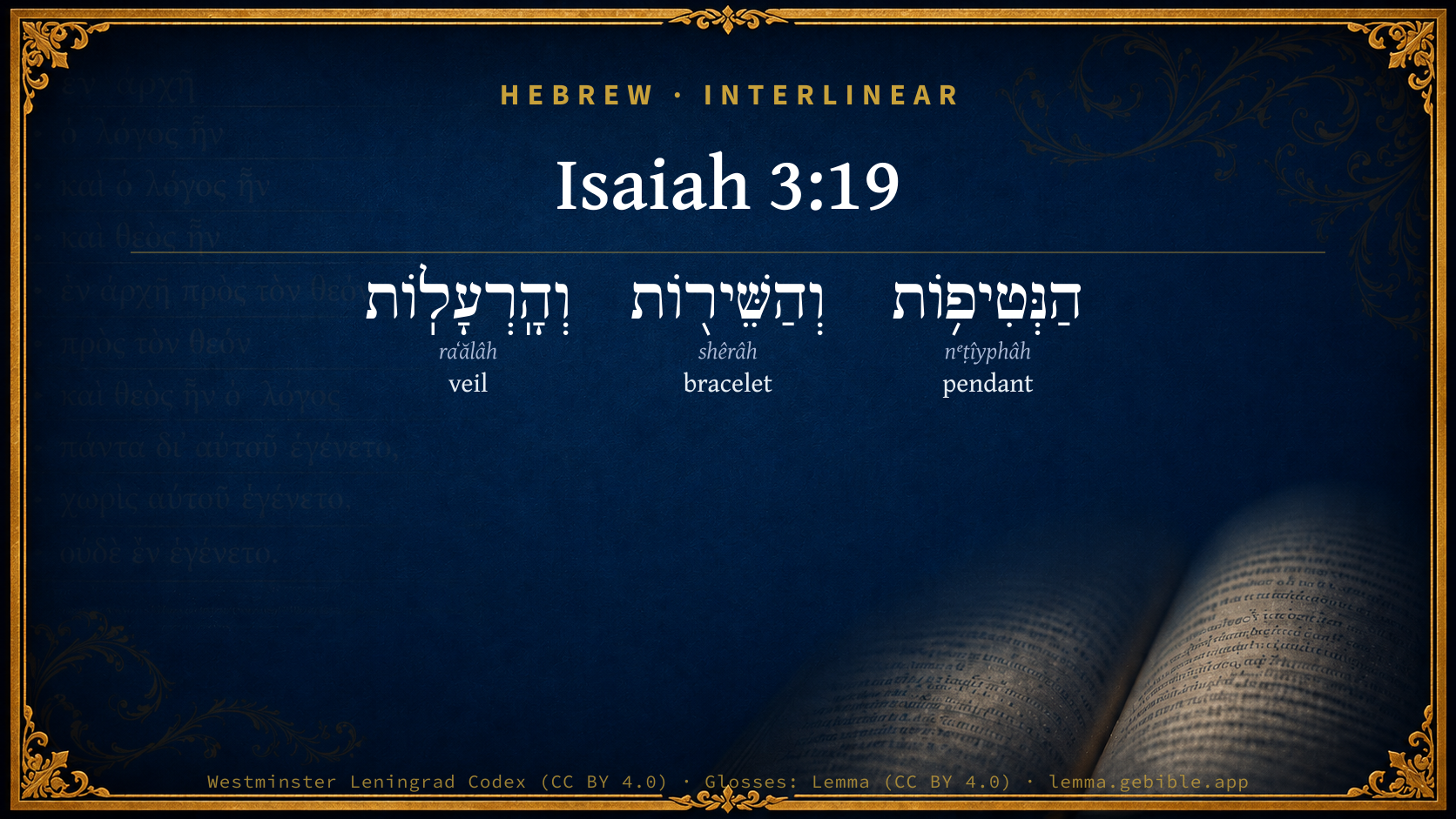
Hebrew (Westminster Leningrad Codex) Isaiah 3:19 appears in the Hebrew Old Testament. The text above is from the Westminster Leningrad Codex. Each word links to its Strong’s number, a concise gloss, and parsing drawn from the Open Scriptures Hebrew Bible morphology. Click any word for its full Brown-Driver-Briggs (BDB) entry.
Download image
Cite this verse

Isaiah 3:19 (World English Bible). Public Domain. Lemma interlinear Bible study tool, https://lemma.gebible.app/v/isaiah/3/19.

Show BibTeX & RIS
BibTeX
RIS
English Translation
the earrings, the bracelets, the veils,
World English Bible · Public Domain
Highlights
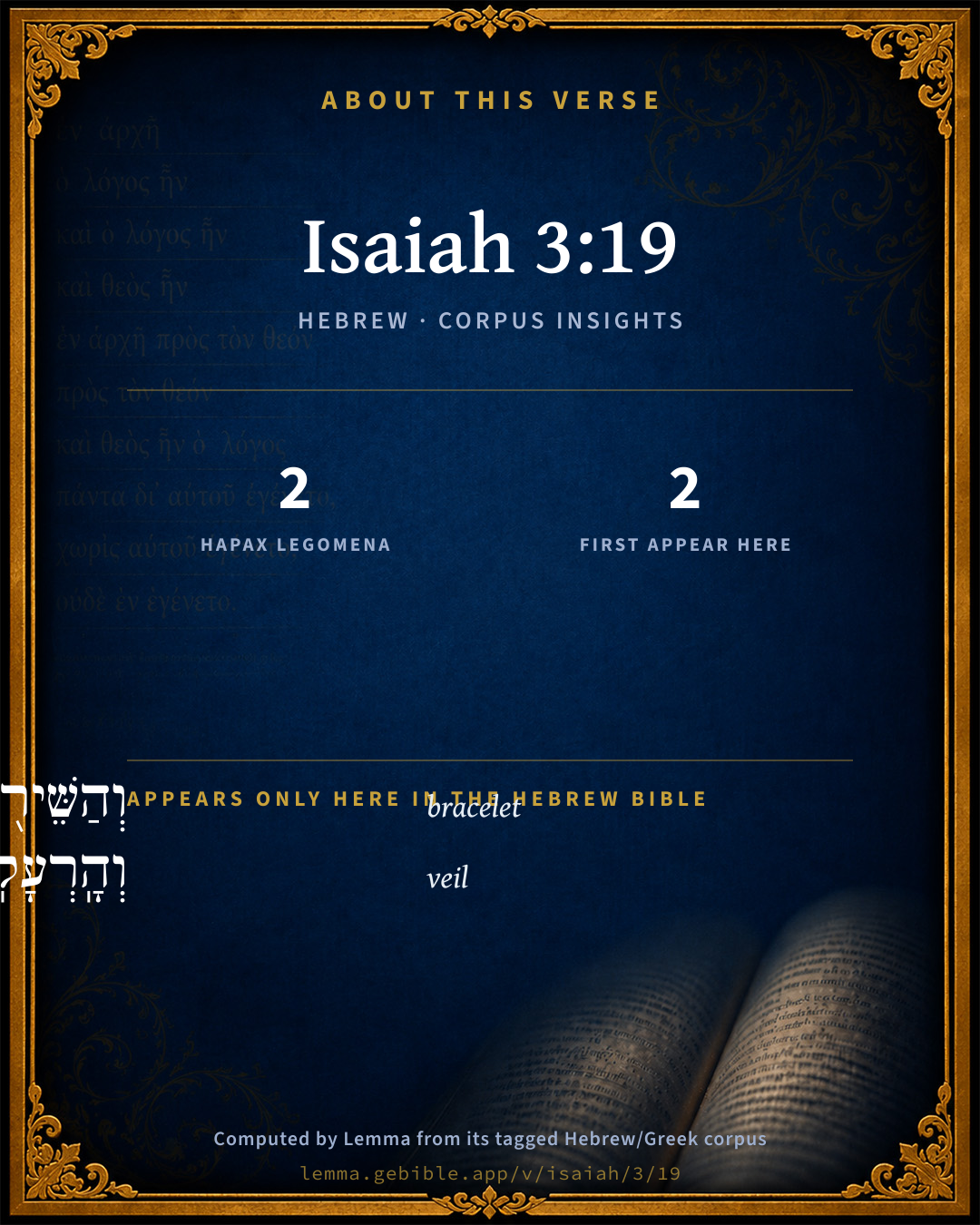
  • 2 hapax legomena — only here in the Hebrew Bible
  • 2 first appearances in the Hebrew Bible
Full analysis ↓
Download a study sheet

One document with this verse’s original text, its word-by-word gloss line, the meaning frame, cross-references with their text, attributed commentary, and full source and license credits — printable, and it pastes into notes with its structure intact.

This verse Autodidact and up

Study sheet (.html) Plain text (.txt)

A passage Seminary Student

Up to 50 verses in one chapter. A passage sheet keeps up to 6 commentary sources and 12 cross-references per verse, in the order this page ranks them, and says so on the sheet whenever that leaves anything out. Ask for a single verse and you get the Autodidact verse sheet above.

Everything on this page stays free to read, with no account — the sheet is a download of what is already on screen, not access to it.

Want to remove ads? Support Godless Engineer
Compare translations 3

The same verse in 3 English versions, stacked beneath the original-language interlinear above. Click any original word for its lexicon entry.

Each is an independent rendering of the whole verse — the interlinear is not word-aligned to these translations.

Highlighted words mark where these versions differ — a whole-verse word diff, not a word-by-word alignment.

  • World English Bible Public Domain
    the earrings, the bracelets, the veils,
  • King James Version Public Domain
    The chains, and the bracelets, and the mufflers,
  • unfoldingWord Literal Text CC BY-SA 4.0
    the pendants and the bracelets and the veils,

unfoldingWord Literal Text — © unfoldingWord, licensed CC BY-SA 4.0. Word-aligned USFM3 via Door43 (git.door43.org/unfoldingWord/en_ult).

Versions to compare (up to 4)

3 of 4 selected

Show all 18 translations

Every available English version of this verse, each an independent rendering of the whole verse.

  • World English Bible Public Domain
    the earrings, the bracelets, the veils,
  • Berean Standard Bible Public Domain
    their pendants, bracelets, and veils;
  • Majority Standard Bible Public Domain
    their pendants, bracelets, and veils;
  • King James Version Public Domain
    The chains, and the bracelets, and the mufflers,
  • American Standard Version (1901) Public Domain
    the pendants, and the bracelets, and the mufflers;
  • Revised Version (1885) Public Domain
    the pendants, and the bracelets, and the mufflers;
  • Geneva Bible (1599) Public Domain
    The sweete balles, and the brasselets, and the bonnets,
  • Douay-Rheims (1899) Public Domain
    And chains and necklaces, and bracelets, and bonnets,
  • Young's Literal Translation Public Domain
    Of the drops, and the bracelets, and the mufflers,
  • Literal Standard Version CC BY-SA 4.0
    Of the pendants, and the bracelets, and the veils,
  • Unlocked Literal Bible CC BY-SA 4.0
    the ear pendants, the bracelets, and the veils;
  • unfoldingWord Literal Text CC BY-SA 4.0
    the pendants and the bracelets and the veils,
  • Darby Bible Public Domain
    the pearl-drops, and the bracelets, and the veils,
  • World Messianic Bible Public Domain
    the earrings, the bracelets, the veils,
  • Webster's Bible Public Domain
    The chains, and the bracelets, and the mufflers,
  • Free Bible Version CC BY-SA 4.0
    pendant earrings, bracelets, veils,
  • Bible in Basic English Public Domain
    The ear-rings, and the chains, and the delicate clothing,
  • JPS Tanakh (1917) Public Domain
    the pendants, and the bracelets, and the veils;

Literal Standard Version (2020), Covenant Press — licensed CC BY-SA 4.0. Text via the HelloAO Bible API (eBible.org). Unlocked Literal Bible (unfoldingWord) — licensed CC BY-SA 4.0. Text via the HelloAO Bible API (eBible.org). unfoldingWord Literal Text — © unfoldingWord, licensed CC BY-SA 4.0. Word-aligned USFM3 via Door43 (git.door43.org/unfoldingWord/en_ult). Free Bible Version, Dr. Jonathan Gallagher — licensed CC BY-SA 4.0. Text via the HelloAO Bible API (eBible.org).

Word by word

More ways to search: Search by grammar → Find every occurrence → Compare this word →

Practice this passage: Drill this verse → Learn its vocabulary →

About this verse

These counts appear in no published source. They are computed here, from the morphology-tagged text and Lemma’s own curated glosses. What Lemma adds →

3
words
3
distinct lemmas
Prophets
section

Notable vocabulary

2 hapax legomena — words that appear only here in the entire Hebrew Bible:

  • וְהַשֵּׁיר֖וֹת bracelet H8285
  • וְהָֽרְעָלֽוֹת veil H7479

First appearance in Scripture

These words make their first canonical appearance in the Hebrew Bible here:

  • וְהַשֵּׁיר֖וֹת bracelet H8285
  • וְהָֽרְעָלֽוֹת veil H7479

Shared distinctive vocabulary

הַנְּטִיפ֥וֹת pendant H5188 occurs in 2 verses of the Hebrew Bible. Also found in:

Grammatical profile

  • 3 nouns

Hebrew & Septuagint length

In English translation the verse runs 6 words from the Hebrew and 9 from the Septuagint (LXX English) — closely comparable.

A rough comparison of the two English renderings, which tokenize alike — not a word-level alignment.

Word counts can differ between the Hebrew and the Greek without any difference in meaning — e.g. the Hebrew direct-object marker אֵת has no separate Greek word, and Greek often adds the article ὁ.

Cross-references

8

Topical passages linked to Isaiah 3:19 in the Treasury of Scripture Knowledge — connected by theme and wording, ordered by reader-vote popularity; previews shown in the World English Bible.

  • Ezekiel 16:11 I decked you with ornaments, and I put bracelets on your hands, and a chain on your neck.
  • Genesis 24:22 It happened, as the camels had done drinking, that the man took a golden ring of half a shekel weight, and two bracelets for her hands of ten shekels weight of gold,
  • Genesis 24:30 It happened, when he saw the ring, and the bracelets on his sister's hands, and when he heard the words of Rebekah his sister, saying, "This is what the man said to me," that he came to the man. Behold, he was standing by the camels at the spring.
  • Genesis 24:53 The servant brought forth jewels of silver, and jewels of gold, and clothing, and gave them to Rebekah. He gave also to her brother and to her mother precious things.
  • Genesis 38:18 He said, "What pledge will I give you?" She said, "Your signet and your cord, and your staff that is in your hand." He gave them to her, and came in to her, and she conceived by him.
  • Exodus 35:22 They came, both men and women, as many as were willing-hearted, and brought brooches, ear-rings, signet-rings, and armlets, all jewels of gold; even every man who offered an offering of gold to Yahweh.
  • Numbers 31:50 We have brought Yahweh's offering, what every man has gotten, of jewels of gold, ankle-chains, and bracelets, signet-rings, ear-rings, and armlets, to make atonement for our souls before Yahweh.
  • Genesis 38:25 When she was brought forth, she sent to her father-in-law, saying, "By the man, whose these are, I am with child." She also said, "Please discern whose are these-- the signet, and the cords, and the staff."

Cross-references courtesy of OpenBible.info (CC BY 4.0).

Hebrew and Greek witnesses Masoretic Hebrew ↔ Greek Septuagint

The same verse in the two great witnesses to the Old Testament, shown verse-for-verse.

These are two independent witnesses, not word-aligned to each other, and the Septuagint is shown in lemma (dictionary) form.

Hebrew Isaiah 3:19 Masoretic · Westminster Leningrad Codex

הַנְּטִיפ֥וֹת וְהַשֵּׁיר֖וֹת וְהָֽרְעָלֽוֹת

the earrings, the bracelets, the veils,

World English Bible · Public Domain

Greek LXX Isaiah 3:19 Septuagint · lemma form

καί ὁ κάθεμα καί ὁ κόσμος ὁ πρόσωπον αὐτός

and the chains, and the ornaments of their faces,

LXX2012 (modern English Septuagint) · Public Domain

On this verse, Albert Barnes' Notes on the Bible discusses the Septuagint’s reading. Read the note in Commentary ↓

Hebrew: Westminster Leningrad Codex (CC BY 4.0). Greek: Septuagint (public domain); English from LXX2012 (modern English Septuagint) (Public Domain). How the Septuagint differs from the Hebrew →

Targum (Aramaic paraphrase)

1

The Targum is the ancient Jewish Aramaic paraphrase of the Hebrew Scriptures — an interpretive translation, not the Hebrew text itself. Onkelos (literal) and Pseudo-Jonathan (expansive) render the Torah, and Jonathan the Prophets. Coverage is partial: where no permissively-licensed English translation exists for a verse, only the Aramaic is shown. This is verse-level text, not a word-by-word alignment to the Hebrew.

  1. Targum Jonathan Prophets (Joshua–Malachi)
    עַנְקַיָא וְשֵׁירֵי יְדַיָא וַחֲנִיסְנְסַיָא:

    The necklaces, and the bracelets for the hands, and the long robes;

    Targum Jonathan — Aramaic: “Mikraot Gedolot” (public domain). English: “Sefaria Community Translation” (CC0 1.0 (public-domain dedication)); “London "Chaldee Paraphrase," 1871” (public domain). Text via Sefaria.

Commentary

Notes on Isaiah 3:19 from classic Christian and Jewish commentators (each source and its license shown beneath its notes). The classic Christian expositions comment on the surrounding passage and are grouped to its opening verse, so a note may address several verses; the Jewish commentaries on the Tanakh (Rashi and others) are per-verse, so they appear only where the commentator wrote on this verse.

Lemma curates 59 commentaries, every one of them public domain or Creative Commons licensed, each selected and text-cleaned for this edition rather than reprinted as found. About our sources →

Trapp's Complete Commentary

John Trapp

Isa 3:19 The chains, and the bracelets, and the mufflers,

Ver. 19. And the chains and the bracelets, &c.] The particulars of all their bravery we can say little unto upon certainty, since we are at this day ignorant of what ornaments and habiliments were then in use; and besides, the names here given unto them are such as the Jews themselves can hardly tell what to make of. It is a sad thing that the gauds and gaities of this age and country are such and so many, as that not six or seven verses, but so many whole chapters might be easily taken up in inventorying them. Lysander, a heathen, will rise up in judgment against many among us; for he would not allow his daughters to wear gorgeous attire, saying it would not make them so comely as common. That is very remarkable that is reported {a} of Mr Foxe the martyrologue, that when a son of his, returning from his travels into foreign parts, came to him in Oxford, attired in a loose, outlandish fashion, Who are you? said his old father, not knowing him. He replied, I am your son. Oh, what enemy of thine, said he, hath taught thee so much vanity? The Hebrew word, beghed, for a garment, comes from baghad, which signifies to deal perfidiously or treacherously, {Isa 21:3} perhaps because it is tegumentum et testimonium, not more a covering of man’s shame than a testimony of his first sin in falling from God. So that a man or woman hath no more cause to brag about his fine clothes, or to be proud of them, than a thief of a silk rope, or than one hath of a plaster laid to his filthy Sore.

{a} Hist. of Mod. Div., by Lupton.

John Trapp, A Commentary or Exposition upon All the Books of the Old and New Testament (1647–1656) — public domain. Text from a community e-Sword module.

Jamieson, Fausset & Brown

Robert Jamieson, A. R. Fausset & David Brown

chains--rather, pendants, hanging about the neck, and dropping on the breast.

mufflers--veils covering the face, with apertures for the eyes, close above and loosely flowing below. The word radically means "tremulous," referring to the changing effect of the spangles on the veil.

Jamieson, Fausset & Brown — Commentary Critical and Explanatory on the Whole Bible (1871) — public domain (CC PDM 1.0). Text via the HelloAO Bible API.

Ellicott's Commentary for English Readers

(19) The chains.—Better, as in Jdg_8:26, where they are also ornaments of Midianite kings, earrings. These and the “bracelets “were probably of gold. The “mufflers” were the long flowing veil, or mantilla, worn so as to cover the head, as now in Spain, or Egypt, or Turkey.

A Bible Commentary for English Readers, edited by Charles John Ellicott (1878–1897) — public domain. Text from a community e-Sword module.

The Cambridge Bible for Schools and Colleges

gen. ed. J. J. S. Perowne

19. The ear-drops (Jdg_8:26, R.V. “collars”) and the arm-chains and the veils—the last (the Arabian ra‘l) is in two parts, one thrown back over the head from above the eyes, the other hanging down over the face.

The Cambridge Bible for Schools and Colleges (gen. ed. J. J. S. Perowne; Cambridge University Press, 1878–1918) — public domain. Text from a community e-Sword module.

John Gill's Exposition

The chains,.... According to Kimchi and R. Levi ben Gersom on Jdg 8:26 these were drop bottles, or vessels of gold, in which were put stacte or balsam; and the former says here, they were such in which balsam was put, and women hung about their necks; though, he observes, some interpret them of chains, which were made of small stones of bdellium; hence pure bdellium is called in the Arabic tongue and so Jarchi renders the word "chains"; and they are called by this name, because they hang about the neck, and drop upon the breast, and are in the form of precious stones, bored and strung:

and the bracelets; hand bracelets, according to the Targum; such as Abraham's servant gave to Rebekah, Gen 24:22,

and the mufflers; these were veils which covered the whole face, excepting the eyes, the same that we call masks: it is said (a) of the Arabian women, that they went out that is, as Bartenora explains it, they were veiled about the head, so that the whole face was covered, excepting their eyes; though Maimonides interprets them of little bells, which the Arabian women went out with; the Targum here explains the word by "women's veils"; though some think only the "spangles" which were on them are meant, so called from their trembling and shaking motion.

(a) Misn. Sabbat, c. 6. sect. 6.

John Gill's Exposition of the Whole Bible (1746–1763) — public domain (CC PDM 1.0). Text via the HelloAO Bible API.

Albert Barnes' Notes on the Bible

The chains - Margin, “sweet balls.” The word used here is derived from the verb נטף nâṭaph, to drop, to fall in drops, or to distil,” as juice from a plant. Hence, it means that which “resembles drops” - as pearls, or precious stones, used as ornaments for the neck or ears. We retain a similar word as applicable to the ornaments of the ears, by calling them “drops.” The Chaldee renders this “chains,” and so also the Vulgate. The Septuagint understands it of a “hanging” or “pendant” ornament - and this is its undoubted meaning - an ornament pendant like gum distilling from a plant. ‘These consist, first, of one most beautifully worked, with a pendant ornament for the neck; there is also a profusion of others which go round the same part, and rest on the bosom. In making curious chains, the goldsmiths of England do not surpass those of the East.’ - “Roberts.”

And the bracelets - For the wrists. The Chaldee translates it, ‘bracelets for the hands.’ These ornaments were very ancient; see Gen 24:22; Num 31:50. - Mahomet promises to those who shall follow him, gold and silver bracelets. ‘The bracelets are large ornaments for the wrists, in which are sometimes enclosed small bells.’ - “Roberts.”

Mufflers - Margin, “spangled ornaments.” The word used here is derived from a verb, “to tremble, to shake” - רעל râ‛al - and the name is given to the ornament, whatever it was, probably from its “tremulous” motion. Perhaps it means a “light, thin veil;” or possibly, as in the margin, spangled ornaments, producing a tremulous, changing aspect. In Zec 7:2, the word is used to denote ‘trembling’ - giddiness, or intoxication. It was early customary, and is still common in Oriental countries, for the females to wear veils. No female ventures abroad without her veil. That which is supposed to be intended here, is described by the Arabian scholiast Safieri, quoted by Gesenius. It is drawn tight over the upper part of the head, but the part around the eyes is open, and a space left to see through, and the lower part is left loose and flowing, and thus produces the “tremulous” appearance indicated in this place; see the notes and illustrations at Isa 3:24.

Albert Barnes' Notes on the Bible (1834–1885) — public domain. Text from a community e-Sword/MySword module.

The Pulpit Commentary

The chains, and the bracelets, and the mufflers; rather, the ear-drops, and the armlets, and the veils. Earrings were worn from very ancient times by both the Assyrians and the Egyptians. The ring had frequently a pendant hanging from it. Men wore armlets in Assyria, and both men and women in Egypt (Lepsius, "Denktamer," pt. 3. pl. 1). Yells have always been regarded in the East as almost a necessary part of female attire.

The Pulpit Commentary (1880–1919), ed. H.D.M. Spence-Jones & Joseph S. Exell — public domain. Text from a community e-Sword module.

J. A. Alexander on Isaiah

Joseph Addison Alexander

“The pendants (literally, drops, (i.e., earrings) and the bracelets (for the arm, or collars for the neck) and the veils” (the word here used denoting the peculiar oriental veil, composed of two pieces hooked together below the eyes, one of which pieces is thrown back over the head, while the other hides the face).

Joseph Addison Alexander, The Prophecies of Isaiah (1846–1847; New York: Scribner, 1870–1878) — public domain. Text from a community e-Sword module.

Rashi

Rabbi Shlomo Yitzchaki (Rashi)

The necklaces [Jonathan renders:] עַנְקַיָא, necklaces, an expression similar to (Proverbs 1:9): “And necklaces (עֲנָקִים) for your throat.” They are called נְטָפוֹת, meaning “to drip,” because they hang on the neck and drip onto the breast, and they are a sort of pierced pearls, strung on a string, mostnecs in O.F.

and the bracelets Heb. וְהַשֵּׁרוֹת, bracelets for the arm, translated וְשִׁירַיָא.

and the veils Heb. וְהָרְעָלוֹת. A veil with which they envelop their entire countenance except the eyeball, so that a man will desire to satisfy himself by gazing at the cheeks. Another explanation is that they are types of pretty shawls, with which to enwrap themselves, and in the language of the Mishnah, there is an instance: “Shawled (רְעוּלוֹת) Arabian women,” in Tractate Shabbath (65a).

Rashi on the Tanakh — English translations: “The Judaica Press complete Tanach with Rashi, translated by A. J. Rosenberg” (CC BY 4.0); “Pentateuch with Rashi's commentary by M. Rosenbaum and A.M. Silbermann, 1929-1934” (public domain); “The Metsudah Tanach series, Lakewood, N.J” (CC BY 4.0); and “The Book of Joshua, Metsudah Publications, 1997” (CC BY 4.0). Text via Sefaria.

Ibn Ezra

Rabbi Abraham ibn Ezra

נטיפות Hap. leg. According to some, an ornament for the hair.

שרות An ornament for the ears; according to others, bracelets; comp. שרין the Chaldean translation of אצעדה bracelets (Num. 31:50).

רעלות Hap. leg. An ornament for the cheeks.

Ibn Ezra on the Tanakh — English translations: “Sefaria Community Translation” (CC0 1.0 (public-domain dedication)); “Yalkut, Sifsei Chachomim Chumash, Metsudah Publications, 2009” (CC BY 4.0); and “Commentary of Ibn Ezra on Isaiah - trans. by M. Friedlander, 1873” (public domain). Text via Sefaria.

Lesson kit

Teaching starters — assembled from the data on this page, not authored interpretation. Every prompt links to the verse data it draws on. Edit before teaching.

Isaiah, in the Prophets, opens this verse with 3 words (3 distinct Hebrew lemmas). Its most distinctive word is shêrâh (“bracelet”). A historical commentator’s framing appears above. Read the whole chapter for the surrounding context.

Discussion questions

  1. How does “bracelet” (shêrâh) shape what this verse is saying?
  2. This verse holds 2 words here found nowhere else in the Hebrew Bible. What might the rare words draw attention to?
  3. 2 words here appear for the first time in Scripture. What is being introduced at this debut?
  4. Judges 8:26 shares the word «pendant» with this verse. How do the two illuminate each other?
  5. These translations render this verse differently. What is at stake in choosing one wording over another?
  6. Reading how Trapp's Complete Commentary and Jamieson, Fausset & Brown read this verse, where do the two commentators agree and where do they part?

Things to notice

  • 2 words in this verse appear nowhere else in the Hebrew Bible.
  • 2 words make their first canonical appearance in Scripture here.
  • These translations choose different wording for 5 words in this verse.
  • 3 distinct Hebrew lemmas span 3 words in this verse.

Reading settings

Reading text

Shown beneath each verse's original-language words.

Old Testament
Old Testament edition

Read the OT as the Masoretic Hebrew (MT) or the Greek Septuagint (LXX).

English shown for the Greek Septuagint (in the Hebrew ↔ Greek comparison).

Comparing translations? Open the Compare panel on any verse page to stack up to four side by side.