
Proverbs 11:22

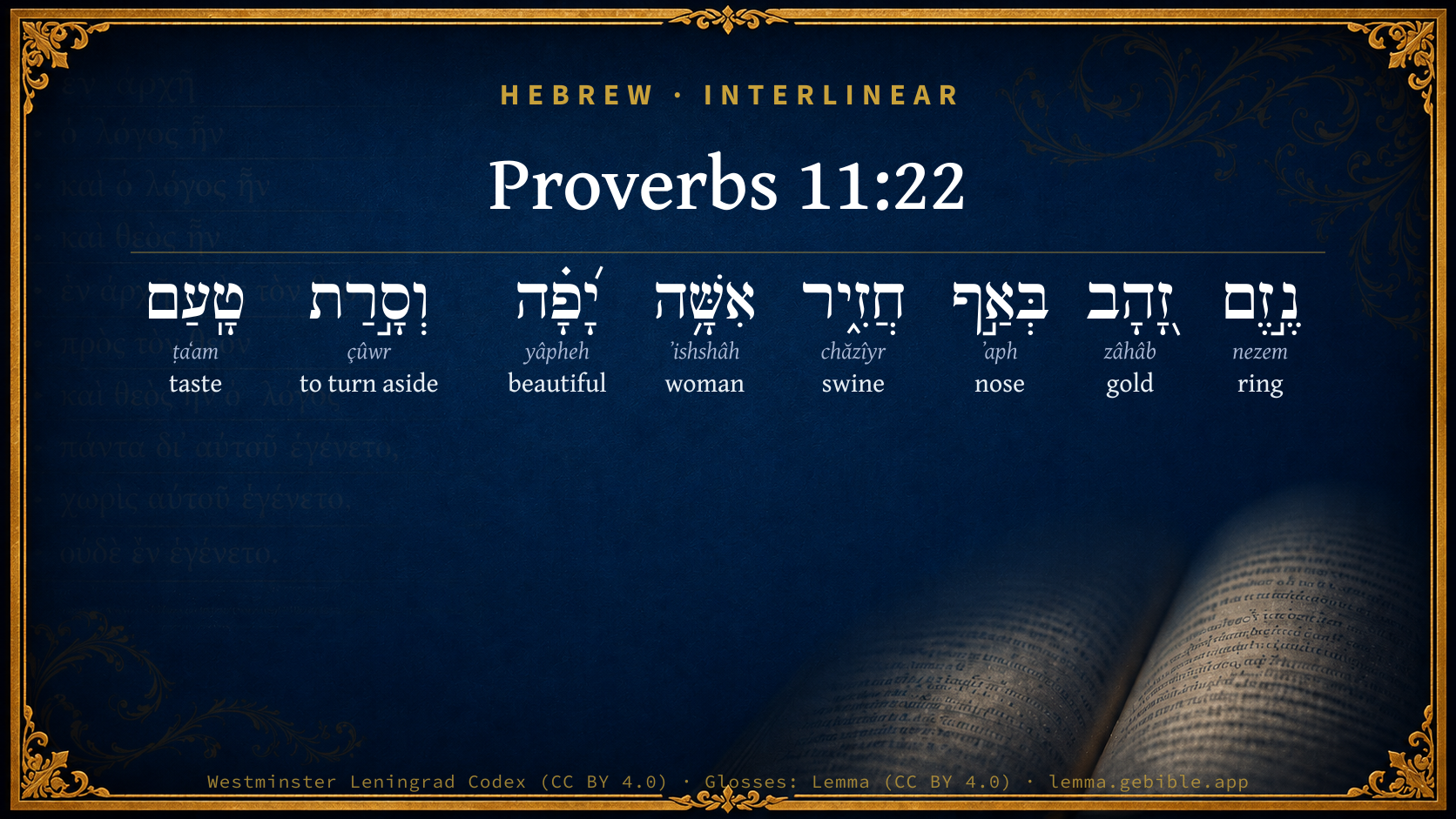
Hebrew (Westminster Leningrad Codex) Proverbs 11:22 appears in the Hebrew Old Testament. The text above is from the Westminster Leningrad Codex. Each word links to its Strong’s number, a concise gloss, and parsing drawn from the Open Scriptures Hebrew Bible morphology. Click any word for its full Brown-Driver-Briggs (BDB) entry.
Download image
Cite this verse

Proverbs 11:22 (World English Bible). Public Domain. Lemma interlinear Bible study tool, https://lemma.gebible.app/v/proverbs/11/22.

Show BibTeX & RIS
BibTeX
RIS
English Translation
Like a gold ring in a pig's snout, Is a beautiful woman who lacks discretion.
World English Bible · Public Domain
Download a study sheet

One document with this verse’s original text, its word-by-word gloss line, the meaning frame, cross-references with their text, attributed commentary, and full source and license credits — printable, and it pastes into notes with its structure intact.

This verse Autodidact and up

Study sheet (.html) Plain text (.txt)

A passage Seminary Student

Up to 50 verses in one chapter. A passage sheet keeps up to 6 commentary sources and 12 cross-references per verse, in the order this page ranks them, and says so on the sheet whenever that leaves anything out. Ask for a single verse and you get the Autodidact verse sheet above.

Everything on this page stays free to read, with no account — the sheet is a download of what is already on screen, not access to it.

Want to remove ads? Support Godless Engineer
Compare translations 3

The same verse in 3 English versions, stacked beneath the original-language interlinear above. Click any original word for its lexicon entry.

Each is an independent rendering of the whole verse — the interlinear is not word-aligned to these translations.

Highlighted words mark where these versions differ — a whole-verse word diff, not a word-by-word alignment.

  • World English Bible Public Domain
    Like a gold ring in a pig's snout, Is a beautiful woman who lacks discretion.
  • King James Version Public Domain
    As a jewel of gold in a swine's snout, so is a fair woman which is without discretion.
  • unfoldingWord Literal Text CC BY-SA 4.0
    A ring of gold in the nose of a pig a beautiful woman turning away discretion.

unfoldingWord Literal Text — © unfoldingWord, licensed CC BY-SA 4.0. Word-aligned USFM3 via Door43 (git.door43.org/unfoldingWord/en_ult).

Versions to compare (up to 4)

3 of 4 selected

Show all 18 translations

Every available English version of this verse, each an independent rendering of the whole verse.

  • World English Bible Public Domain
    Like a gold ring in a pig's snout, Is a beautiful woman who lacks discretion.
  • Berean Standard Bible Public Domain
    Like a gold ring in a pig’s snout is a beautiful woman who lacks discretion.
  • Majority Standard Bible Public Domain
    Like a gold ring in a pig’s snout is a beautiful woman who lacks discretion.
  • King James Version Public Domain
    As a jewel of gold in a swine's snout, so is a fair woman which is without discretion.
  • American Standard Version (1901) Public Domain
    `As' a ring of gold in a swine's snout, `So is' a fair woman that is without discretion.
  • Revised Version (1885) Public Domain
    As a jewel of gold in a swine’s snout, so is a fair woman which is without discretion.
  • Geneva Bible (1599) Public Domain
    As a iewell of golde in a swines snoute: so is a faire woman, which lacketh discretion.
  • Douay-Rheims (1899) Public Domain
    A golden ring in a swine's snout, a woman fair and foolish.
  • Young's Literal Translation Public Domain
    A ring of gold in the nose of a sow -- A fair woman and stubborn of behaviour.
  • Literal Standard Version CC BY-SA 4.0
    A ring of gold in the nose of a sow—A beautiful woman and stubborn of behavior.
  • Unlocked Literal Bible CC BY-SA 4.0
    Like a gold ring in a pig's nose is a beautiful woman without discretion.
  • unfoldingWord Literal Text CC BY-SA 4.0
    A ring of gold in the nose of a pig a beautiful woman turning away discretion.
  • Darby Bible Public Domain
    A fair woman who is without discretion, is [as] a gold ring in a swine's snout.
  • World Messianic Bible Public Domain
    Like a gold ring in a pig’s snout, is a beautiful woman who lacks discretion.
  • Webster's Bible Public Domain
    As a jewel of gold in a swine's snout, so is a fair woman who is without discretion.
  • Free Bible Version CC BY-SA 4.0
    A beautiful woman who lacks good judgment is like a gold ring in a pig's snout.
  • Bible in Basic English Public Domain
    Like a ring of gold in the nose of a pig, is a beautiful woman who has no sense.
  • JPS Tanakh (1917) Public Domain
    As a ring of gold in a swine's snout, so is a fair woman that turneth aside from discretion.

Literal Standard Version (2020), Covenant Press — licensed CC BY-SA 4.0. Text via the HelloAO Bible API (eBible.org). Unlocked Literal Bible (unfoldingWord) — licensed CC BY-SA 4.0. Text via the HelloAO Bible API (eBible.org). unfoldingWord Literal Text — © unfoldingWord, licensed CC BY-SA 4.0. Word-aligned USFM3 via Door43 (git.door43.org/unfoldingWord/en_ult). Free Bible Version, Dr. Jonathan Gallagher — licensed CC BY-SA 4.0. Text via the HelloAO Bible API (eBible.org).

Word by word

More ways to search: Search by grammar → Find every occurrence → Compare this word →

Practice this passage: Drill this verse → Learn its vocabulary →

About this verse

These counts appear in no published source. They are computed here, from the morphology-tagged text and Lemma’s own curated glosses. What Lemma adds →

8
words
8
distinct lemmas
Wisdom
section

Notable vocabulary

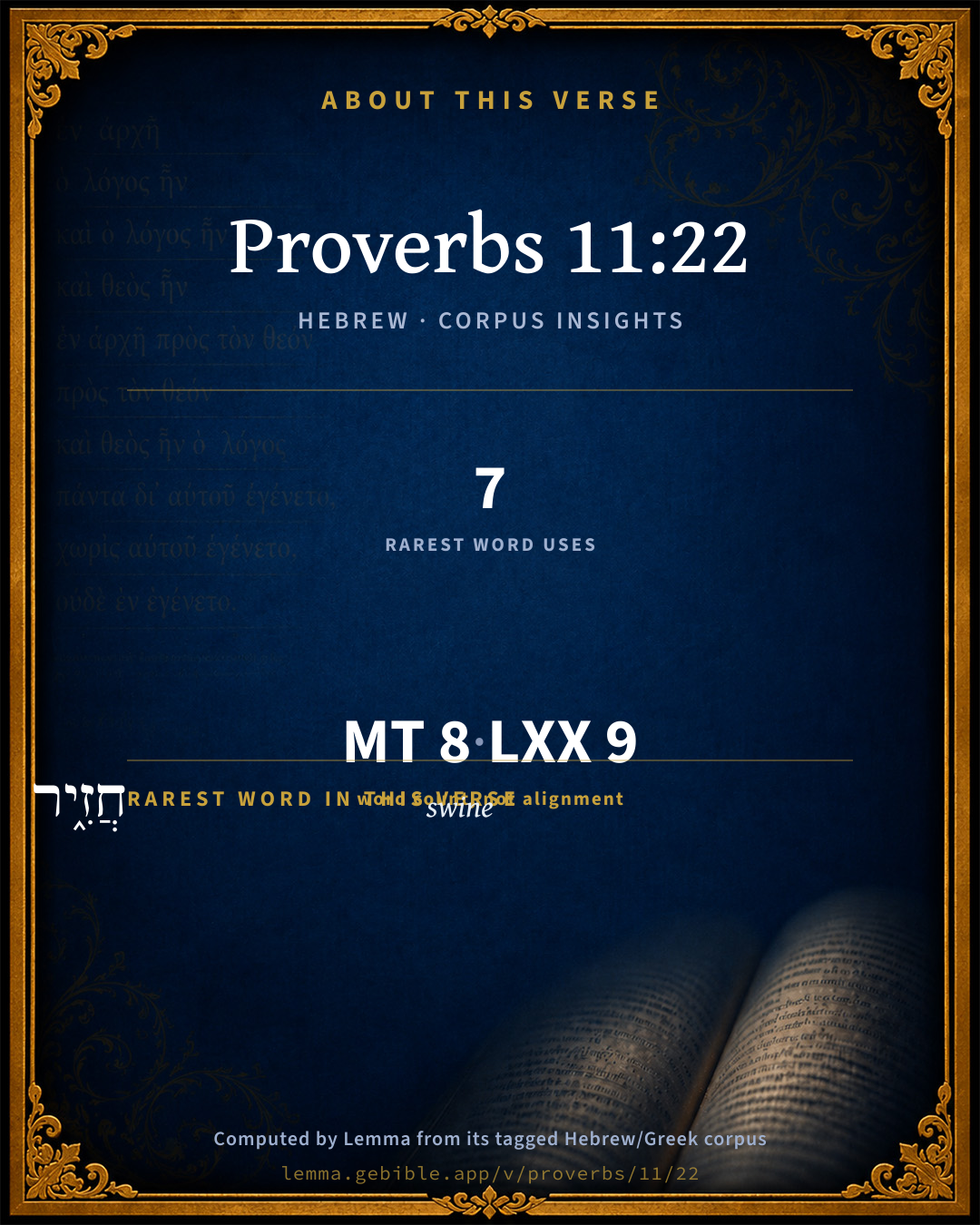
The rarest word here is חֲזִ֑יר swine H2386 — appearing just 7 times in the whole Hebrew Bible.

Shared distinctive vocabulary

חֲזִ֑יר swine H2386 occurs in 7 verses of the Hebrew Bible. Also found in:

Grammatical profile

  • 1 verb
  • 6 nouns
  • 1 adjective

Verb forms

  • וְסָ֣רַת Qal · Participle Active

Hebrew & Septuagint length

In English translation the verse runs 15 words from the Hebrew and 14 from the Septuagint (LXX English) — closely comparable.

A rough comparison of the two English renderings, which tokenize alike — not a word-level alignment.

Word counts can differ between the Hebrew and the Greek without any difference in meaning — e.g. the Hebrew direct-object marker אֵת has no separate Greek word, and Greek often adds the article ὁ.

In the original languages it is 8 Hebrew tokens and 9 Greek tokens — but the two are counted differently (Hebrew bundles its prefixes and suffixes into one token; the Greek is in lemma form), so that isn’t a like-for-like length.

Cross-references

8

Topical passages linked to Proverbs 11:22 in the Treasury of Scripture Knowledge — connected by theme and wording, ordered by reader-vote popularity; previews shown in the World English Bible.

  • 1 Peter 3:3–4 Let your beauty be not just the outward adorning of braiding the hair, and of wearing jewels of gold, or of putting on fine clothing;
  • Proverbs 31:30 Charm is deceitful, and beauty is vain; But a woman who fears Yahweh, she shall be praised.
  • Nahum 3:4–6 because of the multitude of the prostitution of the alluring prostitute, the mistress of witchcraft, who sells nations through her prostitution, and families through her witchcraft.
  • Proverbs 7:10 Behold, there a woman met him with the attire of a prostitute, And with crafty intent.
  • Proverbs 9:13 The foolish woman is loud, Undisciplined, and knows nothing.
  • 2 Peter 2:22 But it has happened to them according to the true proverb, "The dog turns to his own vomit again," and "the sow that had washed to wallowing in the mire."
  • Genesis 24:47 I asked her, and said, 'Whose daughter are you?' She said, 'The daughter of Bethuel, Nahor's son, whom Milcah bare to him.' I put the ring on her nose, and the bracelets on her hands.
  • Ezekiel 16:15–22 But you did trust in your beauty, and played the prostitute because of your renown, and poured out your prostitution on everyone who passed by; his it was.

Cross-references courtesy of OpenBible.info (CC BY 4.0).

Hebrew and Greek witnesses Masoretic Hebrew ↔ Greek Septuagint

The same verse in the two great witnesses to the Old Testament, shown verse-for-verse.

These are two independent witnesses, not word-aligned to each other, and the Septuagint is shown in lemma (dictionary) form.

Hebrew Proverbs 11:22 Masoretic · Westminster Leningrad Codex

נֶ֣זֶם זָ֭הָב בְּאַ֣ף חֲזִ֑יר אִשָּׁ֥ה יָ֝פָ֗ה וְסָ֣רַת טָֽעַם

Like a gold ring in a pig's snout, Is a beautiful woman who lacks discretion.

World English Bible · Public Domain

Greek LXX Proverbs 11:22 Septuagint · lemma form

ὥσπερ ἐνώτιον ἐν ῥίς ὗς οὕτως γυνή κακόφρων κάλλος

As an ornament in a swine's snout, so is beauty to an ill-minded woman.

LXX2012 (modern English Septuagint) · Public Domain

On this verse, The Pulpit Commentary discusses the Septuagint’s reading. Read the note in Commentary ↓

Hebrew: Westminster Leningrad Codex (CC BY 4.0). Greek: Septuagint (public domain); English from LXX2012 (modern English Septuagint) (Public Domain). How the Septuagint differs from the Hebrew →

Commentary

Notes on Proverbs 11:22 from classic Christian and Jewish commentators (each source and its license shown beneath its notes). The classic Christian expositions comment on the surrounding passage and are grouped to its opening verse, so a note may address several verses; the Jewish commentaries on the Tanakh (Rashi and others) are per-verse, so they appear only where the commentator wrote on this verse.

Lemma curates 59 commentaries, every one of them public domain or Creative Commons licensed, each selected and text-cleaned for this edition rather than reprinted as found. About our sources →

Trapp's Complete Commentary

John Trapp

Pro 11:22 [As] a jewel of gold in a swine’s snout, [so is] a fair woman which is without discretion.

Ver. 22. As a jewel of gold in a swine’s snout.] It is a small praise, saith one, to have a good face and an evil nature. No one means, saith another, hath so enriched hell as beautiful faces. Aureliae Orestillae praeter formam nihil unquam bonus laudavit, saith Sallust. In Aurelia Orestilla there was nothing praiseworthy but her beauty. Are thou fair? saith an author; be not like an Egyptian temple, or a painted sepulchre. Art thou foul? let thy soul be like a rich pearl in a rude shell.

“ Si mihi difficilis formam natura negavit:

Ingenio formae damna rependo meae. ”{ a}

So is a fair woman which is without discretion.] Sic dignitas in indigno est ornamentum in lute, saith Salvian. Fair and foolish ones abuse their beauty to pride and incontinence, and so give occasion to some Diogenes to say, O quam bona domus, et malus hospes - O fair house, but ill inhabitant.

{a} Sapph. ap. Ovid.

John Trapp, A Commentary or Exposition upon All the Books of the Old and New Testament (1647–1656) — public domain. Text from a community e-Sword module.

The Biblical Illustrator

Joseph S. Exell

Pro_11:22

As a jewel of gold in a swines snout, so is a fair woman which is without discretion.

A good thing in a bad place

The Jews regarded the pig as an unclean animal. The heathen around worshipped the pig, and they ate it afterwards as an act of worship. The Egyptians, when they wished to draw a picture of a very foolish person, always represented him as a pig. How unlovely is the idea of a jewel that might have been worn by a queen being placed in the nose of a pig! But there are some things that we see every day which are quite as bad. For instance--

1. A pretty face and a very ugly soul. It is nice to be beautiful, but it is far better to be good. When you feel tempted to be proud because you are good-looking, ask yourself, Is my soul good-looking and beautiful to God?

2. A good head and a bad heart. King John, one of Englands worst kings, was a very clever man. It is not enough to be learned, or to have great talents; we want to be holy, and then shall we be able to use our abilities well.

3. Wise words and foolish deeds. It was said of a certain king, that he never said a foolish thing and never did a wise one. A jewel treated as described in this text would be a jewel misapplied. It was never intended for such a use. And God did not intend that we should ever waste our minds and our time in the service of sin. The Jews had a saying that the nose of a pig is walking dirt. If a jewel were placed in it, it would be spoiled. Sin mars a beautiful face; it will even make a clever man foolish; it will ruin us if it be not taken away from us. (J. J. Ellis.)

Bedizened wickedness

A fair woman is one of personal attractions. Discretion means virtue or moral worth. A woman of external attractions who is devoid of mind excellences is a most unsightly object.

I. Here is a very incongruous conjunction in one person. Physical beauty and moral deformity united. Do not despise natural, or personal, or artistic beauty.

II. Here is a very revolting conjunction in one person. Incongruity is not always disgusting, it is sometimes ridiculous. But this incongruity is disgusting when it is seen aright with healthy moral sentiments. We do not always see how revolting it is, because our eye rests upon the personal attraction, and peers not into the moral heart. We are taken up more with the jewel than with the swine.

III. Here is a very common conjunction in one person.

1. Wickedness is prompted by personal attraction.

2. Wickedness is fond of personal attractions. Vulgarity always likes finery, and sin is always fond of making a grand appearance. Do not, in forming your fellowships, be carried away with one side of life. Do not follow the swine for the sake of the jewel. (D. Thomas, D.D.)

The Biblical Illustrator, edited by Joseph S. Exell (c. 1880s–1900s) — public domain. Text from a community e-Sword module.

Joseph Benson's Commentary

Pro 11:22. As a jewel of gold in a swine’s snout — Which would not adorn the swine, but only be disparaged itself; so is a fair woman without discretion — Who disgraceth the beauty of her body by a foolish and filthy mind. There seems to be an allusion in these words to a custom prevalent in the East, of wearing jewels upon their noses: see on Job 42:11. The meaning evidently is, “As a jewel of gold would be ill placed in the snout of a swine, which is always raking in the mire; so is beauty ill bestowed on a woman, whose mind, having lost all relish of virtue, carries her from her husband to wallow in filthy lusts and adulterous pleasures.” See Bishop Patrick.

“Of beauty vain, of virtue void,

What art thou in the sight of God?

A slave to every base desire,

A creature wallowing in the mire.

Go, gaudy pageant of a day,

Thy folly with thy face display:

Set all thy charms and graces out,

And show — the jewel in thy snout.” C. WESLEY.

Joseph Benson's Commentary on the Old and New Testaments (1811–1818) — public domain. Text from a community e-Sword module.

The Preacher's Complete Homiletical Commentary

Joseph S. Exell (gen. ed.)

MAIN HOMILETICS OF Pro_11:22

PRECIOUS THINGS POSSESSED BY UNWORTHY OWNERS

I. There is an analogy between gold and beauty.

1. They are both gifts from God. Whether a man possesses gold by inheritance or as the result of labour it is a gift from God. In the first instance no praise or blame is due to him for being a rich man, he can no more help it than he can help being in existence. And it is no less a gift from God when it has been earned by toil (see Homiletics on chap. Pro_10:22). Beauty is also a gift from God, those who possess it deserve no honour for being beautiful, those who lack it are not to be despised on that account.

2. Both have a certain value. Gold may add much to a man himself, it increases his opportunities of spiritual and intellectual growth. It enables him to add much to the joy and comfort of others, to give them opportunities of growth also; a rich man can, if he pleases, serve his generation most effectually by a right use of wealth, and thereby increase a thousandfold his own happiness as well as that of others. Beauty is precious also. A woman who possesses physical beauty possesses an influence which she can use, if she pleases, as a lever to raise the moral tone of those who come under her influence. A beautiful woman may use her beauty so as to earn for herself a good reward, and gladden the hearts of her fellow-creatures.

3. Both may make their possessors worthy of praise or blame. Although neither praise nor blame can be attached to the possession of them, much may be to their use. He who uses gold as we have just indicated will receive the “well done,” which is the highest praise that man can receive (Mat_25:21). But if, like a sponge, he sucks up all the blessings that his gold can give into his own life, and leaves others unsuccoured and unblest, he will deserve, and he will receive, the sentence passed upon the rich by the Apostle James (chap. Pro_5:1). So with the use or the abuse of beauty. For the right use of this gift of God, praise will be accorded to its possessor, for its abuse she will be called to render an account.

II. Gold and beauty, each in a wrong relation. An ornament of gold is a fitting and becoming adornment of the human person. But the same thing in a swine’s snout is utterly out of place; the conjunction of the two strikes us as entirely incongruous. But it is not more so than to find a fair face united to an unlovely soul—to a soul which lacks the purity and modesty without which a woman is the most repulsive of God’s creatures. For the word translated discretion evidently means womanliness—virtue, and when we see a beautiful face and find that it belongs to one with a foul spirit, we seem to see heaven and hell united in one person. The analogy goes further; the swine uses his snout to grovel in the mire in search of that which will satisfy his animal and swinish nature, he could put a jewel of gold to no other use. And the woman of the proverb does the same with her beauty. She debases this jewel of God’s own workmanship to the vile use of satisfying her own grovelling and lawless desires, and thus renders the resemblance most striking.

ILLUSTRATION

Nearly all the females of the East wear a jewel of gold in their nostrils, or in the septum of their nose; and some of them are exceedingly beautiful, and of great value. The Oriental lady looks with as much pleasure upon the jewel which adorns her nose as any of her sex in England do upon that which deck their ears.—Roberts.

OUTLINES AND SUGGESTIVE COMMENTS

We cannot, if we are ourselves right-minded,—if we have even good sense, apart from piety—admire such beauty. It hardly deserves the name. True loveliness consists not in the mere exquisite symmetry of features. It cannot exist without expression. To constitute true beauty, the countenance must be the index of the mind and heart—of what is intellectual and what is amiable.—Wardlaw.

The most direct proverb, in the sense of “mashal,” or similitude, which has yet reached us.—Plumptre.

Beauty is an earthly jewel, and is a comely ornament, where God and nature have bestowed it. But if there be no discretion to consider whence it cometh, and by whom it is preserved; if there be no understanding to perceive what the nature of it is, to what at last it cometh, and how soon it fadeth, it is then but as a jewel of gold in a swine’s snout.—Jermin.

God makes no more reckoning of sinful people without understanding, than of brute beasts without reason. Though they have human nature, and carry the shape and form of men and women, with best show, yet if there be nothing but flesh and blood and sinfulness, no beauty nor bravery, make the best of them, is more acceptable to Him than is the basest of all the other creatures. It is a very homely comparison wherewith the Holy Ghost disgraceth the wicked in this book, and yet so true, that He toucheth it again in the New Testament (2Pe_2:22).—Dod.

It is small praise, saith one, to have a good face and an evil nature. No one means, saith another, hath so enriched hell as beautiful faces. Art thou fair? saith an author; be not like an Egyptian temple, or a painted sepulchre. Art thou foul? let thy soul be like a rich pearl in a rude shell.—Trapp.

Beauty in the possession of an unthinking woman is more dangerous than a drawn sword in the hands of an idiot.

Beauty, unaccompanied by virtue, is as a flower without perfume.

The Preacher's Complete Homiletical Commentary (gen. ed. Joseph S. Exell; Funk & Wagnalls, c. 1892) — public domain (pre-1929). A full-Bible homiletical/sermon-outline anthology covering 65 of 66 books (2 John is absent from the source module). Text from a community e-Sword module.

Tyndale Open Study Notes

Tyndale Open Resources

11:22 Discretion is the ability to tell right from wrong, the beautiful from the ugly, and good taste from bad taste.

Tyndale Open Study Notes — © Tyndale Open Resources, licensed CC BY-SA 4.0. Text via the HelloAO Bible API.

Geneva Bible (1599)

Geneva Bible translators

Or, of uncomely behavior.

Geneva Bible (1599) marginal notes — public domain. Text via Bolls.life.

Matthew Henry's Commentary

By discretion here we must understand religion and grace, a true taste and relish (so the word signifies) of the honours and pleasures that attend an unspotted virtue; so that a woman without discretion is a woman of a loose and dissolute conversation; and then observe, 1. It is taken for granted here that beauty or comeliness of body is as a jewel of gold, a thing very valuable, and, where there is wisdom and grace to guard against the temptations of it, it is a great ornament, (Gratior est pulchro veniens de corpore virtus - Virtue appears peculiarly graceful when associated with beauty); but a foolish wanton woman, of a light carriage, is fitly compared to a swine, though she be ever so handsome, wallowing in the mire of filthy lusts, with which the mind and conscience are defiled, and, though washed, returning to them. 2. It is lamented that beauty should be so abused as it is by those that have not modesty with it. It seems ill-bestowed upon them; it is quite misplaced, as a jewel in a swine's snout, with which he roots in the dunghill. If beauty be not guarded by virtue, the virtue is exposed by the beauty. It may be applied to all other bodily endowments and accomplishments; it is a pity that those should have them who have not discretion to use them well.

Matthew Henry's Commentary on the Whole Bible (1708–1710) — public domain (CC PDM 1.0). Text via the HelloAO Bible API.

Jamieson, Fausset & Brown

Robert Jamieson, A. R. Fausset & David Brown

Jewels were often suspended from the nose (Gen 24:47; Isa 3:21). Thus adorned, a hog disgusts less than a fair and indiscreet woman.

Jamieson, Fausset & Brown — Commentary Critical and Explanatory on the Whole Bible (1871) — public domain (CC PDM 1.0). Text via the HelloAO Bible API.

Adam Clarke's Commentary

Verse 22. A jewel of gold in a swine's snout] That is, beauty in a woman destitute of good breeding and modest carriage, is as becoming as a gold ring on the snout of a swine. Coverdale translates thus: "A fayre woman without discrete maners, is like a ringe of golde in a swyne's snoute." In Asiatic countries the nose jewel is very common: to this the text alludes.

Adam Clarke's Commentary on the Bible (1810–1826) — public domain. Text from a community e-Sword/MySword module.

Ellicott's Commentary for English Readers

(22) As a jewel of gold in a swine’s snout.—Rather, a nose-ring run through the right nostril and hanging down over the mouth; a female ornament used from the earliest times (Gen_24:47; Isa_3:21; Eze_16:12), and still worn in the East.

A Bible Commentary for English Readers, edited by Charles John Ellicott (1878–1897) — public domain. Text from a community e-Sword module.

The Cambridge Bible for Schools and Colleges

gen. ed. J. J. S. Perowne

22. jewel] Rather, ring (R.V. marg.). The reference to the nosering, which Eastern women wore as an ornament, gives point to the proverb. See Gen_24:47; Eze_16:12, in both which places R.V. renders the same Heb. word, “a ring upon the nose.”

discretion] Lit. taste, which would seem to indicate the innate and instinctive character of womanly purity. We have a good example of it, in the form of tact or perception, in the case of Abigail, the wife of Nabal the Carmelite, to whom David says, using the same Hebrew word, “blessed be thy advice (wisdom, R.V. text, discretion, marg.), and blessed be thou, which hast kept me this day from bloodguiltiness,” 1Sa_25:33. Comp. αἴσθησις, “delicate perception, fine tact,” Php_1:9, and note there in this Series.

The Cambridge Bible for Schools and Colleges (gen. ed. J. J. S. Perowne; Cambridge University Press, 1878–1918) — public domain. Text from a community e-Sword module.

John Gill's Exposition

As a jewel of gold in a swine's snout,.... The allusion seems to be to the ringing of swine, to prevent their rooting up the earth; which is usually done by putting an iron ring into their snout; which is much more proper and suitable than a gold ring, or a jewel set in gold, which is very unbecoming such a creature; and is soon had to the dunghill, or to some miry place, and there defiled;

so is a fair woman which is without discretion; or, "has departed from taste" (y); from a taste of virtue and honour; lost all sense of modesty and chastity; forsaken her husband, and given up herself to the embraces of others. As her beauty is fitly expressed by a "jewel of gold", which is valuable and desirable, and, rightly placed and used, is ornamental; so she is properly represented by a swine, wallowing in the impurities of lust; to which her beauty was the snare, and whereby it is quickly sullied and lost. Jarchi applies this to a disciple of a wise man, or a scholar that departs from the good way, or from the law; which he explains by taste or sense: but it may be better applied to the scarlet whore, or apostate church of Rome; which has departed from Christ, once her professed husband; from the doctrines of the Gospel, and the ordinances of it; from all taste and savour of true religion; and even from common sense and right reason, as in the affair of transubstantiation, and other things; and may be fitly compared to a swine with a jewel of gold in its snout, being "decked with gold, and precious stones, and pearls"; and yet "drunk with the blood of the saints", and "martyrs of Jesus"; and wallowing in all the faith of fornication, of idolatry, and superstition; as well as in all manner of other sins and iniquities, Rev 17:4.

(y) Heb. "recedens a gusta", Piscator; "cujus recessit sapor", Schultens.

John Gill's Exposition of the Whole Bible (1746–1763) — public domain (CC PDM 1.0). Text via the HelloAO Bible API.

Albert Barnes' Notes on the Bible

The most direct proverb, in the sense of “similitude,” which has as yet met us.

Jewel of gold - Better, ring; i. e., the nose-ring Gen 24:22, Gen 24:47; Isa 3:21.

Without discretion - literally, “without taste,” void of the subtle tact and grace, without which mere outward beauty is as ill-bestowed as the nose-ring in the snout of the unclean beast. If we may assume that in ancient Syria, as in modern Europe, swine commonly wore such a ring to hinder them doing mischief, the similitude receives a fresh vividness.

Albert Barnes' Notes on the Bible (1834–1885) — public domain. Text from a community e-Sword/MySword module.

Haydock's Catholic Bible Commentary

Foolish. Beauty, without prudence, leads to ruin, as ornaments are ill bestowed on swine. The women in the east sometimes wore rings in their noses, (Genesis xxiv. 22.; Calmet) or hanging down upon them, Isaias iii. 21. (Menochius)

George Leo Haydock (1774–1849), Haydock's Catholic Family Bible and Commentary, 1859 edition — public domain. Excludes Psalms (Douay-Rheims chapter numbering differs from Protestant) and Deuterocanonical books (Catholic canon only).

Matthew Poole's English Annotations

As a jewel of gold in a swine’s snout; which would not adorn the swine, but only be disparaged itself. It was the custom of some of the Jews to wear jewels upon their noses, and some of their neighbours wore them in their noses.

Which is without discretion; which disgraceth the beauty of her body by a foolish and filthy soul.

Matthew Poole's English Annotations on the Holy Bible (1683–1685) — public domain. Text from a community e-Sword/MySword module.

Whedon's Commentary on the Bible

Daniel D. Whedon

22. A jewel… swine’s snout — There is an allusion here to the nose-ring worn by Eastern women. The general sense of this homely proverb is, that beauty without discretion, שׂעם, (ta’ham,) literally, taste, propriety, moral perception, is of no more suitableness than would be a gold ring in a swine’s snout. The clause imports, Whoso departs or recedes from what is proper, fit, becoming, in a wife or a maiden.

Daniel D. Whedon (gen. ed.), Commentary on the Old and New Testaments (1874–1909) — public domain. Text from a community e-Sword module.

The Pulpit Commentary

This is the first instance of direct "similitude" in the book. As a jewel a ring of gold in a swine"s snout. The greatest incongruity is thus expressed. Women in the East wore, and still sometimes wear, a ring run through the nostril, and hanging over the mouth, so that it is necessary to hold it up when taking food. Such a nezem Abraham"s servant gave to Rebekah. (Gen_24:22; comp. Isa_3:21 Eze_16:12) The Septuagint has enwtion , "an earring." So is a fair woman which is without discretion; without taste, deprived of the faculty of saying and doing what is seemly and fitting. The external beauty of such a woman is as incongruous as a precious ring in the snout of a pig. Lesetre quotes an Arab proverb: "A woman without modesty is food without salt." Whether swine in Eastern countries were "ringed," as they are with us nowadays, is unknown; if they were thus treated, the proverb is still more vivid.

Beauty ill set off.

The comparison of the gold ring in the swine"s snout suggests the idea of glaring incongruity. And the like is the incongruity between beauty and impurity in woman.

I THE SOURCE OF OUR DELIGHT IN PHYSICAL BEAUTY IS THAT IT EXPRESSES MORAL WORTH. Philosophers have always found it impossible to define the beautiful as an object. Analysis at last results in this that in every beautiful object we detect an analogy to some perception in our own minds. It is a visible presentation of spiritual beauty.

II OUR DISPLEASURE IN THE ASSOCIATION OF PHYSICAL BEAUTY WITH MORAL WORTHLESSNESS ARISES FROM THE PRESENCE OF A CONTRADICTION. And the mind is made to love harmony.

III THUS WE HAVE A WITNESS IN OURSELVES THAT GOD DESIGNED BEAUTY AND VIRTUE TO BE INDISSOLUBLY UNITED. As the sign and the thing signified the body and the soul. Sin ever puts asunder what God has joined, and all vice is incongruous with the beauty of his world. J.

The Pulpit Commentary (1880–1919), ed. H.D.M. Spence-Jones & Joseph S. Exell — public domain. Text from a community e-Sword module.

John Wesley's Explanatory Notes

So is a fair woman without discretion - "Of beauty vain, of virtue void, What art thou in the sight of God? A slave to every base desire, A creature wallowing in the mire. Go, gaudy pageant of a day, Thy folly, with thy face display: Set all thy charms and graces out, And shew - the Jewel in thy snout!"

John Wesley, Explanatory Notes Upon the Whole Bible (1754–1765) — public domain. Text via the GEBible commentary corpus.

Keil & Delitzsch

C. F. Keil & F. Delitzsch

The following proverbs are especially directed, as connected with this כן, against the contradiction of the external appearance and of the masked internal nature.

20 An abomination to Jahve are the crookedly dishonest of heart,

And they who are of honest walk are his delight.

Keil & Delitzsch — Biblical Commentary on the Old Testament (1861–1891) — public domain (CC PDM 1.0). Text via the HelloAO Bible API. (Old Testament only.)

Bridges on Proverbs

Charles Bridges

22 ¶ As a jewel of gold in a swine’s snout, so is a fair woman which is without (departeth from, margin) (Pro 7:10 ; Pro 9:13 ) discretion.

A most distasteful, and yet an apt comparison! Let us see things as the Bible shows them to us. If a fair, light-minded young woman should see her own face in this mirror, she might well start aside with horror. Beauty indeed is to be honoured, as the gift of God.†1 Yet in itself it is a fading vanity (Pro 31:30 ); and, without discretion, it is as misplaced, as mis-becoming, as a jewel of gold in a swine’s snout.†2 Would the ornament beautify the filthy animal? Rather would not the unnatural combination make it more than ever an object of disgust? All the charms of beauty are lost upon a foolish woman. Instead of "retaining honour" (Pro 11:16 ), she only brings upon herself disgrace. For just as the jewel is soon employed and besmeared in raking the mire; so too often does the beauty of the indiscreet woman become subservient to the vilest passions. (2Sa 11:2 .) No ornament can give comeliness to a fool (Pro 26:8 ); but "wisdom maketh the face to shine." (Ecc 8:1 .)

’Lightness and fantastic garb in apparel is the very bush or sign hanging out, that tells a vain mind lodges within. The soul fallen from God hath lost its true worth and beauty; and therefore it basely descends to these mean things, to serve and dress the body, and take share with it of its unworthy borrowed ornaments, while it hath lost and forgotten God, and seeks not after him, knows not that he alone is the beauty and ornament of the soul, and his Spirit, and the grace of it, his rich attire.’†3

Learn then to value far beyond beauty of face, the inner "ornaments" of grace, "which are in the sight of God of great price." (1Pe 3:4-5 .) Many a lovely form enshrines a revolting mind. All external, even all intellectual, accomplishments without discretion issue in barrenness. So entirely do we depend upon God’s grace, for a fruitful improvement of his own gifts!

Footnotes:

†1 See Moses, Act 7:20 . Joseph, Gen 39:6 . David, 1Sa 16:12 . Est 2:7 . Job’s daughters, 42:15.

†2 Isa 3:21. See Bishop Lowth’s interesting note.

†3 Leighton on 1Pe 3:3-4 .

Charles Bridges, An Exposition of the Book of Proverbs (1846) — public domain. Text from a community e-Sword module.

Kretzmann's Popular Commentary

Paul E. Kretzmann

v. 22. As a jewel of gold in a swine’s snout, a nose-ring such as is worn in the Orient, so is a fair woman which is without discretion, without a sense of propriety and modesty, her beauty corresponding to the golden nose-ring and her immodesty to the swine s coarseness, in either case a disgusting sight to behold.

Paul E. Kretzmann, Popular Commentary of the Bible (1921–1924) — public domain. Text from a community e-Sword module.

Rashi

Rabbi Shlomo Yitzchaki (Rashi)

[As] a gold ring in a swine’s snout that bemires it in the dungheap, so is a Torah scholar who turns away from the good way.

from whom sense has departed Who has departed from the Torah.

Rashi on the Tanakh — English translations: “The Judaica Press complete Tanach with Rashi, translated by A. J. Rosenberg” (CC BY 4.0); “Pentateuch with Rashi's commentary by M. Rosenbaum and A.M. Silbermann, 1929-1934” (public domain); “The Metsudah Tanach series, Lakewood, N.J” (CC BY 4.0); and “The Book of Joshua, Metsudah Publications, 1997” (CC BY 4.0). Text via Sefaria.

Lesson kit

Teaching starters — assembled from the data on this page, not authored interpretation. Every prompt links to the verse data it draws on. Edit before teaching.

Proverbs, in the Wisdom, opens this verse with 8 words (8 distinct Hebrew lemmas). Its most distinctive word is chăzîyr (“swine”). A historical commentator’s framing appears above. Read the whole chapter for the surrounding context.

Discussion questions

  1. What does “swine” (chăzîyr) contribute to the verse as a whole?
  2. How does Leviticus 11:7, which shares the word «swine», read alongside this verse?
  3. These translations render this verse differently; the difference is in the English rendering, not the original. What questions does that raise?
  4. «וְסָ֣רַת» is a Qal Participle Active verb. How does that grammatical form shape the action described?
  5. Compare how Trapp's Complete Commentary and The Biblical Illustrator read this verse. Where do they agree or differ?

Things to notice

Reading settings

Reading text

Shown beneath each verse's original-language words.

Old Testament
Old Testament edition

Read the OT as the Masoretic Hebrew (MT) or the Greek Septuagint (LXX).

English shown for the Greek Septuagint (in the Hebrew ↔ Greek comparison).

Comparing translations? Open the Compare panel on any verse page to stack up to four side by side.