
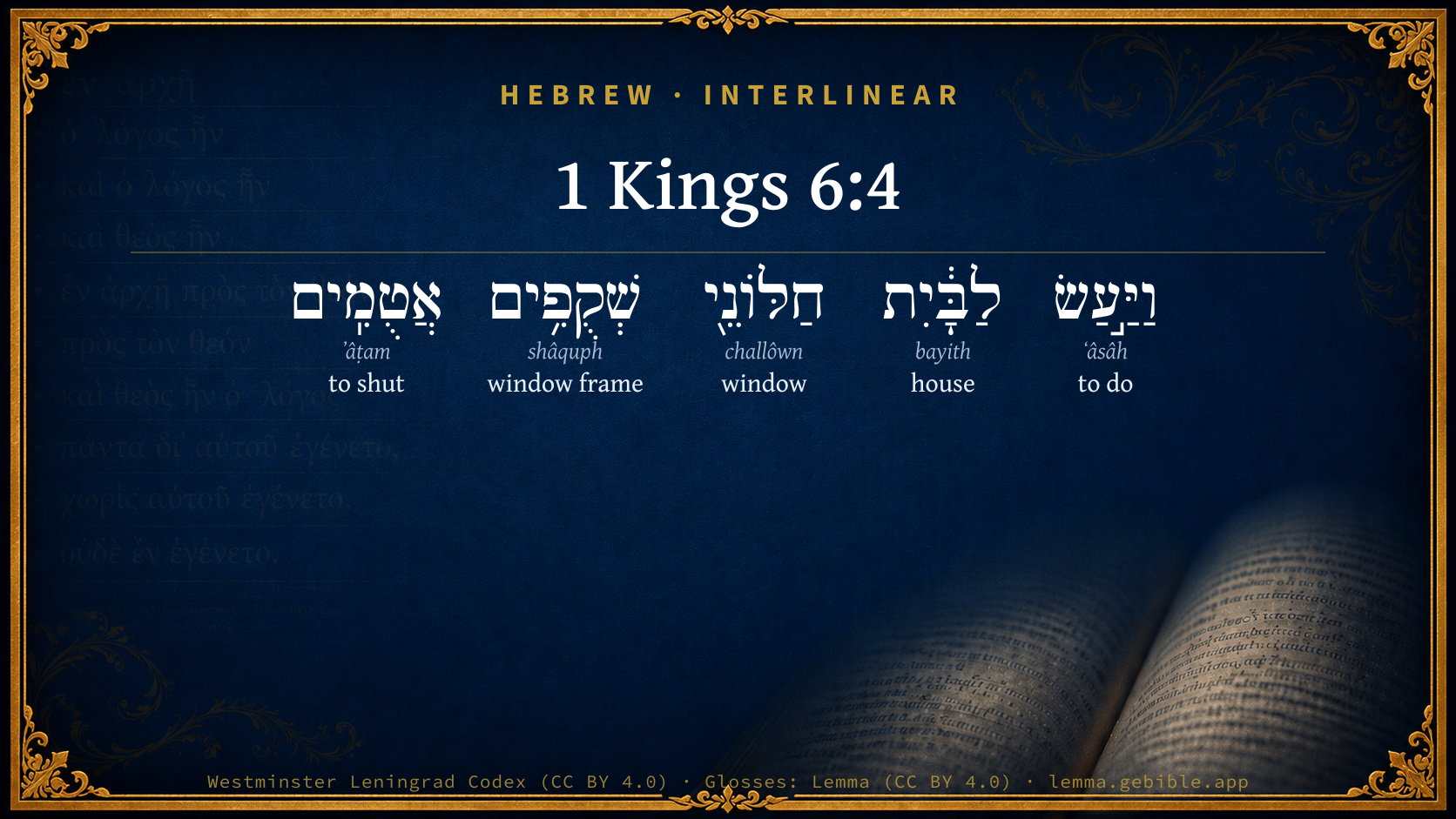
1 Kings 6:4

Hebrew (Westminster Leningrad Codex) 1 Kings 6:4 appears in the Hebrew Old Testament. The text above is from the Westminster Leningrad Codex. Each word links to its Strong’s number, a concise gloss, and parsing drawn from the Open Scriptures Hebrew Bible morphology. Click any word for its full Brown-Driver-Briggs (BDB) entry.
Download image
Cite this verse

1 Kings 6:4 (World English Bible). Public Domain. Lemma interlinear Bible study tool, https://lemma.gebible.app/v/1-kings/6/4.

Show BibTeX & RIS
BibTeX
RIS
English Translation
For the house he made windows of fixed lattice-work.
World English Bible · Public Domain
Highlights
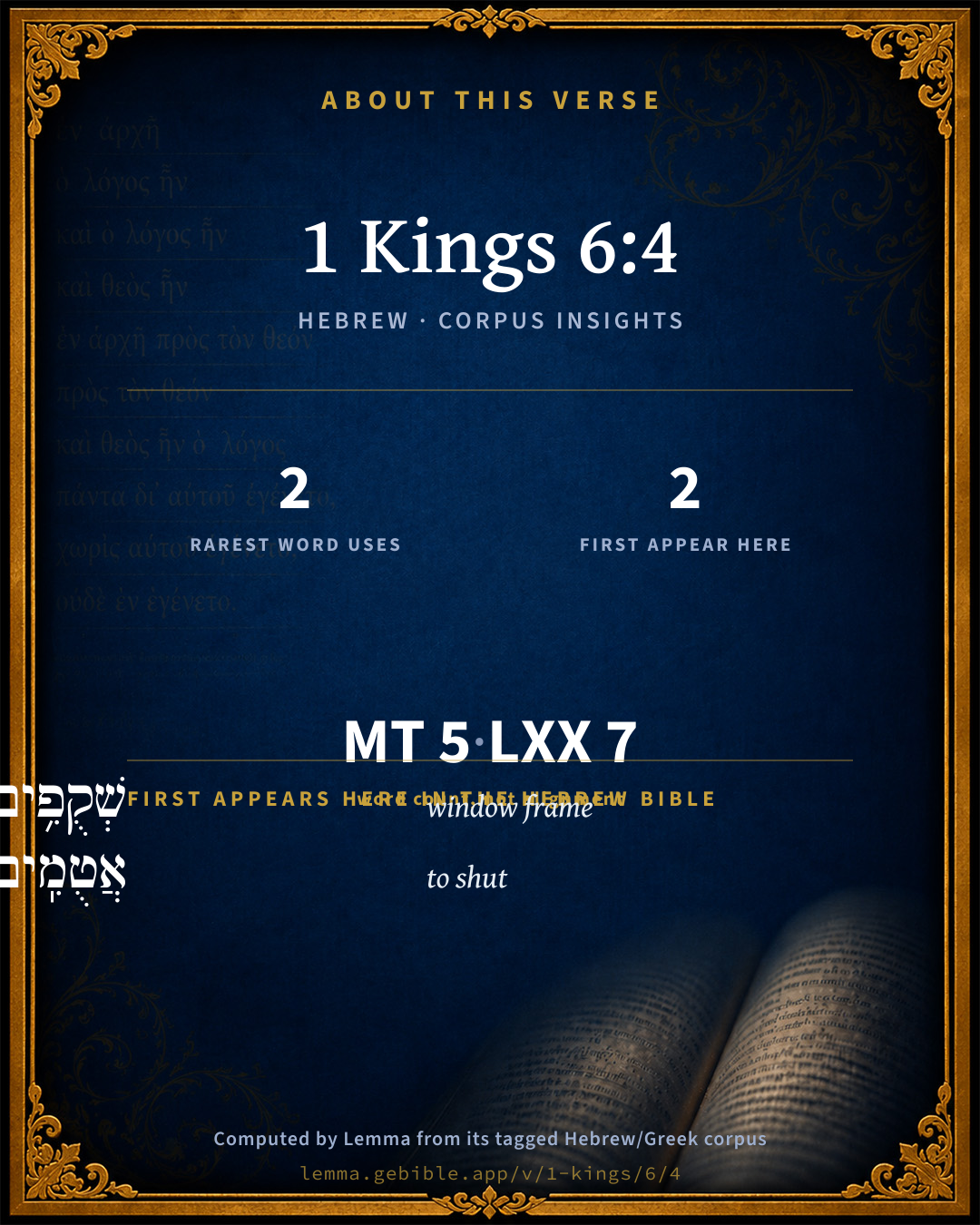
  • 2 first appearances in the Hebrew Bible
Full analysis ↓
Download a study sheet

One document with this verse’s original text, its word-by-word gloss line, the meaning frame, cross-references with their text, attributed commentary, and full source and license credits — printable, and it pastes into notes with its structure intact.

This verse Autodidact and up

Study sheet (.html) Plain text (.txt)

A passage Seminary Student

Up to 50 verses in one chapter. A passage sheet keeps up to 6 commentary sources and 12 cross-references per verse, in the order this page ranks them, and says so on the sheet whenever that leaves anything out. Ask for a single verse and you get the Autodidact verse sheet above.

Everything on this page stays free to read, with no account — the sheet is a download of what is already on screen, not access to it.

Want to remove ads? Support Godless Engineer
Compare translations 3

The same verse in 3 English versions, stacked beneath the original-language interlinear above. Click any original word for its lexicon entry.

Each is an independent rendering of the whole verse — the interlinear is not word-aligned to these translations.

Highlighted words mark where these versions differ — a whole-verse word diff, not a word-by-word alignment.

  • World English Bible Public Domain
    For the house he made windows of fixed lattice-work.
  • King James Version Public Domain
    And for the house he made windows of narrow lights.
  • unfoldingWord Literal Text CC BY-SA 4.0
    And he made for the house windows with narrowed frames.

unfoldingWord Literal Text — © unfoldingWord, licensed CC BY-SA 4.0. Word-aligned USFM3 via Door43 (git.door43.org/unfoldingWord/en_ult).

Versions to compare (up to 4)

3 of 4 selected

Show all 18 translations

Every available English version of this verse, each an independent rendering of the whole verse.

  • World English Bible Public Domain
    For the house he made windows of fixed lattice-work.
  • Berean Standard Bible Public Domain
    He also had narrow windows framed high in the temple.
  • Majority Standard Bible Public Domain
    He also had narrow windows framed high in the temple.
  • King James Version Public Domain
    And for the house he made windows of narrow lights.
  • American Standard Version (1901) Public Domain
    And for the house he made windows of fixed lattice-work.
  • Revised Version (1885) Public Domain
    And for the house he made windows of fixed lattice-work.
  • Geneva Bible (1599) Public Domain
    And in the house he made windowes, broad without, and narrowe within.
  • Douay-Rheims (1899) Public Domain
    And he made in the temple oblique windows.
  • Young's Literal Translation Public Domain
    and he maketh for the house windows of narrow lights.
  • Literal Standard Version CC BY-SA 4.0
    and he makes frames of narrowing windows for the house.
  • Unlocked Literal Bible CC BY-SA 4.0
    For the house he made windows with frames that made them more narrow at the outside than on the inside.
  • unfoldingWord Literal Text CC BY-SA 4.0
    And he made for the house windows with narrowed frames.
  • Darby Bible Public Domain
    And for the house he made closed windows with fixed lattices.
  • World Messianic Bible Public Domain
    He made windows of fixed lattice work for the house.
  • Webster's Bible Public Domain
    And for the house he made windows of narrow lights.
  • Free Bible Version CC BY-SA 4.0
    He had latticed windows made to be placed high up in the Temple.
  • Bible in Basic English Public Domain
    And for the house he made windows, with network across.
  • JPS Tanakh (1917) Public Domain
    And for the house he made windows broad within, and narrow without.

Literal Standard Version (2020), Covenant Press — licensed CC BY-SA 4.0. Text via the HelloAO Bible API (eBible.org). Unlocked Literal Bible (unfoldingWord) — licensed CC BY-SA 4.0. Text via the HelloAO Bible API (eBible.org). unfoldingWord Literal Text — © unfoldingWord, licensed CC BY-SA 4.0. Word-aligned USFM3 via Door43 (git.door43.org/unfoldingWord/en_ult). Free Bible Version, Dr. Jonathan Gallagher — licensed CC BY-SA 4.0. Text via the HelloAO Bible API (eBible.org).

Word by word

More ways to search: Search by grammar → Find every occurrence → Compare this word →

Practice this passage: Drill this verse → Learn its vocabulary →

About this verse

These counts appear in no published source. They are computed here, from the morphology-tagged text and Lemma’s own curated glosses. What Lemma adds →

5
words
5
distinct lemmas
Historical
section

Notable vocabulary

The rarest word here is שְׁקֻפִ֥ים window frame H8261 — appearing just 2 times in the whole Hebrew Bible.

First appearance in Scripture

These words make their first canonical appearance in the Hebrew Bible here:

  • שְׁקֻפִ֥ים window frame H8261
  • אֲטֻמִֽים to shut H331

Shared distinctive vocabulary

שְׁקֻפִ֥ים window frame H8261 occurs in 2 verses of the Hebrew Bible. Also found in:

Grammatical profile

  • 2 verbs
  • 3 nouns

Verb forms

  • וַיַּ֣עַשׂ Qal · Sequential Imperfect
  • אֲטֻמִֽים Qal · Participle Passive

Hebrew & Septuagint length

In English translation the verse runs 9 words from the Hebrew and 10 from the Septuagint (LXX English) — closely comparable.

A rough comparison of the two English renderings, which tokenize alike — not a word-level alignment.

Word counts can differ between the Hebrew and the Greek without any difference in meaning — e.g. the Hebrew direct-object marker אֵת has no separate Greek word, and Greek often adds the article ὁ.

In the original languages it is 5 Hebrew tokens and 7 Greek tokens — but the two are counted differently (Hebrew bundles its prefixes and suffixes into one token; the Greek is in lemma form), so that isn’t a like-for-like length.

Cross-references

4

Topical passages linked to 1 Kings 6:4 in the Treasury of Scripture Knowledge — connected by theme and wording, ordered by reader-vote popularity; previews shown in the World English Bible.

  • Ezekiel 40:16 There were closed windows to the lodges, and to their posts within the gate round about, and likewise to the arches; and windows were round about inward; and on [each] post were palm trees.
  • Ezekiel 41:16 the thresholds, and the closed windows, and the galleries round about on their three stories, over against the threshold, with wood ceilings round about, and [from] the ground up to the windows, (now the windows were covered),
  • Ezekiel 41:26 There were closed windows and palm trees on the one side and on the other side, on the sides of the porch: thus were the side-chambers of the house, and the thresholds.
  • Song of Solomon 2:9 My beloved is like a roe or a young hart. Behold, he stands behind our wall! He looks in at the windows. He glances through the lattice.

Cross-references courtesy of OpenBible.info (CC BY 4.0).

Hebrew and Greek witnesses Masoretic Hebrew ↔ Greek Septuagint

The same verse in the two great witnesses to the Old Testament, shown verse-for-verse.

These are two independent witnesses, not word-aligned to each other, and the Septuagint is shown in lemma (dictionary) form.

Hebrew 1 Kings 6:4 Masoretic · Westminster Leningrad Codex

וַיַּ֣עַשׂ לַבָּ֔יִת חַלּוֹנֵ֖י שְׁקֻפִ֥ים אֲטֻמִֽים

For the house he made windows of fixed lattice-work.

World English Bible · Public Domain

Greek LXX 1 Kings 6:4 Septuagint · lemma form

καί ποιέω ὁ οἶκος θυρίς παρακύπτω κρυπτός

And he made to the house secret windows inclining inward.

LXX2012 (modern English Septuagint) · Public Domain

On this verse, Whedon's Commentary on the Bible discusses the Septuagint’s reading. Read the note in Commentary ↓

Hebrew: Westminster Leningrad Codex (CC BY 4.0). Greek: Septuagint (public domain); English from LXX2012 (modern English Septuagint) (Public Domain). How the Septuagint differs from the Hebrew →

Targum (Aramaic paraphrase)

1

The Targum is the ancient Jewish Aramaic paraphrase of the Hebrew Scriptures — an interpretive translation, not the Hebrew text itself. Onkelos (literal) and Pseudo-Jonathan (expansive) render the Torah, and Jonathan the Prophets. Coverage is partial: where no permissively-licensed English translation exists for a verse, only the Aramaic is shown. This is verse-level text, not a word-by-word alignment to the Hebrew.

  1. Targum Jonathan Prophets (Joshua–Malachi)
    וַעֲבַד לְבֵיתָא כַּוִין פְּתִיחָן מִלְגָיו וּסְתִימָן מִלְבָרָא וְחָפָן כְּלִינְסָא בֵּית אַנְחַת רֵישֵׁי שִׁרְיַת אַרְזַיָא:

    (no public-domain English translation for this verse)

    Targum Jonathan — Aramaic: “Mikraot Gedolot” (public domain). English: “Sefaria Community Translation” (CC0 1.0 (public-domain dedication)); “London "Chaldee Paraphrase," 1871” (public domain). Text via Sefaria.

Commentary

Notes on 1 Kings 6:4 from classic Christian and Jewish commentators (each source and its license shown beneath its notes). The classic Christian expositions comment on the surrounding passage and are grouped to its opening verse, so a note may address several verses; the Jewish commentaries on the Tanakh (Rashi and others) are per-verse, so they appear only where the commentator wrote on this verse.

Lemma curates 59 commentaries, every one of them public domain or Creative Commons licensed, each selected and text-cleaned for this edition rather than reprinted as found. About our sources →

Trapp's Complete Commentary

John Trapp

1Ki 6:4 And for the house he made windows of narrow lights.

Ver. 4. And for the house he made windows of narrow lights.] Or, Broad within and narrow without. Or, Skewed and closed, that is, glazed, as R. Jehudah interpreteth it. Bright the temple was, as being full of windows {a} so Christ came "a light into the world, that whosoever believeth on him should not abide in darkness." {Joh 12:46} The first thing the Spirit doth in a sanctified soul, is to beat out new windows there, and to diffuse a marvellous light. {Act 26:19}

{a} Prospectui accommodas clausus. - Jun.

John Trapp, A Commentary or Exposition upon All the Books of the Old and New Testament (1647–1656) — public domain. Text from a community e-Sword module.

Joseph Benson's Commentary

1Ki 6:4. Windows of narrow lights — Narrow without, to prevent the inconveniences of the weather, and widening by degrees inwardly, that the house might better receive, and more disperse, the light. The tabernacle had no light from without, and it appears by this the temple had not much.

Joseph Benson's Commentary on the Old and New Testaments (1811–1818) — public domain. Text from a community e-Sword module.

Geneva Bible (1599)

Geneva Bible translators

Or, to open and to shut.

Geneva Bible (1599) marginal notes — public domain. Text via Bolls.life.

Jamieson, Fausset & Brown

Robert Jamieson, A. R. Fausset & David Brown

windows of narrow lights--that is, windows with lattices, capable of being shut and opened at pleasure, partly to let out the vapor of the lamps, the smoke of the frankincense, and partly to give light [KEIL].

Jamieson, Fausset & Brown — Commentary Critical and Explanatory on the Whole Bible (1871) — public domain (CC PDM 1.0). Text via the HelloAO Bible API.

Adam Clarke's Commentary

Verse 4. Windows of narrow lights.] The Vulgate says, fenestras obliquas, oblique windows; but what sort of windows could such be?

The Hebrew is חלוני שקפים אטמים challoney shekuphim atumim, windows to look through, which shut. Probably latticed windows: windows through which a person within could see well; but a person without, nothing. Windows, says the Targum, which were open within and shut without. Does he mean windows with shutters; or, are we to understand, with the Arabic, windows opening wide within, and narrow on the outside; such as we still see in ancient castles? This sense our margin expresses. We hear nothing of glass or any other diaphanous substance. Windows, perhaps originally windore, a door to let the wind in, in order to ventilate the building, and through which external objects might be discerned.

Adam Clarke's Commentary on the Bible (1810–1826) — public domain. Text from a community e-Sword/MySword module.

Ellicott's Commentary for English Readers

(4) Windows of narrow lights.—The marginal reading, “windows broad within and narrow without”—splayed as in ordinary Gothic architecture—is supported by very good authorities; but the most probable meaning is “windows with fixed beams”—that is, with fixed lattices, like jalousies, useful for ventilation, but immovable, so that no one could look out or in.

A Bible Commentary for English Readers, edited by Charles John Ellicott (1878–1897) — public domain. Text from a community e-Sword module.

The Cambridge Bible for Schools and Colleges

gen. ed. J. J. S. Perowne

4. windows of narrow lights] It is not easy to explain the nature of these windows from the words used to describe them. They were apparently windows made by overlaid woodwork, either in the fashion of sloping louvre boards or fashioned like latticework crosswise. Then the last word indicates that they were closed in some way or other. Hence the margins of the A.V. ‘windows broad within and narrow without’ or ‘skewed and closed.’ The former of these margins the R.V. has preserved, but gives in the text windows of fixed latticework, taking the word ‘closed’ to imply the permanent nature of the woodwork in the apertures. These windows were in the wall, above the roof of the chambers which are described in the next verse, and must have been of the nature of the clerestory windows which overlook the aisles of a church. There could have been only very little light from them, but the building was lighted artificially.

The Cambridge Bible for Schools and Colleges (gen. ed. J. J. S. Perowne; Cambridge University Press, 1878–1918) — public domain. Text from a community e-Sword module.

John Gill's Exposition

And for the house he made windows of narrow lights. Or "open, shut" (o), which could be both, having shutters to them, to open or shut at pleasure; windows which they could open, and look through at them, or shut when they pleased; the Targum is,

"open within, and shut without;''

or, as others understand it, they were wide within, and narrow without; by being narrow without, the house was preserved from bad weather, as well as could not so easily be looked into by those without; and by being broader within, the light that was let in spread itself within the house; which some interpret only of the holy place, the most holy place having, as they suppose, no windows in it, which yet is not certain: now these windows may denote the word and ordinances of the church of God, whereby light is communicated to men; which in the present state is but narrow or small, in comparison of the new Jerusalem church state, and the ultimate glory; and especially so it was under the legal dispensation, which was very obscure; see Sol 2:9 Isa 55:8.

(o) "apertas clausas", Vatablus; "perspectui accommodas, clausas", Junius & Tremellius, Piscator.

John Gill's Exposition of the Whole Bible (1746–1763) — public domain (CC PDM 1.0). Text via the HelloAO Bible API.

Albert Barnes' Notes on the Bible

Windows of narrow lights - Either (as in the margin) windows, externally mere slits in the wall, but opening wide within, like the windows of old castles: or, more probably, “windows with fixed lattices.” The windows seem to have been placed high in the walls, above the chambers spoken of in 1Ki 6:5-8.

Albert Barnes' Notes on the Bible (1834–1885) — public domain. Text from a community e-Sword/MySword module.

Haydock's Catholic Bible Commentary

Oblique windows. Which were made slanting, that the light might be more easily communicated within. (Haydock) --- On the outside they were not so large. (Worthington) (Menochius) --- Hebrew, "windows to see through, shut," with lattices, (Calmet) or blinds. Protestants, "he made windows of narrow lights." (Haydock) --- Curtains might be hung before them, as no glass was yet used. (Calmet) --- These windows occupied the five cubits above the chambers, which were built on the west end, and on the sides of the temple, 15 cubits high. (Calmet) --- No windows were permitted in the holy of holies. (Menochius)

George Leo Haydock (1774–1849), Haydock's Catholic Family Bible and Commentary, 1859 edition — public domain. Excludes Psalms (Douay-Rheims chapter numbering differs from Protestant) and Deuterocanonical books (Catholic canon only).

Matthew Poole's English Annotations

Narrow outward, to prevent the inconveniences of the weather; widening by degrees inward, that so the house might better receive and more disperse the light. Or, for prospect, i.e. to give light; yet shut, i.e. so far closed as to keep out weather, and let in light.

Matthew Poole's English Annotations on the Holy Bible (1683–1685) — public domain. Text from a community e-Sword/MySword module.

Whedon's Commentary on the Bible

Daniel D. Whedon

4. Windows of narrow lights — Septuagint, holes of concealed network. Vulgate, slanting windows. The Hebrew is, windows of closed bars; that is, of lattice work. They served both for ventilation and for light. The position of these windows is not stated, and we are left to infer that they were set wherever needed, and wherever they would help to enhance the architectural finish and beauty of the building. Hence they were probably both in the upper part of the main building and also in the side-chambers. Compare Eze_40:16.

Daniel D. Whedon (gen. ed.), Commentary on the Old and New Testaments (1874–1909) — public domain. Text from a community e-Sword module.

John Wesley's Explanatory Notes

Narrow - Narrow outward, to prevent the inconveniences of the weather; widening by degrees inward, that so the house might better receive, and more disperse the light.

John Wesley, Explanatory Notes Upon the Whole Bible (1754–1765) — public domain. Text via the GEBible commentary corpus.

Scofield Reference Notes

C. I. Scofield

windows of narrow lights

Cf. 2Ch 4:20. In the holy of holies in the tabernacle no light but the shekinah glory was provided. In many ways Solomon’s temple manifests the spiritual deterioration of the people, and Jehovah’s condescension to it in grace.

The Scofield Reference Bible (1917 edition), notes by C. I. Scofield — public domain. Text from a community e-Sword module.

Rashi

Rabbi Shlomo Yitzchaki (Rashi)

That were open [wide] on the outside and closed [narrow] on the inside. Our Rabbis explained [שקופים] as an expression of looking, an opening, an observation; open on the outside and closed on the inside, narrow on the inside, not in the usual manner of other windows which are made for illumination, to indicate that it was not in need of illumination.

Rashi on the Tanakh — English translations: “The Judaica Press complete Tanach with Rashi, translated by A. J. Rosenberg” (CC BY 4.0); “Pentateuch with Rashi's commentary by M. Rosenbaum and A.M. Silbermann, 1929-1934” (public domain); “The Metsudah Tanach series, Lakewood, N.J” (CC BY 4.0); and “The Book of Joshua, Metsudah Publications, 1997” (CC BY 4.0). Text via Sefaria.

Lesson kit

Teaching starters — assembled from the data on this page, not authored interpretation. Every prompt links to the verse data it draws on. Edit before teaching.

1 Kings, in the Historical, opens this verse with 5 words (5 distinct Hebrew lemmas). Its most distinctive word is shâquph (“window frame”). A historical commentator’s framing appears above. Read the whole chapter for the surrounding context.

Discussion questions

  1. How does “window frame” (shâquph) shape what this verse is saying?
  2. 2 words make their first appearance in Scripture here. What does this debut establish?
  3. How does 1 Kings 7:4, which shares the word «window frame», read alongside this verse?
  4. These translations render this verse differently. What is at stake in choosing one wording over another?
  5. «וַיַּ֣עַשׂ» is a Qal Sequential Imperfect verb. How does that grammatical form shape the action described?
  6. Compare how Trapp's Complete Commentary and Joseph Benson's Commentary read this verse. Where do they agree or differ?

Things to notice

Reading settings

Reading text

Shown beneath each verse's original-language words.

Old Testament
Old Testament edition

Read the OT as the Masoretic Hebrew (MT) or the Greek Septuagint (LXX).

English shown for the Greek Septuagint (in the Hebrew ↔ Greek comparison).

Comparing translations? Open the Compare panel on any verse page to stack up to four side by side.