
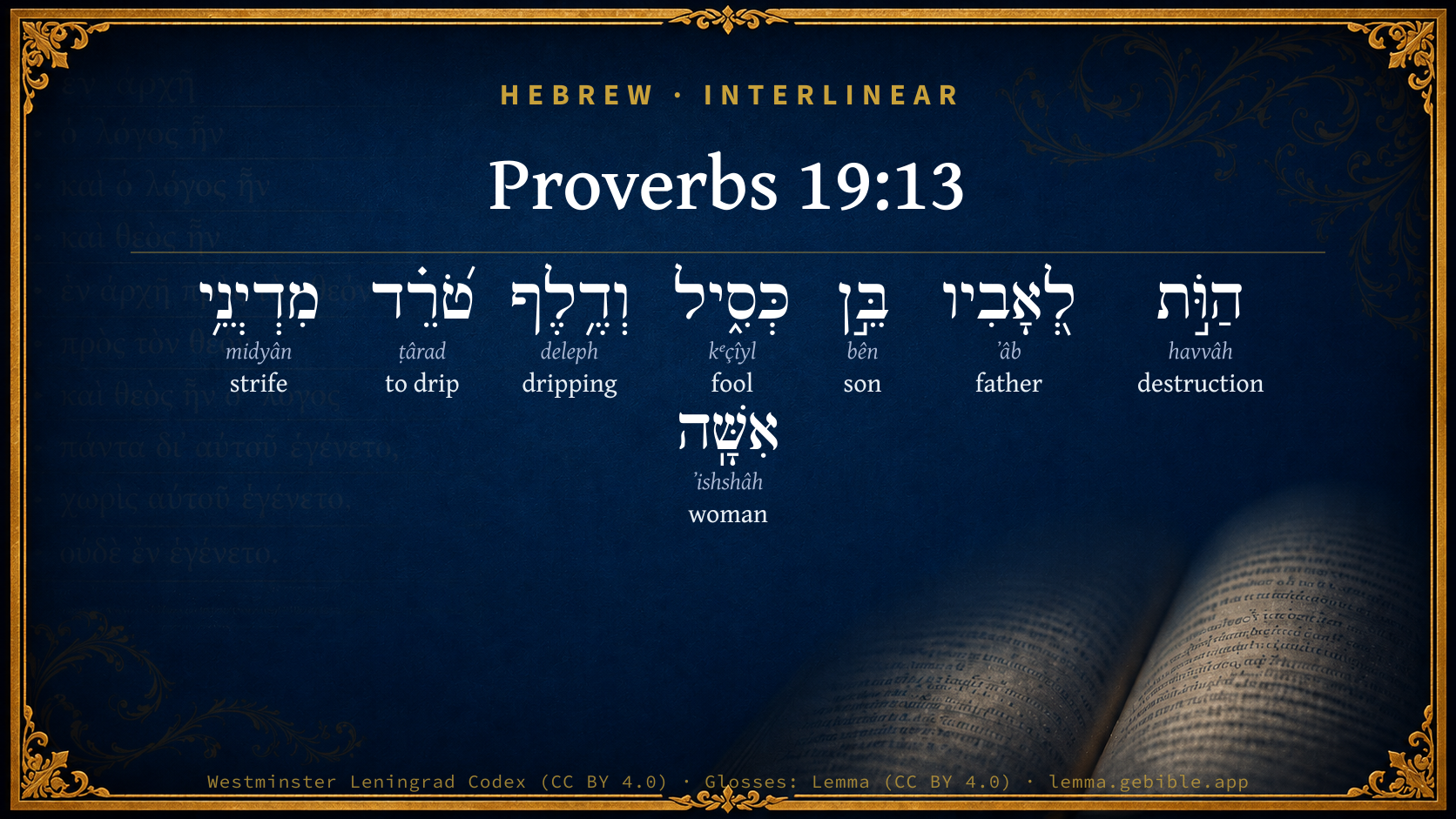
Proverbs 19:13

Hebrew (Westminster Leningrad Codex) Proverbs 19:13 appears in the Hebrew Old Testament. The text above is from the Westminster Leningrad Codex. Each word links to its Strong’s number, a concise gloss, and parsing drawn from the Open Scriptures Hebrew Bible morphology. Click any word for its full Brown-Driver-Briggs (BDB) entry.
Download image
Cite this verse

Proverbs 19:13 (World English Bible). Public Domain. Lemma interlinear Bible study tool, https://lemma.gebible.app/v/proverbs/19/13.

Show BibTeX & RIS
BibTeX
RIS
English Translation
A foolish son is the calamity of his father. A wife's quarrels are a continual dripping.
World English Bible · Public Domain
Highlights
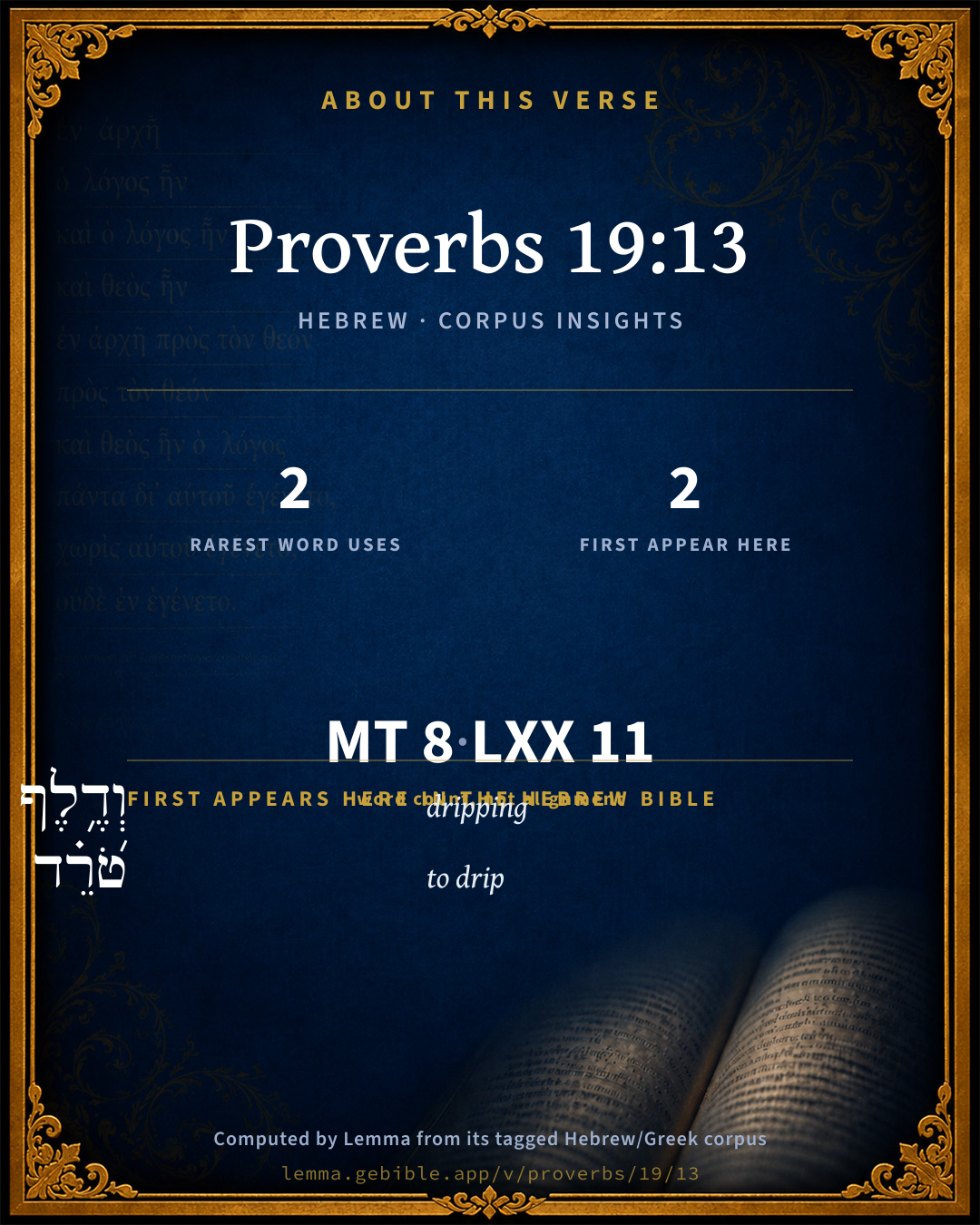
  • 2 first appearances in the Hebrew Bible
Full analysis ↓
Download a study sheet

One document with this verse’s original text, its word-by-word gloss line, the meaning frame, cross-references with their text, attributed commentary, and full source and license credits — printable, and it pastes into notes with its structure intact.

This verse Autodidact and up

Study sheet (.html) Plain text (.txt)

A passage Seminary Student

Up to 50 verses in one chapter. A passage sheet keeps up to 6 commentary sources and 12 cross-references per verse, in the order this page ranks them, and says so on the sheet whenever that leaves anything out. Ask for a single verse and you get the Autodidact verse sheet above.

Everything on this page stays free to read, with no account — the sheet is a download of what is already on screen, not access to it.

Want to remove ads? Support Godless Engineer
Compare translations 3

The same verse in 3 English versions, stacked beneath the original-language interlinear above. Click any original word for its lexicon entry.

Each is an independent rendering of the whole verse — the interlinear is not word-aligned to these translations.

Highlighted words mark where these versions differ — a whole-verse word diff, not a word-by-word alignment.

  • World English Bible Public Domain
    A foolish son is the calamity of his father. A wife's quarrels are a continual dripping.
  • King James Version Public Domain
    A foolish son is the calamity of his father: and the contentions of a wife are a continual dropping.
  • unfoldingWord Literal Text CC BY-SA 4.0
    A stupid son destruction to his father, and a continual dripping, the quarrels of a wife.

unfoldingWord Literal Text — © unfoldingWord, licensed CC BY-SA 4.0. Word-aligned USFM3 via Door43 (git.door43.org/unfoldingWord/en_ult).

Versions to compare (up to 4)

3 of 4 selected

Show all 18 translations

Every available English version of this verse, each an independent rendering of the whole verse.

  • World English Bible Public Domain
    A foolish son is the calamity of his father. A wife's quarrels are a continual dripping.
  • Berean Standard Bible Public Domain
    A foolish son is his father’s ruin, and a quarrelsome wife is like a constant dripping.
  • Majority Standard Bible Public Domain
    A foolish son is his father’s ruin, and a quarrelsome wife is like a constant dripping.
  • King James Version Public Domain
    A foolish son is the calamity of his father: and the contentions of a wife are a continual dropping.
  • American Standard Version (1901) Public Domain
    A foolish son is the calamity of his father; And the contentions of a wife are a continual dropping.
  • Revised Version (1885) Public Domain
    A foolish son is the calamity of his father: and the contentions of a wife are a continual dropping.
  • Geneva Bible (1599) Public Domain
    A foolish sonne is the calamitie of his father, and the contentions of a wife are like a continuall dropping.
  • Douay-Rheims (1899) Public Domain
    A foolish son is the grief of his father: and a wrangling wife is like a roof continually dropping through.
  • Young's Literal Translation Public Domain
    A calamity to his father `is' a foolish son, And the contentions of a wife `are' a continual dropping.
  • Literal Standard Version CC BY-SA 4.0
    A foolish son [is] a calamity to his father, || And the contentions of a wife [are] a continual dropping.
  • Unlocked Literal Bible CC BY-SA 4.0
    A foolish son is ruin to his father and a quarreling wife is a constant dripping of water.
  • unfoldingWord Literal Text CC BY-SA 4.0
    A stupid son destruction to his father, and a continual dripping, the quarrels of a wife.
  • Darby Bible Public Domain
    A foolish son is the calamity of his father; and the contentions of a wife are a continual dropping.
  • World Messianic Bible Public Domain
    A foolish son is the calamity of his father. A wife’s quarrels are a continual dripping.
  • Webster's Bible Public Domain
    A foolish son is the calamity of his father: and the contentions of a wife are a continual dropping.
  • Free Bible Version CC BY-SA 4.0
    A stupid son makes his father miserable, and an argumentative wife is like dripping that never stops.
  • Bible in Basic English Public Domain
    A foolish son is the destruction of his father; and the bitter arguments of a wife are like drops of rain falling without end.
  • JPS Tanakh (1917) Public Domain
    A foolish son is the calamity of his father; and the contentions of a wife are a continual dropping.

Literal Standard Version (2020), Covenant Press — licensed CC BY-SA 4.0. Text via the HelloAO Bible API (eBible.org). Unlocked Literal Bible (unfoldingWord) — licensed CC BY-SA 4.0. Text via the HelloAO Bible API (eBible.org). unfoldingWord Literal Text — © unfoldingWord, licensed CC BY-SA 4.0. Word-aligned USFM3 via Door43 (git.door43.org/unfoldingWord/en_ult). Free Bible Version, Dr. Jonathan Gallagher — licensed CC BY-SA 4.0. Text via the HelloAO Bible API (eBible.org).

Word by word

More ways to search: Search by grammar → Find every occurrence → Compare this word →

Practice this passage: Drill this verse → Learn its vocabulary →

About this verse

These counts appear in no published source. They are computed here, from the morphology-tagged text and Lemma’s own curated glosses. What Lemma adds →

8
words
8
distinct lemmas
Wisdom
section

Notable vocabulary

The rarest word here is וְדֶ֥לֶף dripping H1812 — appearing just 2 times in the whole Hebrew Bible.

First appearance in Scripture

These words make their first canonical appearance in the Hebrew Bible here:

  • וְדֶ֥לֶף dripping H1812
  • טֹ֝רֵ֗ד to drip H2956

Shared distinctive vocabulary

וְדֶ֥לֶף dripping H1812 occurs in 2 verses of the Hebrew Bible. Also found in:

Grammatical profile

  • 1 verb
  • 6 nouns
  • 1 adjective

Verb forms

  • טֹ֝רֵ֗ד Qal · Participle Active

Hebrew & Septuagint length

In English translation the verse runs 16 words from the Hebrew and 21 from the Septuagint (LXX English) — closely comparable.

A rough comparison of the two English renderings, which tokenize alike — not a word-level alignment.

Word counts can differ between the Hebrew and the Greek without any difference in meaning — e.g. the Hebrew direct-object marker אֵת has no separate Greek word, and Greek often adds the article ὁ.

In the original languages it is 8 Hebrew tokens and 11 Greek tokens — but the two are counted differently (Hebrew bundles its prefixes and suffixes into one token; the Greek is in lemma form), so that isn’t a like-for-like length.

Cross-references

11

Topical passages linked to Proverbs 19:13 in the Treasury of Scripture Knowledge — connected by theme and wording, ordered by reader-vote popularity; previews shown in the World English Bible.

  • Proverbs 21:9 It is better to dwell in the corner of the housetop, Than to share a house with a contentious woman.
  • Proverbs 27:15 A continual dropping on a rainy day And a contentious wife are alike:
  • Proverbs 10:1 The proverbs of Solomon. A wise son makes a glad father; But a foolish son brings grief to his mother.
  • Proverbs 25:24 It is better to dwell in the corner of the housetop, Than to share a house with a contentious woman.
  • 2 Samuel 13:1–18 It happened after this, that Absalom the son of David had a beautiful sister, whose name was Tamar; and Amnon the son of David loved her.
  • Job 14:19 The waters wear the stones; The torrents of it wash away the dust of the earth: So you destroy the hope of man.
  • Proverbs 15:20 A wise son makes a father glad, But a foolish man despises his mother.
  • Proverbs 17:21 He who becomes the father of a fool grieves. The father of a fool has no joy.
  • Proverbs 17:25 A foolish son brings grief to his father, And bitterness to her who bore him.
  • Proverbs 21:19 It is better to dwell in a desert land, Than with a contentious and fretful woman.
  • Ecclesiastes 2:18–19 I hated all my labor in which I labored under the sun, seeing that I must leave it to the man who comes after me.

Cross-references courtesy of OpenBible.info (CC BY 4.0).

Hebrew and Greek witnesses Masoretic Hebrew ↔ Greek Septuagint

The same verse in the two great witnesses to the Old Testament, shown verse-for-verse.

These are two independent witnesses, not word-aligned to each other, and the Septuagint is shown in lemma (dictionary) form.

Hebrew Proverbs 19:13 Masoretic · Westminster Leningrad Codex

הַוֺּ֣ת לְ֭אָבִיו בֵּ֣ן כְּסִ֑יל וְדֶ֥לֶף טֹ֝רֵ֗ד מִדְיְנֵ֥י אִשָּֽׁה

A foolish son is the calamity of his father. A wife's quarrels are a continual dripping.

World English Bible · Public Domain

Greek LXX Proverbs 19:13 Septuagint · lemma form

αἰσχύνη πατήρ υἱός ἄφρων καί οὐ ἁγνός εὐχή ἀπό μίσθωμα ἑταίρα

A foolish son is a disgrace to his father: vows paid out of the hire of a harlot are not pure.

LXX2012 (modern English Septuagint) · Public Domain

On this verse, The Pulpit Commentary discusses the Septuagint’s reading. Read the note in Commentary ↓

Hebrew: Westminster Leningrad Codex (CC BY 4.0). Greek: Septuagint (public domain); English from LXX2012 (modern English Septuagint) (Public Domain). How the Septuagint differs from the Hebrew →

Commentary

Notes on Proverbs 19:13 from classic Christian and Jewish commentators (each source and its license shown beneath its notes). The classic Christian expositions comment on the surrounding passage and are grouped to its opening verse, so a note may address several verses; the Jewish commentaries on the Tanakh (Rashi and others) are per-verse, so they appear only where the commentator wrote on this verse.

Lemma curates 59 commentaries, every one of them public domain or Creative Commons licensed, each selected and text-cleaned for this edition rather than reprinted as found. About our sources →

Trapp's Complete Commentary

John Trapp

Pro 19:13 A foolish son [is] the calamity of his father: and the contentions of a wife [are] a continual dropping.

Ver. 13. A foolish son is the calamity of his father.] Children are certain cares, but uncertain comforts. Let them prove never so towardly, yet there is somewhat to do to breed them up, and bring them to good. But if they answer not expectation, the parent’s grief is inexpressible. See the note on Pro 10:1, and xv. 20. How many an unhappy father is tempted to wish with Augustus,

‘O utinam caelebs vixissem, orbusque perissem?’

And the contentions of a wife are a continual dropping.] Like as a man that hath met with hard usage abroad thinks to mend himself at home, but is no sooner sat down there but the rain, dropping through the roof upon his head, drives him out of doors again. Such is the case of him that hath a contentious wife - a far greater cross than that of ungracious children, which yet are the father’s calamities and heart breaks. Augustus had been happy if he had had no children; Sulla if he had had no wife. All evils, as elements, are most troublesome when out of their proper place, as impiety in professors, injustice in judges, discomfort in a wife. This is like a tempest in the haven, most troublesome, most dangerous. {a}

{a} Coniugium coniurgium. De discordi coniugio Themistocles dixit, συνοικουσι, ου συμβιουσι.

John Trapp, A Commentary or Exposition upon All the Books of the Old and New Testament (1647–1656) — public domain. Text from a community e-Sword module.

Joseph Benson's Commentary

Pro 19:13. A foolish son, &c. — Two things make a man exceeding unhappy, a dissolute son, and a contentious wife: for the former is a perpetual grief to his father, to see him likely to prove the utter destruction of his family; and the quarrels of a wife spoil a man’s happiness, like perpetual droppings, which wear away what they fall upon.

Joseph Benson's Commentary on the Old and New Testaments (1811–1818) — public domain. Text from a community e-Sword module.

The Preacher's Complete Homiletical Commentary

Joseph S. Exell (gen. ed.)

CRITICAL NOTES.—

Pro_19:13. Calamity. The word so translated is in the plural form, so as to express the continuance of the trouble.

MAIN HOMILETICS OF Pro_19:13-14; Pro_19:18

DOMESTIC SORROW AND HOW TO AVOID IT

I. Two fruitful sources of sorrow. There are many fountains whence flow waters which sadly embitter the lives of men, but there is none outside of personal character which can more entirely darken their days than either of those mentioned in the thirteenth verse. To be either the father of a foolish son or the husband of a contentious wife is sorrow indeed. The first clause of this proverb is nearly the same as that in chap. Pro_10:1, for Homiletics on which see page 137. The contentious wife is here compared to a “continual dropping,” because although the discomfort would not be great if it was only occasional, its perpetual existence makes life wretched. A drop of water falling upon a man’s head is a very trifling matter, but one of the most dreaded tortures of the Spanish inquisition was that in which a man was placed in such a position that a single drop was constantly descending upon his head. Hour after hour, day after day, and night after night, the drops followed one another in regular and unbroken succession until the poor wretch first lost reason and then life. It is much harder to bear a burden which is never lifted from the shoulders than to carry one which is much heavier for a short time and for a very limited distance. So it is easier for a man to rise above trials which, although they may be almost overwhelming for a time, last but through a comparatively very short portion of his life. But the trial of a contentious wife is unceasing so long as the marriage bond continues, and it is this that makes it so greatly to be dreaded.

II. Means suggested whereby these sources of sorrow may be avoided. If so much depends upon our family relationships—if the character of wife and child have so much to do with our weal and woe—it becomes a most momentous question how to act so as to secure a prudent wife in the first place, and then to avoid the calamity of a foolish son. It must be remembered that the first is purely a matter of choice. A man’s “house and riches” may be “the inheritance of fathers,” his social position may depend upon his parents, but his wife depends upon his own choice, and as “a prudent wife is from the Lord,” if he seeks the guidance of Him who is alone the infallible reader of character, instead of following the leadings of his fancy or consulting his worldly interests, he may with confidence expect to avoid the curse and secure the blessing. The other relationship is not one of choice. Our children are sent to us by the hand of God, and we have no more voice in determining their dispositions and mental constitutions than we have the colour of their hair, or any other bodily characteristic. But of two things we are certain.

1. That they will need a training which will not be always pleasant to them. Where there is disease in the body a cure cannot often be effected without a resort to unpleasant—often to painful—measures. It is not pleasant to a surgeon to use the knife, but it is often indispensable to his patient’s recovery to health. And both experience and revelation testify to the fact that our children come into the world with a moral taint upon them—that they have a tendency to go the wrong way—that, in the words of the Psalmist (Psa_51:5) they are “shapen in iniquity and conceived in sin.” If a parent desires to avoid the calamity of a foolish son he must early recognise the truth that his child will not become morally wise unless he “chasten” him, unless he subject him to a system of moral training, unless he make him feel that punishment must follow sin. This will be as painful sometimes to the parent as to the child; the crying of the son will hurt the father more than the rod will hurt the child, but the end to be attained by present suffering must be borne in mind, and must nerve the heart and hand of him whose duty it is to administer chastisement. (On this subject see also Homiletics on chap. Pro_13:24, page 334).

2. That there is reason to hope that children, if rightly trained, will be a joy and not a sorrow. There is hope. When a river has but just left its source among the hills, and the current is feeble, its progress can be stopped with ease; but when it has flowed on for a few miles and there is depth of water enough to float a fleet, it is almost impossible to stop its onward course. So, when the power of evil in the human soul is in its infancy, it is a much more easy task to restrain it than when it has acquired strength by years of uncontrolled dominion. When the young oak is but a few inches above the ground, the hand of the woodman can bend the slender stem as he pleases; but when it has grown for half a century he is powerless to turn it from the direction which it has taken. So a child’s will is pliable to the wise training of the parent, and if the education of the moral nature be begun early, there is every reason to hope that it will acquire strength to overcome both sin within and without, and that a righteous manhood will in the future more than repay both him whose duty it is to chasten, and him upon whom the chastisement must fall.

OUTLINES AND SUGGESTIVE COMMENTS

Pro_19:13-14. “A prudent wife” is not to be got by an imprudent mode of choice. The gift must be sought “from the Lord.” But this does not mean that the Lord is supernaturally to point out the individual. Our own discretion must be put in exercise, along with prayer for the divine superintendence and direction, so as to bring about a happy result. And then the precious gift should be owned, and the all-bountiful Giver praised for his goodness in bestowing it.—Wardlaw.

“Every good gift is from the Lord” (Jas_1:17) only, some in the ordinary course, others more directly from Him. Houses and riches, though His gifts, come by descent. They are the inheritance of fathers. The heir is known, and in the course of events he takes possession of his estate. But the prudent wife is wholly unconnected with the man. There has been no previous bond of relation. She is often brought from a distance. “The Lord brought her to the man” by His special Providence, and therefore as His special gift.—Bridges.

Pro_19:18. The great force of the rule is its timely application—while there is hope. For hopeless the case may be, if the remedy be delayed. The cure of the evil must be commenced in infancy. Not a moment is to be lost. “Betimes” (chap. Pro_13:24; Pro_22:15)—is the season when the good can be effected with the most ease, and the fewest strokes. The lesson of obedience should be learnt at the first dawn. One decided struggle and victory in very early life, may, under God, do much towards settling the point at once and to the end. On the other hand, sharp chastening may fail later to accomplish, what a slight rebuke in the early course might have wrought.—Bridges.

You are here taught further, that firmness must be in union with affection in applying the rod. The words seem to express a harsh, yet it is an important and most salutary lesson:—“let not thy soul spare for his crying.” The words do not mean, that you should not feel, very far from that. It was the knowledge that feeling was unavoidable, and that the strength and tenderness of it was ever apt to tempt parents to relent and desist, and leave their end unaccomplished,—that made it necessary to warn against too ready a yielding to this natural inclination. The child may cry, and cry bitterly, previously to the correction; but, when you have reason to think the crying is for the rod rather than for the fault, and that, but for the threatened chastisement, the heart would probably have been unmoved, and the eyes dry;—then you must not allow yourselves to be so unmanned by his tears, as to suspend your purpose, and decline its infliction. If a child perceives this (and soon are children sharp enough to find it out) he has discovered the way to move you next time; and will have recourse to it accordingly.—Wardlaw.

On the subject of Pro_19:15 see Homiletics on chap. Pro_6:9-10, page 79.

The Preacher's Complete Homiletical Commentary (gen. ed. Joseph S. Exell; Funk & Wagnalls, c. 1892) — public domain (pre-1929). A full-Bible homiletical/sermon-outline anthology covering 65 of 66 books (2 John is absent from the source module). Text from a community e-Sword module.

Tyndale Open Study Notes

Tyndale Open Resources

19:13-14 No choice for a son is more important than a good wife (cp. 31:10-31); a poor choice brings agony (see 10:1; 11:22; 12:4; 21:9, 19; 25:24; 27:15-17). The wise man will look to the Lord to give an understanding wife.

Tyndale Open Study Notes — © Tyndale Open Resources, licensed CC BY-SA 4.0. Text via the HelloAO Bible API.

Geneva Bible (1599)

Geneva Bible translators

As rain that droppeth and rotteth the house.

Geneva Bible (1599) marginal notes — public domain. Text via Bolls.life.

Matthew Henry's Commentary

It is an instance of the vanity of the world that we are liable to the greatest grief in those things wherein we promise ourselves the greatest comfort. It is as it proves. What greater temporal comfort can a man have than a good wife and good children? Yet, 1. A foolish son is a great affliction, and may make a man wish a thousand times he had been written childless. A son that will apply himself to no study or business, that will take no advice, that lives a lewd, loose, rakish life, and spends what he has extravagantly, games it away and wastes it in the excess of riot, or that is proud, foppish, and conceited, such a one is the grief of his father, because he is the disgrace, and is likely to be the ruin, of his family. He hates all his labour, when he sees to whom he must leave the fruit of it. 2. A cross peevish wife is as great an affliction: Her contentions are continual; every day, and every hour in the day, she finds some occasion to make herself and those about her uneasy. Those that are accustomed to chide never want something or other to chide at; but it is a continual dropping, that is, a continual vexation, as it is to have a house so much out of repair that it rains in and a man cannot lie dry in it. That man has an uncomfortable life, and has need of a great deal of wisdom and grace to enable him to bear his affliction and do his duty, who has a sot for his son and a scold for his wife.

Matthew Henry's Commentary on the Whole Bible (1708–1710) — public domain (CC PDM 1.0). Text via the HelloAO Bible API.

Jamieson, Fausset & Brown

Robert Jamieson, A. R. Fausset & David Brown

calamity--literally, "calamities," varied and many.

continual dropping--a perpetual annoyance, wearing out patience.

Jamieson, Fausset & Brown — Commentary Critical and Explanatory on the Whole Bible (1871) — public domain (CC PDM 1.0). Text via the HelloAO Bible API.

Adam Clarke's Commentary

Verse 13. The contentions of a wife are a continual dropping.] The man who has got such a wife is like a tenant who has got a cottage with a bad roof, through every part of which the rain either drops or pours. He can neither sit, stand, work, nor sleep, without being exposed to these droppings. God help the man who is in such a case, with house or wife!

Adam Clarke's Commentary on the Bible (1810–1826) — public domain. Text from a community e-Sword/MySword module.

Ellicott's Commentary for English Readers

(13) A continual dropping.—As of the rain leaking through the flat roof of an eastern house on a wet day. (Comp. 27:15.)

A Bible Commentary for English Readers, edited by Charles John Ellicott (1878–1897) — public domain. Text from a community e-Sword module.

The Cambridge Bible for Schools and Colleges

gen. ed. J. J. S. Perowne

13. continual] Lit. thrusting, where one drop follows so closely upon another as to thrust it forward. “In quo gutta guttam trudit,” Maur.; “Tecta jugiter perstillantia litigiosa mulier,” Vulg. Comp. Pro_27:15.

The Cambridge Bible for Schools and Colleges (gen. ed. J. J. S. Perowne; Cambridge University Press, 1878–1918) — public domain. Text from a community e-Sword module.

John Gill's Exposition

A foolish son is the calamity of his father,.... Or, "the calamities of his father" (q); he brings them to him. A very great affliction he is, and which has many distresses and sorrows in it; as loss of reputation and credit in his family, which is sunk by his behaviour, instead of being supported and increased; loss of substance, through extravagance and riotous living, and the ruin of his soul and body by his wicked practices; see Pro 10:1;

and the contentions of a wife are a continual dropping; or like the dropping of rain, in a rainy day, into a house out of repair, and which is very uncomfortable to, the inhabitants of it; see Pro 27:15. Such are the contentions of a peevish, ill natured, and brawling wife, who is always scolding; and which is a continual vexation to a man, and renders him very uneasy in life: such a continual dropping was Xantippe to Socrates, who teased him night and day with her brawls and contentions (r). A great unhappiness each of these must be!

(q) "calamitates", Vatablus; "aerumnae", Piscator, Michaelis; "causa aerumnarum", Junius & Tremellius. (r) A. Gell. Noct. Attic. l. 1. c. 17.

John Gill's Exposition of the Whole Bible (1746–1763) — public domain (CC PDM 1.0). Text via the HelloAO Bible API.

Albert Barnes' Notes on the Bible

Calamity - The Hebrew word is plural (as in Psa 57:1; Psa 91:3), and seems to express the multiplied and manifold sorrow caused by the foolish son.

Continual dropping - The irritating, unceasing, sound of the fall, drop after drop, of water through the chinks in the roof.

Albert Barnes' Notes on the Bible (1834–1885) — public domain. Text from a community e-Sword/MySword module.

Haydock's Catholic Bible Commentary

Through. It cannot be endured long. (Calmet) --- Dos est uxoria lites. (Ovid, Art. 1.) --- "Quarrels are a wife’s dowry."

George Leo Haydock (1774–1849), Haydock's Catholic Family Bible and Commentary, 1859 edition — public domain. Excludes Psalms (Douay-Rheims chapter numbering differs from Protestant) and Deuterocanonical books (Catholic canon only).

Matthew Poole's English Annotations

Are like rain continually dropping upon a house, which by degrees marreth the house and household stuff, and driveth the inhabitants out of it. He compareth her to a

continual dropping, because of that inseparable union and necessary cohabitation of husband and wife together, notwithstanding such contentions.

Matthew Poole's English Annotations on the Holy Bible (1683–1685) — public domain. Text from a community e-Sword/MySword module.

Whedon's Commentary on the Bible

Daniel D. Whedon

13. Calamity… contentions — “Two things,” says Patrick, “make a man exceedingly unhappy — a dissolute son and a scolding wife; for the former breaks the heart of the father, and as to the other, he is no more able to live at home with her than to dwell in a rotten and ruinous house, through the roof of which the rain drops perpetually.” Smart says: “A continual dropping of water, for example, on the head, becomes, after a time, a means of the most exquisite suffering.” An Illyrian proverb says, “There is no necessity for him to go to war who has a smoking house, a dropping roof, or a contentious wife; for he has war in his own house.” Compare Pro_21:9; Pro_27:15; Pro_10:1; Pro_15:20; Pro_19:21; Pro_19:25. See note on Pro_27:15.

Daniel D. Whedon (gen. ed.), Commentary on the Old and New Testaments (1874–1909) — public domain. Text from a community e-Sword module.

The Pulpit Commentary

With the first clause we may compare Pro_10:1 Pro_15:20 Pro_17:21, Pro_17:25. Calamity in the Hebrew is in the plural number (contritiones, Pagn.), as if to mark the many and continued sorrows which a bad son brings upon his father, how he causes evil after evil to harass and distress him. The contentions of a wife are a continual dropping. (comp. Pro_27:15) The flat roofs of Eastern houses, formed of planks loosely joined and covered with a coating of clay or plaster, were always subject to leakage in heavy rains. The irritating altercations and bickering of a cross-grained wife are compared to the continuous drip of water through an imperfectly constructed roof. Tecta jugiter perstillantia, as the Vulgate has it. The Scotch say, "A leaky house and a scolding wife are two bad companions." The two clauses of the verse are coordinate, expressing two facts that render home life miserable and unendurable, viz. the misbehaviour of a son and the ill temper of a wife. The Septuagint, following a different reading, has, "Nor are offerings from a harlot"s hire pure," which is an allusion to Deu_23:18.

The Pulpit Commentary (1880–1919), ed. H.D.M. Spence-Jones & Joseph S. Exell — public domain. Text from a community e-Sword module.

John Wesley's Explanatory Notes

Dropping - Are like rain continually dropping upon an house.

John Wesley, Explanatory Notes Upon the Whole Bible (1754–1765) — public domain. Text via the GEBible commentary corpus.

Keil & Delitzsch

C. F. Keil & F. Delitzsch

13 A foolish son is destruction for his father,

And a continual dropping are the contentions of a wife.

Regarding הוּת, vid., at Pro 17:4, cf. Pro 10:3. Line 2a is expanded, Pro 27:15, into a distich. The dropping is טרד, properly striking (cf. Arab. tirad, from tarad III, hostile assault) when it pours itself forth, stroke (drop) after stroke = constantly, or with unbroken continuity. Lightning-flashes are called (Jer Berachoth, p. 114, Shitomir's ed.) טורדין, opp. מפסיקין, when they do not follow in intervals, but constantly flash; and b. Bechoroth 44a; דומעות, weeping eyes, דולפות, dropping eyes, and טורדות, eyes always flowing, are distinguished. An old interpreter (vid., R. Ascher in Pesachim II No. 21) explains דלף טרד by: "which drops, and drops, and always drops." An Arab proverb which I once heard from Wetzstein, says that there are three things which make our house intolerable: âlṭaḳḳ (= âldhalf), the trickling through of rain; âlnaḳḳ, the contention of the wife; and âlbaḳḳ, bugs.

Keil & Delitzsch — Biblical Commentary on the Old Testament (1861–1891) — public domain (CC PDM 1.0). Text via the HelloAO Bible API. (Old Testament only.)

Bridges on Proverbs

Charles Bridges

’Many,’ observes on old commentator — ’are the miseries of a man’s life; but none like that, which cometh from him, who should be the stay of his life.’†1 As "a wise son maketh a glad father" (Pro 10:1 ; Pro 15:20 ), so a foolish son is the father’s calamity†2 — a multitude of calamities meeting in one, such as no earthly portion, no riches, honour, or station, can alleviate or balance. The denunciation — "Write this man childless"†3 — would be to his heart a comparative boon. The throne of grace to the Christian father will be the only refuge for his grief. There will he pour out the bitterness of his soul in humiliation for himself, and supplication for his child; and find rest. (2Sa 23:5 .) Oh! can we be too earnest for the prevention of this calamity? Shall we not seek early grace for our children, and — combined with this — special grace for ourselves (Jdg 13:12 ), to preserve us from unwittingly sowing the seed in their young hearts, that will afterwards spring up with such deadly fruit?

Another domestic calamity is mentioned, not less poignant. The contentions of a wife are as a continual dropping (Pro 27:15, also Pro 21:9, Pro 21:19 ; Pro 25:24 ) of rain through the roof of an old house. Such a dropping utterly destroys a man’s household comfort, and "wears away" a heart firm as a "stone." This trial is the more fretting, because there is no lawful escape. The foolish son may be cast out. (Deu 21:18 .) The contentious wife must be endured. (Mat 5:32 ; Mat 19:9 .) Yet would this cross have been had the plain Scriptural rule of subjection been duly honoured?†4 Or is it not the just chastening for the neglect of the Divine injunction, so essential to secure happiness in the yoke?†5 Or may it not be the "thorn in the flesh," the needful restraint from some imminent, subtle, and fearful danger? (2Co 12:7 .) Self-will and impatience would flee from the cross. Faith will seek strength to bear it meekly to the honour of God, extracting a solid blessing out of a heavy trial. (2Co 12:8-9 .) And who knoweth but the contentious wife may be given to persevering prayer and patient forbearance, as an help-meet to her husband, and both shall ultimately "dwell as heirs together of the grace of life"?†6

But surely our God teaches us a valuable lesson of this world’s vanity, by fixing disappointment on its most substantial comforts. Let his children beware of building their rest on an earthly portion, of being ensnared by their best blessings; else will their jealous Father embitter their sweetest sources of enjoyment, and teach them by painful discipline to look to enter into no rest but his.

Footnotes:

†1 Jermin in loco.

†2 Heb. Plur. Pro 17:21, Pro 17:25 .

†3 Jer 22:30. Augustus in a burst of grief in his domestic trials, is said to have applied to himself Hector’s exclamation against his effeminate brother — ’Would that thou hadst never been born, or never married!’ Iliad, G. 40.

†4 Pro 13:22. Num 27:7 . Deu 21:16 . 1Ki 21:3-4 . 2Co 12:14 .

†5 1Sa 25:39-42 .

†6 1Pe 3:7 . Gen 2:18 . 1Co 7:16 .

Charles Bridges, An Exposition of the Book of Proverbs (1846) — public domain. Text from a community e-Sword module.

Kretzmann's Popular Commentary

Paul E. Kretzmann

v. 13. A foolish son is the calamity of his father, his mischievous and sinful acts are like stroke upon stroke, they strike his father with a steady beating; and the contentions of a wife, her quarrelsome nagging and brawling, are a continual dropping, like water dropping from the eaves with a steady, maddening monotony.

Paul E. Kretzmann, Popular Commentary of the Bible (1921–1924) — public domain. Text from a community e-Sword module.

unfoldingWord translationNotes

Door43 World Missions Community

is ruin to his father

"will ruin a father"

a quarreling wife is a constant dripping of water

This speaks of an annoying wife as if she were the constant dripping of water. AT: "a quarreling wife is as annoying and distracting as a constant dripping of water" (See: Metaphor)

a quarreling wife

"an arguing wife" or "a disagreeing wife"

A house and wealth are inherited from parents

This can be stated in active form. AT: "Children inherit a house and wealth from their parents" (See: Active or Passive)

prudent

See how you translated this word in Proverbs 12:23.

a prudent wife is from Yahweh

This can be stated in active form. AT: "Yahweh gives a prudent wife" (See: Active or Passive)

translationWords

fool

ruin

house

inherit

Yahweh

unfoldingWord translationNotes — © Distant Shores Media and the Door43 World Missions Community, licensed CC BY-SA 4.0. Source: git.door43.org/Door43/en_tn.

Rashi

Rabbi Shlomo Yitzchaki (Rashi)

a constant dripping lit. a driving drip. [As] the dripping of the rain that falls in the house disturbs and drives out the inhabitants of the house, so are the quarrels of a bad wife.

Rashi on the Tanakh — English translations: “The Judaica Press complete Tanach with Rashi, translated by A. J. Rosenberg” (CC BY 4.0); “Pentateuch with Rashi's commentary by M. Rosenbaum and A.M. Silbermann, 1929-1934” (public domain); “The Metsudah Tanach series, Lakewood, N.J” (CC BY 4.0); and “The Book of Joshua, Metsudah Publications, 1997” (CC BY 4.0). Text via Sefaria.

Lesson kit

Teaching starters — assembled from the data on this page, not authored interpretation. Every prompt links to the verse data it draws on. Edit before teaching.

Proverbs, in the Wisdom, opens this verse with 8 words (8 distinct Hebrew lemmas). Its most distinctive word is deleph (“dripping”). A historical commentator’s framing appears above. Read the whole chapter for the surrounding context.

Discussion questions

  1. What does “dripping” (deleph) contribute to the verse as a whole?
  2. 2 words make their first appearance in Scripture here. What does this debut establish?
  3. How does Proverbs 27:15, which shares the word «dripping», read alongside this verse?
  4. The translations on this page render this verse differently — a whole-verse word diff, not a word-by-word alignment. What might account for the different wordings?
  5. «טֹ֝רֵ֗ד» is a Qal Participle Active verb. How does that grammatical form shape the action described?
  6. Compare how Trapp's Complete Commentary and Joseph Benson's Commentary read this verse. Where do they agree or differ?

Things to notice

Reading settings

Reading text

Shown beneath each verse's original-language words.

Old Testament
Old Testament edition

Read the OT as the Masoretic Hebrew (MT) or the Greek Septuagint (LXX).

English shown for the Greek Septuagint (in the Hebrew ↔ Greek comparison).

Comparing translations? Open the Compare panel on any verse page to stack up to four side by side.