Joshua 19:32

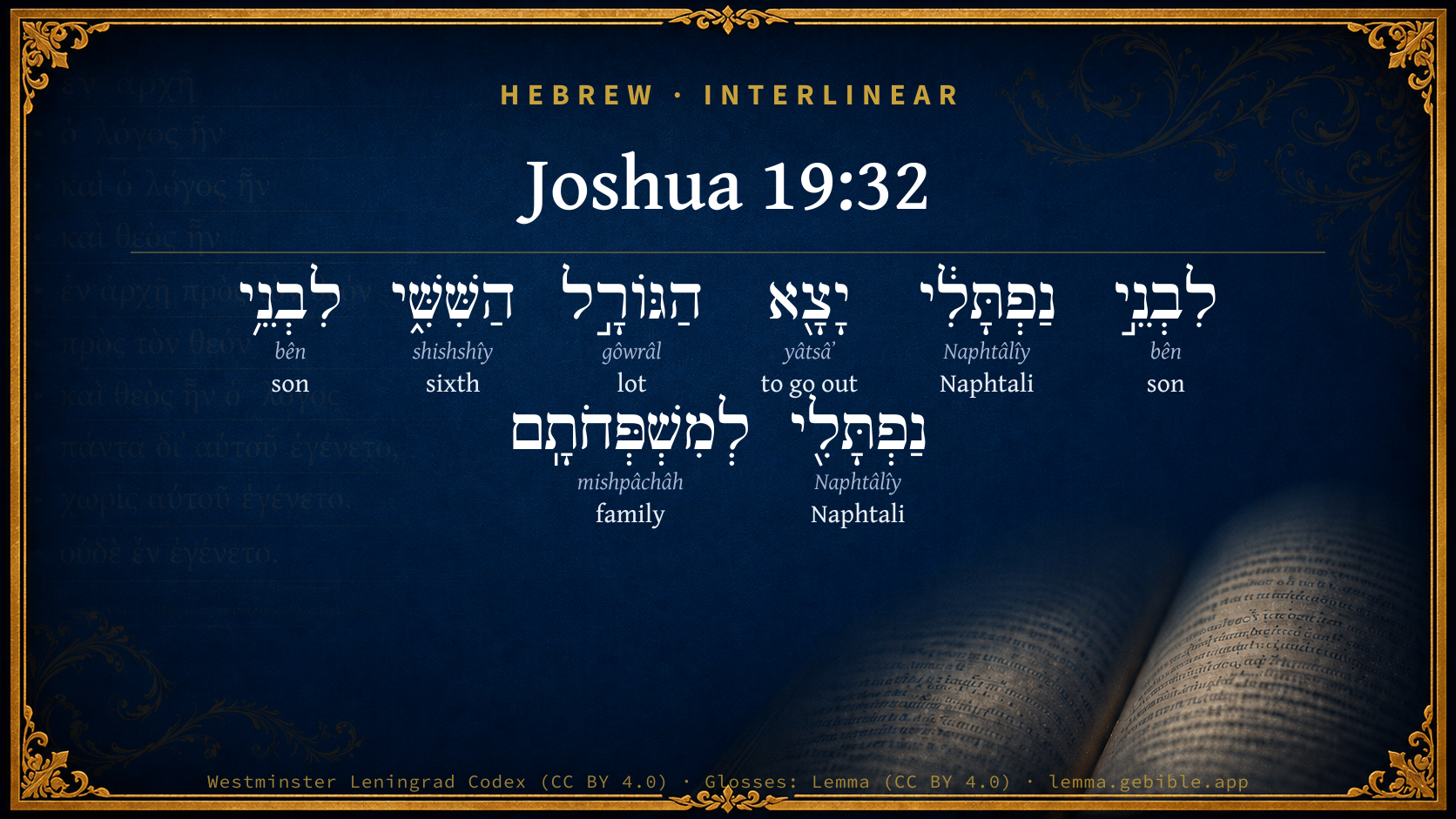
Hebrew (Westminster Leningrad Codex) Joshua 19:32 appears in the Hebrew Old Testament. The text above is from the Westminster Leningrad Codex. Each word links to its Strong’s number, a concise gloss, and parsing drawn from the Open Scriptures Hebrew Bible morphology. Click any word for its full Brown-Driver-Briggs (BDB) entry.
Download image
Cite this verse

Joshua 19:32 (World English Bible). Public Domain. Lemma interlinear Bible study tool, https://lemma.gebible.app/v/joshua/19/32.

Show BibTeX & RIS
BibTeX
RIS
English Translation
The sixth lot came out for the children of Naphtali, even for the children of Naphtali according to their families.
World English Bible · Public Domain
Download a study sheet

One document with this verse’s original text, its word-by-word gloss line, the meaning frame, cross-references with their text, attributed commentary, and full source and license credits — printable, and it pastes into notes with its structure intact.

This verse Autodidact and up

Study sheet (.html) Plain text (.txt)

A passage Seminary Student

Up to 50 verses in one chapter. A passage sheet keeps up to 6 commentary sources and 12 cross-references per verse, in the order this page ranks them, and says so on the sheet whenever that leaves anything out. Ask for a single verse and you get the Autodidact verse sheet above.

Everything on this page stays free to read, with no account — the sheet is a download of what is already on screen, not access to it.

Want to remove ads? Support Godless Engineer
Compare translations 3

The same verse in 3 English versions, stacked beneath the original-language interlinear above. Click any original word for its lexicon entry.

Each is an independent rendering of the whole verse — the interlinear is not word-aligned to these translations.

Highlighted words mark where these versions differ — a whole-verse word diff, not a word-by-word alignment.

  • World English Bible Public Domain
    The sixth lot came out for the children of Naphtali, even for the children of Naphtali according to their families.
  • King James Version Public Domain
    The sixth lot came out to the children of Naphtali, even for the children of Naphtali according to their families.
  • unfoldingWord Literal Text CC BY-SA 4.0
    The sixth lot came out for the sons of Naphtali, for the sons of Napthali according to their clans.

unfoldingWord Literal Text — © unfoldingWord, licensed CC BY-SA 4.0. Word-aligned USFM3 via Door43 (git.door43.org/unfoldingWord/en_ult).

Versions to compare (up to 4)

3 of 4 selected

Show all 18 translations

Every available English version of this verse, each an independent rendering of the whole verse.

  • World English Bible Public Domain
    The sixth lot came out for the children of Naphtali, even for the children of Naphtali according to their families.
  • Berean Standard Bible Public Domain
    The sixth lot came out for the clans of the tribe of Naphtali:
  • Majority Standard Bible Public Domain
    The sixth lot came out for the clans of the tribe of Naphtali:
  • King James Version Public Domain
    The sixth lot came out to the children of Naphtali, even for the children of Naphtali according to their families.
  • American Standard Version (1901) Public Domain
    The sixth lot came out for the children of Naphtali, even for the children of Naphtali according to their families.
  • Revised Version (1885) Public Domain
    The sixth lot came out for the children of Naphtali, even for the children of Naphtali according to their families.
  • Geneva Bible (1599) Public Domain
    The sixt lot came out to the children of Naphtali, euen to the children of Naphtali according to their families.
  • Douay-Rheims (1899) Public Domain
    The sixth lot came out to the sons of Nephtali by their families:
  • Young's Literal Translation Public Domain
    For the sons of Naphtali hath the sixth lot gone out, for the sons of Naphtali, for their families;
  • Literal Standard Version CC BY-SA 4.0
    The sixth lot has gone out for the sons of Naphtali—for the sons of Naphtali, for their families;
  • Unlocked Literal Bible CC BY-SA 4.0
    The sixth casting of lots fell to tribe of Naphtali, clan by clan.
  • unfoldingWord Literal Text CC BY-SA 4.0
    The sixth lot came out for the sons of Naphtali, for the sons of Napthali according to their clans.
  • Darby Bible Public Domain
    The sixth lot came forth to the children of Naphtali, for the children of Naphtali according to their families.
  • World Messianic Bible Public Domain
    The sixth lot came out for the children of Naphtali, even for the children of Naphtali according to their families.
  • Webster's Bible Public Domain
    The sixth lot came out to the children of Naphtali, even for the children of Naphtali according to their families.
  • Free Bible Version CC BY-SA 4.0
    The sixth lot cast went to the tribe of Naphtali, by families.
  • Bible in Basic English Public Domain
    For the children of Naphtali the sixth heritage came out, for the children of Naphtali by their families;
  • JPS Tanakh (1917) Public Domain
    The sixth lot came out for the children of Naphtali, even for the children of Naphtali according to their families.

Literal Standard Version (2020), Covenant Press — licensed CC BY-SA 4.0. Text via the HelloAO Bible API (eBible.org). Unlocked Literal Bible (unfoldingWord) — licensed CC BY-SA 4.0. Text via the HelloAO Bible API (eBible.org). unfoldingWord Literal Text — © unfoldingWord, licensed CC BY-SA 4.0. Word-aligned USFM3 via Door43 (git.door43.org/unfoldingWord/en_ult). Free Bible Version, Dr. Jonathan Gallagher — licensed CC BY-SA 4.0. Text via the HelloAO Bible API (eBible.org).

Word by word

More ways to search: Search by grammar → Find every occurrence → Compare this word →

Practice this passage: Drill this verse → Learn its vocabulary →

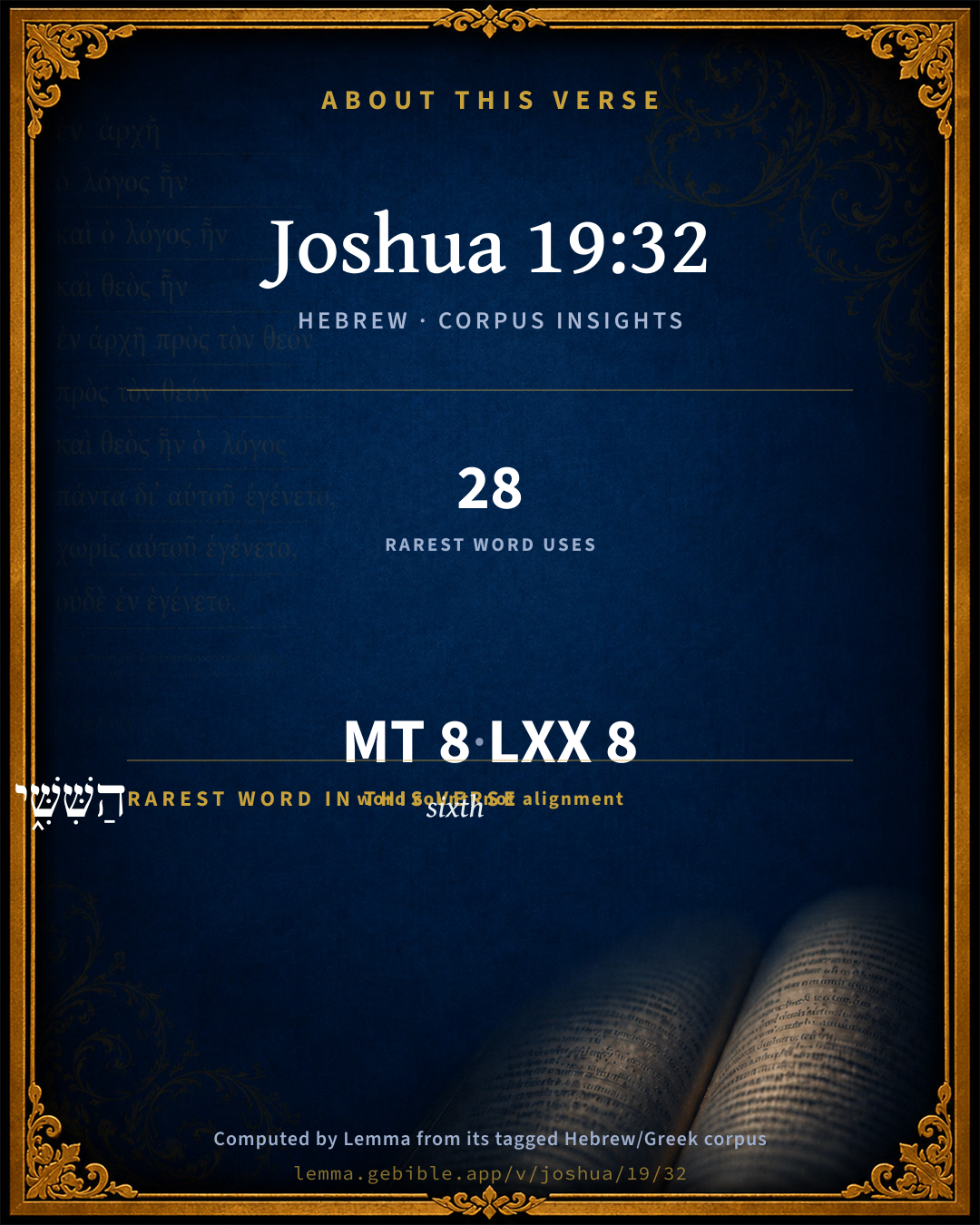
הַשִּׁשִּׁ֑י
shishshîy
H8345
“the · sixth”
Particle, Definite Article + Adjective, Ordinal number, Masculine, Singular, Absolute
Part of Speech
Particle + Adjective
Type
Ordinal number
Gender
Masculine
Number
Singular
State
Absolute
Full BDB Definition

Origin: from H8337

TWOT: 2336b

sixth - sixth (ordinal number) - sixth (as fraction)
  1. לִבְנֵ֣י bên H1121 “to/for · sons of” Preposition + Noun, Common, Masculine, Plural, Construct
  2. נַפְתָּלִ֔י Naphtâlîy H5321 “Naphtali” Noun, Proper
  3. יָצָ֖א yâtsâʼ H3318 “to go out” Verb, Qal, Perfect, 3rd Person, Masculine, Singular
  4. הַגּוֹרָ֣ל gôwrâl H1486 “the · lot” Particle, Definite Article + Noun, Common, Masculine, Singular, Absolute
  5. לִבְנֵ֥י bên H1121 “to/for · sons of” Preposition + Noun, Common, Masculine, Plural, Construct
  6. נַפְתָּלִ֖י Naphtâlîy H5321 “Naphtali” Noun, Proper
  7. לְמִשְׁפְּחֹתָֽם mishpâchâh H4940 “to/for · families · their” Preposition + Noun, Common, Feminine, Plural, Construct + Suffix, Personal, 3rd Person, Masculine, Plural

About this verse

These counts appear in no published source. They are computed here, from the morphology-tagged text and Lemma’s own curated glosses. What Lemma adds →

8
words
6
distinct lemmas
Historical
section

Shared distinctive vocabulary

הַשִּׁשִּׁ֑י sixth H8345 occurs in 26 verses of the Hebrew Bible. Also found in:

Grammatical profile

  • 1 verb
  • 6 nouns
  • 1 adjective

Verb forms

  • יָצָ֖א Qal · Perfect

Repetition

Words recur within this verse — often emphatic in Hebrew:

  • לִבְנֵ֣י son H1121 ×2
  • נַפְתָּלִ֔י Naphtali H5321 ×2

Hebrew & Septuagint length

In English translation the verse runs 20 words from the Hebrew and 8 from the Septuagint (LXX English) — the Septuagint runs noticeably shorter here. See the side-by-side →

A rough comparison of the two English renderings, which tokenize alike — not a word-level alignment.

Word counts can differ between the Hebrew and the Greek without any difference in meaning — e.g. the Hebrew direct-object marker אֵת has no separate Greek word, and Greek often adds the article ὁ.

In the original languages it is 8 Hebrew tokens and 8 Greek tokens — but the two are counted differently (Hebrew bundles its prefixes and suffixes into one token; the Greek is in lemma form), so that isn’t a like-for-like length.

Hebrew and Greek witnesses Masoretic Hebrew ↔ Greek Septuagint

The same verse in the two great witnesses to the Old Testament, shown verse-for-verse.

Here the Septuagint runs noticeably shorter than the Hebrew — LXX2012 (modern English Septuagint) 8 words vs World English Bible 20. A rough length comparison of the two English translations, not a word-level alignment — read both below.

These are two independent witnesses, not word-aligned to each other, and the Septuagint is shown in lemma (dictionary) form.

Hebrew Joshua 19:32 Masoretic · Westminster Leningrad Codex

לִבְנֵ֣י נַפְתָּלִ֔י יָצָ֖א הַגּוֹרָ֣ל הַשִּׁשִּׁ֑י לִבְנֵ֥י נַפְתָּלִ֖י לְמִשְׁפְּחֹתָֽם

The sixth lot came out for the children of Naphtali, even for the children of Naphtali according to their families.

World English Bible · Public Domain

Greek LXX Joshua 19:32 Septuagint · lemma form

καί ὁ νεφθαλι ἐκἔρχομαι ὁ κλῆρος ὁ ἕκτος

And the sixth lot came out to Nephthali.

LXX2012 (modern English Septuagint) · Public Domain

On this verse, Keil & Delitzsch discusses the Septuagint’s reading. Read the note in Commentary ↓

Hebrew: Westminster Leningrad Codex (CC BY 4.0). Greek: Septuagint (public domain); English from LXX2012 (modern English Septuagint) (Public Domain). How the Septuagint differs from the Hebrew →

Targum (Aramaic paraphrase)

1

The Targum is the ancient Jewish Aramaic paraphrase of the Hebrew Scriptures — an interpretive translation, not the Hebrew text itself. Onkelos (literal) and Pseudo-Jonathan (expansive) render the Torah, and Jonathan the Prophets. Coverage is partial: where no permissively-licensed English translation exists for a verse, only the Aramaic is shown. This is verse-level text, not a word-by-word alignment to the Hebrew.

  1. Targum Jonathan Prophets (Joshua–Malachi)
    לִבְנֵי נַפְתָּלִי נְפַק עַדְבָא שְׁתִיתָאָה לִבְנֵי נַפְתָּלִי לְזַרְעֲיַתְהוֹן:

    (no public-domain English translation for this verse)

    Targum Jonathan — Aramaic: “Mikraot Gedolot” (public domain). English: “Sefaria Community Translation” (CC0 1.0 (public-domain dedication)); “London "Chaldee Paraphrase," 1871” (public domain). Text via Sefaria.

Commentary

Notes on Joshua 19:32 from classic Christian and Jewish commentators (each source and its license shown beneath its notes). The classic Christian expositions comment on the surrounding passage and are grouped to its opening verse, so a note may address several verses; the Jewish commentaries on the Tanakh (Rashi and others) are per-verse, so they appear only where the commentator wrote on this verse.

Lemma curates 59 commentaries, every one of them public domain or Creative Commons licensed, each selected and text-cleaned for this edition rather than reprinted as found. About our sources →

Jamieson, Fausset & Brown

Robert Jamieson, A. R. Fausset & David Brown

OF NAPHTALI. (Jos 19:32-39)

the sixth lot came out to the children of Naphtali--Although the cities mentioned have not been discovered, it is evident, from Zaanannim, which is by Kedesh, that is, on the northwest of Lake Merom (Jdg 4:11), that the boundary described (Jos 19:34) ran from the southwest towards the northeast, up to the sources of the Jordan.

Jamieson, Fausset & Brown — Commentary Critical and Explanatory on the Whole Bible (1871) — public domain (CC PDM 1.0). Text via the HelloAO Bible API.

Joseph Benson's Commentary

Jos 19:32-33. The sixth lot came out, &c. — Here the younger son of Bilhah, the hand-maid of Rachel, is preferred before the elder, who was Dan, (Gen 30:6; Gen 30:8,) as Zebulun was before Issachar. Such was the method of Divine Providence in that nation, to convince them that they ought not to value themselves too highly, as they were apt to do, upon their external privileges. Their coast — Their northern border, drawn from west to east, as appears; because, when the coast is described and brought to its end, it is said to turn from the east westward, Jos 19:34. The out- goings — The end of that coast.

Joseph Benson's Commentary on the Old and New Testaments (1811–1818) — public domain. Text from a community e-Sword module.

Whedon's Commentary on the Bible

Daniel D. Whedon

NAPHTALI’S LOT, Jos_19:32-39.

[The territory of Naphtali was bounded on the east by the Jordan and sea of Galilee, on the south by Zebulun, on the west and north by Asher. The northern limit probably ran into the splendid valley of the Litany, which separates the two great ranges of Lebanon. The excellence of Naphtali’s portion is indicated in Moses’ song, where he speaks of him as “satisfied with favour, and full with the blessing of the Lord, possessing the west and the south.” Deu_33:23. The latter part should be rendered, “Possess thou the sea and the sunny clime.” “Naphtali possessed,” says J.L. Porter, “a greater variety of soil, scenery, and climate than any of the other tribes. Its northern portions are the highlands of Palestine. The sublime ravine of the Leontes separates its mountains from the chain of Lebanon, of which, however, they may be regarded as a prolongation. The scenery is here rich and beautiful. In the centre of this park-like region lie the ruins of the sanctuary of the tribe, the northern city of refuge, Kadesh-Naphtali.

The ridge rises gradually towards the south, and culminates at Safed, which has an elevation of nearly three thousand feet.

“The southern section of Naphtali was the garden of Palestine. The little plains along the shore of the Sea of Galilee and the vales that run up into the mountains are of unrivalled fertility. Josephus describes the plain on the shore of the lake as an earthly paradise, where the choicest fruits grew luxuriantly, and where eternal spring reigned. His words were not much exaggerated, for now, though more a wilderness than a paradise, its surpassing richness is apparent.”

Jacob spoke of Naphtali as “a hind let loose.” Gen_49:21. The tribe had many a noble and fleet warrior. but, like the timid hind, they shrunk from aggressive war, and left several of their cities in the hands of the Canaanites. Jdg_1:33. The valiant Barak lacked confidence to venture alone against the hosts of Sisera, (Jos_4:8,) but when fully roused, like a hind brought to bay, he scorned his soul to death on the high places of the battlefield. Jdg_5:18, note.] From his exposed position on the northern frontier Naphtali was the first to fall into the hands of the Assyrian invaders, (2Ki_15:29,) but after the captivity the Israelites largely settled again in thin territory. His lot included the scene of the great victory of Joshua over the northern confederacy, and also many places where the Greater Joshua, by his mighty miracles and wondrous teachings, confounded his foes and laid the foundation of his everlasting kingdom. This region is Galilee of the Gentiles, whose “people, which sat in darkness, saw great light.” Isa_9:1; Mat_4:16.

Daniel D. Whedon (gen. ed.), Commentary on the Old and New Testaments (1874–1909) — public domain. Text from a community e-Sword module.

Tyndale Open Study Notes

Tyndale Open Resources

19:32-39 The tribe of Naphtali occupied eastern Galilee and overlooked the Sea of Galilee. Because a branch of an international trade route from Egypt to Mesopotamia ran through the territory of Naphtali, this tribe enjoyed periods of prosperity when Israel’s kings were strong. The city of Hazor was within Naphtali’s territory, guarding a section of that route. Naphtali is mentioned in Matt 4:13-16 in connection with Jesus’ ministry in Galilee.

Tyndale Open Study Notes — © Tyndale Open Resources, licensed CC BY-SA 4.0. Text via the HelloAO Bible API.

Matthew Henry's Commentary

Naphtali lay furthest north of all the tribes, bordering on Mount Libanus. The city of Leshem, or Liash, lay on the utmost edge of it to the north, and therefore when the Danites had made themselves masters of it, and called it Dan, the length of Canaan from north to south was reckoned from Dan to Beersheba. It had Zebulun on the south, Asher on the west, and Judah upon Jordan, probably a city of that name, and so distinguished from the tribe of Judah on the east. It was in the lot of this tribe, near the waters of Merom, that Joshua fought and routed Jabin, Jos 11:1. etc. In this tribe stood Capernaum and Bethsaida, on the north end of the sea of Tiberias, in which Christ did so many mighty works; and the mountain (as is supposed) on which Christ preached, Mat 5:1.

Matthew Henry's Commentary on the Whole Bible (1708–1710) — public domain (CC PDM 1.0). Text via the HelloAO Bible API.

John Calvin's Commentaries

The next lot mentioned is that of Naphtali, and it seems to correspond with the disposition and manners of that tribe. For Jacob had testified, Naphtali is a hind let loose; he gave goodly words. For this reason they seem to have been contiguous on one side to the children of Judah, and to have been surrounded on other sides by the enclosures of their brethren. Indeed, in its being said that the tribe of Dan took Lesen, there seems to be a tacit comparison, because the children of Naphtali did not employ arms to force their way into their inheritance, but kept themselves quietly in a subdued territory, and thus enjoyed safety and tranquillity under the faith, and, as it were, protection of Judah and the other tribes. The capture of Lesen by the children of Dan, in accordance with the divine grant which they had received of it, did not take place till after the death of Joshua. But the fact which is more fully detailed in the book of Judges is here mentioned in passing, because praise was due to them for their boldness and activity in thus embracing the right which God had bestowed upon them, and so trusting in him as to go down bravely and defeat the enemy.

John Calvin's Commentaries (1540-1563) — public domain. Text from the Calvin Translation Society English edition (1840s-50s) via the Christian Classics Ethereal Library (ccel.org). Calvin's coverage is partial (roughly two-thirds of the Bible); uncommented books and verses are honest gaps, never fabricated. The 19th-century editor's footnotes and remarks are omitted so the notes are faithfully Calvin's own voice.

The Cambridge Bible for Schools and Colleges

gen. ed. J. J. S. Perowne

32–39. The Territory of the Tribe of Naphtali

32. The sixth lot] fell out to the tribe descended from Naphtali, the fifth son of the patriarch Jacob, which, during the march through the wilderness, occupied a position north of the Tabernacle, side by side with Dan and Asher (Num_2:25-31), and at the census taken at Mount Sinai numbered upwards of 53400 fighting men (Num_1:43; Num_2:30).

The Cambridge Bible for Schools and Colleges (gen. ed. J. J. S. Perowne; Cambridge University Press, 1878–1918) — public domain. Text from a community e-Sword module.

John Gill's Exposition

And their coast was from Heleph,.... That is, their northern coast, reaching from west to east, as appears by the ending of it at Jordan; the Alexandrian copy of the Greek version calls it Mlepeh, the Targum, Meheleph, and Jerom, Mealeb, which he calls the border of Naphtali; which, though to the north, cannot be expressly said what and where it was:

from Allon to Zaanannim; or rather from the oak, or from the plain in Zaanannim (d); for it seems to be the same with the plain of Zanaaim, Jdg 4:11.

and Adami, Nekeb; some make these to be but one city, and the latter only an epithet of the former; but the Talmudists (e) make them two, as we do, and call the first Damin, and the latter Ziadetha; but what and where either of them were exactly is not known; for Adami cannot be the same with Adam, Jos 3:16; as some think; for that was in Peraea, on the other side Jordan; See Gill on Jos 3:16,

and Jabneel; Jabneel is different from that which was on the borders of Judah, Jos 15:11; and is called by the Jews (f) since Cepherjamah:

unto Lakum; of which we nowhere else read:

and the outgoings thereof were at Jordan; here the coast ended this way.

(d) "Ab querceto in Tzahanannimis", Junius & Tremellius; so Piscator. (e) T. Hieros. Megillah, fol. 70. 1. (f) T. Hieros. Megillah, fol. 70. 1.

John Gill's Exposition of the Whole Bible (1746–1763) — public domain (CC PDM 1.0). Text via the HelloAO Bible API.

Keil & Delitzsch

C. F. Keil & F. Delitzsch

The Inheritance of Naphtali. - This fell between Asher and the upper Jordan. It reached northwards to the northern boundary of Canaan, and touched Zebulun and Issachar on the south. In Jos 19:33 and Jos 19:34 the boundary lines are given: viz., in Jos 19:33 the western boundary towards Asher, with the northern and eastern boundaries: in Jos 19:34 the southern boundary; but with the uncertainty which exists as to several of the places named, it cannot be traced with certainty.

Jos 19:33

"Its boundary was (its territory reached) from Heleph, from the oak-forest at Zaanannim, and Adami Nekeb and Jabneel to Lakkum; and its outgoings were the Jordan." Heleph is unknown, though in all probability it was to the south of Zaanannim, and not very far distant. According to Jdg 4:11, the oak-forest (allon: see the remarks on Gen 12:6) at Zaanannim was near Kedesh, on the north-west of Lake Huleh. There are still many oaks in that neighbourhood (Rob. Bibl. Res. p. 386); and on the south of Bint Jebail Robinson crossed a low mountain-range which was covered with small oak trees (Pal. iii. p. 372). Adami hannekeb, i.e., Adami of the pass (Nekeb, judging from the analogy of the Arabic, signifying foramen, via inter montes), is supposed by Knobel to be Deir-el-ahmar, i.e., red cloister, a place which is still inhabited, three hours to the north-west of Baalbek, on the pass from the cedars to Baalbek (Seetzen, i. pp. 181, 185; Burckhardt, Syr. p. 60; and Ritter, Erdk. xvii. p. 150), so called from the reddish colour of the soil in the neighbourhood, which would explain the name Adami. Knobel also connects Jabneel with the lake Jemun, Jemuni, or Jammune, some hours to the north-west of Baalbek, on the eastern side of the western Lebanon range (Rob. Bibl. Res. p. 548; Ritter, xvii. pp. 304ff.), where there are still considerable ruins of a very early date to be found, especially the ruins of an ancient temple and a celebrated place of pilgrimage, with which the name "god's building" agrees. And lastly, he associates Lakkum with the mountains of Lokham, as the northern part of Lebanon on the Syrian mountains, from the latitude of Laodicea to that of Antioch on the western side of the Orontes, is called by the Arabian geographers Isztachri, Abulfeda, and others. So far as the names are concerned, these combinations seem appropriate enough, but they are hardly tenable. The resemblance between the names Lakkum and Lokham is only in appearance, as the Hebrew name is written with ק and the Arabic with כ. Moreover, the mountains of Lokham are much too far north for the name to be adduced as an explanation of Lakkum. The interpretation of Adami Nekeb and Jabneel is also irreconcilable with the circumstance that the lake Jamun was two hours to the west of the red convent, so that the boundary, which starts from the west, and is drawn first of all towards the north, and then to the north-east and east, must have run last of all from the red convent, and not from the Jamun lake to the Jordan. As Jabneel is mentioned after Adami Nekeb, it must be sought for to the east of Adami Nekeb, whereas the Jamun lake lies in the very opposite direction, namely, directly to the west of the red convent. The three places mentioned, therefore, cannot be precisely determined at present. The Jordan, where the boundary of Asher terminated, was no doubt the upper Jordan, or rather the Nahr Hasbany, one of the sources of the Jordan, which formed, together with the Huleh lake and the Jordan itself, between Lake Huleh and the Sea of Tiberias, and down to the point where it issues from the latter, the eastern boundary of Asher.

Jos 19:34

From the Jordan below the Lake of Tiberias, or speaking more exactly, from the point at which the Wady Bessum enters the Jordan, "the boundary (of Asher) turned westwards to Asnoth-tabor, and went thence out to Hukkok." This boundary, i.e., the southern boundary of Asher, probably followed the course of the Wady Bessum from the Jordan, which wady was the boundary of Issachar on the north-east, and then ran most likely from Kefr Sabt (see at Jos 19:22) to Asnoth-tabor, i.e., according to the Onom. (s. v. Azanoth), a vicus ad regionem Diocaesareae pertinens in campestribus, probably on the south-east of Diocaesarea, i.e., Sepphoris, not far from Tabor, to which the boundary of Issachar extended (Jos 19:22). Hukkok has not yet been traced. Robinson (Bibl. Res. p. 82) and Van de Velde (Mem. p. 322) are inclined to follow Rabbi Parchi of the fourteenth century, and identify this place with the village of Yakk, on the north-west of the Lake of Gennesareth; but this village is too far to the north-east to have formed the terminal point of the southern boundary of Naphtali, as it ran westwards from the Jordan. After this Naphtali touched "Zebulun on the south, Asher on the west, and Judah by the Jordan toward the sun-rising or east." "The Jordan" is in apposition to "Judah," in the sense of "Judah of the Jordan," like "Jordan of Jericho" in Num 22:1; Num 26:3, etc. The Masoretic pointing, which separates these two words, was founded upon some false notion respecting this definition of the boundary, and caused the commentators great perplexity, until C. v. Raumer succeeded in removing the difficulty, by showing that the district of the sixty towns of Jair, which was upon the eastern side of the Jordan, is called Judah here, or reckoned as belonging to Judah, because Jair, the possessor of these towns, was a descendant of Judah on the father's side through Hezron (Ch1 2:5, Ch1 2:21-22); whereas in Jos 13:30, and Num 32:41, he is reckoned contra morem, i.e., against the rule laid down in Num 36:7, as a descendant of Manasseh, on account of his descent from Machir the Manassite, on his mother's side.

(Note: See C. v. Raumer's article on "Judaea on the east of Jordan," in Tholuck's litt. Anz. 1834, Nos. 1 and 2, and his Palstina, pp. 233ff. ed. 4; and for the arbitrary attempts that had been made to explain the passage by alterations of the text and in other ways, see Rosenmller's Bibl. Alterthk. ii. 1, pp. 301-2; and Keil's Comm. on Joshua, pp. 438-9.)

Jos 19:35

The fortified towns of Naphtali were the following. Ziddim: unknown, though Knobel suggests that "it may possibly be preserved in Chirbet es Saudeh, to the west of the southern extremity of the Lake of Tiberias (Rob. iii. App.);" but this place is to the west of the Wady Bessum, i.e., in the territory of Issachar. Zer is also unknown. As the lxx and Syriac give the name as Zor, Knobel connects it with Kerak, which signifies fortress as well as Zor (= מצור), a heap of ruins at the southern end of the lake (Rob. iii. p. 263), the place which Josephus calls Taricheae (see Reland, p. 1026), - a very doubtful combination! Hammath (i.e., thermae), a Levitical town called Hammaoth-dor in Jos 21:32, and Hammon in Ch1 6:61, was situated, according to statements in the Talmud, somewhere near the later city of Tiberias, on the western shore of the Lake of Gennesareth, and was no doubt identical with the κώμεε Αμμαούς in the neighbourhood of Tiberias, a place with warm baths (Jos. Ant. xviii. 2, 3; Bell. Judg. iv. 1, 3). There are warm springs still to be found half an hour to the south of Tabaria, which are used as baths (Burckhardt, Syr. pp. 573-4; Rob. iii. pp. 258ff.). Rakkath (according to the Talm. and Rabb. ripa littus) was situated, according to rabbinical accounts, in the immediate neighbourhood of Hammath, and was the same place as Tiberias; but the account given by Josephus (Ant. xviii. 2, 3; cf. Bell. Judg. ii. 9, 1) respecting the founding of Tiberias by Herod the tetrarch is at variance with this; so that the rabbinical statements appear to have no other foundation than the etymology of the name Rakkath. Chinnereth is given in the Targums as גניסר, גינוסר, גּנּוסר, i.e., Γεννησάρ. According to Josephus (Bell. Jud. iii. 10, 8), this name was given to a strip of land on the shore of the Sea of Galilee, which was distinguished for its natural beauty, its climate, and its fertility, namely the long plain, about twenty minutes broad and an hour long, which stretches along the western shore of this lake, from el-Mejdel on the south to Khan Minyeh on the north (Burckhardt, Syr. pp. 558-9; Rob. iii. pp. 279, 290). It must have been in this plain that the town of Chinnereth stood, from which the plain and lake together derived the name of Chinnereth (Deu 3:17) or Chinneroth (Jos 11:2), and the lake alone the name of "Sea of Chinnereth," or "Sea of Chinneroth" (Jos 12:3; Jos 13:27; Num 34:11).

Jos 19:36

Adamah is unknown. Knobel is of opinion, that as Adamah signifies red, the place referred to may possibly be Ras el Ahmar, i.e., red-head, on the north of Safed (Rob. iii. p. 370; Bibl. Res. p. 69). Ramah is the present Rameh (Ramea), a large well-built village, inhabited by Christians and Druses, surrounded by extensive olive plantations, and provided with an excellent well. It stands upon the slope of a mountain, in a beautiful plain on the south-west of Safed, but without any relics of antiquity (see Seetzen, ii. p. 129; Rob. Bibl. Res. pp. 78-9). Hazor has not yet been traced with certainty (see at Jos 11:1).

Jos 19:37

Kedesh (see at Jos 12:2). Edrei, a different place from the town of the same name in Bashan (Jos 1:2, Jos 1:4), is still unknown. En-hazor is probably to be sought for in Bell Hazur and Ain Hazur, which is not very far distant, on the south-west of Rameh, though the ruins upon Tell Hazur are merely the ruins of an ordinary village, with one single cistern that has fallen to pieces (Rob. Bibl. Res. pp. 80, 81).

Jos 19:38-39

Jireon (Iron) is probably the present village of Jarn, an hour to the south-east of Bint-Jebeil, with the ruins of an ancient Christian church (Seetzen, ii. pp. 123-4; Van de Velde, R. i. p. 133). Migdal-el, so far as the name is concerned, might be Magdala (Mat 15:39), on the western shore of the Lake of Gennesareth, between Capernaum and Tiberias (Rob. iii. pp. 279ff.); the only difficulty is, that the towns upon this lake have already been mentioned in Jos 19:35. Knobel connects Migdal-el with Chorem, so as to form one name, and finds Migdal el Chorem in the present Mejdel Kerum, on the west of Rameh (Seetzen, ii. p. 130; Van de Velde, i. p. 215), a common Mahometan village. But there is nothing to favour this combination, except the similarity in sound between the two names; whereas it has against it not only the situation of the village, which was so far to the west, being not more than three hours from Acca, that the territory of Naphtali can hardly have reached so far, but also the very small resemblance between Chorem and Kerum, not to mention the fact that the accents separate Chorem from Migdal-el, whilst the omission of the copula (vav) before Chorem cannot have any weight, as the copula is also wanting before Zer and Rakkath. Chorem and Beth-anath have not yet been discovered. From the latter place Naphtali was unable to expel the Canaanites (Jdg 1:33). Beth-shemesh, a different place from the town of the same name in Issachar (Jos 19:22), is also still unknown. The total number of towns is given as nineteen, whereas only sixteen are mentioned by name. It is hardly correct to seek for the missing places among the border towns mentioned in Jos 19:33 and Jos 19:34, as the enumeration of the towns themselves is introduced by מבצר וערי in Jos 19:35, and in this way the list of towns is separated from the description of the boundaries. To this we may add, that the town of Karthan or Kirjathaim, which Naphtali gave up to the Levites (Jos 21:32; Ch1 6:61), does not occur either among the border towns or in the list of towns, from which we may see that the list of towns is an imperfect one.

Keil & Delitzsch — Biblical Commentary on the Old Testament (1861–1891) — public domain (CC PDM 1.0). Text via the HelloAO Bible API. (Old Testament only.)

unfoldingWord translationNotes

Door43 World Missions Community

The sixth casting of lots

See how you translated this phrase in Joshua 19:1.

The sixth

number six in a list (See: Ordinal Numbers)

Heleph ... Zaanannim ... Adami Nekeb ... Jabneel ... Lakkum ... Aznoth Tabor ... Hukkok

These are the names of cities. (See: How to Translate Names)

translationWords

tribe

Naphtali

clan

oak

Zebulun

Asher

Judah

Jordan River

unfoldingWord translationNotes — © Distant Shores Media and the Door43 World Missions Community, licensed CC BY-SA 4.0. Source: git.door43.org/Door43/en_tn.

Lesson kit

Teaching starters — assembled from the data on this page, not authored interpretation. Every prompt links to the verse data it draws on. Edit before teaching.

Joshua, in the Historical, opens this verse with 8 words (6 distinct Hebrew lemmas). Its most distinctive word is shishshîy (“sixth”). The Greek Septuagint runs shorter here. A historical commentator’s framing appears above. Read the whole chapter for the surrounding context.

Discussion questions

  1. What does “sixth” (shishshîy) contribute to the verse as a whole?
  2. How does Genesis 1:31, which shares the word «sixth», read alongside this verse?
  3. What does the repetition of “son” (2× in this one verse) do in this verse?
  4. The Septuagint runs shorter here than the Hebrew. What might account for the difference?
  5. These translations render this verse differently; the difference is in the English rendering, not the original. What questions does that raise?
  6. «יָצָ֖א» is a Qal Perfect verb. How does that grammatical form shape the action described?
  7. Compare how Jamieson, Fausset & Brown and Joseph Benson's Commentary read this verse. Where do they agree or differ?

Things to notice

Reading settings

Reading text

Shown beneath each verse's original-language words.

Old Testament
Old Testament edition

Read the OT as the Masoretic Hebrew (MT) or the Greek Septuagint (LXX).

English shown for the Greek Septuagint (in the Hebrew ↔ Greek comparison).

Comparing translations? Open the Compare panel on any verse page to stack up to four side by side.