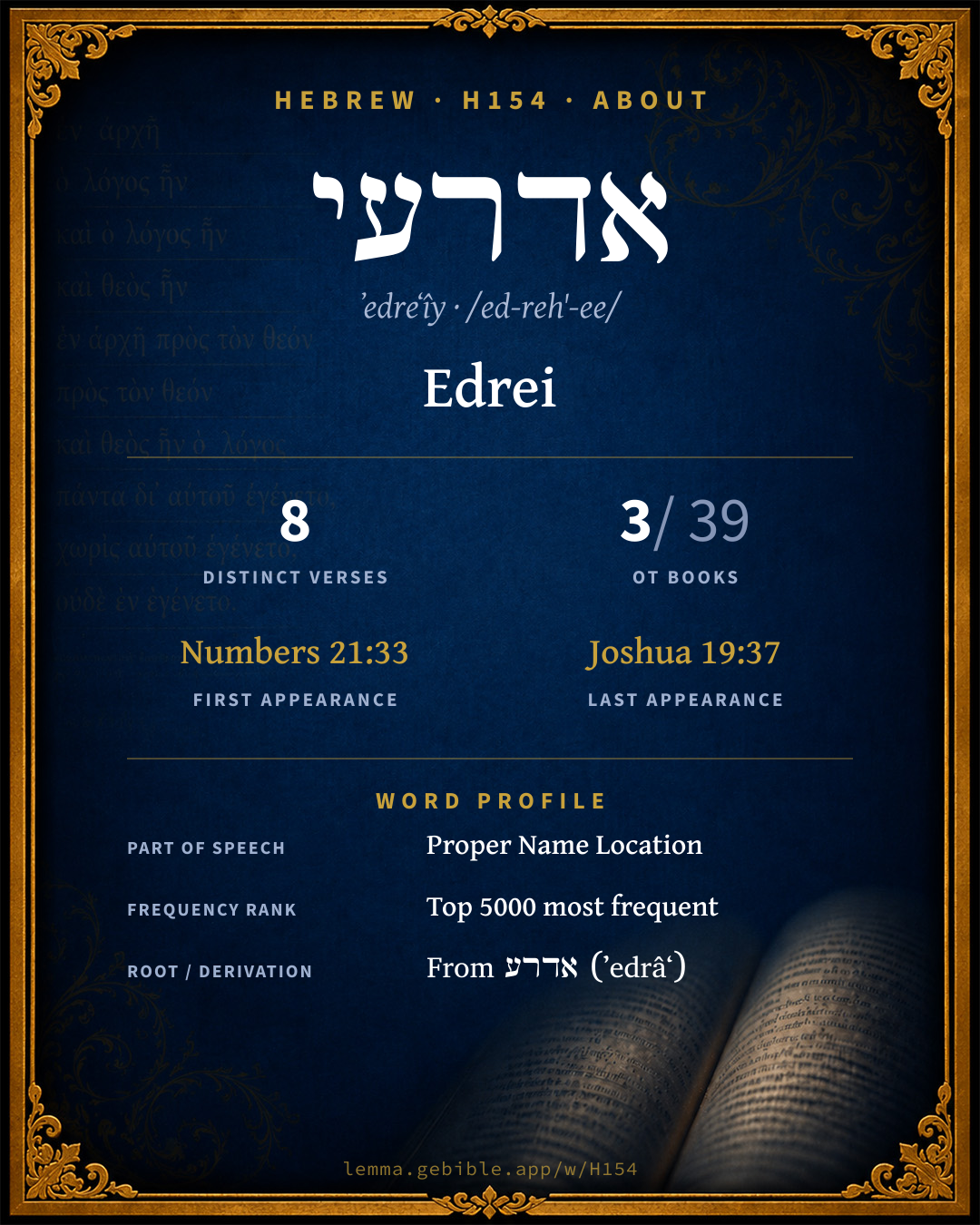
אֶדְרֶ֫עִי
Edrei
BDB lists 2 entries for ‘Edrei’ fuller range ↓
Full lexicon entry — Brown-Driver-Briggs (BDB)
From Brown-Driver-Briggs (BDB)
Where this word appears
Grammar key — what these labels mean
Part of speech
- Noun
- A naming word — a person, place, thing, or idea.
Noun type
- Proper
- A name of a specific person, place, or people (e.g. Abraham, Zion, Israel).
Every verse where H154 appears — 8 distinct verses across 3 books. Click any verse to open its interlinear word-by-word view. Verse text shown in the World English Bible for context — . Each verse’s Hebrew form is shown with its reference; the English is not keyword-highlighted, since the data carries no word-level English alignment. Use “Compare translations” on any verse to read it across multiple English versions. This concordance covers the Hebrew Bible; Septuagint (Greek Old Testament) occurrences are not indexed here.
Numbers 1 verse
Deuteronomy 3 verses
- Deuteronomy 1:4 בְּ/אֶדְרֶֽעִי prep + n Proper after he had struck Sihon the king of the Amorites, who lived in Heshbon, and Og the king of Bashan, who lived in Ashtaroth, at Edrei.
- Deuteronomy 3:1 אֶדְרֶֽעִי n Proper Then we turned, and went up the way to Bashan: and Og the king of Bashan came out against us, he and all his people, to battle at Edrei.
- Deuteronomy 3:10 וְ/אֶדְרֶ֑עִי conj + n Proper all the cities of the plain, and all Gilead, and all Bashan, to Salecah and Edrei, cities of the kingdom of Og in Bashan.
Joshua 4 verses
- Joshua 12:4 וּ/בְ/אֶדְרֶֽעִי conj + prep + n Proper and the border of Og king of Bashan, of the remnant of the Rephaim, who lived at Ashtaroth and at Edrei,
- Joshua 13:12 וּ/בְ/אֶדְרֶ֑עִי conj + prep + n Proper all the kingdom of Og in Bashan, who reigned in Ashtaroth and in Edrei (the same was left of the remnant of the Rephaim); for these did Moses strike, and drove them out.
- Joshua 13:31 וְ/אֶדְרֶ֔עִי conj + n Proper and half Gilead, and Ashtaroth, and Edrei, the cities of the kingdom of Og in Bashan, were for the children of Machir the son of Manasseh, even for the half of the children of Machir according to their families.
- Joshua 19:37 וְ/אֶדְרֶ֖עִי conj + n Proper and Kedesh, and Edrei, and En Hazor,
About this entry
At a glance — auto-summarized from this page’s data, not written by a person. Every figure links to its source below. This summary describes the numbers; it doesn’t interpret them.
אדרעי — transliterated ʼedreʻîy — is a Hebrew name carrying the sense “Edrei.” Its uses cluster heavily in Joshua (50% of all occurrences). Spanning 8 verses in 3 books, it ranks among the uncommon words of the Hebrew Bible. Debuting at Numbers 21:33, it then recurs through the corpus. See 8-verse concordance and the renderings breakdown below.
Gloss history
Strong's 1890 vs modern scholarship
About this word
Strong's H154 catalogs a Hebrew word from the Hebrew Old Testament.
These counts are not copied from any lexicon or concordance. They are computed here, from the morphology-tagged Hebrew Old Testament. What Lemma adds →
- 8
- distinct verses
- The word appears in 8 distinct verses.
- 3 / 39
- OT books
- The word appears in 3 of 39 Old Testament books.
- #2,625
- by frequency
- Top 5000 most frequent Hebrew words (rank 2,625 of 8,640 Hebrew words by occurrence).
View all 8 occurrences in the concordance →
Most concentrated in
- Joshua 4 verses 50%
- Deuteronomy 3 verses 38%
- Numbers 1 verse 13%
By section of the Old Testament
By traditional corpus
Conventional, traditional groupings — biblical authorship is debated, so this is a traditional corpus grouping, not an authorship claim. Each share is this word’s portion of its verses in that division of the Hebrew canon. Each figure is a share of the word’s 8 distinct verses.
- Torah (Pentateuch) 4 verses · 50%
- Prophets (Nevi'im) 4 verses · 50%
How translations render this word
Counts come from each version’s own published word-to-Strong’s tagging or interlinear alignment — an approximate guide to how each version renders this word, not a word-level alignment the data otherwise carries. Because each total is that version’s own tagged count, the per-version totals vary from one another and need not match the appearance or distinct-verse counts above. These counts may also differ from a printed concordance because Lemma counts each distinctly tagged rendering and does not collapse phrase taggings into a single head-word total. This is a fixed set of word-tagged versions (KJV, ASV, BSB, ULT) and does not change with the reading translation you choose elsewhere. Each version’s license is shown beside its name below (and on Sources).
- King James Version: Edrei 8×
- American Standard Version: Edrei 8×
- Berean Standard Bible: Edrei 8×
- unfoldingWord Literal Text: Edrei 8×
King James Version Public Domain
Renders H154 across 8 tagged occurrences — most commonly:
American Standard Version Public Domain
Renders H154 across 8 tagged occurrences — most commonly:
Berean Standard Bible Public Domain
Renders H154 across 8 tagged occurrences — most commonly:
unfoldingWord Literal Text CC BY-SA 4.0
Renders H154 across 8 tagged occurrences — most commonly:
Senses in BDB
The 2 senses BDB distinguishes for this word, in lexicon order (not ranked by frequency or importance). The full entry — with sub-senses — is in the Lexicon Entry tab.
- Edrei = "goodly pasture"
- a chief city of Bashan, north of Jabbok river
Word origin
n.pr.loc. a chief city of Bashan אֶדְרֶ֖עִי Jos 19:37; אֶדְרֶ֑עִי Nu 21:33 = Dt 3:1, Dt 3:10; בְּעַשְׁתָּרֹת בְּאֶדְרֶ֑עִי Dt 1:4; בְּעַשְׁתָּרֹת וּבְאֶדְרֶ֑עִי Jos 12:4; 13:12 cf. 13:31;—on identity of all these cf. Di Dt 3:10; modern Derʿât, 7 1/2 hours WNW. of Bosra; Euseb. Ἀδραά (LagOnom. 213, 86, 2nd ed. 235) cf. Di Nu 21:33 WetzstHauran 47, 77, 123 BdPal 201.
— Brown-Driver-Briggs (Oxford 1906, public domain), digitized via Sefaria, supplemented by the OpenScriptures HebrewLexicon (CC BY 4.0). See Sources.
Derived from אדרע (ʼedrâʻ) (H153) — strength.
Forms in the corpus
The 7 distinct written forms H154 takes in the Hebrew Bible, most frequent first — each parse links to that state’s occurrences in the concordance. Hebrew forms include their vowel points and cantillation, so a single lemma takes many written forms.
| Form | Parsing | Example | Uses |
|---|---|---|---|
| אֶדְרֶֽעִי | Noun, Proper | Deuteronomy 3:1 | 2 |
| בְּ/אֶדְרֶֽעִי | Noun, Proper | Deuteronomy 1:4 | 1 |
| וְ/אֶדְרֶ֑עִי | Noun, Proper | Deuteronomy 3:10 | 1 |
| וְ/אֶדְרֶ֔עִי | Noun, Proper | Joshua 13:31 | 1 |
| וְ/אֶדְרֶ֖עִי | Noun, Proper | Joshua 19:37 | 1 |
| וּ/בְ/אֶדְרֶ֑עִי | Noun, Proper | Joshua 13:12 | 1 |
| וּ/בְ/אֶדְרֶֽעִי | Noun, Proper | Joshua 12:4 | 1 |
Bible dictionary
Public-domain dictionary articles matched to this entry by name (Edrei). A biblical name can be shared by more than one person or place, so an article may treat several.
Easton's Bible Dictionary · M. G. Easton, 1897
Mighty; strength. (1.) One of the chief towns of the kingdom of Bashan (Josh. 12:4, 5). Here Og was defeated by the Israelites, and the strength of the Amorites broken (Num. 21:33-35). It subsequently belonged to Manasseh, for a short time apparently, and afterwards became the abode of banditti and outlaws (Josh. 13:31). It has been identified with the modern Edr'a, which stands on a rocky promontory on the south-west edge of the Lejah (the Argob of the Hebrews, and Trachonitis of the Greeks). The ruins of Edr'a are the most extensive in the Hauran. They are 3 miles in circumference. A number of the ancient houses still remain; the walls, roofs, and doors being all of stone. The wild region of which Edrei was the capital is thus described in its modern aspect: "Elevated about 20 feet above the plain, it is a labyrinth of clefts and crevasses in the rock, formed by volcanic action; and owing to its impenetrable condition, it has become a refuge for outlaws and turbulent characters, who make it a sort of Cave of Adullam...It is, in fact, an impregnable natural fortress, about 20 miles in length and 15 in breadth" (Porter's Syria, etc.). Beneath this wonderful city there is also a subterranean city, hollowed out probably as a refuge for the population of the upper city in times of danger. (See BASHAN.)
(2.) A town of Naphtali (Josh. 19:37).
Smith's Bible Dictionary · William Smith, 1863
(stronghold).
+ One of the two capital cities of Bashan, in the territory of Manasseh east of the Jordan. (Numbers 21:33; 1:4; 3:10; Joshua 12:4) In Scripture it is only mentioned in connection with the victory gained by the Israelites over the Amorites under Og their king, and the territory thus acquired. The ruins of this ancient city, still bearing the name Edr'a, stand on a rocky promontory which projects from the southwest corner of the Lejah. The ruins are nearly three miles in circumference, and have a strange, wild, look, rising up in dark, shattered masses from the midst of a wilderness of black rocks. + A town of northern Palestine, allotted to the tribe of Naphtali, and situated near Kedesh. (Joshua 19:37) About two miles south of Kedesh is a conical rocky hill called Tell Khuraibeh, the "tell of the ruin," which may be the site of Edrei.
Hitchcock's Bible Names Dictionary · Roswell D. Hitchcock, 1869
a very great mass, or cloud
Classic public-domain reference works; full attribution on Sources.
Septuagint verse parallels
This word appears in 8 verses that also exist in the Greek Old Testament (Septuagint), out of the 8 Hebrew verses it occurs in. You can read those verses in Greek by switching the Old Testament edition to the Septuagint.
Read these verses in the Septuagint
This is a verse-level parallel only — the same verses exist in both the Hebrew and Greek Old Testaments. No word-level Hebrew↔Greek correspondence is claimed: the data carries no such alignment, so no Greek word is shown as this Hebrew word’s translation. Coverage is not total — the Septuagint omits the deuterocanon and renumbers the Psalms, so some Hebrew verses have no direct Greek parallel.