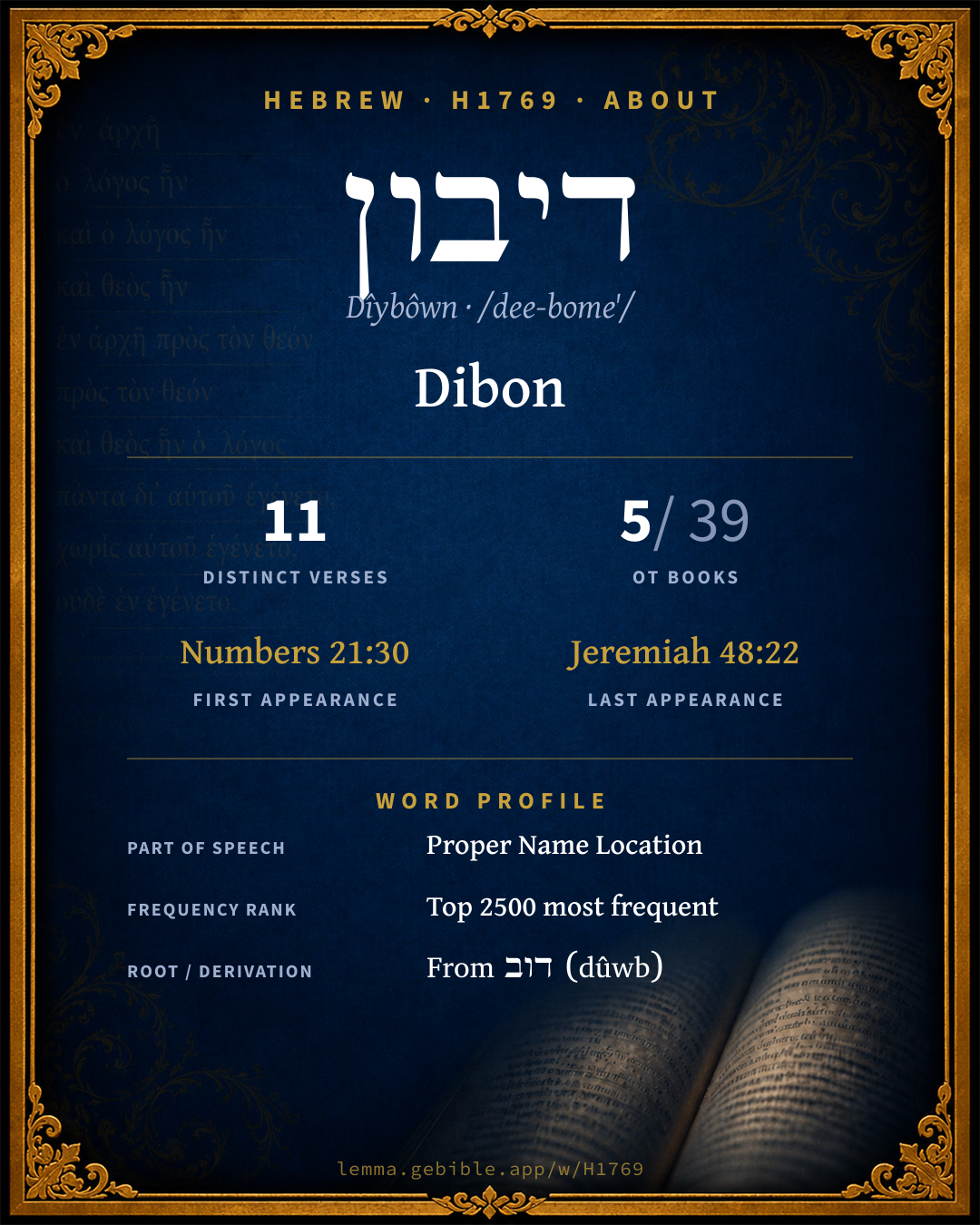
דִּיבֹן
Dibon
BDB lists 3 entries for ‘Dibon’ fuller range ↓
Full lexicon entry — Brown-Driver-Briggs (BDB)
From Brown-Driver-Briggs (BDB)
Where this word appears
Grammar key — what these labels mean
Part of speech
- Noun
- A naming word — a person, place, thing, or idea.
Noun type
- Proper
- A name of a specific person, place, or people (e.g. Abraham, Zion, Israel).
Every verse where H1769 appears — 11 distinct verses across 5 books. Click any verse to open its interlinear word-by-word view. Verse text shown in the World English Bible for context — . Each verse’s Hebrew form is shown with its reference; the English is not keyword-highlighted, since the data carries no word-level English alignment. Use “Compare translations” on any verse to read it across multiple English versions. This concordance covers the Hebrew Bible; Septuagint (Greek Old Testament) occurrences are not indexed here.
Numbers 5 verses
- Numbers 21:30 דִּיב֑וֹן n Proper We have shot at them; Heshbon is perished even to Dibon, We have laid waste even to Nophah, Which [reaches] to Medeba.
- Numbers 32:3 וְ/דִיבֹן֙ conj + n Proper Ataroth, and Dibon, and Jazer, and Nimrah, and Heshbon, and Elealeh, and Sebam, and Nebo, and Beon,
- Numbers 32:34 דִּיבֹ֖ן n Proper The children of Gad built Dibon, and Ataroth, and Aroer,
- Numbers 33:45 בְּ/דִיבֹ֥ן prep + n Proper They traveled from Iyim, and encamped in Dibon-gad.
- Numbers 33:46 מִ/דִּיבֹ֣ן prep + n Proper They traveled from Dibon-gad, and encamped in Almon Diblathaim.
Joshua 2 verses
- Joshua 13:9 דִּיבֽוֹן n Proper from Aroer, that is on the edge of the valley of the Arnon, and the city that is in the middle of the valley, and all the plain of Medeba to Dibon;
- Joshua 13:17 דִּיבוֹן֙ n Proper Heshbon, and all its cities that are in the plain; Dibon, and Bamoth Baal, and Beth Baal Meon,
Nehemiah 1 verse
Isaiah 1 verse
Jeremiah 2 verses
About this entry
At a glance — auto-summarized from this page’s data, not written by a person. Every figure links to its source below. This summary describes the numbers; it doesn’t interpret them.
“Dibon” is the headline sense of the Hebrew name דיבון (Dîybôwn). First canonically at Numbers 21:30, it enters the text early. It turns up in 11 verses across 5 books, an uncommon footprint. It concentrates in Numbers, which alone accounts for 45% of its uses. See 11-verse concordance and the renderings breakdown below.
Gloss history
Strong's 1890 vs modern scholarship
About this word
Strong's H1769 catalogs a Hebrew word from the Hebrew Old Testament.
These counts are not copied from any lexicon or concordance. They are computed here, from the morphology-tagged Hebrew Old Testament. What Lemma adds →
- 11
- distinct verses
- The word appears in 11 distinct verses.
- 5 / 39
- OT books
- The word appears in 5 of 39 Old Testament books.
- #2,210
- by frequency
- Top 2500 most frequent Hebrew words (rank 2,210 of 8,640 Hebrew words by occurrence).
View all 11 occurrences in the concordance →
By section of the Old Testament
By traditional corpus
Conventional, traditional groupings — biblical authorship is debated, so this is a traditional corpus grouping, not an authorship claim. Each share is this word’s portion of its verses in that division of the Hebrew canon. Each figure is a share of the word’s 11 distinct verses.
- Torah (Pentateuch) 5 verses · 45%
- Prophets (Nevi'im) 5 verses · 45%
- Writings (Ketuvim) 1 verse · 9%
How translations render this word
Counts come from each version’s own published word-to-Strong’s tagging or interlinear alignment — an approximate guide to how each version renders this word, not a word-level alignment the data otherwise carries. Because each total is that version’s own tagged count, the per-version totals vary from one another and need not match the appearance or distinct-verse counts above. These counts may also differ from a printed concordance because Lemma counts each distinctly tagged rendering and does not collapse phrase taggings into a single head-word total. This is a fixed set of word-tagged versions (KJV, ASV, BSB, ULT) and does not change with the reading translation you choose elsewhere. Each version’s license is shown beside its name below (and on Sources).
- King James Version: Dibon 8×, Dibongad 2×
- American Standard Version: Dibon 8×, Dibon-gad 2×
- Berean Standard Bible: Dibon 7×, Dibon-gad 2×
- unfoldingWord Literal Text: Dibon 7×, Dibon gad 2×
King James Version Public Domain
Renders H1769 across 11 tagged occurrences — most commonly:
Plus 1 rendering that appears only once — usually multi-word phrases or single function words the recovered tagging swept in, not distinct renderings.
American Standard Version Public Domain
Renders H1769 across 11 tagged occurrences — most commonly:
Plus 1 rendering that appears only once — usually multi-word phrases or single function words the recovered tagging swept in, not distinct renderings.
Berean Standard Bible Public Domain
Renders H1769 across 11 tagged occurrences — most commonly:
Plus 2 renderings that appear only once — usually multi-word phrases or single function words the recovered tagging swept in, not distinct renderings.
unfoldingWord Literal Text CC BY-SA 4.0
Renders H1769 across 9 tagged occurrences — most commonly:
Senses in the full BDB
What do BDB’s symbols mean?
BDB uses these scholarly abbreviations:
| Symbol | Meaning |
|---|---|
| 𝔊 | the Septuagint (the ancient Greek translation, LXX) |
| 𝔙 | the Vulgate (the Latin translation) |
| 𝔖 | the Syriac version (the Peshitta) |
| 𝔗 | the Targum (the Aramaic translation) |
| ψ | the Psalms |
| √ | root (the underlying root or stem) |
| ‖ | parallel passage (a synonymous or contrasted parallel) |
| † | the dagger: every passage where the word occurs is cited |
The 2 senses and sub-senses the full Brown-Driver-Briggs lexicon distinguishes for this word, in lexicon order (not ranked by frequency), with BDB’s own verbatim wording and sub-sense lettering. Shown in Hebrew script with BDB’s own scholarly abbreviations. The condensed entry is in the Lexicon Entry tab. See also the Forms in the corpus table below.
- 1. city in Moab (MI21, 28 דיבן, cf. ib.1 adj. gent. הדיבני)—דִּיבֹן Nu 21:30; 32:3, 34 (built up or at by Gad) Is 15:2; in territory of Gad, hence דִּיבֹן גָּ֑ד Nu 33:45, 46 (cf. on these vv. & 32:34 MI10 f.); also דִּיבוֹן Jos 13:9, 17 Je 48:22; ישֶׁבֶת בַּת דִּיבוֹן Je 48:18; = דִּימוֹן Is 15:9, vid. also מֵי דִימוֹן v 9 = Arnon, cf. Che & HptZA 1887, 268;—mod. Dîbân, north of Arnon, cf. SeetzenReisen i. 409 TristrLand of Moab 132 ff. Bd.Pal. 193 e.g. Numbers 21:30
- 2. דִּיבֹן Ne 11:25 place in Judah, toward south = דִּימוֹנָה Jos 15:22, cf. Hptl.c.; conject. by Kn Ke (cf. Di) to be Tell ed Dheib (vandeVeldeMem 252) called also Ehdeib (RobBR ii. 102) e.g. Nehemiah 11:25
Senses from the full Brown-Driver-Briggs lexicon (Brown, Driver, Briggs; Oxford 1906 — public domain), digitized via Sefaria, supplemented by the OpenScriptures HebrewLexicon (CC BY 4.0). Full attribution on Sources.
Word origin
Derived from דוב (dûwb) (H1727) — to pine away.
Jastrow Dictionary
A second Hebrew/Aramaic lexicon for comparison, covering Aramaic and post-biblical (Talmudic, Targumic, Midrashic) usage that the biblical-Hebrew BDB does not. Matched by lemma rather than by Strong’s number, so a lemma may carry more than one Jastrow headword (shown separately below), and the entries cover usage well beyond the Bible.
דיבון
- , Targ. Y. II, Num. XXXII, 24 some ed., v. דִּכְוָון
A Dictionary of the Targumim, the Talmud Babli and Yerushalmi, and the Midrashic Literature (Marcus Jastrow; London, Luzac, 1903) — Public Domain. Digitized via Sefaria. Digitized via Sefaria. Full attribution on Sources.
Forms in the corpus
The 10 distinct written forms H1769 takes in the Hebrew Bible, most frequent first — each parse links to that state’s occurrences in the concordance. Hebrew forms include their vowel points and cantillation, so a single lemma takes many written forms.
| Form | Parsing | Example | Uses |
|---|---|---|---|
| דִּיב֑וֹן | Noun, Proper | Jeremiah 48:18 | 2 |
| בְּ/דִיבֹ֥ן | Noun, Proper | Numbers 33:45 | 1 |
| דִּיב֣וֹן | Noun, Proper | Jeremiah 48:22 | 1 |
| דִּיבֹ֖ן | Noun, Proper | Numbers 32:34 | 1 |
| דִּיבֽוֹן | Noun, Proper | Joshua 13:9 | 1 |
| דִּיבוֹן֙ | Noun, Proper | Joshua 13:17 | 1 |
| וְ/דִיבֹ֛ן | Noun, Proper | Isaiah 15:2 | 1 |
| וְ/דִיבֹן֙ | Noun, Proper | Numbers 32:3 | 1 |
| וּ/בְ/דִיבֹן֙ | Noun, Proper | Nehemiah 11:25 | 1 |
| מִ/דִּיבֹ֣ן | Noun, Proper | Numbers 33:46 | 1 |
Same root — word family
Other BDB entries built from the same root as H1769, grouped by Strong’s listed origin. These share a root / origin per the lexicon — not necessarily a shared meaning. Each links to that word’s own entry.
Derives from
Proper names from this root
People and places named from this root — a name, not an additional meaning of the word.
Compare all same-root words → 1 of the same-root words is a proper name (a person or place). They share a root, not necessarily a meaning.
Bible dictionary
Public-domain dictionary articles matched to this entry by name (Dibon). A biblical name can be shared by more than one person or place, so an article may treat several.
Easton's Bible Dictionary · M. G. Easton, 1897
Pining; wasting. (1.) A city in Moab (Num. 21:30); called also Dibon-gad (33:45), because it was built by Gad and Dimon (Isa. 15:9). It has been identified with the modern Diban, about 3 miles north of the Arnon and 12 miles east of the Dead Sea. (See Moabite Stone.)
(2.) A city of the tribe of Judah, inhabited after the Captivity (Neh. 11:25); called also Dimonah (Josh. 15:22). It is probably the modern ed-Dheib.
Smith's Bible Dictionary · William Smith, 1863
(wasting).
+ A town on the east side of Jordan, in the rich pastoral country, which was taken possession of and rebuilt by the children of Gad. (Numbers 32:3,34) From this circumstance it possibly received the name of DIBON-GAD. (Numbers 33:45,46) Its first mention is in (Numbers 21:30) and from this it appears to have belonged originally to the Moabites. We find Dibon counted to Reuben in the lists of Joshua. (Joshua 13:9,17) In the time of Isaiah and Jeremiah, however, it was again in possession of Moab. (Isaiah 15:2; Jeremiah 48:18,22) comp. Jere 48:24 In modern times the name Dhiban has been discovered as attached to extensive ruins on the Roman road, about three miles north of the Arnon (Wady Modjeb). + One of the towns which were reinhabited by the men of Judah after the return from captivity, (Nehemiah 11:25) identical with Dimonah.
Hitchcock's Bible Names Dictionary · Roswell D. Hitchcock, 1869
abundance of knowledge
Classic public-domain reference works; full attribution on Sources.
Septuagint verse parallels
This word appears in 9 verses that also exist in the Greek Old Testament (Septuagint), out of the 11 Hebrew verses it occurs in. You can read those verses in Greek by switching the Old Testament edition to the Septuagint.
Read these verses in the Septuagint
This is a verse-level parallel only — the same verses exist in both the Hebrew and Greek Old Testaments. No word-level Hebrew↔Greek correspondence is claimed: the data carries no such alignment, so no Greek word is shown as this Hebrew word’s translation. Coverage is not total — the Septuagint omits the deuterocanon and renumbers the Psalms, so some Hebrew verses have no direct Greek parallel.