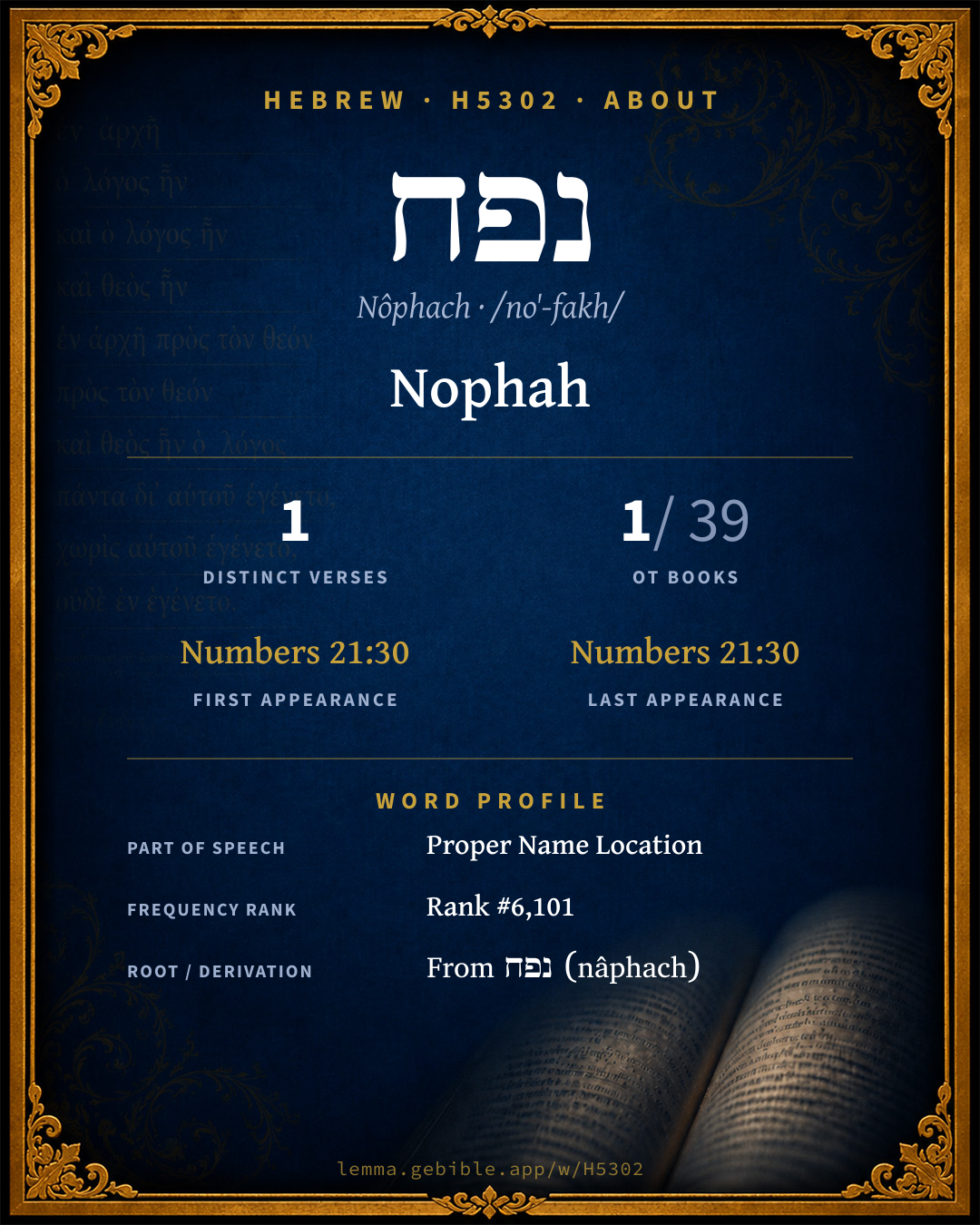
נֹ֫פַח
Nophah
BDB lists 2 entries for ‘Nophah’ fuller range ↓
Full lexicon entry — Brown-Driver-Briggs (BDB)
From Brown-Driver-Briggs (BDB)
Where this word appears
Grammar key — what these labels mean
Part of speech
- Noun
- A naming word — a person, place, thing, or idea.
Noun type
- Proper
- A name of a specific person, place, or people (e.g. Abraham, Zion, Israel).
Every verse where H5302 appears — 1 distinct verse across 1 book. Click any verse to open its interlinear word-by-word view. Verse text shown in the World English Bible for context — . Each verse’s Hebrew form is shown with its reference; the English is not keyword-highlighted, since the data carries no word-level English alignment. Use “Compare translations” on any verse to read it across multiple English versions. This concordance covers the Hebrew Bible; Septuagint (Greek Old Testament) occurrences are not indexed here.
Numbers 1 verse
About this entry
At a glance — auto-summarized from this page’s data, not written by a person. Every figure links to its source below. This summary describes the numbers; it doesn’t interpret them.
נפח (Nôphach) is a Hebrew name most often rendered “Nophah.” The Hebrew Bible uses it only 1 verse. Numbers dominates its distribution — 1 of 1 verses. Its lone occurrence is Numbers 21:30. The sections below give every occurrence and version rendering.
Gloss history
Strong's 1890 vs modern scholarship
About this word
Strong's H5302 catalogs a Hebrew word from the Hebrew Old Testament.
These counts are not copied from any lexicon or concordance. They are computed here, from the morphology-tagged Hebrew Old Testament. What Lemma adds →
- 1
- distinct verses
- The word appears in 1 distinct verse.
- 1 / 39
- OT books
- The word appears in 1 of 39 Old Testament books.
- #6,101
- by frequency
- Rank #6,101 (rank 6,101 of 8,640 Hebrew words by occurrence).
View all 1 occurrence in the concordance →
Most concentrated in
- Numbers 1 verse 100%
By section of the Old Testament
By traditional corpus
Conventional, traditional groupings — biblical authorship is debated, so this is a traditional corpus grouping, not an authorship claim. Each share is this word’s portion of its verses in that division of the Hebrew canon. Each figure is a share of the word’s 1 distinct verse.
- Torah (Pentateuch) 1 verse · 100%
How translations render this word
Counts come from each version’s own published word-to-Strong’s tagging or interlinear alignment — an approximate guide to how each version renders this word, not a word-level alignment the data otherwise carries. Because each total is that version’s own tagged count, the per-version totals vary from one another and need not match the appearance or distinct-verse counts above. These counts may also differ from a printed concordance because Lemma counts each distinctly tagged rendering and does not collapse phrase taggings into a single head-word total. This is a fixed set of word-tagged versions (KJV, ASV, BSB, ULT) and does not change with the reading translation you choose elsewhere. Each version’s license is shown beside its name below (and on Sources).
- King James Version: Nophah 1×
- American Standard Version: Nophah 1×
- Berean Standard Bible: Far as nophah 1×
- unfoldingWord Literal Text: Nophah 1×
King James Version Public Domain
Renders H5302 across 1 tagged occurrence — most commonly:
American Standard Version Public Domain
Renders H5302 across 1 tagged occurrence — most commonly:
Berean Standard Bible Public Domain
Renders H5302 across 1 tagged occurrence — most commonly:
unfoldingWord Literal Text CC BY-SA 4.0
Renders H5302 across 1 tagged occurrence — most commonly:
Senses in BDB
The 2 senses BDB distinguishes for this word, in lexicon order (not ranked by frequency or importance). The full entry — with sub-senses — is in the Lexicon Entry tab.
- Nophah = "blast"
- a place in Moab
Word origin
appar. n.pr.loc. Nu 21:30 (= נֹבַח?) perhaps נֻפַּח (𝔊 προσεξέκαυσαν), v. נפח Pu.
— Brown-Driver-Briggs (Oxford 1906, public domain), digitized via Sefaria, supplemented by the OpenScriptures HebrewLexicon (CC BY 4.0). See Sources.
Derived from נפח (nâphach) (H5301) — to breathe.
Jastrow Dictionary
A second Hebrew/Aramaic lexicon for comparison, covering Aramaic and post-biblical (Talmudic, Targumic, Midrashic) usage that the biblical-Hebrew BDB does not. Matched by lemma rather than by Strong’s number, so a lemma may carry more than one Jastrow headword (shown separately below), and the entries cover usage well beyond the Bible.
נָפַח
- 1. to blow, breathe. Y. Sabb. VII, 10ᵈ הנוֹפֵח כלי זכוכית he who shapes glass vessels by blowing (on the Sabbath); Bab. Sabb. 75ᵇ המְנַפֵּחַ בכלי וכ׳. Makhsh. I, 6 הנופח בעדשים וכ׳ he who breathes at lentils to ascertain their quality. Tosef. Sabb. XV (XVI), 2 נופח בחוטמו וכ׳ you blow into its nostrils and put the teat into its mouth; Sabb. 128ᵇ; Y. ib. XVIII, end, 16ᶜ מביא יין ונופח וכ׳ you take wine and squirt it &c. B. Mets. 60ᵇ אין נוֹפְחִין בקרביים it is not permitted to blow up entrails (for sale, to give them a delusive appearance); a. fr.
- 2. to be blown up, to swell. Tanḥ. K’dosh. 8 נָפְחוּ פניו his face was swollen. Ib. עיניו נְפוּחוֹת his eyes swollen.
- same. Sabb. 75ᵇ, v. supra. Maasr. IV, 5 מְנַפֵּיחַ … ואם ני׳ וכ׳ Y. ed. (Bab. ed. מנפח … נפח; Ms. M. מנפיח; Mish. ed. מנפה … נפה, v. Rabb. D. S. a. l. note 7) he may blow out (the chaff of the wheat-ears) from hand to hand and eat, but if he blows and puts the grain in his lap, he is bound (to pay tithes); Bets. 13ᵇ. Ib. 14ᵃ. Ber. 19ᵇ; Nidd. 57ᵃ, a. e., v. פְּרַס; a. fr.—[Y. Peah VIII, 21ᵇ top המנפח, read המכפח, v. קָפַח.]
- to be blown, fanned. Treat. S’maḥ. ch. VIII מוטב … אש שנוּפְּחָה ולא אש שלא נופחה וכ׳ it is better that a fire consume me which has been blown (by man), than a fire that has not been fanned (Gehenna; Job XX, 26). e.g. Job 20:26
- to be blown up, to swell. Num. R. s. 7 תִּנָּפֵחַ כרסי וכ׳ my belly may swell and burst.
נְפַח
- 1. to blow. Targ. Gen. II, 7; a. fr.—Y. Bets. II, end, 62ᵇ (ל) מִנְפּוֹחַ וכ׳ to blow meat up. Gitt. 69ᵃ bot. לִינְפַּח ליה חבריה וכ׳ let his neighbor blow white cress-seeds (into his throat) through a straw. Ḥull. 46ᵇ ונַפְחִינָא לה and we blow the lungs up; a. fr.—Part. pass. נְפִיחַ; f. נְפִיחָא; pl. נְפִיחִין; נְפִיחָן blown, ignited; blown up, swollen. Targ. Job XX, 26. Targ. O. Num. V, 21; a. fr.—Ḥull. 47ᵇ א"ד דנפיחא (not דנפיחה) some explain דמיא לאופתא (v. אוּפְתָּא) as meaning lungs which look as if distended (white). Sabb. 33ᵃ נְפִיחֵי כפן, v. כַּפְנָא; a. fr.
- 2. to be blown up, to swell. Targ. O. Num. V, 27, v. Ithpa. (Y. ותְנָפַח, prob. to be read: ותִתְנְפַח).—Lev. R. s. 33; Cant. R. to II, 14, v. קוּלְתָא.
- same, to blow, cause swelling. Targ. Y. Num. V, 22 (O. לְאַפָּחָא, Af.; ed. Amst. לַאֲפָחָא); a. e.—Part. pass. מְנַפַּח; f. מְנַפְּחָא; pl. מְנַפְּחִין; מְנַפְּחָן. Targ. Y. ib. 21.—Lam. R. to I, 1 רבתי (חד כות׳ 1) כל עמא מְנַפְּחִין לי וכ׳ (I dreamt) all the people were blowing at me with their full cheeks. Ib. דאינון מנפחין (it meant) that it (the wheat) was swollen (through rain drippings). Snh. 43ᵃ; B. Bath. 134ᵇ מְנַפֵּח רב ששת וכ׳ R. Sh. blew into his hand (intimating that the question raised was scurrilous); a. e.
- 1. to blow, swell. Targ. O. Num. V, 22, v. supra. Targ. Ps. XI, 6 מַפְּחִין דאשתא (Ms. מפ׳ אש׳) blowers (winds) of fire (h. text פחים אש).
- 2. (with נפש) to incite longing, to cause despair. Targ. Job XXXI, 39. Targ. I Sam. II, 33 (h. text לאדיב).—V. מַפַּח.
- ; Ithpe. אִתְנְפַח, אִינְּ׳
- 1. to be swollen. Targ. Y. Num. V, 27 (v. supra; O. ויִפְּחוּן, ed. Berl. ויִפְחוּן). Targ. Job XIX, 26 (ed. Wil. אִתְּפָח; h. text נקפו). Targ. Koh. XII, 5.—Y. Maas. Sh. IV, end, 55ᶜ אִינַּפְּחָן the wheat shall swell (v. supra).
- 2. to be blown, ignited. Sabb. 26ᵃ אינפח בה נורא she caught fire.
נֶפֶח
- (preced.) swelling; bulk, volume (v. אַפּוּחָא). B. Mets. VI, 5 הנ׳ קשה כמשאוי an increase of volume makes the load harder for the animal (Bab. ed. 80ᵃ הנ׳ קשה כמשאוי an increase of size is as hard for the animal as an increase of weight), v. נִפְחָא. B. Kam. 47ᵃ נִיפְחָהּ, v. נִפְחָא.
נַפָּח
- (preced. wds.) smith. Gen. R. s. 84, beg. [read:] נ׳ שהיה מפוחו פתוח באמצע פלטיא ופתח בנו זהבי מפוח כנגדו a smith whose open shop was in the middle of the road, and whose son, a jeweler, opened a smithy opposite him; Tanḥ. Vayesheb 1; a. fr.—Y. R. Hash. II, 58ᵇ top, a. e. בן הנ׳ the smith’s son, i.e. R. Johanan, v. next w.—Pl. נַפָּחִין. Y. B. Bath. II, beg. 13ᵇ ולא של נ׳ nor dare an oven for smiths be put up (without the precautions mentioned in the Mishnah).
A Dictionary of the Targumim, the Talmud Babli and Yerushalmi, and the Midrashic Literature (Marcus Jastrow; London, Luzac, 1903) — Public Domain. Digitized via Sefaria. Digitized via Sefaria. Full attribution on Sources.
Same root — word family
Other BDB entries built from the same root as H5302, grouped by Strong’s listed origin. These share a root / origin per the lexicon — not necessarily a shared meaning. Each links to that word’s own entry.
Derives from
Shares the same root
Compare all same-root words → Showing 4 of 5 — not the complete family. They share a root, not necessarily a meaning.
Bible dictionary
Public-domain dictionary articles matched to this entry by name (Nophah). A biblical name can be shared by more than one person or place, so an article may treat several.
Easton's Bible Dictionary · M. G. Easton, 1897
Blast, a city of Moab which was occupied by the Amorites (Num. 21:30).
Hitchcock's Bible Names Dictionary · Roswell D. Hitchcock, 1869
fearful; binding
Classic public-domain reference works; full attribution on Sources.
Septuagint verse parallels
This word appears in 1 verse that also exists in the Greek Old Testament (Septuagint), out of the 1 Hebrew verse it occurs in. You can read those verses in Greek by switching the Old Testament edition to the Septuagint.
Read these verses in the Septuagint
This is a verse-level parallel only — the same verses exist in both the Hebrew and Greek Old Testaments. No word-level Hebrew↔Greek correspondence is claimed: the data carries no such alignment, so no Greek word is shown as this Hebrew word’s translation. Coverage is not total — the Septuagint omits the deuterocanon and renumbers the Psalms, so some Hebrew verses have no direct Greek parallel.