
Ezra 2:43

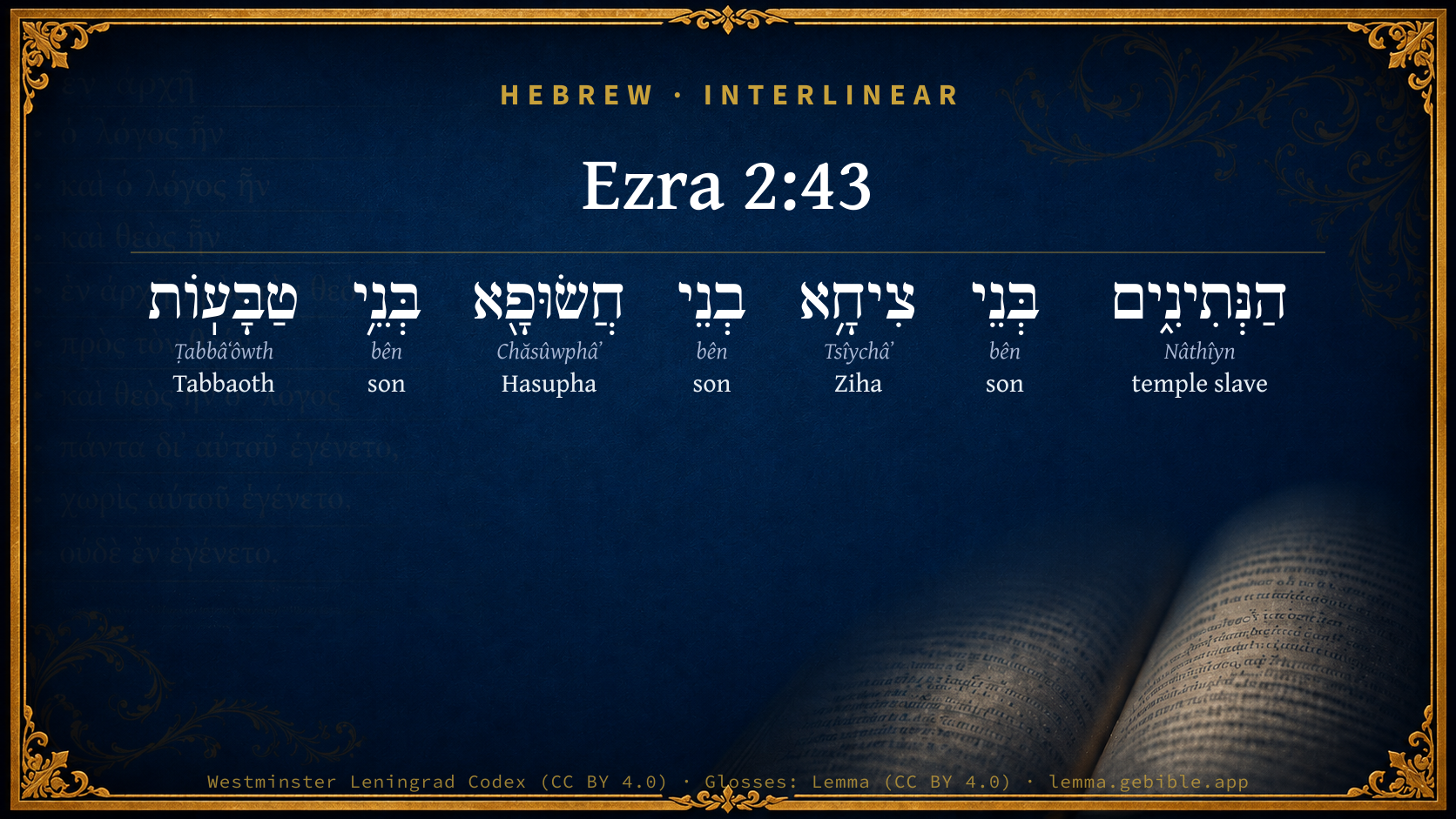
Hebrew (Westminster Leningrad Codex) Ezra 2:43 appears in the Hebrew Old Testament. The text above is from the Westminster Leningrad Codex. Each word links to its Strong’s number, a concise gloss, and parsing drawn from the Open Scriptures Hebrew Bible morphology. Click any word for its full Brown-Driver-Briggs (BDB) entry.
Download image
Cite this verse

Ezra 2:43 (World English Bible). Public Domain. Lemma interlinear Bible study tool, https://lemma.gebible.app/v/ezra/2/43.

Show BibTeX & RIS
BibTeX
RIS
English Translation
The Nethinim: the children of Ziha, the children of Hasupha, the children of Tabbaoth,
World English Bible · Public Domain
Highlights
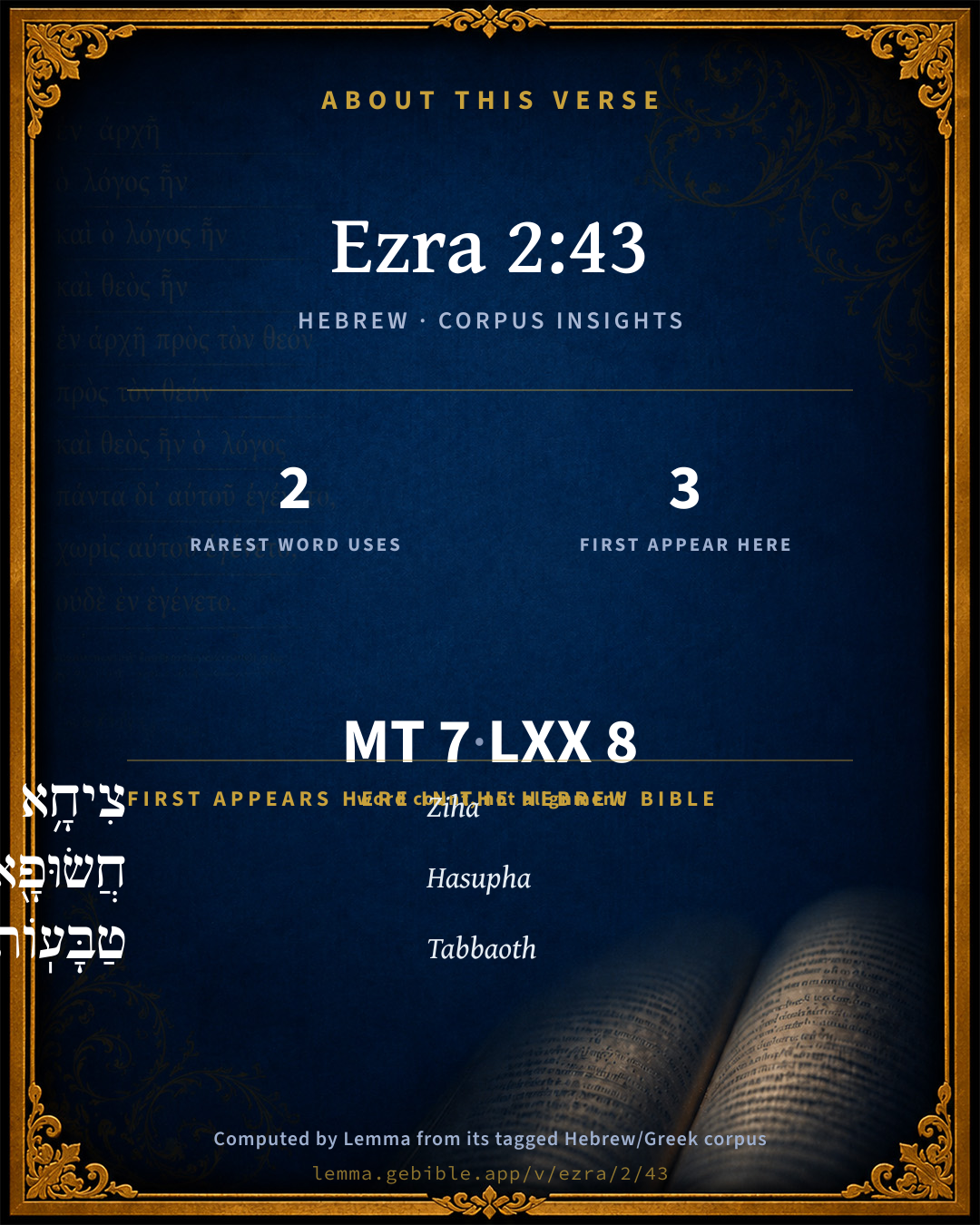
  • 3 first appearances in the Hebrew Bible
Full analysis ↓
Download a study sheet

One document with this verse’s original text, its word-by-word gloss line, the meaning frame, cross-references with their text, attributed commentary, and full source and license credits — printable, and it pastes into notes with its structure intact.

This verse Autodidact and up

Study sheet (.html) Plain text (.txt)

A passage Seminary Student

Up to 50 verses in one chapter. A passage sheet keeps up to 6 commentary sources and 12 cross-references per verse, in the order this page ranks them, and says so on the sheet whenever that leaves anything out. Ask for a single verse and you get the Autodidact verse sheet above.

Everything on this page stays free to read, with no account — the sheet is a download of what is already on screen, not access to it.

Want to remove ads? Support Godless Engineer
Compare translations 3

The same verse in 3 English versions, stacked beneath the original-language interlinear above. Click any original word for its lexicon entry.

Each is an independent rendering of the whole verse — the interlinear is not word-aligned to these translations.

Highlighted words mark where these versions differ — a whole-verse word diff, not a word-by-word alignment.

  • World English Bible Public Domain
    The Nethinim: the children of Ziha, the children of Hasupha, the children of Tabbaoth,
  • King James Version Public Domain
    The Nethinims: the children of Ziha, the children of Hasupha, the children of Tabbaoth,
  • unfoldingWord Literal Text CC BY-SA 4.0
    The temple servants: the sons of Ziha, the sons of Hasupha, the sons of Tabbaoth,

unfoldingWord Literal Text — © unfoldingWord, licensed CC BY-SA 4.0. Word-aligned USFM3 via Door43 (git.door43.org/unfoldingWord/en_ult).

Versions to compare (up to 4)

3 of 4 selected

Show all 18 translations

Every available English version of this verse, each an independent rendering of the whole verse.

  • World English Bible Public Domain
    The Nethinim: the children of Ziha, the children of Hasupha, the children of Tabbaoth,
  • Berean Standard Bible Public Domain
    The temple servants: the descendants of Ziha, the descendants of Hasupha, the descendants of Tabbaoth,
  • Majority Standard Bible Public Domain
    The temple servants: the descendants of Ziha, the descendants of Hasupha, the descendants of Tabbaoth,
  • King James Version Public Domain
    The Nethinims: the children of Ziha, the children of Hasupha, the children of Tabbaoth,
  • American Standard Version (1901) Public Domain
    The Nethinim: the children of Ziha, the children of Hasupha, the children of Tabbaoth,
  • Revised Version (1885) Public Domain
    The Nethinim: the children of Ziha, the children of Hasupha, the children of Tabbaoth;
  • Geneva Bible (1599) Public Domain
    The Nethinims: the sonnes of Ziha, the sonnes of Hasupha, the sonnes of Tabbaoth,
  • Douay-Rheims (1899) Public Domain
    The Nathinites: the children of Siha, the children of Hasupha, the children of Tabbaoth,
  • Young's Literal Translation Public Domain
    The Nethinim: sons of Ziha, sons of Hasupha, sons of Tabbaoth,
  • Literal Standard Version CC BY-SA 4.0
    The Nethinim: sons of Ziha, sons of Hasupha, sons of Tabbaoth,
  • Unlocked Literal Bible CC BY-SA 4.0
    Those who were assigned to serve in the temple: descendants of Ziha, Hasupha, Tabbaoth,
  • unfoldingWord Literal Text CC BY-SA 4.0
    The temple servants: the sons of Ziha, the sons of Hasupha, the sons of Tabbaoth,
  • Darby Bible Public Domain
    The Nethinim: the children of Ziha, the children of Hasupha, the children of Tabbaoth,
  • World Messianic Bible Public Domain
    The temple servants: the children of Ziha, the children of Hasupha, the children of Tabbaoth,
  • Webster's Bible Public Domain
    The Nethinims: the children of Ziha, the children of Hasupha, the children of Tabbaoth,
  • Free Bible Version CC BY-SA 4.0
    The descendants of these Temple servants: Ziha, Hasupha, Tabbaoth,
  • Bible in Basic English Public Domain
    The Nethinim: the children of Ziha, the children of Hasupha, the children of Tabbaoth,
  • JPS Tanakh (1917) Public Domain
    The Nethinim: the children of Ziha, the children of Hasupha, the children of Tabbaoth;

Literal Standard Version (2020), Covenant Press — licensed CC BY-SA 4.0. Text via the HelloAO Bible API (eBible.org). Unlocked Literal Bible (unfoldingWord) — licensed CC BY-SA 4.0. Text via the HelloAO Bible API (eBible.org). unfoldingWord Literal Text — © unfoldingWord, licensed CC BY-SA 4.0. Word-aligned USFM3 via Door43 (git.door43.org/unfoldingWord/en_ult). Free Bible Version, Dr. Jonathan Gallagher — licensed CC BY-SA 4.0. Text via the HelloAO Bible API (eBible.org).

Word by word

More ways to search: Search by grammar → Find every occurrence → Compare this word →

Practice this passage: Drill this verse → Learn its vocabulary →

About this verse

These counts appear in no published source. They are computed here, from the morphology-tagged text and Lemma’s own curated glosses. What Lemma adds →

7
words
5
distinct lemmas
Historical
section

Notable vocabulary

The rarest word here is חֲשׂוּפָ֖א Hasupha H2817 — appearing just 2 times in the whole Hebrew Bible.

First appearance in Scripture

These words make their first canonical appearance in the Hebrew Bible here:

  • צִיחָ֥א Ziha H6727
  • חֲשׂוּפָ֖א Hasupha H2817
  • טַבָּעֽוֹת Tabbaoth H2884

Shared distinctive vocabulary

חֲשׂוּפָ֖א Hasupha H2817 occurs in 2 verses of the Hebrew Bible. Also found in:

Grammatical profile

  • 7 nouns

Repetition

A word recurs within this verse — often emphatic in Hebrew:

  • בְּנֵי son H1121 ×3

Hebrew & Septuagint length

In English translation the verse runs 14 words from the Hebrew and 14 from the Septuagint (LXX English) — the same length.

A rough comparison of the two English renderings, which tokenize alike — not a word-level alignment.

Word counts can differ between the Hebrew and the Greek without any difference in meaning — e.g. the Hebrew direct-object marker אֵת has no separate Greek word, and Greek often adds the article ὁ.

In the original languages it is 7 Hebrew tokens and 8 Greek tokens — but the two are counted differently (Hebrew bundles its prefixes and suffixes into one token; the Greek is in lemma form), so that isn’t a like-for-like length.

Cross-references

4

Topical passages linked to Ezra 2:43 in the Treasury of Scripture Knowledge — connected by theme and wording, ordered by reader-vote popularity; previews shown in the World English Bible.

  • 1 Chronicles 9:2 Now the first inhabitants who lived in their possessions in their cities were Israel, the priests, the Levites, and the Nethinim.
  • Ezra 2:58 All the Nethinim, and the children of Solomon's servants, were three hundred ninety-two.
  • Nehemiah 7:46–56 The Nethinim: the children of Ziha, the children of Hasupha, the children of Tabbaoth,
  • Nehemiah 10:28 The rest of the people, the priests, the Levites, the porters, the singers, the Nethinim, and all those who had separated themselves from the peoples of the lands to the law of God, their wives, their sons, and their daughters, everyone who had knowledge, and understanding;

Cross-references courtesy of OpenBible.info (CC BY 4.0).

Hebrew and Greek witnesses Masoretic Hebrew ↔ Greek Septuagint

The same verse in the two great witnesses to the Old Testament, shown verse-for-verse.

These are two independent witnesses, not word-aligned to each other, and the Septuagint is shown in lemma (dictionary) form.

Hebrew Ezra 2:43 Masoretic · Westminster Leningrad Codex

הַנְּתִינִ֑ים בְּנֵי צִיחָ֥א בְנֵי חֲשׂוּפָ֖א בְּנֵ֥י טַבָּעֽוֹת

The Nethinim: the children of Ziha, the children of Hasupha, the children of Tabbaoth,

World English Bible · Public Domain

Greek LXX Ezra 2:43 Septuagint · lemma form

ὁ ναθιναῖοι υἱός σουια υἱός ασουφε υἱός ταβαωθ

The Nathinim: the children of Suthia, the children of Asupha, the children of Tabaoth,

LXX2012 (modern English Septuagint) · Public Domain

In the Septuagint this is one book — Esdras B (2 Esdras): Ezra is chapters 1–10, Nehemiah 11–23.

Hebrew: Westminster Leningrad Codex (CC BY 4.0). Greek: Septuagint (public domain); English from LXX2012 (modern English Septuagint) (Public Domain). How the Septuagint differs from the Hebrew →

Commentary

Notes on Ezra 2:43 from classic Christian and Jewish commentators (each source and its license shown beneath its notes). The classic Christian expositions comment on the surrounding passage and are grouped to its opening verse, so a note may address several verses; the Jewish commentaries on the Tanakh (Rashi and others) are per-verse, so they appear only where the commentator wrote on this verse.

Lemma curates 59 commentaries, every one of them public domain or Creative Commons licensed, each selected and text-cleaned for this edition rather than reprinted as found. About our sources →

The Cambridge Bible for Schools and Colleges

gen. ed. J. J. S. Perowne

43. Nethinims] R.V. Nethinim. The termination ‘-im’ is the sign of the plural. In the same way the R.V. corrects the inaccurate form ‘Cherubims’ to ‘Cherubim’ (Gen_3:24), ‘Anakims’ to ‘Anakim’, ‘Horims’ to ‘Horites’, ‘Emims’ to ‘Emim’, ‘Zanzummims’ to ‘Zanzummim’, ‘Avims’ and ‘Caphtorims’ to ‘Avvim’ and ‘Caphtorim’ (Deu_2:10-12; Deu_2:20-23).

43–54. Nethinim. This class is mentioned in the books Ezra and Nehemiah (Ezr_2:43; Ezr_2:58; Ezr_2:70; Ezr_7:7; Ezr_7:24; Ezr_8:17; Ezr_8:20; Neh_3:26; Neh_3:31; Neh_7:46; Neh_7:60; Neh_7:73; Neh_10:28; Neh_11:3; Neh_11:21) and only once elsewhere (1Ch_9:2). From these passages it is evident that the Nethinim were a class subordinate to the Levites but ranking before ‘the servants of Solomon’ (Ezr_2:55) in the services of the Temple. Their origin is hid in great obscurity. The name denotes ‘given’. Jewish tradition identified them mainly with the Gibeonites, who had been assigned by Joshua to the Levites to assist them in the discharge of the more menial tasks (Jos_9:3-27). Their numbers were also, according to this supposition, increased by the captives taken in war, of whom a certain proportion were given over to the priests and Levites as their share in the booty of a campaign (Num_31:28 &c.). Thus in Ezr_8:20 we find a mention of certain of this class ‘whom David and the princes had appointed (lit. ‘given’) for the service of the Levites’.

The later Jewish tradition of the Talmud spoke of the Nethinim with great contempt and forbade intermarriage between them and the Jews. It is not improbable that these expressions were employed long after this distinctive class had been lost to view, and merely reflected the tradition which ascribed their origin to the Gibeonites and the Canaanites who fell under the special ban of the Law (Exo_34:12-16; Deu_7:1 &c.).

A recent theory, coupling the strong terms of Jewish hatred with the numerous feminine terminations in -a and -ah to be found in the genealogy of the Nethinim, supposes them to be the descendants of those who during the monarchy had led infamous lives in the precincts and vicinity of the Temple as devotees of Astarte and of Ashera (see Babyl. and Orient. Record, Feb., March 1888). But even if it were granted that the very odium of their origin would thus account for the mystery in which it is veiled, it does not seem probable that the strict notions which prevailed at the time of the Return would have admitted such a class to participate in the ministrations, however lowly, of the Temple.

The peculiar termination of the names derives a natural explanation from their foreign extraction.

The Cambridge Bible for Schools and Colleges (gen. ed. J. J. S. Perowne; Cambridge University Press, 1878–1918) — public domain. Text from a community e-Sword module.

Trapp's Complete Commentary

John Trapp

Ezr 2:43 The Nethinims: the children of Ziha, the children of Hasupha, the children of Tabbaoth,

Ver. 43. The Nethinims] i.e. Deodati, men given to God, devoted to the service of his house. These were those Gibeonites that, having saved their lives by a lie, were made drawers of water to the temple for a punishment. God made this cross a mercy: for the nearer they were to the Church the nearer to God. Their employment was to minister to the Levites, as the Levites did to the priests, Jos 9:21; and this gave them occasion to partake of the things of God, and to behold his face in righteousness.

John Trapp, A Commentary or Exposition upon All the Books of the Old and New Testament (1647–1656) — public domain. Text from a community e-Sword module.

Joseph Benson's Commentary

Ezr 2:43. Nethinims — Persons devoted to the inferior services of the priests and Levites. Commonly supposed to be the Gibeonites, given (so their name signifies) by Joshua first, and again by David, when Saul had expelled them, to the priests and Levites, for those services.

Joseph Benson's Commentary on the Old and New Testaments (1811–1818) — public domain. Text from a community e-Sword module.

Tyndale Open Study Notes

Tyndale Open Resources

2:43-54 The Temple servants were probably descendants of the Gibeonites (Josh 9:23-27). They assisted the Levites (8:20) by carrying water and wood and by sweeping floors.

Tyndale Open Study Notes — © Tyndale Open Resources, licensed CC BY-SA 4.0. Text via the HelloAO Bible API.

Geneva Bible (1599)

Geneva Bible translators

So called, because they were given to the Temple, to cut wood and bear water for the use of the sacrifices, and came of the Gibeonites, which were appointed to this use by Joshua, Josh. 9:23.

Geneva Bible (1599) marginal notes — public domain. Text via Bolls.life.

Ellicott's Commentary for English Readers

(43-58) The Nethinims.—By the etymology those given: known by this name only in the later books. (See 1Ch_9:2.) They were hieroduli, or temple-bondsmen: the lowest order of the ministry, performing the more laborious duties of the sanctuary. Their history runs through a long period. Moses apportioned them first, from the Midianite captives (Num_31:47); they were reinforced from the Gibeonites (Jos_9:23), and probably later by David (Ezr_8:20). Three names—Akkub, Hagab, and Asnah—have dropped from Neheniiah’s list, which gives also some unimportant changes in the spelling of the names.

A Bible Commentary for English Readers, edited by Charles John Ellicott (1878–1897) — public domain. Text from a community e-Sword module.

John Gill's Exposition

The children of Delaiah, the children of Tobiah, and the children of Nekoda, six hundred fifty and two. These, though their immediate parents were known, yet by their being mentioned here, it seems as if they could not carry their genealogy further, and make it clearly appear what was the house of their fathers, or what their family.

The children of Delaiah, the children of Tobiah, and the children of Nekoda, six hundred fifty and two. These, though their immediate parents were known, yet by their being mentioned here, it seems as if they could not carry their genealogy further, and make it clearly appear what was the house of their fathers, or what their family.

Ezra 2:61

ezr 2:61

ezr 2:61

ezr 2:61And of the children of the priests,.... Who could not make out their pedigree, for those that could are mentioned before:

the children of Habaiah, the children of Koz, the children of Barzillai; how the latter came by this name follows:

which took a wife of the daughters of Barzillai the Gileadite, and was called after their name; this man married a woman that descended from the famous Barzillai the Gileadite, in the times of David; and the priesthood being in disuse, and mean and despicable, in Babylon, he chose to take the name of his wife's family, and pass for a descendant from that, and perhaps destroyed, or at least neglected, to take care of the genealogy of his own family.

John Gill's Exposition of the Whole Bible (1746–1763) — public domain (CC PDM 1.0). Text via the HelloAO Bible API.

Albert Barnes' Notes on the Bible

The Nethinims - The hieroduli or sacred slaves, “given” to the Levites to assist them in their work (see 1Ch 9:2 note).

Albert Barnes' Notes on the Bible (1834–1885) — public domain. Text from a community e-Sword/MySword module.

Haydock's Catholic Bible Commentary

Nathinites, "people given" (1 Paralipomenon ix. 2.; Haydock) by Josue, David, and Solomon. (Tirinus)

George Leo Haydock (1774–1849), Haydock's Catholic Family Bible and Commentary, 1859 edition — public domain. Excludes Psalms (Douay-Rheims chapter numbering differs from Protestant) and Deuterocanonical books (Catholic canon only).

Matthew Poole's English Annotations

The Nethinims; the persons devoted to the inferior services of the priests and Levites; of whom see 1Ch 9:2.

Matthew Poole's English Annotations on the Holy Bible (1683–1685) — public domain. Text from a community e-Sword/MySword module.

Whedon's Commentary on the Bible

Daniel D. Whedon

43. The Nethinim — The given ones, that is, given to the Levites as hereditary temple servants, to perform for them the menial work of the sanctuary See on 1Ch_9:2.

Daniel D. Whedon (gen. ed.), Commentary on the Old and New Testaments (1874–1909) — public domain. Text from a community e-Sword module.

The Pulpit Commentary

The Nethiaims. See note on 1Ch_9:2.

The Pulpit Commentary (1880–1919), ed. H.D.M. Spence-Jones & Joseph S. Exell — public domain. Text from a community e-Sword module.

John Wesley's Explanatory Notes

Nethinims - Persons devoted to the inferior services of the priests and Levites. Commonly supposed to be the Gibeonites, given, (so their name signifies) by Joshua first, and again by David, when Saul had expelled them, to the priests and Levites, for those services.

John Wesley, Explanatory Notes Upon the Whole Bible (1754–1765) — public domain. Text via the GEBible commentary corpus.

unfoldingWord translationNotes

Door43 World Missions Community

General Information:

This section continues listing the names of Levites whose descendants returned from the exile.

Ziha, Hasupha, Tabbaoth, Keros, Siaha, Padon, Lebanah, Hagabah ... Hagab, Shalmai, and Hanan

These are men's names. (See: How to Translate Names)

Akkub

See how you translated this in Esra 2:42.

translationWords

servant

temple

descend

unfoldingWord translationNotes — © Distant Shores Media and the Door43 World Missions Community, licensed CC BY-SA 4.0. Source: git.door43.org/Door43/en_tn.

Rashi

Rabbi Shlomo Yitzchaki (Rashi)

The Nethinim Now he counts those Nethinim who were woodcutters and water-drawers for the congregation, and from there they derived their livelihood.

Rashi on the Tanakh — English translations: “The Judaica Press complete Tanach with Rashi, translated by A. J. Rosenberg” (CC BY 4.0); “Pentateuch with Rashi's commentary by M. Rosenbaum and A.M. Silbermann, 1929-1934” (public domain); “The Metsudah Tanach series, Lakewood, N.J” (CC BY 4.0); and “The Book of Joshua, Metsudah Publications, 1997” (CC BY 4.0). Text via Sefaria.

Lesson kit

Teaching starters — assembled from the data on this page, not authored interpretation. Every prompt links to the verse data it draws on. Edit before teaching.

Ezra, in the Historical, opens this verse with 7 words (5 distinct Hebrew lemmas). Its most distinctive word is Chăsûwphâʼ (“Hasupha”). A historical commentator’s framing appears above. Read the whole chapter for the surrounding context.

Discussion questions

  1. The word Chăsûwphâʼ carries the sense “Hasupha.” How does it shape the verse?
  2. 3 words make their first appearance in Scripture here. What does this debut establish?
  3. How does Nehemiah 7:46, which shares the word «Hasupha», read alongside this verse?
  4. What does the repetition of “son” (3× in this one verse) do in this verse?
  5. The translations on this page render this verse differently — a whole-verse word diff, not a word-by-word alignment. What might account for the different wordings?
  6. Compare how The Cambridge Bible for Schools and Colleges and Trapp's Complete Commentary read this verse. Where do they agree or differ?

Things to notice

Reading settings

Reading text

Shown beneath each verse's original-language words.

Old Testament
Old Testament edition

Read the OT as the Masoretic Hebrew (MT) or the Greek Septuagint (LXX).

English shown for the Greek Septuagint (in the Hebrew ↔ Greek comparison).

Comparing translations? Open the Compare panel on any verse page to stack up to four side by side.