

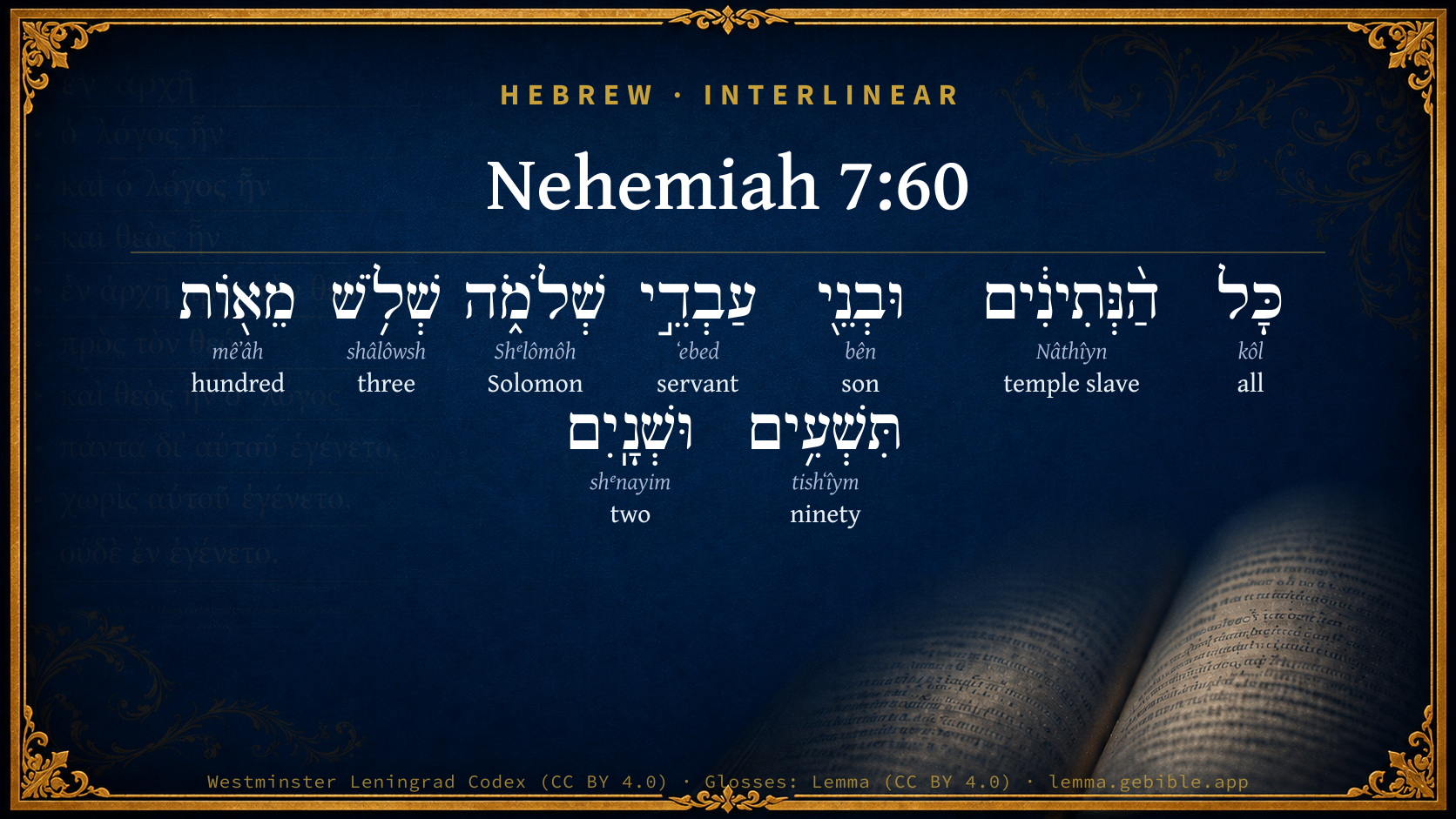
כָּל הַ֨נְּתִינִ֔ים וּבְנֵ֖י עַבְדֵ֣י שְׁלֹמֹ֑ה שְׁלֹ֥שׁ מֵא֖וֹת תִּשְׁעִ֥ים וּשְׁנָֽיִם
All the Nethinim, and the children of Solomon's servants, were three hundred ninety-two.
World English Bible · Public Domain
All the Nethinim, and the children of Solomon's servants, were three hundred ninety-two.
One document with this verse’s original text, its word-by-word gloss line, the meaning frame, cross-references with their text, attributed commentary, and full source and license credits — printable, and it pastes into notes with its structure intact.
This verse Autodidact and up
A passage Seminary Student
Up to 50 verses in one chapter. A passage sheet keeps up to 6 commentary sources and 12 cross-references per verse, in the order this page ranks them, and says so on the sheet whenever that leaves anything out. Ask for a single verse and you get the Autodidact verse sheet above.
Everything on this page stays free to read, with no account — the sheet is a download of what is already on screen, not access to it.
The same verse in 3 English versions, stacked beneath the original-language interlinear above. Click any original word for its lexicon entry.
Each is an independent rendering of the whole verse — the interlinear is not word-aligned to these translations.
Highlighted words mark where these versions differ — a whole-verse word diff, not a word-by-word alignment.
All the Nethinim, and the children of Solomon's servants, were three hundred ninety-two.
All the Nethinims, and the children of Solomon's servants, were three hundred ninety and two.
All the Nethinim and the sons of the servants of Solomon were 392.
unfoldingWord Literal Text — © unfoldingWord, licensed CC BY-SA 4.0. Word-aligned USFM3 via Door43 (git.door43.org/unfoldingWord/en_ult).
Every available English version of this verse, each an independent rendering of the whole verse.
All the Nethinim, and the children of Solomon's servants, were three hundred ninety-two.
The temple servants and descendants of the servants of Solomon numbered 392 in all.
The temple servants and descendants of the servants of Solomon numbered 392 in all.
All the Nethinims, and the children of Solomon's servants, were three hundred ninety and two.
All the Nethinim, and the children of Solomon's servants, were three hundred ninety and two.
All the Nethinim, and the children of Solomon’s servants, were three hundred ninety and two.
All the Nethinims, and the sonnes of Salomons seruantes were three hundreth, ninetie and two.
All the Nathinites, and the children of the servants of Solomon, three hundred ninety-two.
All the Nethinim and the sons of the servants of Solomon `are' three hundred ninety and two.
All the Nethinim and the sons of the servants of Solomon [are] three hundred ninety-two.
All the temple servants, and the descendants of Solomon's servants, were 392.
All the Nethinim and the sons of the servants of Solomon were 392.
All the Nethinim, and the children of Solomon's servants, three hundred and ninety-two.
All the temple servants and the children of Solomon’s servants were three hundred ninety-two.
All the Nethinims, and the children of Solomon's servants, were three hundred and ninety two.
The total of the Temple servants and the descendants of Solomon's servants was 392.
All the Nethinim and the children of Solomon's servants were three hundred and ninety-two.
All the Nethinim, and the children of Solomon's servants, were three hundred ninety and two.
Literal Standard Version (2020), Covenant Press — licensed CC BY-SA 4.0. Text via the HelloAO Bible API (eBible.org). Unlocked Literal Bible (unfoldingWord) — licensed CC BY-SA 4.0. Text via the HelloAO Bible API (eBible.org). unfoldingWord Literal Text — © unfoldingWord, licensed CC BY-SA 4.0. Word-aligned USFM3 via Door43 (git.door43.org/unfoldingWord/en_ult). Free Bible Version, Dr. Jonathan Gallagher — licensed CC BY-SA 4.0. Text via the HelloAO Bible API (eBible.org).
More ways to search: Search by grammar → Find every occurrence → Compare this word →
Practice this passage: Drill this verse → Learn its vocabulary →
These counts appear in no published source. They are computed here, from the morphology-tagged text and Lemma’s own curated glosses. What Lemma adds →
Topical passages linked to Nehemiah 7:60 in the Treasury of Scripture Knowledge — connected by theme and wording, ordered by reader-vote popularity; previews shown in the World English Bible.
Cross-references courtesy of OpenBible.info (CC BY 4.0).
The same verse in the two great witnesses to the Old Testament, shown verse-for-verse.
These are two independent witnesses, not word-aligned to each other, and the Septuagint is shown in lemma (dictionary) form.
כָּל הַ֨נְּתִינִ֔ים וּבְנֵ֖י עַבְדֵ֣י שְׁלֹמֹ֑ה שְׁלֹ֥שׁ מֵא֖וֹת תִּשְׁעִ֥ים וּשְׁנָֽיִם
All the Nethinim, and the children of Solomon's servants, were three hundred ninety-two.
World English Bible · Public Domain
The Septuagint has no separate book of Nehemiah. Its Greek text is the second half of Esdras B (2 Esdras), chapters 11–23; Ezra is the first half (1–10).
A verse-for-verse comparison isn’t shown here because the chapters and verses don’t line up. Switch to the LXX edition with the MT / LXX toggle above to read the Greek directly.
Hebrew: Westminster Leningrad Codex (CC BY 4.0). Greek: Septuagint (public domain); English from a public-domain English Septuagint. How the Septuagint differs from the Hebrew →
Teaching starters — assembled from the data on this page, not authored interpretation. Every prompt links to the verse data it draws on. Edit before teaching.
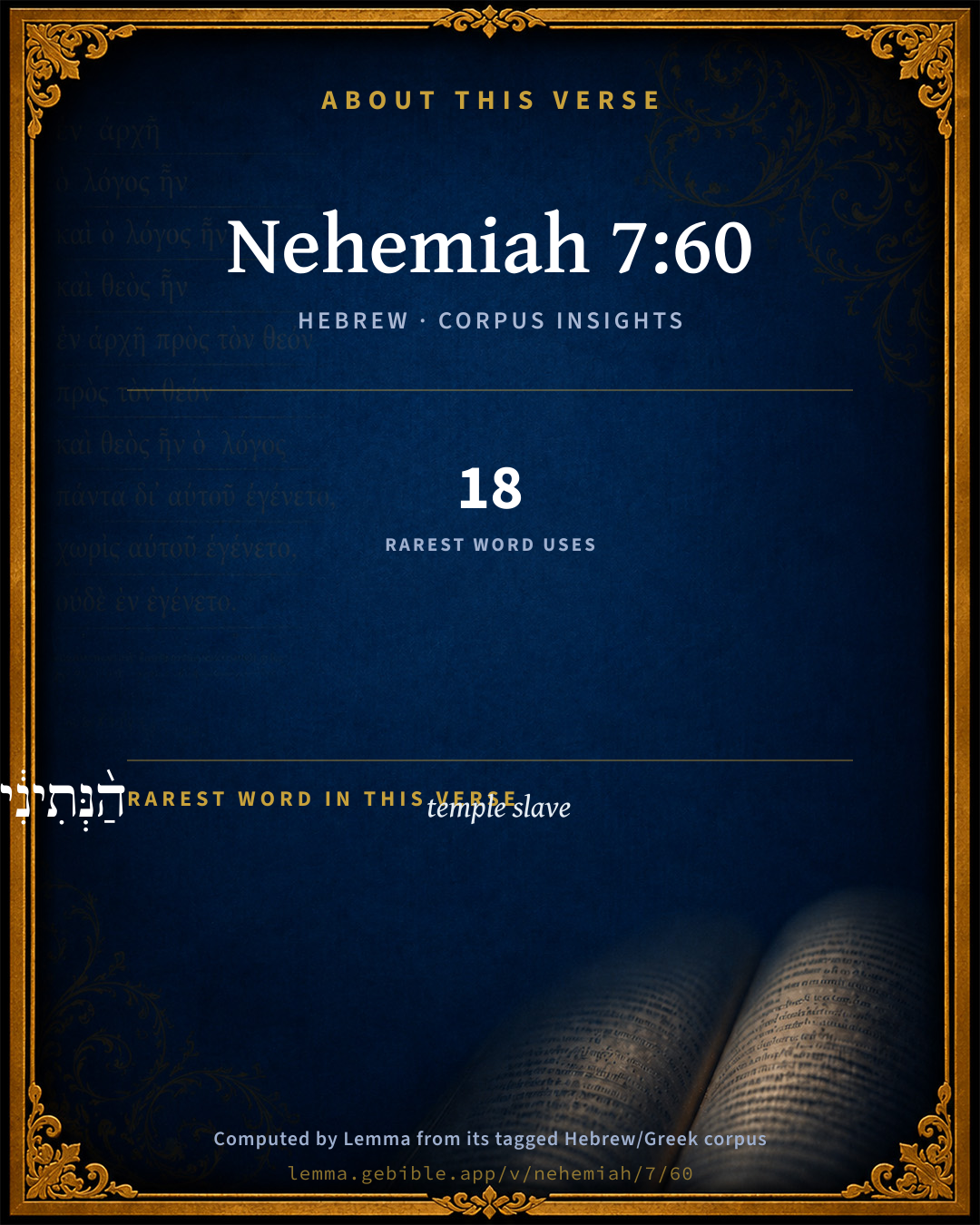
Nehemiah, in the Historical, opens this verse with 9 words (9 distinct Hebrew lemmas). Its most distinctive word is Nâthîyn (“temple slave”). A historical commentator’s framing appears above. Read the whole chapter for the surrounding context.
Commentary
Notes on Nehemiah 7:60 from classic Christian and Jewish commentators (each source and its license shown beneath its notes). The classic Christian expositions comment on the surrounding passage and are grouped to its opening verse, so a note may address several verses; the Jewish commentaries on the Tanakh (Rashi and others) are per-verse, so they appear only where the commentator wrote on this verse.
Lemma curates 59 commentaries, every one of them public domain or Creative Commons licensed, each selected and text-cleaned for this edition rather than reprinted as found. About our sources →
Tyndale Open Study Notes
Tyndale Open Resources
Tyndale Open Study Notes — © Tyndale Open Resources, licensed CC BY-SA 4.0. Text via the HelloAO Bible API.