
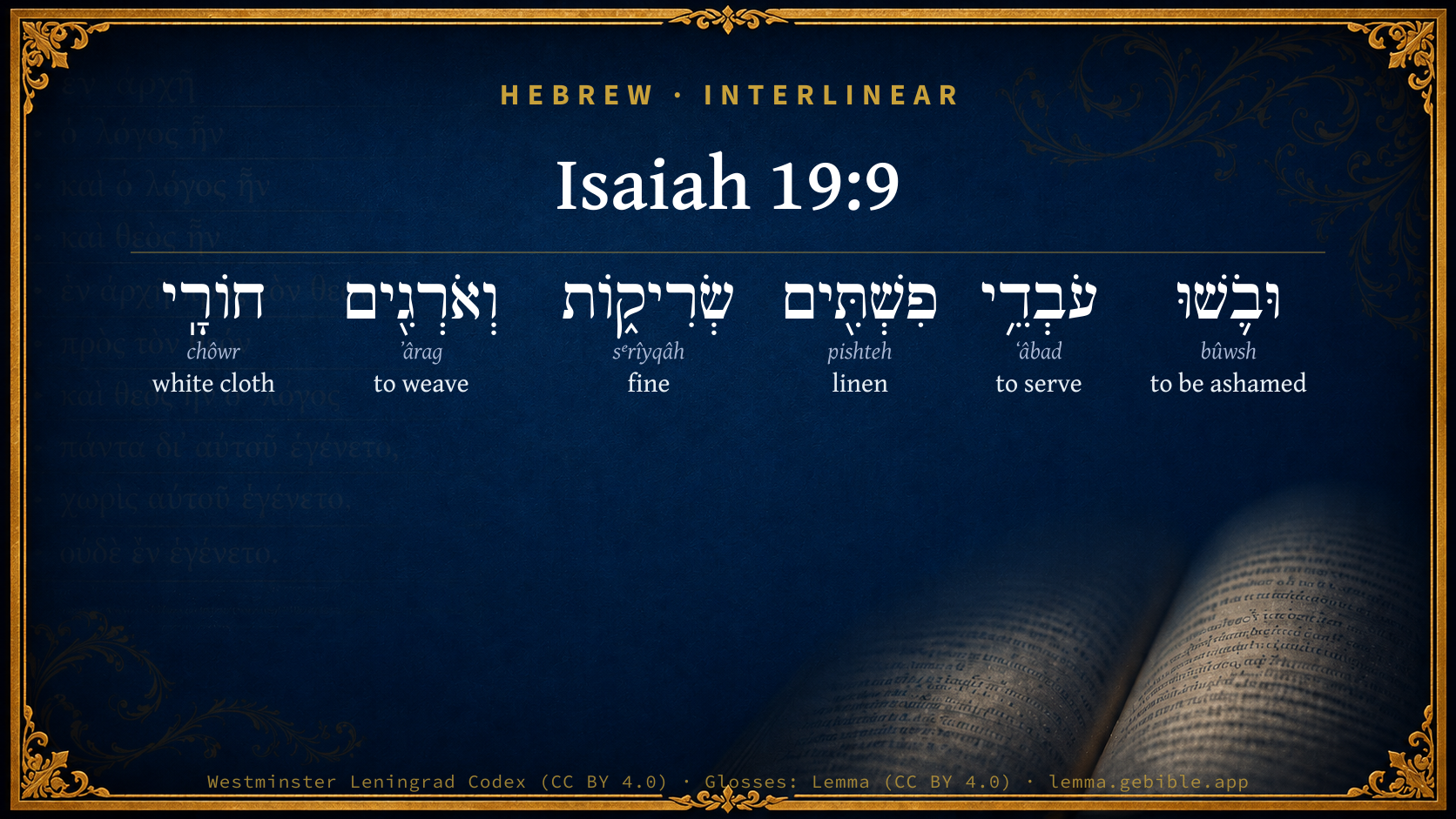
Isaiah 19:9

Hebrew (Westminster Leningrad Codex) Isaiah 19:9 appears in the Hebrew Old Testament. The text above is from the Westminster Leningrad Codex. Each word links to its Strong’s number, a concise gloss, and parsing drawn from the Open Scriptures Hebrew Bible morphology. Click any word for its full Brown-Driver-Briggs (BDB) entry.
Download image
Cite this verse

Isaiah 19:9 (World English Bible). Public Domain. Lemma interlinear Bible study tool, https://lemma.gebible.app/v/isaiah/19/9.

Show BibTeX & RIS
BibTeX
RIS
English Translation
Moreover those who work in combed flax, and those who weave white cloth, shall be confounded.
World English Bible · Public Domain
Highlights
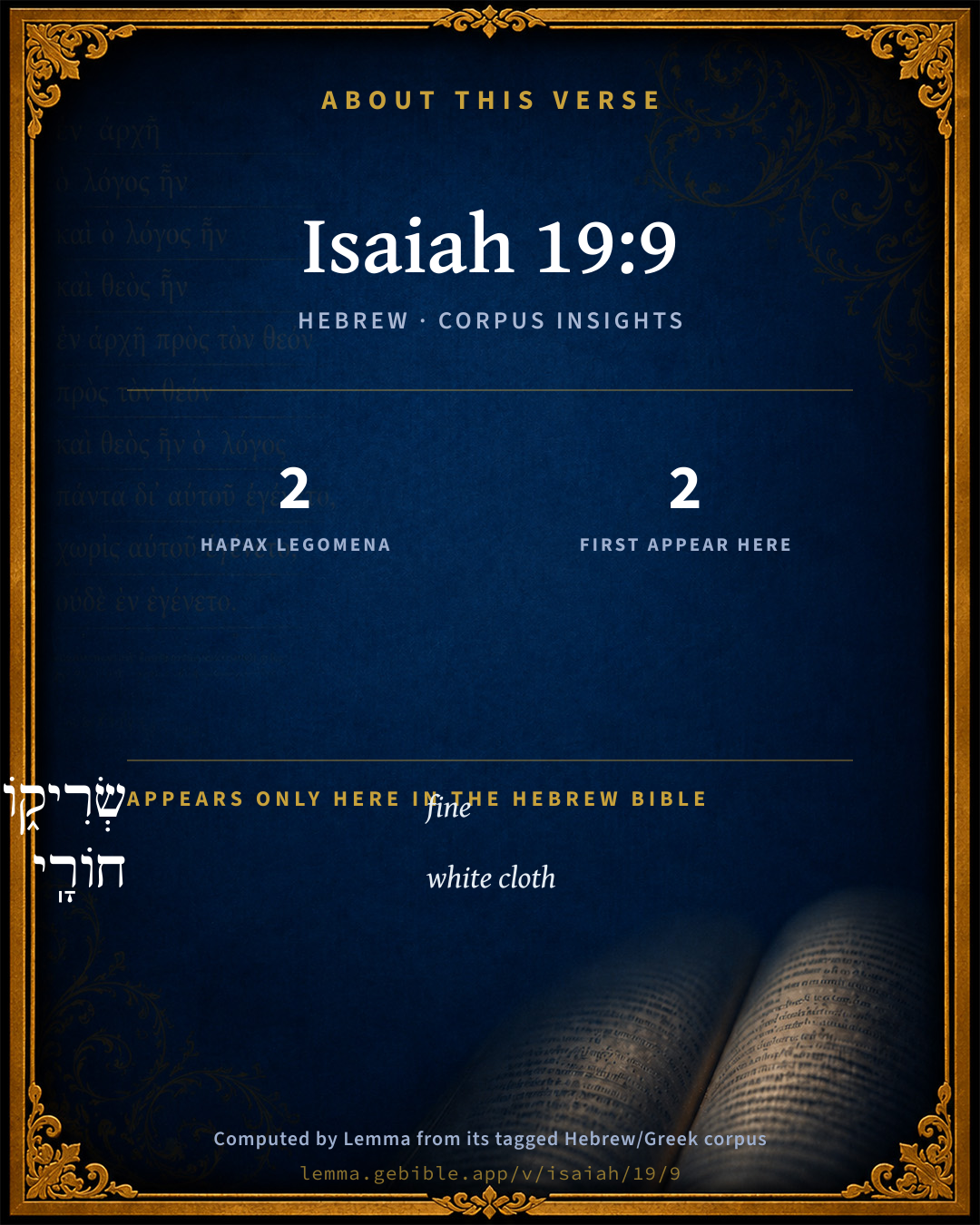
  • 2 hapax legomena — only here in the Hebrew Bible
  • 2 first appearances in the Hebrew Bible
Full analysis ↓
Download a study sheet

One document with this verse’s original text, its word-by-word gloss line, the meaning frame, cross-references with their text, attributed commentary, and full source and license credits — printable, and it pastes into notes with its structure intact.

This verse Autodidact and up

Study sheet (.html) Plain text (.txt)

A passage Seminary Student

Up to 50 verses in one chapter. A passage sheet keeps up to 6 commentary sources and 12 cross-references per verse, in the order this page ranks them, and says so on the sheet whenever that leaves anything out. Ask for a single verse and you get the Autodidact verse sheet above.

Everything on this page stays free to read, with no account — the sheet is a download of what is already on screen, not access to it.

Want to remove ads? Support Godless Engineer
Compare translations 3

The same verse in 3 English versions, stacked beneath the original-language interlinear above. Click any original word for its lexicon entry.

Each is an independent rendering of the whole verse — the interlinear is not word-aligned to these translations.

Highlighted words mark where these versions differ — a whole-verse word diff, not a word-by-word alignment.

  • World English Bible Public Domain
    Moreover those who work in combed flax, and those who weave white cloth, shall be confounded.
  • King James Version Public Domain
    Moreover they that work in fine flax, and they that weave networks, shall be confounded.
  • unfoldingWord Literal Text CC BY-SA 4.0
    And the workers of combed flax will have shame, and the weavers of white cloth.

unfoldingWord Literal Text — © unfoldingWord, licensed CC BY-SA 4.0. Word-aligned USFM3 via Door43 (git.door43.org/unfoldingWord/en_ult).

Versions to compare (up to 4)

3 of 4 selected

Show all 18 translations

Every available English version of this verse, each an independent rendering of the whole verse.

  • World English Bible Public Domain
    Moreover those who work in combed flax, and those who weave white cloth, shall be confounded.
  • Berean Standard Bible Public Domain
    The workers in flax will be dismayed, and the weavers of fine linen will turn pale.
  • Majority Standard Bible Public Domain
    The workers in flax will be dismayed, and the weavers of fine linen will turn pale.
  • King James Version Public Domain
    Moreover they that work in fine flax, and they that weave networks, shall be confounded.
  • American Standard Version (1901) Public Domain
    Moreover they that work in combed flax, and they that weave white cloth, shall be confounded.
  • Revised Version (1885) Public Domain
    Moreover they that work in combed flax, and they that weave white cloth, shall be ashamed.
  • Geneva Bible (1599) Public Domain
    Moreouer, they that worke in flaxe of diuers sortes, shall be confounded, and they that weaue nettes.
  • Douay-Rheims (1899) Public Domain
    They shall be confounded that wrought in flax, combing and weaving fine linen.
  • Young's Literal Translation Public Domain
    And ashamed have been makers of fine flax, And weavers of net-works.
  • Literal Standard Version CC BY-SA 4.0
    And makers of fine flax have been ashamed, || And weavers of networks.
  • Unlocked Literal Bible CC BY-SA 4.0
    The workers in combed flax and those who weave white cloth will turn pale.
  • unfoldingWord Literal Text CC BY-SA 4.0
    And the workers of combed flax will have shame, and the weavers of white cloth.
  • Darby Bible Public Domain
    And they that work in fine flax, and they that weave white stuffs shall be ashamed.
  • World Messianic Bible Public Domain
    Moreover those who work in combed flax, and those who weave white cloth, will be confounded.
  • Webster's Bible Public Domain
    Moreover they that work in fine flax, and they that weave net-works shall be confounded.
  • Free Bible Version CC BY-SA 4.0
    The workers who prepare the flax for linen and the weavers of white fabric will be in despair.
  • Bible in Basic English Public Domain
    And all the workers in linen thread, and those who make cotton cloth, will be put to shame.
  • JPS Tanakh (1917) Public Domain
    Moreover they that work in combed flax, and they that weave cotton, shall be ashamed.

Literal Standard Version (2020), Covenant Press — licensed CC BY-SA 4.0. Text via the HelloAO Bible API (eBible.org). Unlocked Literal Bible (unfoldingWord) — licensed CC BY-SA 4.0. Text via the HelloAO Bible API (eBible.org). unfoldingWord Literal Text — © unfoldingWord, licensed CC BY-SA 4.0. Word-aligned USFM3 via Door43 (git.door43.org/unfoldingWord/en_ult). Free Bible Version, Dr. Jonathan Gallagher — licensed CC BY-SA 4.0. Text via the HelloAO Bible API (eBible.org).

Word by word

More ways to search: Search by grammar → Find every occurrence → Compare this word →

Practice this passage: Drill this verse → Learn its vocabulary →

About this verse

These counts appear in no published source. They are computed here, from the morphology-tagged text and Lemma’s own curated glosses. What Lemma adds →

6
words
6
distinct lemmas
Prophets
section

Notable vocabulary

2 hapax legomena — words that appear only here in the entire Hebrew Bible:

  • שְׂרִיק֑וֹת fine H8305
  • חוֹרָֽי white cloth H2355

First appearance in Scripture

These words make their first canonical appearance in the Hebrew Bible here:

  • שְׂרִיק֑וֹת fine H8305
  • חוֹרָֽי white cloth H2355

Shared distinctive vocabulary

וְאֹרְגִ֖ים to weave H707 occurs in 13 verses of the Hebrew Bible. Also found in:

Grammatical profile

  • 3 verbs
  • 2 nouns
  • 1 adjective

Verb forms

  • וּבֹ֛שׁוּ Qal · Sequential Perfect
  • עֹבְדֵ֥י Qal · Participle Active
  • וְאֹרְגִ֖ים Qal · Participle Active

Hebrew & Septuagint length

In English translation the verse runs 16 words from the Hebrew and 16 from the Septuagint (LXX English) — the same length.

A rough comparison of the two English renderings, which tokenize alike — not a word-level alignment.

Word counts can differ between the Hebrew and the Greek without any difference in meaning — e.g. the Hebrew direct-object marker אֵת has no separate Greek word, and Greek often adds the article ὁ.

Cross-references

3

Topical passages linked to Isaiah 19:9 in the Treasury of Scripture Knowledge — connected by theme and wording, ordered by reader-vote popularity; previews shown in the World English Bible.

  • Ezekiel 27:7 Of fine linen with embroidered work from Egypt was your sail, that it might be to you for an ensign; blue and purple from the isles of Elishah was your awning.
  • Proverbs 7:16 I have spread my couch with carpets of tapestry, With striped cloths of the yarn of Egypt.
  • 1 Kings 10:28 The horses which Solomon had were brought out of Egypt; and the king's merchants received them in droves, each drove at a price.

Cross-references courtesy of OpenBible.info (CC BY 4.0).

Hebrew and Greek witnesses Masoretic Hebrew ↔ Greek Septuagint

The same verse in the two great witnesses to the Old Testament, shown verse-for-verse.

These are two independent witnesses, not word-aligned to each other, and the Septuagint is shown in lemma (dictionary) form.

Hebrew Isaiah 19:9 Masoretic · Westminster Leningrad Codex

וּבֹ֛שׁוּ עֹבְדֵ֥י פִשְׁתִּ֖ים שְׂרִיק֑וֹת וְאֹרְגִ֖ים חוֹרָֽי

Moreover those who work in combed flax, and those who weave white cloth, shall be confounded.

World English Bible · Public Domain

Greek LXX Isaiah 19:9 Septuagint · lemma form

καί αἰσχύνη λαμβάνω ὁ ἐργάζομαι ὁ λίνον ὁ σχιστός καί ὁ ἐργάζομαι ὁ βύσσος

And shame shall come upon them that work fine flax, and them that make fine linen.

LXX2012 (modern English Septuagint) · Public Domain

Hebrew: Westminster Leningrad Codex (CC BY 4.0). Greek: Septuagint (public domain); English from LXX2012 (modern English Septuagint) (Public Domain). How the Septuagint differs from the Hebrew →

Targum (Aramaic paraphrase)

1

The Targum is the ancient Jewish Aramaic paraphrase of the Hebrew Scriptures — an interpretive translation, not the Hebrew text itself. Onkelos (literal) and Pseudo-Jonathan (expansive) render the Torah, and Jonathan the Prophets. Coverage is partial: where no permissively-licensed English translation exists for a verse, only the Aramaic is shown. This is verse-level text, not a word-by-word alignment to the Hebrew.

  1. Targum Jonathan Prophets (Joshua–Malachi)
    וְיִבְהֲתוּן פַּלְחֵי כִּתָּנָא דִסְרִיקִין וּמְחָן מִנֵהּ מַצְדָן:

    They shall be confounded which work combed flax, and weave nets of it.

    Targum Jonathan — Aramaic: “Mikraot Gedolot” (public domain). English: “Sefaria Community Translation” (CC0 1.0 (public-domain dedication)); “London "Chaldee Paraphrase," 1871” (public domain). Text via Sefaria.

Commentary

Notes on Isaiah 19:9 from classic Christian and Jewish commentators (each source and its license shown beneath its notes). The classic Christian expositions comment on the surrounding passage and are grouped to its opening verse, so a note may address several verses; the Jewish commentaries on the Tanakh (Rashi and others) are per-verse, so they appear only where the commentator wrote on this verse.

Lemma curates 59 commentaries, every one of them public domain or Creative Commons licensed, each selected and text-cleaned for this edition rather than reprinted as found. About our sources →

Trapp's Complete Commentary

John Trapp

Isa 19:9 Moreover they that work in fine flax, and they that weave networks, shall be confounded.

Ver. 9. They that work in fine flax shall be confounded,] sc., For want of materials, such as were wont to be sown by the brooks {Isa 19:7 1Ki 10:28 Pro 7:16 Eze 27:7} (Plin., lib. ix. cap. 1).

They that weave networks.] Or rather whiteworks {a} - that is, white garments made of the fine flax of Egypt. These were much worn by nobles. {Pro 7:16 Dan 7:9} Whence also in Hebrew they have their name. {1Ki 21:8 Neh 2:16 Ecc 10:17, &c.}

{a} תודים, Albi seu candidati.

John Trapp, A Commentary or Exposition upon All the Books of the Old and New Testament (1647–1656) — public domain. Text from a community e-Sword module.

Tyndale Open Study Notes

Tyndale Open Resources

19:9 There was no flax or thread: The drought crippled the linen industry.

Tyndale Open Study Notes — © Tyndale Open Resources, licensed CC BY-SA 4.0. Text via the HelloAO Bible API.

Jamieson, Fausset & Brown

Robert Jamieson, A. R. Fausset & David Brown

fine flax--GESENIUS, for "fine," translates, "combed"; fine "linen" was worn by the rich only (Luk 16:19). Egypt was famous for it (Exo 9:31; Kg1 10:28; Pro 7:16; Eze 27:7). The processes of its manufacture are represented on the Egyptian tombs. Israel learned the art in Egypt (Exo 26:36). The cloth now found on the mummies was linen, as is shown by the microscope. WILKINSON mentions linen from Egypt which has five hundred forty (or two hundred seventy double) threads in one inch in the warp; whereas some modern cambric has but a hundred sixty [BARNES].

networks--rather, white cloth (Est 1:6; Est 8:16).

Jamieson, Fausset & Brown — Commentary Critical and Explanatory on the Whole Bible (1871) — public domain (CC PDM 1.0). Text via the HelloAO Bible API.

Adam Clarke's Commentary

Verse 9. They that work in fine flax] פשתים שריקות pishtim sericoth, heckled flax, i.e., flax dressed on the heckle, or comb used for that purpose. The Vulgate uses the word pectentes, combing.

They that weave networks shall be confounded - And confounden schul ben that wrogten flax, plattinge and wevynge sotel thingis. - Old MS. Bible.

Adam Clarke's Commentary on the Bible (1810–1826) — public domain. Text from a community e-Sword/MySword module.

Ellicott's Commentary for English Readers

(9) Moreover they that work in fine flax.—Another class also would find its occupation gone. The “fine flax” was used especially for the dress of the priests (Herod. ii. 81), and for the mummy clothes of the dead (1Ki_10:28; Eze_27:7).

They that weave networks.—Better, white cloths, the cotton or byssus fabrics for which Egypt was famous.

A Bible Commentary for English Readers, edited by Charles John Ellicott (1878–1897) — public domain. Text from a community e-Sword module.

The Cambridge Bible for Schools and Colleges

gen. ed. J. J. S. Perowne

9. Textile manufactures, linen and cotton, flourished greatly in ancient Egypt. fine flax] combed flax (R.V.). For networks read white-stuffs, probably cotton.

The Cambridge Bible for Schools and Colleges (gen. ed. J. J. S. Perowne; Cambridge University Press, 1878–1918) — public domain. Text from a community e-Sword module.

John Gill's Exposition

Moreover they that work in fine flax,.... Of which they made fine linen cloth, and yarn, and was much wore by the Egyptians, and was the commodity of the country, and for which other nations traded with them, Kg1 10:28 but now would have no flax to work, that being withered and gone which was sown by the sides of the brooks, Isa 19:7 and no linen cloth or yarn to sell, and consequently in great confusion and distress, as they are here represented (l). The Targum renders the whole verse thus,

"they shall be confounded which work flax, which they comb, and of it weave nets;''

and so Jarchi and Kimchi interpret it, not of persons that wrought in flax, to make yarn or linen of it; but who combed it, to make nets of it, as follows:

and they that weave networks shall be confounded: because they would have no sale for their nets, the fishermen having no use for them, the rivers being dried up. The word for "networks" signifies "holes", because nets are made with holes large enough to let the water through, and so small that the fishes may not get out. Some render the word "white works" (m), white linen, white cloth, of which white garments are made, such as nobles and princes formerly wore; hence, in the Hebrew language, they are called by a name of the same root and signification; but the former sense seems best.

(l) is by us rendered "fine"; and so, Ben Melech says, in the Arabic language the best and finest linen is called and so says Kimchi in Sepher Shorash.; with which Schindler agrees, Arab. sericum or "muslin"; but it is a question whether this is of so early a date, and especially not fit to make nets of. De Dieu and Bochart think it denotes the colour of the linen, which was yellow, that being the best; but others render it "combed". (m) "et textores alborum operum", Junius & Tremellius, Piscator.

John Gill's Exposition of the Whole Bible (1746–1763) — public domain (CC PDM 1.0). Text via the HelloAO Bible API.

Albert Barnes' Notes on the Bible

Moreover - In addition to the calamities that will come upon the fishermen, the drying up of the river will affect all who are supported by that which the overflowing of its waters produced.

They that work in short flax - Egypt was celebrated anciently for producing flax in large quantities, and of a superior quality (see Exo 9:31; 1Ki 10:28). The fine linen of Egypt which was manufactured from this is celebrated in Scripture Pro 7:16; Eze 27:7. The Egyptians had early carried the art of manufacturing linen to a great degree of perfection. As early as the exode of the Hebrews, we find that the art was known by which stuffs made of linen or other materials were curiously worked and embroidered. ‘And thou shalt make an hanging for the door of the tent, of blue, and purple, and scarlet, and fine-twined linen, made with needlework’ (Exo 26:36; compare Exo 27:16; Exo 36:37). So Eze 27:7 : ‘Fine linen, with broidered work from Egypt.’ So also Martial refers to embroidery with the needle in Egypt:

Haec tibi Memphitis tellus dat munera; victa est

Pectine Niliaco jam Babylonis acus.

Martial, xiv. Ep. 50.

In regard to the “fineness” of the linen which was produced and made in Egypt, we may introduce a statement made by Pliny when speaking of the “nets” which were made there. ‘So delicate,’ says he, ‘were some of them, that they would pass through a man’s ring, and a single person could carry a sufficient number of them to surround a whole wood. Julius Lupus, who died while governor of Egypt, had some of those nets, each string of which consisted of 150 threads; a fact perfectly surprising to those who are not aware that the Rhodians preserve to this day, in the temple of Minerva, the remains of a linen corslet, presented to them by Amasis, king of Egypt, whose threads are composed each of 365 fibres.’ (Pliny, xix. 1.) Herodotus also mentions this corslet (iii. 47), and also another presented by Amasis to the Lacedemonians, which had been carried off by the Samians: ‘It was of linen, ornamented with numerous figures of animals, worked in gold and cotton.

Each thread of the corslet was worthy of admiration. For though very fine, every one was composed of 360 other threads, all distinct; the quality being similar to that dedicated to Minerva at Lindus, by the same monarch.’ Pliny (xix. 1) mentions four kinds of linen that were particularly celebrated in Egypt - the Tanitic, the Pelusiac, the Butine, and the tentyritic. He also says that the quantity of flax cultivated in Egypt was accounted for, by their exporting linen to Arabia and India. It is now known, also, that the cloth used for enveloping the dead, and which is now found in abundance on the mummies, was “linen.” This fact was long doubted, and it was until recently supposed by many that the cloth was made of cotton. This fact that it is linen was settled beyond dispute by some accurate experiments made by Dr. Ure, Mr. Bauer, and Mr. Thompson, with the aid of powerful microscopes.

It was found that linen fibres uniformly present a cylindrical form, transparent, and articulated, or jointed like a cane, while the fibres of cotton have the appearance of a flat ribbon, with a hem or border at the edge. In the mummy cloths, it was found, without exception, that the fibres were linen. Vast quantities of linen must, therefore, have been used. The linen of the mummy cloths is generally coarse. The warp usually contains about 90 threads in the inch; the woof about 44. Occasionally, however, very fine linen cloth is found, showing the skill with which the manufacture was executed. Sir John G. Wilkinson observes, that a piece of linen in his possession from Egypt had 540 (or 270 double) threads in one inch in the warp. Some of the cambric which is now manufactured has but 160 threads in the inch in the warp, and 140 in the woof. It is to be remembered, also, that the linen in Egypt was spun by hand, and without the aid of machinery (see, on this whole subject, Wilkinson’s “Ancient Egyptians,” vol. iii. pp. 113-142. Ed. Lond. 1837). The word rendered ‘fine’ here denotes, according to Gesenius, “combed or hatchelled.” The word ‘fine,’ however, expresses the idea with sufficient accuracy. Fine linen was used for clothing; but was so expensive that it was worn chiefly by the rich and by princes Luk 16:19.

They that weave networks - Margin, ‘White-works.’ According to Gesenius the word הורי hôrây means “white linen” - that which is fully bleached. The word הוד hôd means “a hole or cavern,” but is not applied to cloth. The parallelism seems rather to require that the word should mean ‘white,’ or that which would correspond to ‘fine,’ or valuable; and it is not known that the Egyptians had the art of working lace from linen. Saadias supposes that “nets” are meant, as being made with holes or meshes; but it is evident that a finer work is intended than that.

Shall be confounded - Hebrew, ‘Shall be ashamed.’ That is, they shall be thrown out of employment, and not know what to do.

Albert Barnes' Notes on the Bible (1834–1885) — public domain. Text from a community e-Sword/MySword module.

Haydock's Catholic Bible Commentary

Linen. Greek, "silk." Ezechiel xvi. 10. (Calmet)

George Leo Haydock (1774–1849), Haydock's Catholic Family Bible and Commentary, 1859 edition — public domain. Excludes Psalms (Douay-Rheims chapter numbering differs from Protestant) and Deuterocanonical books (Catholic canon only).

Matthew Poole's English Annotations

That work in fine flax; that make fine linen, which was one of their best commodities; of which See Poole "1Ki 10:28", See Poole "Pro 7:16", See Poole "Eze 27:7".

Matthew Poole's English Annotations on the Holy Bible (1683–1685) — public domain. Text from a community e-Sword/MySword module.

Whedon's Commentary on the Bible

Daniel D. Whedon

9. Fine flax — In Hebrew, hatchelled flax.

Networks — White linen. — Gesenius. Pro_7:16; Eze_27:7.

Daniel D. Whedon (gen. ed.), Commentary on the Old and New Testaments (1874–1909) — public domain. Text from a community e-Sword module.

The Pulpit Commentary

They that work in fine flax. Linen of great fineness and delicacy was woven in Egypt, for the priests" dresses, for mummy-cloths, and for corselets. Solomon imported "linen yarn" from his Egyptian neighbors, (1Ki_10:28) and the Phoenicians a linen fabric for their sails". (Eze_27:7) In the general decline of Egyptian prosperity, caused by the circumstances of the time, the manufacturers of linen would suffer. They that weave networks; rather, they that weave while clothes. Cotton fabrics are probably intended. Shall be confounded; literally, shall blush, or be ashamed.

The Pulpit Commentary (1880–1919), ed. H.D.M. Spence-Jones & Joseph S. Exell — public domain. Text from a community e-Sword module.

John Wesley's Explanatory Notes

They - That make fine linen, which was one of their best commodities.

John Wesley, Explanatory Notes Upon the Whole Bible (1754–1765) — public domain. Text via the GEBible commentary corpus.

J. A. Alexander on Isaiah

Joseph Addison Alexander

“And ashamed (disappointed or confounded) are the workers of combed (or hatchelled) flax, and the weavers of white (stuffs).” The older writers supposed the class of persons here described to be the manufacturers of nets for fishing. The moderns understand the verse as having reference to the working of flax and manufacture of linen.

Joseph Addison Alexander, The Prophecies of Isaiah (1846–1847; New York: Scribner, 1870–1878) — public domain. Text from a community e-Sword module.

unfoldingWord translationNotes

Door43 World Missions Community

The workers in combed flax and those who weave white cloth will turn pale. The cloth workers of Egypt will be crushed

These two phrases mean basically the same thing. If necessary, the reason they will be distressed can be stated clearly. AT: "The linen makers of Egypt will be humiliated because there is no flax" (See: Assumed Knowledge and Implicit Information and Parallelism)

The workers in combed flax

"Those who work with combed flax"

combed flax

Flax is a plant that grows along the Nile River. People comb its fibers in order to separate them, and use them to make thread for linen cloth. (See: Translate Unknowns)

will turn pale

"will be ashamed"

The cloth workers of Egypt

"The people of Egypt who make cloth"

will be crushed

Being crushed represents being discouraged. AT: "will be discouraged" (See: Metaphor)

work for hire

"work for pay"

will be grieved within themselves

"will feel very sad"

translationWords

Egypt

unfoldingWord translationNotes — © Distant Shores Media and the Door43 World Missions Community, licensed CC BY-SA 4.0. Source: git.door43.org/Door43/en_tn.

Rashi

Rabbi Shlomo Yitzchaki (Rashi)

Those who work at flax Who sow flax by the river.

to be combed Flax that they comb and from which they weave fish nets, which are made with many holes.

nets [lit. holes.] Since the suffix is irregular, ordinarily חוֹרִים Rashi enumerates similar instances e.g.,] (Psalms 8:5) “The beasts of the field (שָׂדָי)”; (Jer. 22:14) “And he will cut out for himself windows (חַלּוֹנָי).”

Rashi on the Tanakh — English translations: “The Judaica Press complete Tanach with Rashi, translated by A. J. Rosenberg” (CC BY 4.0); “Pentateuch with Rashi's commentary by M. Rosenbaum and A.M. Silbermann, 1929-1934” (public domain); “The Metsudah Tanach series, Lakewood, N.J” (CC BY 4.0); and “The Book of Joshua, Metsudah Publications, 1997” (CC BY 4.0). Text via Sefaria.

Ibn Ezra

Rabbi Abraham ibn Ezra

שריקות Red. Some compare it with משרק comb, but more correctly it is derived from שורק vine branch (5:2), and it signifies, having the colour of the vine branch, red; comp. שרקים red (Zac. 1:8).

חורי It is either an adjective, meaning white, or a noun, signifying fine things, חוֹרָי being a plural form used instead of חורים; comp. חוֹרֵי the nobles of (Jer. 27:20).

Ibn Ezra on the Tanakh — English translations: “Sefaria Community Translation” (CC0 1.0 (public-domain dedication)); “Yalkut, Sifsei Chachomim Chumash, Metsudah Publications, 2009” (CC BY 4.0); and “Commentary of Ibn Ezra on Isaiah - trans. by M. Friedlander, 1873” (public domain). Text via Sefaria.

Lesson kit

Teaching starters — assembled from the data on this page, not authored interpretation. Every prompt links to the verse data it draws on. Edit before teaching.

Isaiah, in the Prophets, opens this verse with 6 words (6 distinct Hebrew lemmas). Its most distinctive word is sᵉrîyqâh (“fine”). A historical commentator’s framing appears above. Read the whole chapter for the surrounding context.

Discussion questions

  1. How does “fine” (sᵉrîyqâh) shape what this verse is saying?
  2. This verse holds 2 words here found nowhere else in the Hebrew Bible. What might the rare words draw attention to?
  3. 2 words here appear for the first time in Scripture. What is being introduced at this debut?
  4. Exodus 28:32 shares the word «to weave» with this verse. How do the two illuminate each other?
  5. The translations on this page render this verse differently — a whole-verse word diff, not a word-by-word alignment. What might account for the different wordings?
  6. The verb «וּבֹ֛שׁוּ» is Qal Sequential Perfect. How does its form color the action?
  7. Reading how Trapp's Complete Commentary and Tyndale Open Study Notes read this verse, where do the two commentators agree and where do they part?

Things to notice

  • 2 words in this verse appear nowhere else in the Hebrew Bible.
  • 2 words make their first canonical appearance in Scripture here.
  • These translations choose different wording for 16 words in this verse.
  • 6 distinct Hebrew lemmas span 6 words in this verse.

Reading settings

Reading text

Shown beneath each verse's original-language words.

Old Testament
Old Testament edition

Read the OT as the Masoretic Hebrew (MT) or the Greek Septuagint (LXX).

English shown for the Greek Septuagint (in the Hebrew ↔ Greek comparison).

Comparing translations? Open the Compare panel on any verse page to stack up to four side by side.