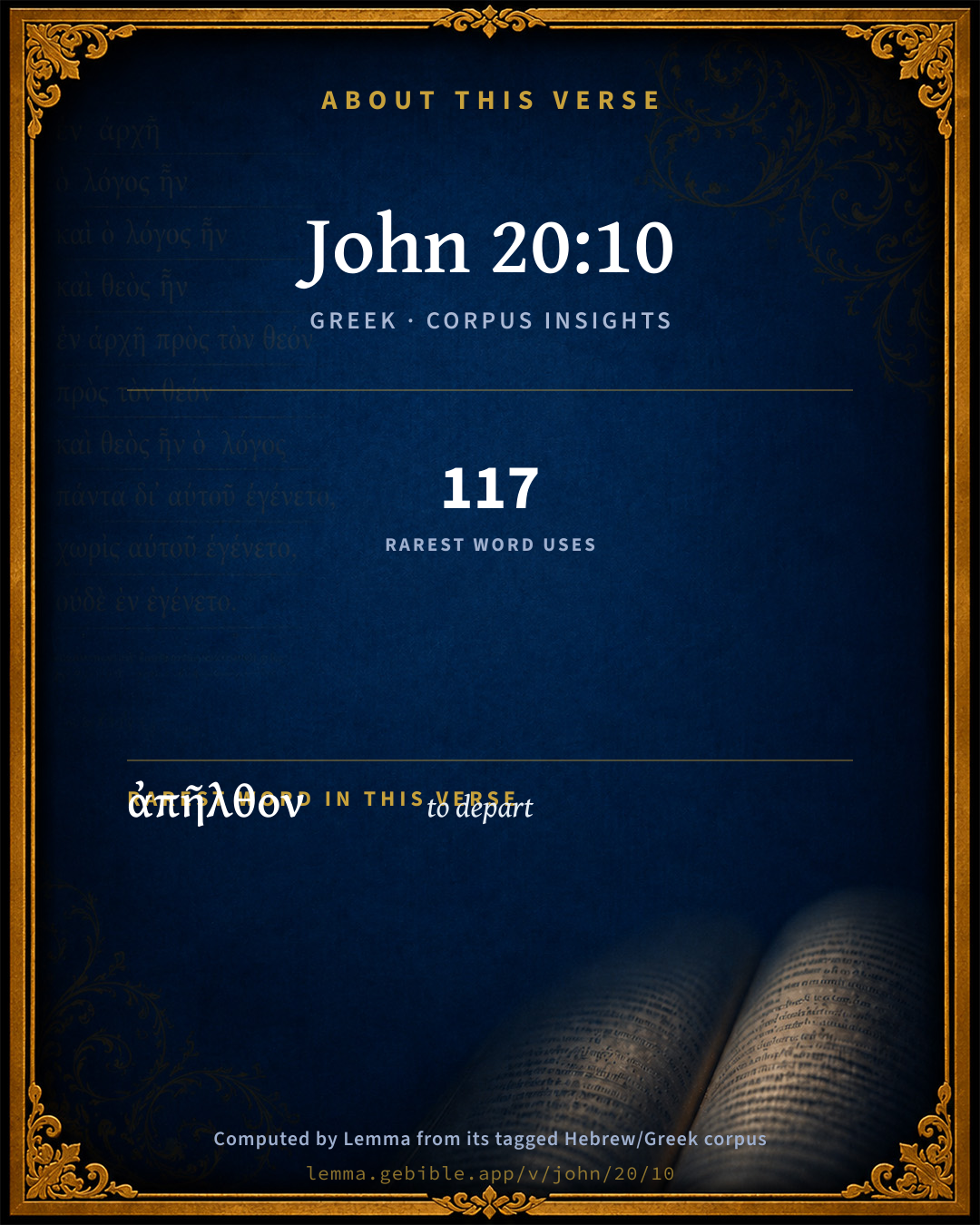
John 20:10

Greek (Tischendorf 8th ed.) John 20:10 appears in the Greek New Testament. The text above is from the Tischendorf 8th edition. Each word links to its Strong’s number and a concise gloss. Click any word for its full Thayer’s Greek Lexicon entry.
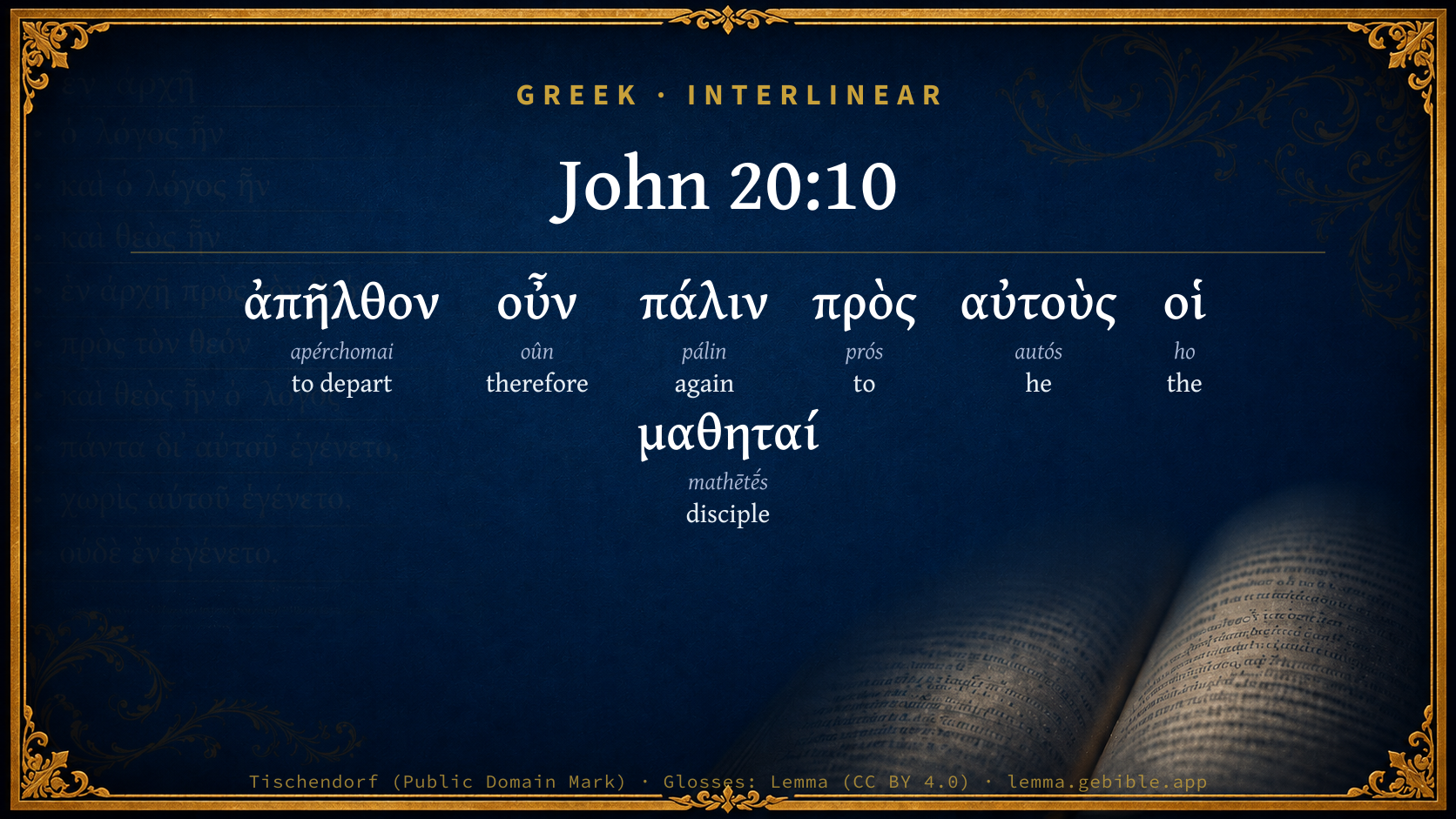
Download image
Cite this verse

John 20:10 (World English Bible). Public Domain. Lemma interlinear Bible study tool, https://lemma.gebible.app/v/john/20/10.

Show BibTeX & RIS
BibTeX
RIS
English Translation
So the disciples went away again to their own homes.
World English Bible · Public Domain
Download a study sheet

One document with this verse’s original text, its word-by-word gloss line, the meaning frame, cross-references with their text, attributed commentary, and full source and license credits — printable, and it pastes into notes with its structure intact.

This verse Autodidact and up

Study sheet (.html) Plain text (.txt)

A passage Seminary Student

Up to 50 verses in one chapter. A passage sheet keeps up to 6 commentary sources and 12 cross-references per verse, in the order this page ranks them, and says so on the sheet whenever that leaves anything out. Ask for a single verse and you get the Autodidact verse sheet above.

Everything on this page stays free to read, with no account — the sheet is a download of what is already on screen, not access to it.

Want to remove ads? Support Godless Engineer
Compare translations 3

The same verse in 3 English versions, stacked beneath the original-language interlinear above. Click any original word for its lexicon entry.

Each is an independent rendering of the whole verse — the interlinear is not word-aligned to these translations.

Highlighted words mark where these versions differ — a whole-verse word diff, not a word-by-word alignment.

  • World English Bible Public Domain
    So the disciples went away again to their own homes.
  • King James Version Public Domain
    Then the disciples went away again unto their own home.
  • unfoldingWord Literal Text CC BY-SA 4.0
    Then the disciples went away again to their.

unfoldingWord Literal Text — © unfoldingWord, licensed CC BY-SA 4.0. Word-aligned USFM3 via Door43 (git.door43.org/unfoldingWord/en_ult).

Versions to compare (up to 4)

3 of 4 selected

Show all 19 translations

Every available English version of this verse, each an independent rendering of the whole verse.

  • World English Bible Public Domain
    So the disciples went away again to their own homes.
  • Berean Standard Bible Public Domain
    Then the disciples returned to their homes.
  • Majority Standard Bible Public Domain
    Then the disciples returned to their homes.
  • King James Version Public Domain
    Then the disciples went away again unto their own home.
  • American Standard Version (1901) Public Domain
    So the disciples went away again unto their own home.
  • Revised Version (1885) Public Domain
    So the disciples went away again unto their own home.
  • Geneva Bible (1599) Public Domain
    And the disciples went away againe vnto their owne home.
  • Douay-Rheims (1899) Public Domain
    The disciples therefore departed again to their home.
  • Young's Literal Translation Public Domain
    The disciples therefore went away again unto their own friends,
  • Literal Standard Version CC BY-SA 4.0
    The disciples therefore went away again to their own friends,
  • Unlocked Literal Bible CC BY-SA 4.0
    So the disciples went back home again.
  • unfoldingWord Literal Text CC BY-SA 4.0
    Then the disciples went away again to their.
  • Darby Bible Public Domain
    The disciples therefore went away again to their own home.
  • World Messianic Bible Public Domain
    So the disciples went away again to their own homes.
  • Webster's Bible Public Domain
    Then the disciples went away again to their own home.
  • Free Bible Version CC BY-SA 4.0
    Then the disciples went back to where they were staying.
  • Bible in Basic English Public Domain
    So then the disciples went away again to their houses.
  • Text-Critical English NT CC BY 4.0
    Then the disciples went back to their homes.
  • Tyndale New Testament (1534) Public Domain
    And the disciples wet awaye agayne vnto their awne home.

Literal Standard Version (2020), Covenant Press — licensed CC BY-SA 4.0. Text via the HelloAO Bible API (eBible.org). Unlocked Literal Bible (unfoldingWord) — licensed CC BY-SA 4.0. Text via the HelloAO Bible API (eBible.org). unfoldingWord Literal Text — © unfoldingWord, licensed CC BY-SA 4.0. Word-aligned USFM3 via Door43 (git.door43.org/unfoldingWord/en_ult). Free Bible Version, Dr. Jonathan Gallagher — licensed CC BY-SA 4.0. Text via the HelloAO Bible API (eBible.org).

Word by word

More ways to search: Search by grammar → Find every occurrence → Compare this word →

Practice this passage: Drill this verse → Learn its vocabulary →

ἀπῆλθον
apérchomai
G565
“to depart”
Verb, Aorist, Active, Indicative, 3rd person, Plural
Part of Speech
Verb
Tense
Aorist
Voice
Active
Mood
Indicative
Person
3rd person
Number
Plural
Full Thayer's Definition

Origin: from G575 and G2064

TDNT: 13:15,3

1. to go away, depart a. to go away in order to follow any one, go after him, to follow his party, follow him as a leader 2. to go away a. of departing evils and sufferings b. of good things taken away from one c. of an evanescent state of things
  1. οὖν oûn G3767 “therefore” Conjunction
  2. πάλιν pálin G3825 “again” Adverb
  3. πρὸς prós G4314 “to” Preposition
  4. αὐτοὺς autós G846 “he” Personal pronoun, Accusative, Plural, Masculine
  5. οἱ ho G3588 “the” Article, Nominative, Plural, Masculine
  6. μαθηταί mathētḗs G3101 “disciple” Noun, Nominative, Plural, Masculine

About this verse

These counts appear in no published source. They are computed here, from the morphology-tagged text and Lemma’s own curated glosses. What Lemma adds →

7
words
7
distinct lemmas
Gospels
section

Cross-references

2

Topical passages linked to John 20:10 in the Treasury of Scripture Knowledge — connected by theme and wording, ordered by reader-vote popularity; previews shown in the World English Bible.

  • John 16:32 Behold, the time is coming, yes, and has now come, that you will be scattered, everyone to his own place, and you will leave me alone. Yet I am not alone, because the Father is with me.
  • John 7:53 Everyone went to his own house,

Cross-references courtesy of OpenBible.info (CC BY 4.0).

Commentary

Notes on John 20:10 from classic Christian and Jewish commentators (each source and its license shown beneath its notes). The classic Christian expositions comment on the surrounding passage and are grouped to its opening verse, so a note may address several verses; the Jewish commentaries on the Tanakh (Rashi and others) are per-verse, so they appear only where the commentator wrote on this verse.

Lemma curates 59 commentaries, every one of them public domain or Creative Commons licensed, each selected and text-cleaned for this edition rather than reprinted as found. About our sources →

Joseph Benson's Commentary

Joh 20:10-13. Then the disciples (Peter and John) went away again unto their own home — Went to their companions in the city, as the original expression, προς εαυτους, seems evidently to signify. Accordingly, soon after this the women found the eleven and the rest together. It was very prudent in Peter and John to retire immediately, lest they should have been questioned by the rulers, if found near the sepulchre. But Mary stood without — It seems she had followed Peter and John to the sepulchre, but did not return to the city with them, being anxious to find the body of her Lord; but after they were gone, she stood without at the sepulchre weeping — Being in great perplexity at her not knowing what was become of it. And as she wept, she stooped down, and looked into the sepulchre — To examine it afresh; and seeth — To her great surprise; two angels — In the form of men; in white — That is, clothed in white habits; the one at the head, and the other at the feet, &c. — “The sepulchre seems to have been a square room hewn out of a rock, partly above ground, its roof being as high as the top of the door, which formed its entrance. This door opened upon a stair which ran down straight to the bottom of the sepulchre, along with the side of its left wall. Having carried the body down with its feet foremost, they would naturally place it length-ways, by the right-side wall of the sepulchre, with its feet to the back wall. This description is agreeable to the accounts which travellers give us of the Jewish sepulchres, particularly Mr. Maundrell, who was on the spot and saw several of them. They were generally caves, or rooms hewn out of rocks. And as the Jews did not make use of coffins, they placed their dead separately in niches, or little cells cut into the sides of these caves. But Joseph’s sepulchre, being a new one, was in all probability unfinished; and might have no niches cut into its sides, where they could deposite the dead; for which reason they laid Jesus on the floor, in the manner described, intending when the sabbath was passed to remove him to some finished burying-place.” — Macknight. And they say unto her — With a tender regard; Woman, why weepest thou? — This question was only designed to give occasion to inform her of that which would turn her mourning into rejoicing. She saith, Because they have taken away my Lord — The blessed body which I came to embalm; and I know not where they have laid him — That is, laid it; or how the sacred corpse may be neglected or abused.

Joseph Benson's Commentary on the Old and New Testaments (1811–1818) — public domain. Text from a community e-Sword module.

Bengel's Gnomon

Johann Albrecht Bengel

Joh 20:10. Ἀπῆλθον) went away; as if nothing more remained now to be done in this business.—πάλιν, again) as before. Comp. ch. Joh 16:32, “Ye shall be scattered every man to his own;” Mat 26:56.—πρὸς ἑαυτοὺς, to their own homes) Joh 20:2, “She cometh to Simon Peter,” i.e. to his house. Comp. “Wolfii Curae” on this passage.—οἱ μαθηταὶ, the disciples) viz. Peter and John, being about to bring the tidings to the rest.

Bengel's Gnomon of the New Testament — English translation (T&T Clark, Edinburgh, 1860) — public domain. Text from a community e-Sword module.

Expositor's Greek Testament

ed. W. Robertson Nicoll

Joh 20:10 . Satisfied in their own minds ἀπῆλθον οὖν … οἱ μαθηταί . πρὸς ἐαυτούς or αὐτούς or αὑτούς = home; “chez eux,” Segond’s French version; εἰς τὰ ἴδια , modern Greek. Kypke gives examples of a phrase which he says is “trita profanis”.

The Expositor's Greek Testament, edited by W. Robertson Nicoll (1897–1910) — public domain. Text from a community e-Sword module.

Adam Clarke's Commentary

Verse 10. Unto their own home.] Either to their own houses, if they still had any; or to those of their friends, or to those where they had a hired lodging, and where they met together for religious purposes. See Joh 20:19.

Adam Clarke's Commentary on the Bible (1810–1826) — public domain. Text from a community e-Sword/MySword module.

John Calvin's Commentaries

10. Then the disciples went away again to their own homes. It is possible that their minds were still in a state of doubt and uncertainty, when they returned home; for, though John says that they believed, yet their faith was not strong, but was only some confused remembrance of the miracle and resembled a trance, until it was more fully confirmed; and indeed, a strong faith could not be produced merely by the sight which they had beheld. Besides, Christ did not present himself to their view, until they had been more fully awakened from their carnal stupidity. They had indeed given a praise worthy demonstration of their zeal, in hastening to the sepulcher; yet Christ hid himself from them, because they sought him with too great superstition.

John Calvin's Commentaries (1540-1563) — public domain. Text from the Calvin Translation Society English edition (1840s-50s) via the Christian Classics Ethereal Library (ccel.org). Calvin's coverage is partial (roughly two-thirds of the Bible); uncommented books and verses are honest gaps, never fabricated. The 19th-century editor's footnotes and remarks are omitted so the notes are faithfully Calvin's own voice.

Ellicott's Commentary for English Readers

(10) Then the disciples went away again unto their own home.—More exactly, of course, to their lodgings in Jerusalem. They had accomplished the object of their visit to the sepulchre. One, at least, had realised, and he must have told his thoughts to his friend, that the Lord was not to be looked for in the empty grave, and that Mary’s fears (Joh_20:2) were groundless. No enemies had taken the body away. They return, then, with hearts filled with this truth, to ponder over its meaning, or to tell it to others of the Eleven, or to wonder and to wait until He should come again to them, as He had promised.

A Bible Commentary for English Readers, edited by Charles John Ellicott (1878–1897) — public domain. Text from a community e-Sword module.

The Cambridge Bible for Schools and Colleges

gen. ed. J. J. S. Perowne

10. Then the disciples] The disciples therefore; because nothing more could be done at the sepulchre.

The Cambridge Bible for Schools and Colleges (gen. ed. J. J. S. Perowne; Cambridge University Press, 1878–1918) — public domain. Text from a community e-Sword module.

John Gill's Exposition

Then the disciples,.... Peter and John, after they had seen and examined things, and satisfied themselves as much as they could:

went away again unto their own home; or "to themselves", as in the original text, and so the Vulgate Latin reads it; not that the meaning is, that they had been out of their minds, and proper exercise of them, and now came to themselves; but they returned to their own company, to the rest of the disciples they left at home, who were as themselves. The Syriac renders it, "to their own place", and so the Arabic and Persic versions; the place from whence they came, and where the rest were assembled together, to pray, converse, and consult together, what was to be done at this juncture.

John Gill's Exposition of the Whole Bible (1746–1763) — public domain (CC PDM 1.0). Text via the HelloAO Bible API.

Trapp's Complete Commentary

John Trapp

10 Then the disciples went away again unto their own home.

Ver. 10. Went again to their own home] Waiting till God should further enlighten both organ and object, as Mary also did, Luk 2:19; Luk 2:51.

John Trapp, A Commentary or Exposition upon All the Books of the Old and New Testament (1647–1656) — public domain. Text from a community e-Sword module.

Matthew Poole's English Annotations

Peter and John, when they had been within the sepulchre, and seen that the body was not there, went home; believing verily that what the women at first told them was true, that somebody had removed the body out of the sepulchre; whither, they knew not.

Matthew Poole's English Annotations on the Holy Bible (1683–1685) — public domain. Text from a community e-Sword/MySword module.

Whedon's Commentary on the Bible

Daniel D. Whedon

10. Went… their own home—It might not have been safe for them to remain long at the sepulchre. Their own home may have been the abode of John and the blessed mother, and we have Peter in the western margin of Jerusalem.

Daniel D. Whedon (gen. ed.), Commentary on the Old and New Testaments (1874–1909) — public domain. Text from a community e-Sword module.

The Pulpit Commentary

The disciples then again departed to their own homes. Pro corresponds with Luk_24:12, to the pron to which Peter returned. Here, again, there is a vivid touch of individuality.John"s own home contained the mother of the Lord. Around Peter were gathered the other apostles, and they were shortly to be joined by John himself. To them the more detailed report of the language of the angel would be repeated a hundred times. The "other Mary," Salome, Joanna, all press the wondrous assurance upon the eleven, as they mourned and wept, and for the most part were either bewildered or unbelieving. The two disciples start for Emmaus, and all that these knew as yet was that "certain women affirmed the tomb to be empty, that they had seen a vision of angels, which declared him to be alive," and "that certain of our company had visited the sepulcher, and found it even as the women "had said, but him they saw not". (Luk_24:22-24)

The Pulpit Commentary (1880–1919), ed. H.D.M. Spence-Jones & Joseph S. Exell — public domain. Text from a community e-Sword module.

John Wesley's Explanatory Notes

They went home - Not seeing what they could do farther.

John Wesley, Explanatory Notes Upon the Whole Bible (1754–1765) — public domain. Text via the GEBible commentary corpus.

Burkitt's Expository Notes on the New Testament

William Burkitt

Here we have a description of the great love of Mary Magdalene, which she expressed towards Christ, after his resurrection; she went to his sepulchre early, when it was yet dark; she hastily calls the disciples Peter and John, to the sepulchre; and she stays behind weeping at the sepulchre when they were gone away to their own home. And as Mary first sought him, and longest sought him, so she first found him.

Here note, 1. Mary’s carriage and behaviour towards her Saviour: that is discovered by her patient attendance, She stood without at the sepulchre; by her passionate mourning, she stood at the sepulchre weeping; by her unwearied diligence, She stooped down and looked into the sepulchre. Here was great love indeed in this poor woman; a love stronger than death; a love which did outstrip and go beyond the greatest apostles.

Learn thence, 1. That true love to Christ suffers not itself to be stinted or limited, no not by the greatest examples; the weakest woman that truly loves Christ, may piously strive with the greatest apostle in this point; though he be learneder, wiser, more useful, and more eminent than any of us, yet it is holy and wise not to suffer ourselves to be exceeded by any in our love to Christ’ every Christian may strive to exceed any one in grace, and to attain the highest place in the kingdom of heaven.

Learn, 2. That strong love is valient and undaunted, it will grapple and encounter with the stongest opposition; Mary fears nothing in seeking of her Lord, neither the darkness of the night, nor the terror of the soldiers, nor the malice of the Jews; love is as strong as death, and the flames thereof are vehement.

Note farther, the success of Mary Magdalene’s love to Christ, and unwearied attendance on his sepulchre; she found not the dead body of Christ, and it is well she did not; for if death could have held him, it would not have let him go.

But though she found not her Lord in the grave, she found two of his servants there, two angels. Of all things in the world, one would have least expected to find an angel in the grave, spirits in the place of dead bodies, and immortality in the place of corruption.

But from hence we learn, that such as sincerely seek the Lord, shall certainly find, if not the very thing which they seek, yet that which is much fitter and better for them; Mary did not find Christ’s dead body, but she finds that which is more comfortable for her to find, namely, two angels, to testify that he was risen.

Where note, the posture of these angels described; the one sitting at the head, the other at the feet. It is a matter of comfort to the members of Christ, that angels do not wait upon the head only; but upon the feet also; and it ought to be matter of imitation also.

Let us imitate our blessed Saviour in having an angel not at our head only, but at our feet also. Many have an ambition to have an angel at their head, a great measure of light and knowledge there, but they care not for an angel at their feet, they delight not to walk answerably to their light and knowledge, they have an angelical understanding and a diabolical conversation; it is sad for a man to have all his religion in his brain and tongue, and nothing in his heart and life.

William Burkitt's Expository Notes on the New Testament (1700–1703) — public domain. Text from a community e-Sword module.

Cambridge Greek Testament for Schools and Colleges

10. ἀπῆλθον … πρὸς αὐτούς. The reading is doubtful: αὑτοὺς = ἑαυτούς is best. Comp. ἀπῆλθον καθ’ ἑαυτούς (1Sa 26:12).

Cambridge Greek Testament for Schools and Colleges (Cambridge University Press, 1896; 21 vols, various authors incl. Carr, Maclear, Plummer, Farrar, Lumby, Moule, M. R. James, Simcox) — public domain. Text from a community e-Sword module.

Alford’s Greek Testament

Henry Alford

10.] Luke has the very same expression, ἀπῆλθεν πρὸς ἑαυτόν. This is remarkable, as he evidently has a fragment of the same incident.

πρὸς ἑαυτ., to their lodging.

Henry Alford, The Greek Testament (1849–1861) — public domain. Text from a community e-Sword module.

International Critical Commentary

10. ἀπῆλθον οὖν πάλιν κτλ. “Dans un trouble extrême” is Renan’s description of their state of mind. But for this there is no evidence. Luk 24:12 describes Peter as bewildered rather than troubled, while Joh 20:8 records that the Beloved Disciple’s faith in the Risen Christ was already assured.

προς αὑτούς, i.e. chez eux, “to their lodgings.” John had brought the Virgin Mother εἰς τὰ ἴδια (19:27), and nothing could be more probable than that he should bring the wonderful news to her without any delay, as it is here recorded that he did.

πρὸς αὑτούς is used in a similar way by Josephus (Antt. viii. iv. 6), πρὸς αὑτοὺς … ἀπῄεσαν, “they returned home.”

οἱ μαθηταί, sc. the disciples Peter and John. See on 2:2.

The Appearance of Christ to Mary and Her Report to the Disciples (vv. 11-18)

International Critical Commentary — older volumes (1896–1929), various authors — public domain. Text from a community e-Sword module.

Lesson kit

Teaching starters — assembled from the data on this page, not authored interpretation. Every prompt links to the verse data it draws on. Edit before teaching.

John, in the Gospels, opens this verse with 7 words (7 distinct Greek lemmas). Its most distinctive word is apérchomai (“to depart”). A historical commentator’s framing appears above. Read the whole chapter for the surrounding context.

Discussion questions

  1. How does “to depart” (apérchomai) shape what this verse is saying?
  2. John 16:32 shares this passage’s theme. How do the two illuminate each other?
  3. These translations render this verse differently. What is at stake in choosing one wording over another?
  4. Reading how Joseph Benson's Commentary and Bengel's Gnomon read this verse, where do the two commentators agree and where do they part?

Things to notice

Reading settings

Reading text

Shown beneath each verse's original-language words.

Old Testament
Old Testament edition

Read the OT as the Masoretic Hebrew (MT) or the Greek Septuagint (LXX).

English shown for the Greek Septuagint (in the Hebrew ↔ Greek comparison).

Comparing translations? Open the Compare panel on any verse page to stack up to four side by side.