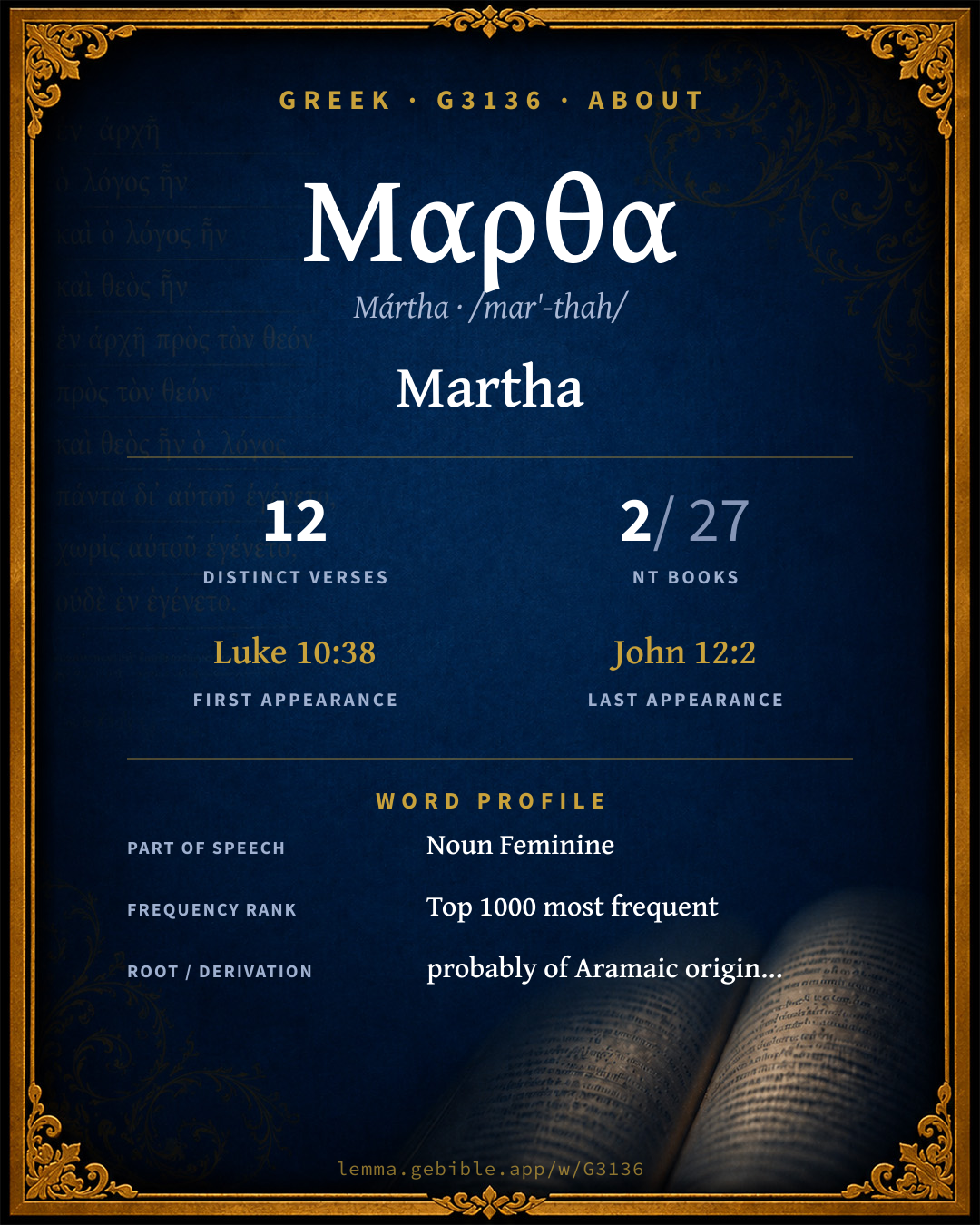
Μάρθα
Martha
Thayer's lists 2 entries for ‘Martha’ fuller range ↓
Full lexicon entry — Thayer's Greek Lexicon
From Thayer's Greek Lexicon
Where this word appears
See every Nominative-case word in the Greek New Testament →
Grammar key — what these labels mean
Part of speech
- Noun
- A naming word — a person, place, thing, or idea.
Case
- Nominative
- The case of the subject (and the predicate nominative).
- Accusative
- The case of the direct object and of extent.
- Vocative
- The case of direct address (“O Lord”).
- Genitive
- The case of source, possession, or “of” — answers “whose / from what.”
Gender
- Feminine
- Grammatically feminine.
Number
- Singular
- One.
Grammatical forms
- Noun, Nominative, Singular, Feminine 8 times (62%)
- Noun, Accusative, Singular, Feminine 2 times (15%)
- Noun, Vocative, Singular, Feminine 2 times (15%)
- Noun, Genitive, Singular, Feminine 1 time (8%)
Parsed forms decoded from the imported morphology (Robinson–Tischendorf, public domain), counted across 13 parsed occurrences — not distinct verses.
Every verse where G3136 appears — 12 distinct verses across 2 books. Click any verse to open its interlinear word-by-word view. Verse text shown in the World English Bible for context — . Each verse’s Greek form is shown with its reference; the English is not keyword-highlighted, since the data carries no word-level English alignment. Use “Compare translations” on any verse to read it across multiple English versions. This concordance covers the Greek New Testament; Septuagint (Greek Old Testament) occurrences of this word are not indexed here.
Luke 3 verses
- Luke 10:38 Μάρθα n nom sg fem It happened as they went on their way, he entered into a certain village, and a certain woman named Martha received him into her house.
- Luke 10:40 Μάρθα n nom sg fem But Martha was distracted with much serving, and she came up to him, and said, "Lord, don't you care that my sister left me to serve alone? Ask her therefore to help me."
- Luke 10:41 Μάρθα Μάρθα n voc sg fem n voc sg fem Jesus answered her, "Martha, Martha, you are anxious and troubled about many things,
John 9 verses
- John 11:1 Μάρθας n gen sg fem Now a certain man was sick, Lazarus from Bethany, of the village of Mary and her sister, Martha.
- John 11:5 Μάρθαν n acc sg fem Now Jesus loved Martha, and her sister, and Lazarus.
- John 11:19 Μάρθαν n acc sg fem Many of the Jews had joined the women around Martha and Mary, to console them concerning their brother.
- John 11:20 Μάρθα n nom sg fem Then when Martha heard that Jesus was coming, she went and met him, but Mary stayed in the house.
- John 11:21 Μάρθα n nom sg fem Therefore Martha said to Jesus, "Lord, if you would have been here, my brother wouldn't have died.
- John 11:24 Μάρθα n nom sg fem Martha said to him, "I know that he will rise again in the resurrection at the last day."
- John 11:30 Μάρθα n nom sg fem Now Jesus had not yet come into the village, but was in the place where Martha met him.
- John 11:39 Μάρθα n nom sg fem Jesus said, "Take away the stone." Martha, the sister of him who was dead, said to him, "Lord, by this time there is a stench, for he has been dead four days."
- John 12:2 Μάρθα n nom sg fem So they made him a supper there. Martha served, but Lazarus was one of those who sat at the table with him.
About this entry
At a glance — auto-summarized from this page’s data, not written by a person. Every figure links to its source below. This summary describes the numbers; it doesn’t interpret them.
At its core, Μαρθα (Mártha) means “Martha.” The word gravitates to John (75%), then Luke. It turns up in 12 verses across 2 books, an uncommon footprint. It first appears in Luke 10:38. Dig into 12-verse concordance and the renderings breakdown below.
Gloss history
Strong's 1890 vs modern scholarship
About this word
Strong's G3136 catalogs a Greek word from the Greek New Testament.
These counts are not copied from any lexicon or concordance. They are computed here, from the morphology-tagged Greek New Testament. What Lemma adds →
- 12
- distinct verses
- The word appears in 12 distinct verses.
- 2 / 27
- NT books
- The word appears in 2 of 27 New Testament books.
- #863
- by frequency
- Top 1000 most frequent Greek words (rank 863 of 5,347 Greek words by occurrence).
View all 12 occurrences in the concordance →
By traditional corpus
Conventional, traditional groupings — biblical authorship is debated, so this is a traditional corpus grouping, not an authorship claim. Some books belong to more than one corpus (Luke is in both the Gospels and the Lukan corpus, and so on), so these shares overlap and need not total 100%. Each figure is a share of the word’s 12 distinct verses.
- Gospels 12 verses · 100%
- Johannine 9 verses · 75%
- Lukan (Luke–Acts) 3 verses · 25%
How translations render this word
Counts come from each version’s own published word-to-Strong’s tagging or interlinear alignment — an approximate guide to how each version renders this word, not a word-level alignment the data otherwise carries. Because each total is that version’s own tagged count, the per-version totals vary from one another and need not match the appearance or distinct-verse counts above. These counts may also differ from a printed concordance because Lemma counts each distinctly tagged rendering and does not collapse phrase taggings into a single head-word total. This is a fixed set of word-tagged versions (KJV, ASV, BSB, ULT) and does not change with the reading translation you choose elsewhere. Each version’s license is shown beside its name below (and on Sources).
- King James Version: Martha 13×
- American Standard Version: Martha 12×
- Berean Standard Bible: Martha 13×
- unfoldingWord Literal Text: Martha 13×
King James Version Public Domain
Renders G3136 across 13 tagged occurrences — most commonly:
American Standard Version Public Domain
Renders G3136 across 12 tagged occurrences — most commonly:
Berean Standard Bible Public Domain
Renders G3136 across 13 tagged occurrences — most commonly:
unfoldingWord Literal Text CC BY-SA 4.0
Renders G3136 across 13 tagged occurrences — most commonly:
Senses in Thayer's
The 2 senses Thayer's distinguishes for this word, in lexicon order (not ranked by frequency or importance). The full entry — with sub-senses — is in the Lexicon Entry tab.
- Martha = "she was rebellious"
- was the sister of Lazarus and Mary of Bethany
Word origin
Origin: probably of Aramaic origin (meaning mistress)
Probably of Chaldee origin (meaning mistress ); Martha a Christian woman : - Martha.
— Strong’s Exhaustive Concordance (1890), public domain.
Forms in the corpus
The 3 distinct written forms G3136 takes in the Greek New Testament, most frequent first — each parse links to that case’s occurrences in the concordance.
| Form | Parsing | Example | Uses |
|---|---|---|---|
| Μάρθα Mártha | Noun, Nominative, Singular, Feminine | Luke 10:38 | 10 |
| Μάρθαν Márthan | Noun, Accusative, Singular, Feminine | John 11:5 | 2 |
| Μάρθας Márthas | Noun, Genitive, Singular, Feminine | John 11:1 | 1 |
Bible dictionary
Public-domain dictionary articles matched to this entry by name (Martha). A biblical name can be shared by more than one person or place, so an article may treat several.
Easton's Bible Dictionary · M. G. Easton, 1897
Bitterness, the sister of Lazarus and Mary, and probably the eldest of the family, who all resided at Bethany (Luke 10:38, 40, 41; John 11:1-39). From the residence being called "her house," some have supposed that she was a widow, and that her brother and sister lodged with her. She seems to have been of an anxious, bustling spirit, anxious to be helpful in providing the best things for the Master's use, in contrast to the quiet earnestness of Mary, who was more concerned to avail herself of the opportunity of sitting at his feet and learning of him. Afterwards at a supper given to Christ and his disciples in her house "Martha served." Nothing further is known of her.
"Mary and Martha are representatives of two orders of human character. One was absorbed, preoccupied, abstracted; the other was concentrated and single-hearted. Her own world was the all of Martha; Christ was the first thought with Mary. To Martha life was a succession of particular businesses;' to Mary life 'was rather the flow of one spirit.' Martha was Petrine, Mary was Johannine. The one was a well-meaning, bustling busybody; the other was a reverent disciple, a wistful listener." Paul had such a picture as that of Martha in his mind when he spoke of serving the Lord "without distraction" (1 Cor. 7:35).
Smith's Bible Dictionary · William Smith, 1863
(a lady), the sister of Lazarus and Mary. [Lazarus] The facts recorded in Luke 10 and John 11 indicate a character devout after the customary Jewish type of devotion, sharing in Messianic hopes and accepting Jesus as the Christ. When she first comes before us, (Luke 10:38) her spirit is "cumbered with much serving," is "careful and troubled about many things." Her love, though imperfect in its form, is yet recognized as true, and she has the distinction of being one whom Jesus loved. (John 11:5) Her position is obviously that of the elder sister the head and manager of the household. In the supper at Bethany (John 12:2) the old character shows itself still, but it has been freed from evil. She is no longer "cumbered," no longer impatient. Activity has been calmed by trust.
Hitchcock's Bible Names Dictionary · Roswell D. Hitchcock, 1869
who becomes bitter; provoking
Classic public-domain reference works; full attribution on Sources.