
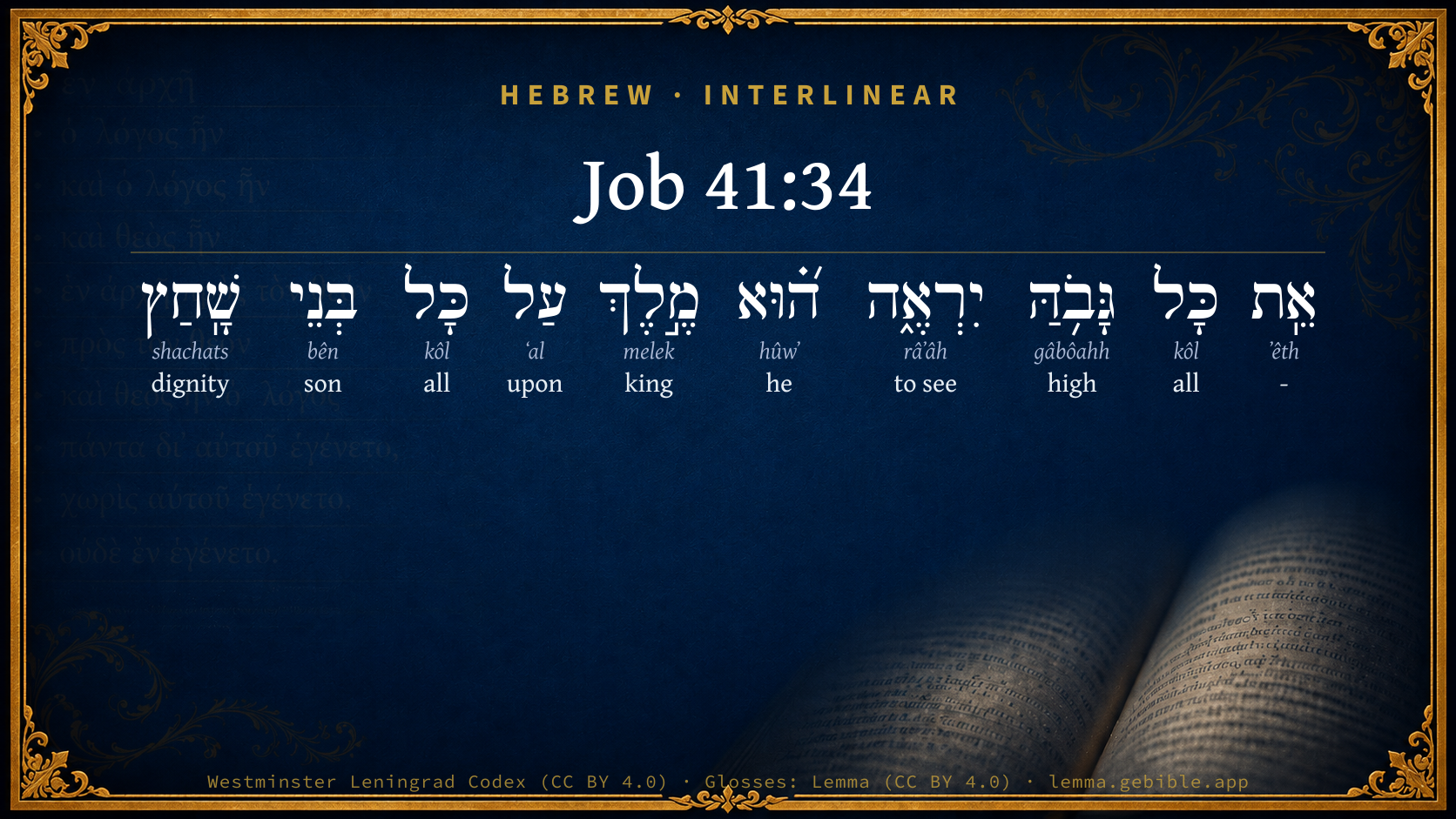
Job 41:34

Hebrew (Westminster Leningrad Codex) Job 41:34 appears in the Hebrew Old Testament. The text above is from the Westminster Leningrad Codex. Each word links to its Strong’s number, a concise gloss, and parsing drawn from the Open Scriptures Hebrew Bible morphology. Click any word for its full Brown-Driver-Briggs (BDB) entry.
Download image
Cite this verse

Job 41:34 (World English Bible). Public Domain. Lemma interlinear Bible study tool, https://lemma.gebible.app/v/job/41/34.

Show BibTeX & RIS
BibTeX
RIS
English Translation
He sees everything that is high: He is king over all the sons of pride."
World English Bible · Public Domain
Download a study sheet

One document with this verse’s original text, its word-by-word gloss line, the meaning frame, cross-references with their text, attributed commentary, and full source and license credits — printable, and it pastes into notes with its structure intact.

This verse Autodidact and up

Study sheet (.html) Plain text (.txt)

A passage Seminary Student

Up to 50 verses in one chapter. A passage sheet keeps up to 6 commentary sources and 12 cross-references per verse, in the order this page ranks them, and says so on the sheet whenever that leaves anything out. Ask for a single verse and you get the Autodidact verse sheet above.

Everything on this page stays free to read, with no account — the sheet is a download of what is already on screen, not access to it.

Want to remove ads? Support Godless Engineer
Compare translations 3

The same verse in 3 English versions, stacked beneath the original-language interlinear above. Click any original word for its lexicon entry.

Each is an independent rendering of the whole verse — the interlinear is not word-aligned to these translations.

Highlighted words mark where these versions differ — a whole-verse word diff, not a word-by-word alignment.

  • World English Bible Public Domain
    He sees everything that is high: He is king over all the sons of pride."
  • King James Version Public Domain
    He beholdeth all high things: he is a king over all the children of pride.
  • unfoldingWord Literal Text CC BY-SA 4.0
    It sees all of the high; it king over all of the sons of pride.”

unfoldingWord Literal Text — © unfoldingWord, licensed CC BY-SA 4.0. Word-aligned USFM3 via Door43 (git.door43.org/unfoldingWord/en_ult).

Versions to compare (up to 4)

3 of 4 selected

Show all 14 translations

Every available English version of this verse, each an independent rendering of the whole verse.

  • World English Bible Public Domain
    He sees everything that is high: He is king over all the sons of pride."
  • Berean Standard Bible Public Domain
    He looks down on all the haughty; he is king over all the proud.”
  • Majority Standard Bible Public Domain
    He looks down on all the haughty; he is king over all the proud.”
  • King James Version Public Domain
    He beholdeth all high things: he is a king over all the children of pride.
  • American Standard Version (1901) Public Domain
    He beholdeth everything that is high: He is king over all the sons of pride.
  • Revised Version (1885) Public Domain
    He beholdeth every thing that is high: he is king over all the sons of pride.
  • Young's Literal Translation Public Domain
    Every high thing he doth see, He `is' king over all sons of pride.
  • Literal Standard Version CC BY-SA 4.0
    He sees every high thing, || He [is] king over all sons of pride.”
  • Unlocked Literal Bible CC BY-SA 4.0
    He sees everything that is proud; he is king over all the sons of pride.”
  • unfoldingWord Literal Text CC BY-SA 4.0
    It sees all of the high; it king over all of the sons of pride.”
  • Darby Bible Public Domain
    He beholdeth all high things; he is king over all the proud beasts.
  • World Messianic Bible Public Domain
    He sees everything that is high. He is king over all the sons of pride.”
  • Free Bible Version CC BY-SA 4.0
    It looks down on all other creatures. It is the proudest of all.”
  • JPS Tanakh (1917) Public Domain
    (41-26) He looketh at all high things; he is king over all the proud beasts.

Literal Standard Version (2020), Covenant Press — licensed CC BY-SA 4.0. Text via the HelloAO Bible API (eBible.org). Unlocked Literal Bible (unfoldingWord) — licensed CC BY-SA 4.0. Text via the HelloAO Bible API (eBible.org). unfoldingWord Literal Text — © unfoldingWord, licensed CC BY-SA 4.0. Word-aligned USFM3 via Door43 (git.door43.org/unfoldingWord/en_ult). Free Bible Version, Dr. Jonathan Gallagher — licensed CC BY-SA 4.0. Text via the HelloAO Bible API (eBible.org).

Word by word

More ways to search: Search by grammar → Find every occurrence → Compare this word →

Practice this passage: Drill this verse → Learn its vocabulary →

About this verse

These counts appear in no published source. They are computed here, from the morphology-tagged text and Lemma’s own curated glosses. What Lemma adds →

10
words
9
distinct lemmas
Wisdom
section

Notable vocabulary

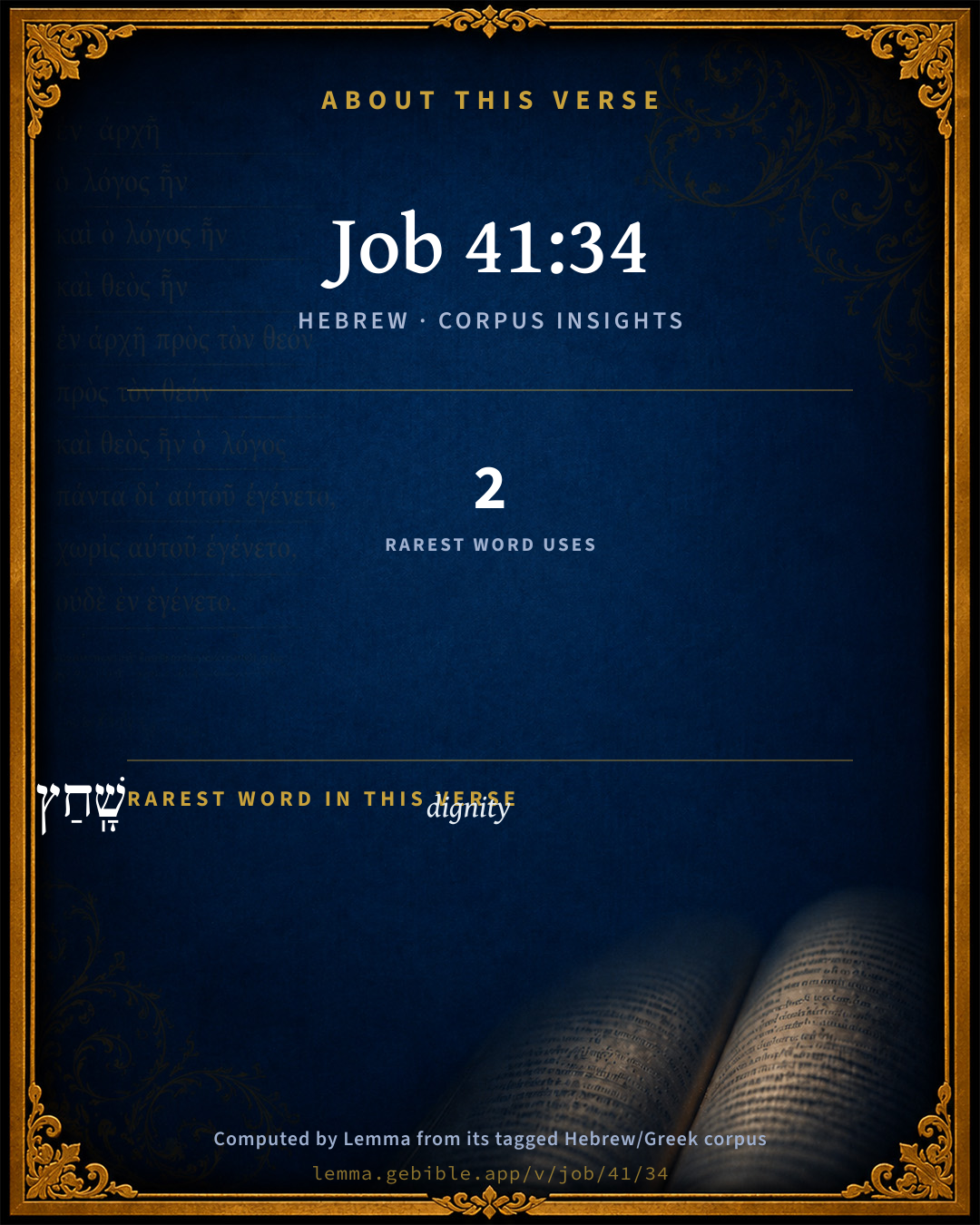
The rarest word here is שָֽׁחַץ dignity H7830 — appearing just 2 times in the whole Hebrew Bible.

Shared distinctive vocabulary

שָֽׁחַץ dignity H7830 occurs in 2 verses of the Hebrew Bible. Also found in:

Grammatical profile

  • 1 verb
  • 5 nouns
  • 1 adjective
  • 1 pronoun
  • 1 preposition
  • 1 particle

Verb forms

  • יִרְאֶ֑ה Qal · Imperfect

Repetition

A word recurs within this verse — often emphatic in Hebrew:

Cross-references

10

Topical passages linked to Job 41:34 in the Treasury of Scripture Knowledge — connected by theme and wording, ordered by reader-vote popularity; previews shown in the World English Bible.

  • Ezekiel 29:3 speak, and say, Thus says the Lord Yahweh: Behold, I am against you, Pharaoh king of Egypt, the great monster that lies in the midst of his rivers, that has said, My river is my own, and I have made it for myself.
  • Psalms 73:6 Therefore pride is like a chain around their neck. Violence covers them like a garment.
  • Job 26:12 He stirs up the sea with his power, And by his understanding he strikes through Rahab.
  • Job 28:8 The proud animals have not trodden it, Nor has the fierce lion passed by there.
  • Exodus 5:2 Pharaoh said, "Who is Yahweh, that I should listen to his voice to let Israel go? I don't know Yahweh, and moreover I will not let Israel go."
  • Psalms 73:10 Therefore their people return to them, And they drink up waters of abundance.
  • Isaiah 28:1 Woe to the crown of pride of the drunkards of Ephraim, and to the fading flower of his glorious beauty, which is on the head of the fat valley of those who are overcome with wine!
  • Revelation 12:1–3 A great sign was seen in heaven: a woman clothed with the sun, and the moon under her feet, and on her head a crown of twelve stars.
  • Revelation 13:2 The beast which I saw was like a leopard, and his feet were like those of a bear, and his mouth like the mouth of a lion. The dragon gave him his power, his throne, and great authority.
  • Revelation 20:2–3 He seized the dragon, the old serpent, which is the devil and Satan, who deceives the whole inhabited earth, and bound him for a thousand years,

Cross-references courtesy of OpenBible.info (CC BY 4.0).

Hebrew and Greek witnesses Masoretic Hebrew ↔ Greek Septuagint

The same verse in the two great witnesses to the Old Testament, shown verse-for-verse.

These are two independent witnesses, not word-aligned to each other, and the Septuagint is shown in lemma (dictionary) form.

Hebrew Job 41:34 Masoretic · Westminster Leningrad Codex

אֵֽת כָּל גָּבֹ֥הַּ יִרְאֶ֑ה ה֝֗וּא מֶ֣לֶךְ עַל כָּל בְּנֵי שָֽׁחַץ

He sees everything that is high: He is king over all the sons of pride."

World English Bible · Public Domain

Hebrew: Westminster Leningrad Codex (CC BY 4.0). Greek: Septuagint (public domain); English from a public-domain English Septuagint. How the Septuagint differs from the Hebrew →

Commentary

Notes on Job 41:34 from classic Christian and Jewish commentators (each source and its license shown beneath its notes). The classic Christian expositions comment on the surrounding passage and are grouped to its opening verse, so a note may address several verses; the Jewish commentaries on the Tanakh (Rashi and others) are per-verse, so they appear only where the commentator wrote on this verse.

Lemma curates 59 commentaries, every one of them public domain or Creative Commons licensed, each selected and text-cleaned for this edition rather than reprinted as found. About our sources →

Trapp's Complete Commentary

John Trapp

Job 41:34 He beholdeth all high [things]: he [is] a king over all the children of pride.

Ver. 34. He beholdeth all high things] As far below him (be they never so excellent) both for bulk of body and stoutness of mind.

He is a king over all the children of pride] Or, over all the wild creatures (so Tremellius and Buxtorf interpret it), which are proud, and do domineer over the tame ones, no less than leviathan, if he were among them, would do over them.

John Trapp, A Commentary or Exposition upon All the Books of the Old and New Testament (1647–1656) — public domain. Text from a community e-Sword module.

Joseph Benson's Commentary

Job 41:34. He beholdeth all high things — He looks about him with contempt and disdain on every thing he sees. He does not turn his back upon, or hide his face from, the highest and mightiest creatures, but beholds them with a bold and undaunted countenance, as being without any fear of them. He is king over all the children of pride — He carries himself with princely majesty and courage toward the strongest, loftiest, and fiercest creatures, which, though far higher in stature than himself, he strikes down with one stroke of his tail, as he commonly does cows and horses, and sometimes elephants. Heath’s translation of this verse seems peculiarly proper, as referring to, and closing the description of, the crocodile: He will look upon any thing with contempt, be it ever so high: he is king over all the sons of rapine; that is, over the most ravenous beasts, according to the Syriac and Arabic. Dr. Young’s paraphrase on these last two verses will please the reader, and give him a juster idea of their contents, than any thing we have said upon them:

“His like earth bears not on her spacious face;

Alone in nature stands his dauntless race,

For utter ignorance of fear renown’d;

In wrath he rolls his baleful eyes around;

Makes every swoll’n, disdainful heart subside,

And holds dominion o’er the sons of pride.”

Here end the words of God to Job, whereby he sets forth his wisdom and power, in the works of the creation: from whence Job might be led to infer, that the wisdom and power of God being so immense, men ought to speak most reverently of him, and think most humbly and lowly of themselves; persuaded that, though we cannot always see the reason why the divine providence suffers certain things to come to pass, yet we ought to rest assured that they are wisely, and therefore justly, ordered, and therefore we should resignedly submit our selves to the divine will in all things.

Joseph Benson's Commentary on the Old and New Testaments (1811–1818) — public domain. Text from a community e-Sword module.

Jamieson, Fausset & Brown

Robert Jamieson, A. R. Fausset & David Brown

beholdeth--as their superior.

children of pride--the proud and fierce beasts. So Job 28:8; Hebrew, "sons of pride." To humble the pride of man and to teach implicit submission, is the aim of Jehovah's speech and of the book; therefore with this as to leviathan, the type of God in His lordship over creation, He closes.

Next: Job Chapter 42

Jamieson, Fausset & Brown — Commentary Critical and Explanatory on the Whole Bible (1871) — public domain (CC PDM 1.0). Text via the HelloAO Bible API.

Adam Clarke's Commentary

Verse 34. He is a king over all the children of pride.] There is no animal in the waters that does not fear and fly from him. Hence the Chaldee renders it, all the offspring of FISHES.

Calmet says, that by the children of pride the Egyptians are meant; that the crocodile is called their king, because he was one of their principal divinities; that the kings of Egypt were called Pharaoh, which signifies a crocodile; and that the Egyptians were proverbial for their pride, as may be seen in Eze 32:12. And it is very natural to say that Job, wishing to point out a cruel animal, adored by the Egyptians, and considered by them as their chief divinity, should describe him under the name of king of all the children of pride.

Houbigant considers the לויתן livyathan, the coupled dragon, to be emblematical of Satan: "He lifts his proud look to God, and aspires to the high heavens; and is king over all the sons of pride." He is, in effect, the governor of every proud, haughty, impious man. What a king! What laws! What subjects!

Others think that MEN are intended by the sons of pride; and that it is with the design to abate their pride, and confound them in the high notions they have of their own importance, that God produces and describes an animal of whom they are all afraid, and whom none of them can conquer.

AFTER all, what is leviathan? I have strong doubts whether either whale or crocodile be meant. I think even the crocodile overrated by this description. He is too great, too powerful, too important, in this representation. No beast, terrestrial or aquatic, deserves the high character here given, though that character only considers him as unconquerably strong, ferociously cruel, and wonderfully made. Perhaps leviathan was some extinct mammoth of the waters, as behemoth was of the land. However, I have followed the general opinion by treating him as the crocodile throughout these notes; but could not finish without stating my doubts on the subject, though I have nothing better to offer in the place of the animal in behalf of which almost all learned men and critics argue, and concerning which they generally agree. As to its being an emblem either of Pharaoh or the devil, I can say little more than, I doubt. The description is extremely dignified; and were we sure of the animal, I have no doubt we should find it in every instance correct. But after all that has been said, we have yet to learn what leviathan is!

Adam Clarke's Commentary on the Bible (1810–1826) — public domain. Text from a community e-Sword/MySword module.

The Cambridge Bible for Schools and Colleges

gen. ed. J. J. S. Perowne

34. he beholdeth all high things] Or, he looketh on all that is high; he looks them boldly in the face without terror.

the children of pride] That is, the proud beasts; comp. ch. Job_28:8.

The Cambridge Bible for Schools and Colleges (gen. ed. J. J. S. Perowne; Cambridge University Press, 1878–1918) — public domain. Text from a community e-Sword module.

Albert Barnes' Notes on the Bible

He beholdeth all high things - That is, he looks down on everything as inferior to him.

He is a king over all the children of pride - Referring, by “the children of pride,” to the animals that are bold, proud, courageous - as the lion, the panther, etc. The lion is often spoken of as “the king of the forest,” or “the king of beasts,” and in a similar sense the leviathan is here spoken of as at the head of the animal creation. He is afraid of none of them; he is subdued by none of them; he is the prey of none of them. The whole argument, therefore, closes with this statement, that he is at the head of the animal creation; and it was by this magnificent description of the power of the creatures which God had made, that it was intended to impress the mind of Job with a sense of the majesty and power of the Creator. It had the effect. He was overawed with a conviction of the greatness of God, and he saw how wrong it had been for him to presume to call in question the justice, or sit in judgment on the doings, of such a Being. God did not, indeed, go into an examination of the various points which had been the subject of controversy; he did not explain the nature of his moral administration so as to relieve the mind from perplexity; but he evidently meant to leave the impression that he was vast and incomprehensible in his government, infinite in power, and had a right to dispose of his creation as he pleased. No one can doubt that God could with infinite ease have so explained the nature of his administration as to free the mind from perplexity, and so as to have resolved the difficulties which hung over the various subjects which had come into debate between Job and his friends. “Why” he did not do this, is nowhere stated, and can only be the subject of conjecture. It is possible, however, that the following suggestions may do something to show the reasons why this was not done:

(1) We are to remember the early period of the world when these transactions occurred, and when this book was composed. It was in the infancy of society, and when little light had gleamed on the human mind in regard to questions of morals and religion.

(2) In that state of things, it is not probable that either Job or his friends would have been able to comprehend the principles in accordance with which the wicked are permitted to flourish and the righteous are so much afflicted, if they had been stated. Much higher knowledge than they then possessed about the future world was necessary to understand the subject which then agitated their minds. It could not have been done without a very decided reference to the future state, where all these inequalities are to be removed.

(3) It has been the general plan of God to communicate knowledge by degrees; to impart it when people have had full demonstration of their own imbecility, and when they feel their need of divine teaching; and to reserve the great truths of religion for an advanced period of the world. In accordance with this arrangement, God bas been pleased to keep in reserve, from age to age, certain great and momentous truths, and such as were particularly adapted to throw light on the subjects of discussion between Job and his friends. They are the truths pertaining to the resurrection of the body; the retributions of the day of judgment; the glories of heaven and the woes of hell, where all the inequalities of the present state may receive their final and equal adjustment. These great truths were reserved for the triumph and glory of Christianity; and to have stated them in the time of Job, would have been to have anticipated the most important revelations of that system. The truths of which we are now in possession would have relieved much of the perplexity then felt, and solved most of those questions; but the world was not then in the proper state for their revelation.

(4) It was a very important lesson to be taught to people, to bow with submission to a sovereign God, without knowing the reason of his doings. No lesson, perhaps, could be learned of higher value than this. To a proud, self-confident, philosophic mind, a mind prone to rely on its own resources, and trust to its own deductions, it was of the highest importance to inculcate the duty of submission to “will” and to “sovereignty.” This is a lesson which we often have to learn in life, and which almost all the trying dispensations of Providence are fitted to teach us. It is not because God has no reason for what he does; it is not because he intends we shall never know the reason; but it is because it is our “duty” to bow with submission to his will, and to acquiesce in his right to reign, even when we cannot see the reason of his doings. Could we “reason it out,” and then submit “because” we saw the reason, our submission would not be to our Maker’s pleasure, but to the deductions of our own minds.

Hence, all along, he so deals with man, by concealing the reason of his doings, as to bring him to submission to his authority, and to humble all human pride. To this termination all the reasonings of the Almighty in this book are conducted; and after the exhibition of his power in the tempest, after his sublime description of his own works, after his appeal to the numerous things which are in fact incomprehensible by man, we feel that God is great - that it is presumptuous in man to sit in judgment on his works - and that the mind, no matter what he does, should bow before him with profound veneration and silence. These are the great lessons which we are every day called to learn in the actual dispensations of his providence; and the “arguments” for these lessons were never elsewhere stated with so much power and sublimity as in the closing chapters of the book of Job. We have the light of the Christian religion; we can look into eternity, and see how the inequalities of the present order of things can be adjusted there; and we have sources of consolation which neither Job nor his friends enjoyed; but still, with all this light, there are numerous cases where we are required to bow, not because we see the reason of the divine dealings, but because such is the will of God. To us, in such circumstances, this argument of the Almighty is adapted to teach the most salutary lessons.

Albert Barnes' Notes on the Bible (1834–1885) — public domain. Text from a community e-Sword/MySword module.

Matthew Poole's English Annotations

He doth not turn his back upon nor hide his face from the highest and proudest creatures, but looks upon them with a bold and undaunted countenance, as being without any fear of them, as was now said. He carries himself with princely majesty and courage towards the stoutest and loftiest creatures; which, though of far higher stature than himself, he striketh down with one stroke of his tail, as he commonly doth cows, and horses, and sometimes elephants.

Matthew Poole's English Annotations on the Holy Bible (1683–1685) — public domain. Text from a community e-Sword/MySword module.

Whedon's Commentary on the Bible

Daniel D. Whedon

34. He beholdeth all high things — Without fear he looks in the face of man, the monarch, here standing in contradistinction to the king of beasts, in the second clause. Comp. Job_40:11-12. Children of pride — Rendered “the lion’s whelps,” in Job_28:8. It is here used of the most formidable of beasts, with their characteristically majestic and haughty step. Aben Ezra, however, remarks that בני שׁחצ “is a comprehensive expression, including whatsoever hath its birth in the waters.” That pride should be the last word of this wonderful description is orthy of note; and may help somewhat to solve the mystery of the divine address. The figure with which it closes is a startling one — that of the most fearful of all reptiles — their king, and, as the ancients thought, the embodiment of evil — staring not only at all that is high, but at poor, humbled Job. His pride — if such were his infirmity — is now all broken, and the work of discipline is complete.

Daniel D. Whedon (gen. ed.), Commentary on the Old and New Testaments (1874–1909) — public domain. Text from a community e-Sword module.

The Pulpit Commentary

He beholdeth all high things He looks without fear on everything that is high and great. Nothing alarms him; nothing disturbs his equanimity. He is a king over all the children (literally, sons) of pride. (comp Job_28:8) He feels himself superior to all other animals that come within his ken. They may be "sons of pride," but he has more to be proud of than the proudest of them. Ordinarily, the lion poses as "the king of beasts;" but here he is, as it were, deposed, and relegated into the second position, (Job_38:39) the crocodile being exalted into his place. From different points of view, there are several great beasts which might be regarded as the lords of the animal creation.

"A king over all the children of pride.

This magniloquent title crowns the elaborate description of leviathan, which occupies the whole chapter. It gives us a vivid idea of the supremacy and kinship that are to be found in nature.

I THERE ARE GRADATIONS OF RANK IN NATURE. Nature is not democratic or communistic. Among her various orders we observe ascending ranks of living creatures. There is a natural aristocracy; there is a natural kingship. All creatures are not endowed alike. Some are gifted with powers that lift them above their fellows. We see the same facts in the human world. All men are not endowed equally. Some have five talents, some two talents, some but one talent. There are men who seem born to rule; power is native to them. Now, these facts may seem to justify a rigid adherence to differences of rank and a repression of efforts to bring about a state of equality. But we must modify the application of them to men in two or three respects.

1. Men are all of one greatly, and are therefore am! brethren, whereas in the animal world we have been considering differences of species.

2. Men have a moral nature, and can discern a higher right than that of might.

3. Men have a religion, which teaches them that their own instincts and wills are to be subordinate to the will of God.

II THE HIGHEST KINGSHIP IS MENTAL AND MORAL. It is only in a highly rhetorical description that the crocodile, even when idealized, can be described as "a king over all the children of pride," for he does not really rule over the beasts and birds and fishes of the Nile. It is his dragon-like size and form and power that suggest to us an idea of royalty. And what royalty! Here we have the reductio ad absurdum of the kingship of force. It is natural and right in the crocodile, who lives up to his nature. Yet with all his toughness and terror this animal is one of the most senseless of creatures. It is not much to be able to boast of physical supremacy. The born kings of men are the great leaders in the higher life leaders of thought, as Plato, Augustine, Aquinas, Bacon, Newton, Kant; leaders of religious life and conduct, as St. Paul, Athanasius, Luther, Wesley.

III GOD IS KING OF KINGS. It would be a fearful thing if the power and supremacy that are entrusted to the larger animals had been given to them without limits or restraints. But the kingly animals, the lion and the eagle, as well as leviathan himself, are all obedient subjects of the Lord who rules over all the works of nature. They could not rebel against their Suzerain if they would. Their kingdoms are but satrapies of the grand empire of nature which God rules absolutely. Hence the order of the worm in spite of the power of these monstrous creatures. Man alone is able to rebel. Yet God overrules the rebellion even of the human world, and brings kings to do his will, although they may recognize him as little as leviathan recognizes his Lord and Maker. Thus God gives power within limits. Men of the largest liberty and the highest privileges will be called to account before their supreme Master. Therefore it is for us to look up above all earthly greatness and rule to that perfect kingship and that one supreme authority which has been revealed to us in Christ for the guidance of our lives into the path of loyal obedience. W.F.A.

The Pulpit Commentary (1880–1919), ed. H.D.M. Spence-Jones & Joseph S. Exell — public domain. Text from a community e-Sword module.

John Wesley's Explanatory Notes

King, &c. - He can tame both the behemoth and leviathan, as strong and stout-hearted as they are. This discourse concerning them was brought in, to prove that it is God only, who can look upon proud men and abase them, bring them low, and hide them in the dust, he it is that beholdeth all high things, and wherein men dealt proudly, he is above them. He is king over all the children of pride, brutal or rational, and makes them either bend or break before him.

John Wesley, Explanatory Notes Upon the Whole Bible (1754–1765) — public domain. Text via the GEBible commentary corpus.

Lesson kit

Teaching starters — assembled from the data on this page, not authored interpretation. Every prompt links to the verse data it draws on. Edit before teaching.

Job, in the Wisdom, opens this verse with 10 words (9 distinct Hebrew lemmas). Its most distinctive word is shachats (“dignity”). A historical commentator’s framing appears above. Read the whole chapter for the surrounding context.

Discussion questions

  1. How does “dignity” (shachats) shape what this verse is saying?
  2. How does Job 28:8, which shares the word «dignity», read alongside this verse?
  3. What does the repetition of “all” (2× in this one verse) do in this verse?
  4. These translations render this verse differently. What is at stake in choosing one wording over another?
  5. «יִרְאֶ֑ה» is a Qal Imperfect verb. How does that grammatical form shape the action described?
  6. Compare how Trapp's Complete Commentary and Joseph Benson's Commentary read this verse. Where do they agree or differ?

Things to notice

Reading settings

Reading text

Shown beneath each verse's original-language words.

Old Testament
Old Testament edition

Read the OT as the Masoretic Hebrew (MT) or the Greek Septuagint (LXX).

English shown for the Greek Septuagint (in the Hebrew ↔ Greek comparison).

Comparing translations? Open the Compare panel on any verse page to stack up to four side by side.