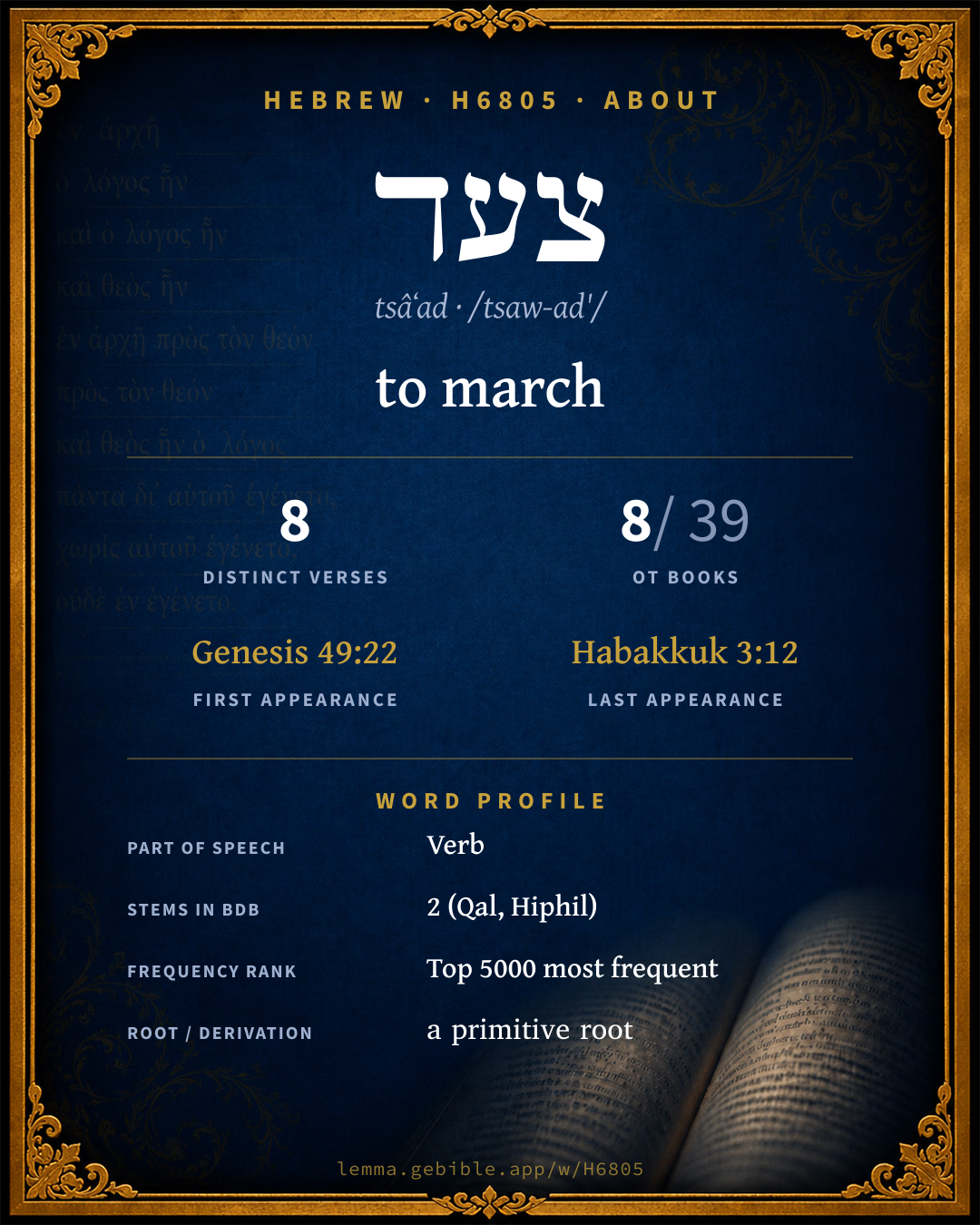
צָעַד
to march
‘to march’ is one of 3 main senses fuller range ↓
Full lexicon entry — Brown-Driver-Briggs (BDB)
From Brown-Driver-Briggs (BDB)
Where this word appears
See every Qal verb in the Hebrew Bible →
Grammar key — what these labels mean
Part of speech
- Verb
- An action or state-of-being word.
Stem
- Qal
- The basic, simple active stem — the plain form of the verb (“he wrote”).
- Hiphil
- The causative active stem (“he caused / brought about”).
Form
- Infinitive Construct
- A bound verbal noun, frequently with prepositions (“to write / in writing”).
- Imperfect
- An incomplete, ongoing, or future action (“he will / would write”).
- Perfect
- A completed action or state — Hebrew marks aspect (completeness) more than strict tense (“he wrote”).
Person
- 3rd Person
- The one spoken about (“he / she / it / they”).
- 2nd Person
- The one addressed (“you”).
Gender
- Feminine
- Grammatically feminine.
- Masculine
- Grammatically masculine.
- Common
- Either gender — not distinguished for this form.
Number
- Singular
- One.
- Plural
- More than one (in Hebrew, generally three or more).
Grammatical forms
- Verb, Qal, Infinitive Construct 2 times (25%)
- Verb, Hiphil, Imperfect, 3rd Person, Feminine, Singular 1 time (13%)
- Verb, Qal, Imperfect, 2nd Person, Masculine, Singular 1 time (13%)
- Verb, Qal, Imperfect, 3rd Person, Masculine, Plural 1 time (13%)
- Verb, Qal, Imperfect, 3rd Person, Masculine, Singular 1 time (13%)
- Verb, Qal, Perfect, 3rd Person, Common, Plural 1 time (13%)
- Verb, Qal, Perfect, 3rd Person, Feminine, Singular 1 time (13%)
Parsed forms decoded from the imported morphology (morphhb / Westminster Leningrad Codex — WLC text public domain, morphhb tagging CC BY 4.0), counted across 8 parsed occurrences — not distinct verses.
Every verse where H6805 appears — 8 distinct verses across 8 books. Click any verse to open its interlinear word-by-word view. Verse text shown in the World English Bible for context — . Each verse’s Hebrew form is shown with its reference; the English is not keyword-highlighted, since the data carries no word-level English alignment. Use “Compare translations” on any verse to read it across multiple English versions. This concordance covers the Hebrew Bible; Septuagint (Greek Old Testament) occurrences are not indexed here.
Genesis 1 verse
Judges 1 verse
2 Samuel 1 verse
Job 1 verse
Psalms 1 verse
Proverbs 1 verse
Jeremiah 1 verse
Habakkuk 1 verse
About this entry
At a glance — auto-summarized from this page’s data, not written by a person. Every figure links to its source below. This summary describes the numbers; it doesn’t interpret them.
צעד (tsâʻad) is a Hebrew verb most often rendered “to march.” Scripture first uses it in Genesis 49:22. Spanning 8 verses in 8 books, it ranks among the uncommon words of the Hebrew Bible. Across 2 stems, its meaning turns on the binyan (Qal, Hiphil). Sharing its root, it stands alongside מצעד. For the data behind this summary, explore the sense tree and the renderings breakdown below.
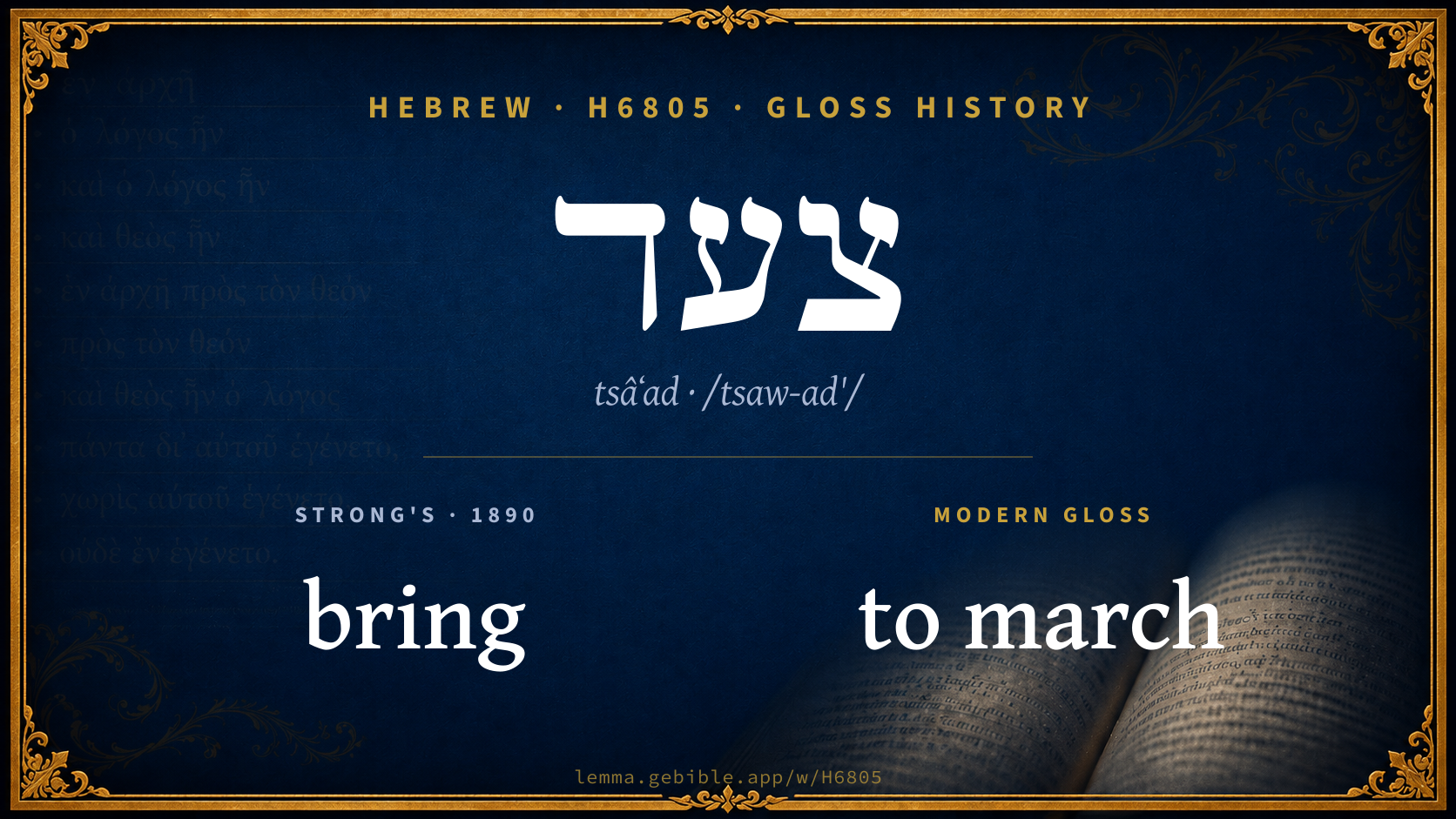
Gloss history
Strong's 1890 vs modern scholarship
About this word
Strong's H6805 catalogs a Hebrew word from the Hebrew Old Testament.
These counts are not copied from any lexicon or concordance. They are computed here, from the morphology-tagged Hebrew Old Testament. What Lemma adds →
- 8
- distinct verses
- The word appears in 8 distinct verses.
- 8 / 39
- OT books
- The word appears in 8 of 39 Old Testament books.
- #2,625
- by frequency
- Top 5000 most frequent Hebrew words (rank 2,625 of 8,640 Hebrew words by occurrence).
View all 8 occurrences in the concordance →
By section of the Old Testament
By traditional corpus
Conventional, traditional groupings — biblical authorship is debated, so this is a traditional corpus grouping, not an authorship claim. Each share is this word’s portion of its verses in that division of the Hebrew canon. Each figure is a share of the word’s 8 distinct verses.
- Prophets (Nevi'im) 4 verses · 50%
- Writings (Ketuvim) 3 verses · 38%
- Torah (Pentateuch) 1 verse · 13%
How translations render this word
Counts come from each version’s own published word-to-Strong’s tagging or interlinear alignment — an approximate guide to how each version renders this word, not a word-level alignment the data otherwise carries. Because each total is that version’s own tagged count, the per-version totals vary from one another and need not match the appearance or distinct-verse counts above. These counts may also differ from a printed concordance because Lemma counts each distinctly tagged rendering and does not collapse phrase taggings into a single head-word total. This is a fixed set of word-tagged versions (KJV, ASV, BSB, ULT) and does not change with the reading translation you choose elsewhere. Each version’s license is shown beside its name below (and on Sources).
- King James Version: Had gone 1×, He went 1×, Run 1×
- American Standard Version: Had gone 1×, He shall be brought 1×, He went 1×
- Berean Standard Bible: You marched 3×
- unfoldingWord Literal Text: Go up 1×, Had stepped 1×, He steps 1×
King James Version Public Domain
Renders H6805 across 8 tagged occurrences — most commonly:
American Standard Version Public Domain
Renders H6805 across 8 tagged occurrences — most commonly:
Berean Standard Bible Public Domain
Renders H6805 across 8 tagged occurrences — most commonly:
Plus 5 renderings that appear only once — usually multi-word phrases or single function words the recovered tagging swept in, not distinct renderings.
unfoldingWord Literal Text CC BY-SA 4.0
Renders H6805 across 12 tagged occurrences — most commonly:
Senses in the full BDB
Hebrew verbs can shift meaning by stem (binyan): Qal is the basic action, Niphal is often passive or reflexive, Piel often intensifies or makes it factitive, and Hiphil is typically causative. The senses below are grouped under the stem BDB assigns to each.
What do BDB’s symbols mean?
BDB uses these scholarly abbreviations:
| Symbol | Meaning |
|---|---|
| 𝔊 | the Septuagint (the ancient Greek translation, LXX) |
| 𝔙 | the Vulgate (the Latin translation) |
| 𝔖 | the Syriac version (the Peshitta) |
| 𝔗 | the Targum (the Aramaic translation) |
| ψ | the Psalms |
| √ | root (the underlying root or stem) |
| ‖ | parallel passage (a synonymous or contrasted parallel) |
| † | the dagger: every passage where the word occurs is cited |
The 2 senses and sub-senses the full Brown-Driver-Briggs lexicon distinguishes for this word, in lexicon order (not ranked by frequency), with BDB’s own verbatim wording and sub-sense lettering. Shown in Hebrew script with BDB’s own scholarly abbreviations. The condensed entry is in the Lexicon Entry tab. See also the Forms in the corpus table below.
Qal
- Pf. 3 fs. צָֽעֲדָה Gn 49:22 (but on text v. infr.); 3 pl. צָֽעֲדוּ 2 S 6:13; Impf. 3 ms. יִצְעָ֑ד Pr 7:8, etc.; Inf. cstr. sf. בְּצַעַדְךָ Ju 5:4, בְּצַעְדְּךָ ψ 68:8;—step, march, of י׳ Ju 5:4 ψ 68:8 (c. ב loc.), Hb 3:12 (c. acc. אֶרֶץ); read prob. also צֹעֵד Is 63:1 (for MT צֹעֶה, v. צעה); of men, c. acc. cogn. צְעָדִים 2 S 6:13 they had gone six steps; c. acc. דֶּרֶךְ step a certain way Pr 7:8; of idols, לֹא יִצְעָ֑דוּ Je 10:5.—בָּנוֹת צָֽעֲדָה עֲלֵי־שׁוּר Gn 49:22 is dubious: usually (its) daughters (twigs of bough) have climbed over the wall (on sg. vb. v. Ges§ 145 k; others think ה—ָ old fpl. ending, e.g. NöZMG xxxviii (1884), 411 JPPetersHbr iii (1887), 111; v (1888), 199; conject. emend. of text v. in BallHpt Holz). e.g. Genesis 49:22
Hiphil
- Impf. 3 fs. sf. וְתַצְעִדֵהוּ Jb 18:14 and it (an unseen power Di; disease Du, reading וְיַצ׳) makes him march, c. ל pers. e.g. Job 18:14
Senses from the full Brown-Driver-Briggs lexicon (Brown, Driver, Briggs; Oxford 1906 — public domain), digitized via Sefaria, supplemented by the OpenScriptures HebrewLexicon (CC BY 4.0). Full attribution on Sources.
Word origin
vb. step, march (NH id. (rare); Arabic صَعِدَ ascend);—
— Brown-Driver-Briggs (Oxford 1906, public domain), digitized via Sefaria, supplemented by the OpenScriptures HebrewLexicon (CC BY 4.0). See Sources.
Origin: a primitive root
Jastrow Dictionary
A second Hebrew/Aramaic lexicon for comparison, covering Aramaic and post-biblical (Talmudic, Targumic, Midrashic) usage that the biblical-Hebrew BDB does not. Matched by lemma rather than by Strong’s number, so a lemma may carry more than one Jastrow headword (shown separately below), and the entries cover usage well beyond the Bible.
צָעַד
- (b. h.) to step, walk. Taan. 20ᵇ ולא צָעַדְתִּי בפני מי וכ׳ I never walked in front of one my superior; Meg. 28ᵃ.—[Yalk. Ex. 346 הצועד, v. צוֹעֵר.]
- to cause to walk, direct. Ber. 29ᵇ שתוליכני לשלום ותַצְעִידֵנִי וכ׳ that thou mayest lead me in safety and direct me in safety.
- to climb. Pirké d’R. El. ch. XXXIX והיו … מְצַעֲדוֹת על וכ׳ and the Egyptian girls used to climb up the walls and throw to him (Joseph) rings &c.
צַעַד
- preced.) step. — Pl. צְעָדִים, צְעָדוֹת. Pirké d’R. El. ch. XVII עשר צ׳; Yalk. Kings 232 עשרה צ׳. Pirké d’R. El. ch. XXXVI (ref. to Prov. IV, 12) לא צרו צְעָדָיו וכ׳ Jacob’s steps were not straitened; Midr. Till. to Ps. XCI. e.g. Proverbs 4:12
A Dictionary of the Targumim, the Talmud Babli and Yerushalmi, and the Midrashic Literature (Marcus Jastrow; London, Luzac, 1903) — Public Domain. Digitized via Sefaria. Digitized via Sefaria. Full attribution on Sources.
Forms in the corpus
The 8 distinct written forms H6805 takes in the Hebrew Bible, most frequent first — each parse links to that stem’s occurrences in the concordance. Hebrew forms include their vowel points and cantillation, so a single lemma takes many written forms.
| Form | Parsing | Example | Uses |
|---|---|---|---|
| בְּ/צַעְדְּ/ךָ֖ | Verb, Qal, Infinitive Construct | Psalms 68:7 | 1 |
| בְּ/צַעְדְּ/ךָ֙ | Verb, Qal, Infinitive Construct | Judges 5:4 | 1 |
| וְ֝/תַצְעִדֵ֗/הוּ | Verb, Hiphil, Imperfect, 3rd Person, Feminine, Singular | Job 18:14 | 1 |
| יִצְעָ֑דוּ | Verb, Qal, Imperfect, 3rd Person, Masculine, Plural | Jeremiah 10:5 | 1 |
| יִצְעָֽד | Verb, Qal, Imperfect, 3rd Person, Masculine, Singular | Proverbs 7:8 | 1 |
| צָעֲד֛וּ | Verb, Qal, Perfect, 3rd Person, Common, Plural | 2 Samuel 6:13 | 1 |
| צָעֲדָ֖ה | Verb, Qal, Perfect, 3rd Person, Feminine, Singular | Genesis 49:22 | 1 |
| תִּצְעַד | Verb, Qal, Imperfect, 2nd Person, Masculine, Singular | Habakkuk 3:12 | 1 |
Same root — word family
Other BDB entries built from the same root as H6805, grouped by Strong’s listed origin. These share a root / origin per the lexicon — not necessarily a shared meaning. Each links to that word’s own entry.
Derived from this word
Compare all same-root words → They share a root, not necessarily a meaning.
Septuagint verse parallels
This word appears in 7 verses that also exist in the Greek Old Testament (Septuagint), out of the 8 Hebrew verses it occurs in. You can read those verses in Greek by switching the Old Testament edition to the Septuagint.
Read these verses in the Septuagint
This is a verse-level parallel only — the same verses exist in both the Hebrew and Greek Old Testaments. No word-level Hebrew↔Greek correspondence is claimed: the data carries no such alignment, so no Greek word is shown as this Hebrew word’s translation. Coverage is not total — the Septuagint omits the deuterocanon and renumbers the Psalms, so some Hebrew verses have no direct Greek parallel.