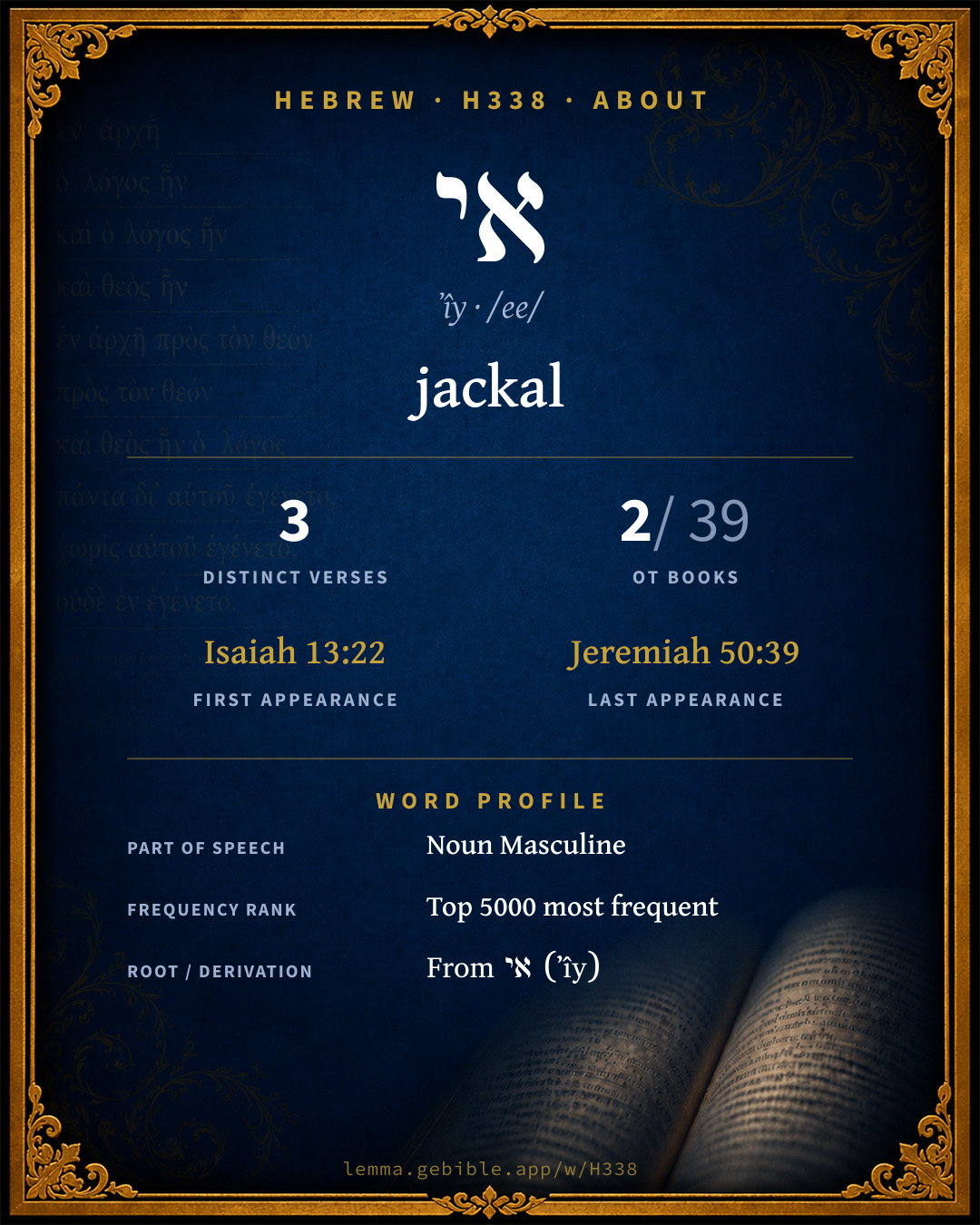
אִי
jackal
Full lexicon entry — Brown-Driver-Briggs (BDB)
From Brown-Driver-Briggs (BDB)
Where this word appears
Grammar key — what these labels mean
Part of speech
- Noun
- A naming word — a person, place, thing, or idea.
Noun type
- Common
- A common noun — a general class of person, place, or thing (“king,” “city,” “water”), not a specific name.
State
- Absolute
- The independent form of a noun, not bound to a following word.
Gender
- Masculine
- Grammatically masculine.
Number
- Plural
- More than one (in Hebrew, generally three or more).
Every verse where H338 appears — 3 distinct verses across 2 books. Click any verse to open its interlinear word-by-word view. Verse text shown in the World English Bible for context — . Each verse’s Hebrew form is shown with its reference; the English is not keyword-highlighted, since the data carries no word-level English alignment. Use “Compare translations” on any verse to read it across multiple English versions. This concordance covers the Hebrew Bible; Septuagint (Greek Old Testament) occurrences are not indexed here.
Isaiah 2 verses
- Isaiah 13:22 אִיִּים֙ n c mp Wolves shall cry in their castles, and jackals in the pleasant palaces: and her time is near to come, and her days shall not be prolonged.
- Isaiah 34:14 אִיִּ֔ים n c mp The wild animals of the desert shall meet with the wolves, and the wild goat shall cry to his fellow; yes, the night-monster shall settle there, and shall find her a place of rest.
Jeremiah 1 verse
About this entry
At a glance — auto-summarized from this page’s data, not written by a person. Every figure links to its source below. This summary describes the numbers; it doesn’t interpret them.
At its core, אי (ʼîy) means “jackal.” It occurs a mere 3 verses across Scripture. The word gravitates to Isaiah (67%), then Jeremiah. It first appears in Isaiah 13:22. It clusters with אי and איה under a shared root. Each statement above links to its evidence; the full detail follows below.
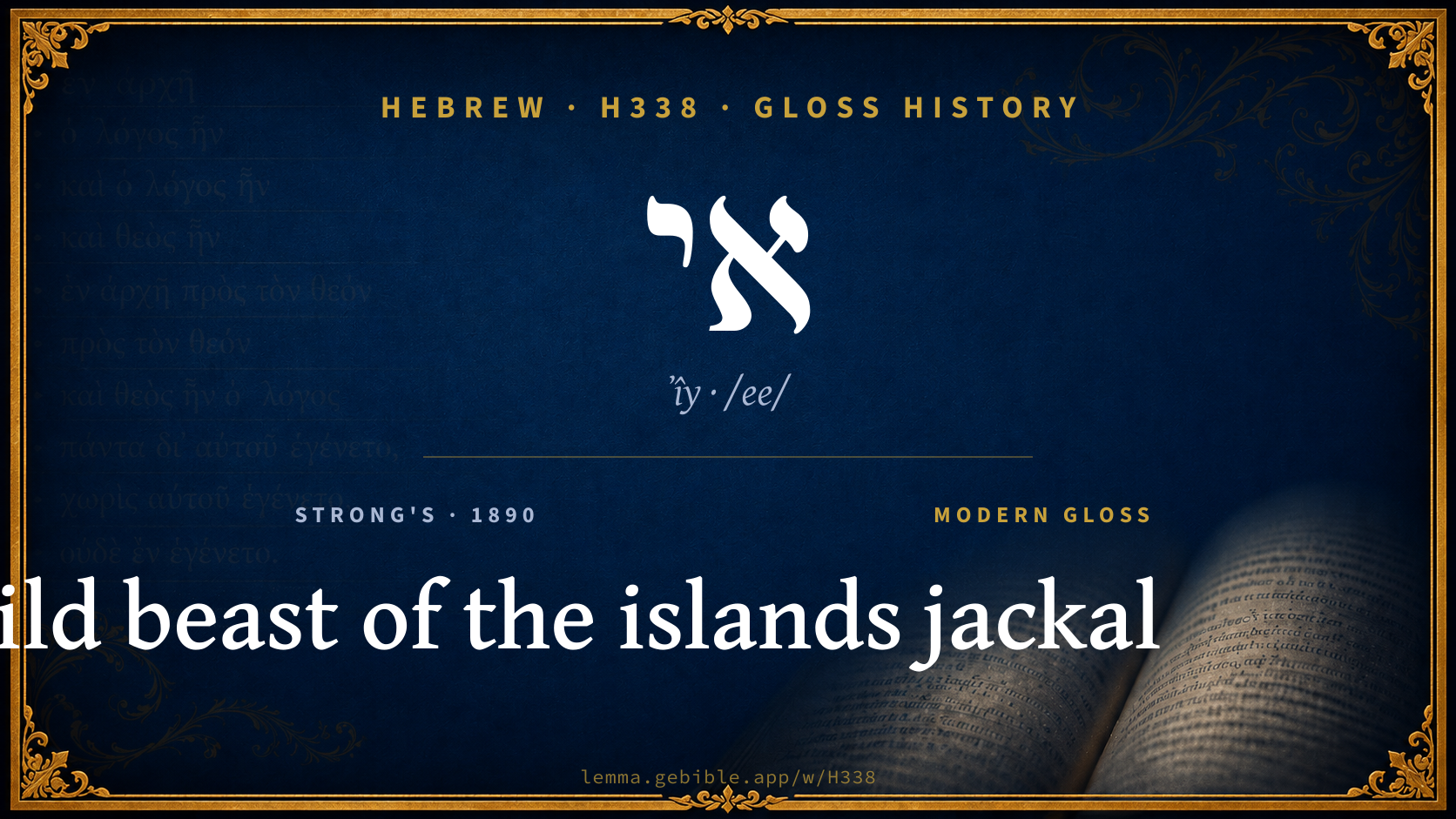
Gloss history
Strong's 1890 vs modern scholarship
About this word
Strong's H338 catalogs a Hebrew word from the Hebrew Old Testament.
These counts are not copied from any lexicon or concordance. They are computed here, from the morphology-tagged Hebrew Old Testament. What Lemma adds →
- 3
- distinct verses
- The word appears in 3 distinct verses.
- 2 / 39
- OT books
- The word appears in 2 of 39 Old Testament books.
- #4,179
- by frequency
- Top 5000 most frequent Hebrew words (rank 4,179 of 8,640 Hebrew words by occurrence).
View all 3 occurrences in the concordance →
By traditional corpus
Conventional, traditional groupings — biblical authorship is debated, so this is a traditional corpus grouping, not an authorship claim. Each share is this word’s portion of its verses in that division of the Hebrew canon. Each figure is a share of the word’s 3 distinct verses.
- Prophets (Nevi'im) 3 verses · 100%
How translations render this word
Counts come from each version’s own published word-to-Strong’s tagging or interlinear alignment — an approximate guide to how each version renders this word, not a word-level alignment the data otherwise carries. Because each total is that version’s own tagged count, the per-version totals vary from one another and need not match the appearance or distinct-verse counts above. These counts may also differ from a printed concordance because Lemma counts each distinctly tagged rendering and does not collapse phrase taggings into a single head-word total. This is a fixed set of word-tagged versions (KJV, ASV, BSB, ULT) and does not change with the reading translation you choose elsewhere. Each version’s license is shown beside its name below (and on Sources).
BDB lists this Strong’s number as 5 distinct words (homographs). Each count above pools all of them and is not split by sense — see the Senses section below. A low-frequency rendering may belong to a different one of those words, not the primary meaning.
- King James Version†: Wild beasts of the islands 2×
- American Standard Version†: Wolves 3×
- Berean Standard Bible†: Hyenas 3×
- unfoldingWord Literal Text†: Hyenas 2×
King James Version Public Domain
Renders H338 across 3† tagged occurrences — most commonly:
Plus 1 rendering that appears only once — usually multi-word phrases or single function words the recovered tagging swept in, not distinct renderings.
American Standard Version Public Domain
Renders H338 across 3† tagged occurrences — most commonly:
Berean Standard Bible Public Domain
Renders H338 across 3† tagged occurrences — most commonly:
unfoldingWord Literal Text CC BY-SA 4.0
Renders H338 across 2† tagged occurrences — most commonly:
Senses in the full BDB
What do BDB’s symbols mean?
BDB uses these scholarly abbreviations:
| Symbol | Meaning |
|---|---|
| 𝔊 | the Septuagint (the ancient Greek translation, LXX) |
| 𝔙 | the Vulgate (the Latin translation) |
| 𝔖 | the Syriac version (the Peshitta) |
| 𝔗 | the Targum (the Aramaic translation) |
| ψ | the Psalms |
| √ | root (the underlying root or stem) |
| ‖ | parallel passage (a synonymous or contrasted parallel) |
| † | the dagger: every passage where the word occurs is cited |
The 0 senses and sub-senses the full Brown-Driver-Briggs lexicon distinguishes for this word, in lexicon order (not ranked by frequency), with BDB’s own verbatim wording and sub-sense lettering. Shown in Hebrew script with BDB’s own scholarly abbreviations. The condensed entry is in the Lexicon Entry tab. See also the Forms in the corpus table below.
אי I jackal (howler, for* אָוִי v. BaNB 188, cf. Arabic اِبْنُ آوَى, whence ܒ̈ܢܳܬ ܐܰܘܰܝ )
אי II interj. (so in Rabb., v. DeKoh 197 WrEccl. 490) alas! (late) Ec 4
אי III ot (frequently in Rabb., as אִי אֶפְשַׁר impossible
אי IV isle, coast, v. I. אָוָה.
Senses from the full Brown-Driver-Briggs lexicon (Brown, Driver, Briggs; Oxford 1906 — public domain), digitized via Sefaria, supplemented by the OpenScriptures HebrewLexicon (CC BY 4.0). Full attribution on Sources.
Word origin
I. n.m. Is 20:6 (†f. Is. 23:2) coast, region (contr. from אֱוִי so Ol§ 152 b; place whither one betakes oneself for resting, etc., orig. from mariner’s standpoint)—אִי abs. Is 20:6 +; cstr. Je 47:4; (Jb 22:30 v. sub IV. אִי cf. Di) pl. אִיִּים ψ 72:10 +; אִיִּן Ez 26:18 (Co איים) אִיֵּי Gn 10:5 +;—coast, border region (mostly late), of Philistia & Phoenicia with adjacent country Is 20:6; 23:2, 6; so of Caphtor (= Crete) Je 47:4; מַלְכֵי הָאִי אֲשֶׁר בְּעֵבֶר הַיָּם Je 25:22; elsewhere pl., coasts of Kittim Je 2:10; Ez 27:6, of Elishah v 7; different countries (on or in sea) v 3, 15, 35; 26:15, 18(×2) (last del. Co cf. 𝔊) cf. 39:6, so also אִיֵּי הַגּוֹיִם Gn 10:5 (P); partic. אִיֵּי הַיָּם = coast-lands & islands Is 11:11; 24:15, ‖ הָאָרֶץ Est 10:1; v. (without הַיָּם) Dn 11:18, & ψ 72:10, so often Is 2 incl. inhabitants, 41:1, 5; 42:4, 10 (אִיִּים וְישְׁבֵיהֶם ‖ הַיָּם וּמְלֹאוֹ) v 12; 49:1; 51:5; 59:18; 60:9; 66:19; cf. Je 31:10 ψ 97:1, Zp 2:11 (אִיֵּי הַגּוֹיִם); islands, distinctly (taken up by י׳ as little things) Is 40:15; coasts, banks, i.e. habitable lands Is 42:15 (‖ נְהָרוֹת).
II. n.m. jackal (howler, for* אָוִי v. BaNB 188, cf. Arabic اِبْنُ آوَى, whence ܒ̈ܢܳܬ ܐܰܘܰܝ )—pl. אִיִּים, Is 13:22; 34:14; Je 50:39 (inhabitant of desert, ruin).
III. interj. (so in Rabb., v. DeKoh 197 WrEccl. 490) alas! (late) Ec 4:10 אִי לוֹ (written in MT as one word) alas for him (Ew§ 309 c), the one, who falleth, etc. (i.e. who falleth alone) 10:16.
IV. adv. not (frequently in Rabb., as אִי אֶפְשַׁר impossible; and in Ethiopic the ordinary negative; cf. Ph. אי CISi. 3, 5 and in איבל 165, 18; 167, 11; Ass. ai) Jb 22:30 אִי־נָקִי the non-innocent read perhaps אֵל (Me), or אֱלֹהַּ (Ley), with וְתִמָּלֵט in v b.
V. n.m. isle, coast, v. I. אָוָה.
— Brown-Driver-Briggs (Oxford 1906, public domain), digitized via Sefaria, supplemented by the OpenScriptures HebrewLexicon (CC BY 4.0). See Sources.
Derived from אי (ʼîy) (H337) — alas.
Jastrow Dictionary
A second Hebrew/Aramaic lexicon for comparison, covering Aramaic and post-biblical (Talmudic, Targumic, Midrashic) usage that the biblical-Hebrew BDB does not. Matched by lemma rather than by Strong’s number, so a lemma may carry more than one Jastrow headword (shown separately below), and the entries cover usage well beyond the Bible.
אִי II
- (= אִין; h. אִם; cmp. אוֹ)
- 1. if, whether. Targ. Cant. VII, 13; a. e.—Ber. 2ᵃ, a. fr. אי הכי (abbrev. א"ה) if this be so (introducing an argument against one’s opinion).—R. Hash. 3ᵃ כי משמש וכ׳ khi has four meanings, אי if, &c.—אי נמי (abbrev. א"נ) a) if you choose, it may also be said; or. B. Mets. 98ᵃ; a. fr.—b) even if, v. נַמִּי. Ḥull. 12ᵃ א"נ דילמא וכ׳ (Rashi א"נ שמע איניש וכ׳) even if somebody else overheard it; a. fr.—אי אמרת בשלמא (abbr. אא"ב = בשלמא אי אמרת) I grant, if you were to say … היינו then would be right what &c.; v. בשלמא. Yoma 17ᵇ; a. fr.—אי … אי whether … or. Targ. Koh. XI, 6. B. Mets. 98ᵃ; a. fr.
- 2. adv. of interrogation, v. אִין II. Targ. Job XI, 2 Ms. (ed. אין).
אִי־
- prefix, v. אִ־
אִי I
- fem. of אוּ q. v.
אִי III
- (= h. אֵין) not. Git. IV, 5 אי אפשר it is impossible. Keth. XII, 3 אי אפשי I want not; a. fr.
אִי IV
- (abbr. of אִית, as לי = לית) there is. Y. Snh. VI, 23ᵇ bot. אי בי וכ׳ there is in me (the possibility of) doing, i.e. I can do it. Ib. מה אי וכ׳ what is it thou canst do? (v. Y. Ḥag. II, 78ᵃ top).
אֵי II
- Interj. Eh! Oh! Woe! Targ. Y. II, Lev. XXVI, 29.—Taan. 7ᵃ אי חכמה וכ׳ Oh, for such a brilliant mind in such an ugly vessel (body)! R. Hash. 19ᵃ אי שמים Oh heavens!; a. fr. Y. Shek. V, end, 49ᵇ אי לי שאני וכ׳ woe unto me, that I thus see thee! Y. Yeb. XIII, 14ᵃ top; a. fr. [Babli, usually אוֹי.]
אֵי III
- (אֵיי) h. (b. h. אֵי, אַיֵה) where? what? how?—אי מנן whence? Targ. Josh. II, 4; a. e.—Hebr. אי זה (often אֵיזֶה, אֵזֶה in one word) who? which? Y. Kil. VIII, beg. 31ᵇ לאי זה דבר נאמר with regard to what (in what way, sense) has it been said? Y. Shebi. I, beg. 33ᵃ ואי זה זה and which (ploughing time) is this?; a. v. fr.—Y. Peah III, 17ᶜ top ואיי דינו מירוג (= אידין) and what is the meaning of merog? Kerith. 6ᵇ לאיי מיצרך צריכי what need is there (of the others)? Cmp. אֵיזֶה; אֵימָתי; Kerith. 6ᵇ לאיי מיצרך צריכי what need is there (of the others)? Cmp. אֵיזֶה; אֵימָתי; כֵּיצַד.
A Dictionary of the Targumim, the Talmud Babli and Yerushalmi, and the Midrashic Literature (Marcus Jastrow; London, Luzac, 1903) — Public Domain. Digitized via Sefaria. Digitized via Sefaria. Full attribution on Sources.
Forms in the corpus
The 2 distinct written forms H338 takes in the Hebrew Bible, most frequent first — each parse links to that state’s occurrences in the concordance. Hebrew forms include their vowel points and cantillation, so a single lemma takes many written forms.
| Form | Parsing | Example | Uses |
|---|---|---|---|
| אִיִּ֔ים | Noun, Common, Masculine, Plural, Absolute | Isaiah 34:14 | 2 |
| אִיִּים֙ | Noun, Common, Masculine, Plural, Absolute | Isaiah 13:22 | 1 |
Same root — word family
Other BDB entries built from the same root as H338, grouped by Strong’s listed origin. These share a root / origin per the lexicon — not necessarily a shared meaning. Each links to that word’s own entry.
Derives from
Shares the same root
Compare all same-root words → They share a root, not necessarily a meaning.
Septuagint verse parallels
This word appears in 2 verses that also exist in the Greek Old Testament (Septuagint), out of the 3 Hebrew verses it occurs in. You can read those verses in Greek by switching the Old Testament edition to the Septuagint.
Read these verses in the Septuagint
This is a verse-level parallel only — the same verses exist in both the Hebrew and Greek Old Testaments. No word-level Hebrew↔Greek correspondence is claimed: the data carries no such alignment, so no Greek word is shown as this Hebrew word’s translation. Coverage is not total — the Septuagint omits the deuterocanon and renumbers the Psalms, so some Hebrew verses have no direct Greek parallel.