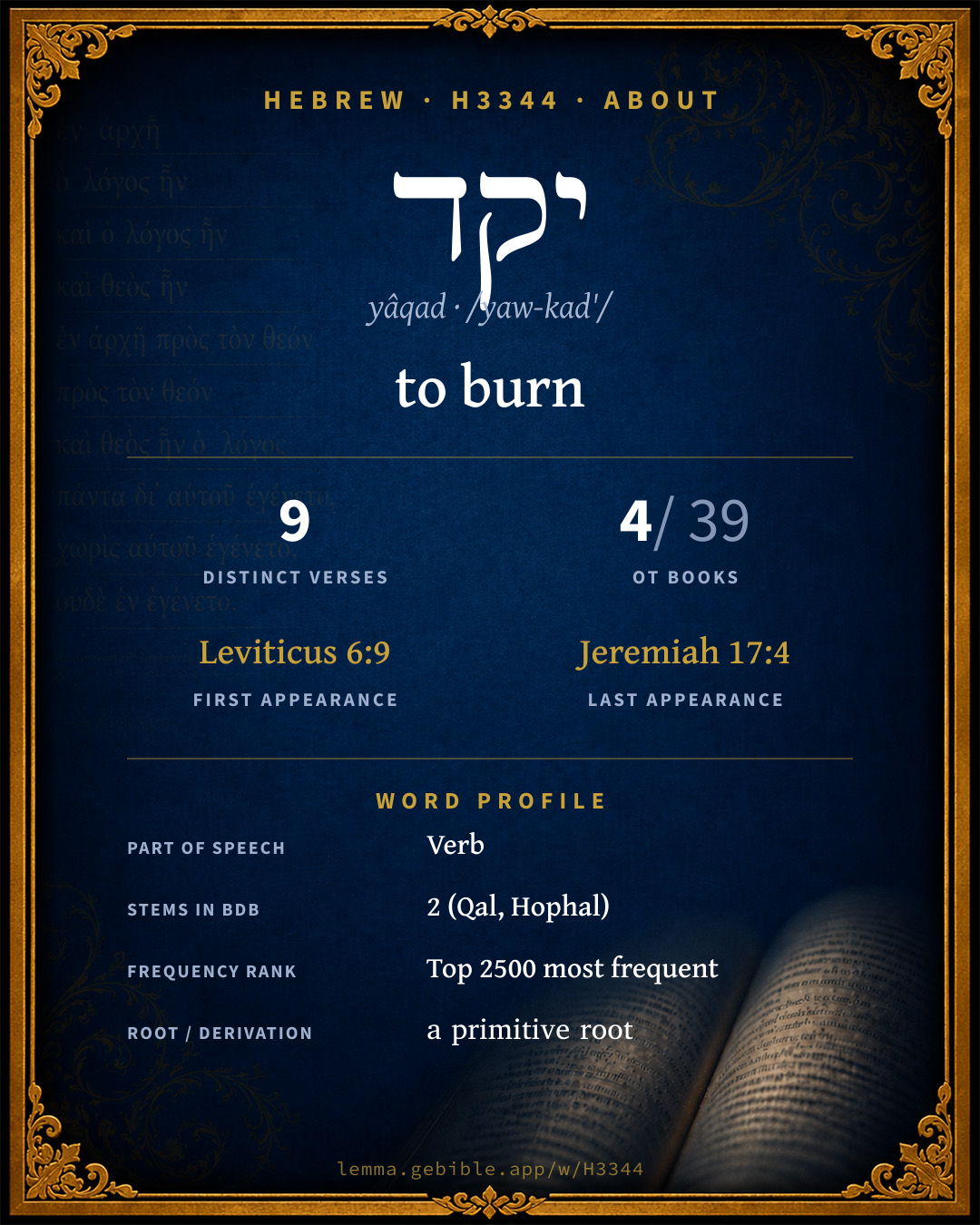
יָקַד
to burn
also: kindle, be kindled fuller range ↓
Full lexicon entry — Brown-Driver-Briggs (BDB)
From Brown-Driver-Briggs (BDB)
Where this word appears
See every Hophal verb in the Hebrew Bible →
Grammar key — what these labels mean
Part of speech
- Verb
- An action or state-of-being word.
Noun type
- Common
- A common noun — a general class of person, place, or thing (“king,” “city,” “water”), not a specific name.
Stem
- Hophal
- The passive counterpart of the Hiphil (“he was caused to…”).
- Qal
- The basic, simple active stem — the plain form of the verb (“he wrote”).
Form
- Imperfect
- An incomplete, ongoing, or future action (“he will / would write”).
- Sequential Imperfect
- An imperfect with prefixed waw — the standard past-narrative form (waw-consecutive imperfect).
- Participle Active
- A verbal adjective expressing ongoing or characteristic action (“writing / one who writes”).
State
- Absolute
- The independent form of a noun, not bound to a following word.
Person
- 3rd Person
- The one spoken about (“he / she / it / they”).
Gender
- Feminine
- Grammatically feminine.
- Masculine
- Grammatically masculine.
Number
- Singular
- One.
Grammatical forms
- Verb, Hophal, Imperfect, 3rd Person, Feminine, Singular 5 times (56%)
- Verb, Qal, Sequential Imperfect, 3rd Person, Feminine, Singular 1 time (11%)
- Noun, Common, Masculine, Singular, Absolute 1 time (11%)
- Verb, Qal, Imperfect, 3rd Person, Masculine, Singular 1 time (11%)
- Verb, Qal, Participle Active, Feminine, Singular, Absolute 1 time (11%)
Parsed forms decoded from the imported morphology (morphhb / Westminster Leningrad Codex — WLC text public domain, morphhb tagging CC BY 4.0), counted across 9 parsed occurrences — not distinct verses.
Every verse where H3344 appears — 9 distinct verses across 4 books. Click any verse to open its interlinear word-by-word view. Verse text shown in the World English Bible for context — . Each verse’s Hebrew form is shown with its reference; the English is not keyword-highlighted, since the data carries no word-level English alignment. Use “Compare translations” on any verse to read it across multiple English versions. This concordance covers the Hebrew Bible; Septuagint (Greek Old Testament) occurrences are not indexed here.
Leviticus 3 verses
- Leviticus 6:9 תּ֥וּקַד Hophal impf 3fs "Command Aaron and his sons, saying, 'This is the law of the burnt offering: the burnt offering shall be on the hearth on the altar all night until the morning; and the fire of the altar shall be kept burning on it.
- Leviticus 6:12 תּֽוּקַד Hophal impf 3fs The fire on the altar shall be kept burning on it, it shall not go out; and the priest shall burn wood on it every morning: and he shall lay the burnt offering in order upon it, and shall burn on it the fat of the peace offerings.
- Leviticus 6:13 תּוּקַ֥ד Hophal impf 3fs Fire shall be kept burning on the altar continually; it shall not go out.
Deuteronomy 1 verse
Isaiah 3 verses
- Isaiah 10:16 יֵקַ֥ד Qal impf 3ms Therefore will the Lord, Yahweh of Hosts, send among his fat ones leanness; and under his glory there shall be kindled a burning like the burning of fire.
- Isaiah 30:14 מִ/יָּק֔וּד prep + n c ms He shall break it as a potter's vessel is broken, breaking it in pieces without sparing; so that there shall not be found among the pieces of it a broken piece with which to take fire from the hearth, or to dip up water out of the cistern."
- Isaiah 65:5 יֹקֶ֖דֶת Qal ptcp.act fs who say, Stand by yourself, don't come near to me, for I am holier than you. These are a smoke in my nose, a fire that burns all the day.
Jeremiah 2 verses
- Jeremiah 15:14 תּוּקָֽד Hophal impf 3fs I will make [them] to pass with your enemies into a land which you don't know; for a fire is kindled in my anger, which shall burn on you.
- Jeremiah 17:4 תּוּקָֽד Hophal impf 3fs You, even of yourself, shall discontinue from your heritage that I gave you; and I will cause you to serve your enemies in the land which you don't know: for you have kindled a fire in my anger which shall burn forever.
About this entry
At a glance — auto-summarized from this page’s data, not written by a person. Every figure links to its source below. This summary describes the numbers; it doesn’t interpret them.
The Hebrew verb יקד centers on the idea of “to burn.” First canonically at Leviticus 6:9, it enters the text early. It turns up in 9 verses across 4 books, an uncommon footprint. The word gravitates to Leviticus (33%), then Isaiah and Jeremiah. Across 2 stems, its meaning turns on the binyan (Qal, Hophal). For the data behind this summary, explore the sense tree and the renderings breakdown below.
Gloss history
Strong's 1890 vs modern scholarship
About this word
Strong's H3344 catalogs a Hebrew word from the Hebrew Old Testament.
These counts are not copied from any lexicon or concordance. They are computed here, from the morphology-tagged Hebrew Old Testament. What Lemma adds →
- 9
- distinct verses
- The word appears in 9 distinct verses.
- 4 / 39
- OT books
- The word appears in 4 of 39 Old Testament books.
- #2,481
- by frequency
- Top 2500 most frequent Hebrew words (rank 2,481 of 8,640 Hebrew words by occurrence).
View all 9 occurrences in the concordance →
By section of the Old Testament
By traditional corpus
Conventional, traditional groupings — biblical authorship is debated, so this is a traditional corpus grouping, not an authorship claim. Each share is this word’s portion of its verses in that division of the Hebrew canon. Each figure is a share of the word’s 9 distinct verses.
- Prophets (Nevi'im) 5 verses · 56%
- Torah (Pentateuch) 4 verses · 44%
How translations render this word
Counts come from each version’s own published word-to-Strong’s tagging or interlinear alignment — an approximate guide to how each version renders this word, not a word-level alignment the data otherwise carries. Because each total is that version’s own tagged count, the per-version totals vary from one another and need not match the appearance or distinct-verse counts above. These counts may also differ from a printed concordance because Lemma counts each distinctly tagged rendering and does not collapse phrase taggings into a single head-word total. This is a fixed set of word-tagged versions (KJV, ASV, BSB, ULT) and does not change with the reading translation you choose elsewhere. Each version’s license is shown beside its name below (and on Sources).
- King James Version: Shall burn 3×, Shall be burning 2×
- American Standard Version: Burneth 2×, Shall be kept burning 2×
- Berean Standard Bible: Burns 2×, Shall be kept burning 2×, Will burn 2×
- unfoldingWord Literal Text: Shall be made to burn 3×, Shall burn 2×
King James Version Public Domain
Renders H3344 across 9 tagged occurrences — most commonly:
Plus 4 renderings that appear only once — usually multi-word phrases or single function words the recovered tagging swept in, not distinct renderings.
American Standard Version Public Domain
Renders H3344 across 9 tagged occurrences — most commonly:
Plus 5 renderings that appear only once — usually multi-word phrases or single function words the recovered tagging swept in, not distinct renderings.
Berean Standard Bible Public Domain
Renders H3344 across 9 tagged occurrences — most commonly:
Plus 3 renderings that appear only once — usually multi-word phrases or single function words the recovered tagging swept in, not distinct renderings.
unfoldingWord Literal Text CC BY-SA 4.0
Renders H3344 across 9 tagged occurrences — most commonly:
Plus 4 renderings that appear only once — usually multi-word phrases or single function words the recovered tagging swept in, not distinct renderings.
Senses in the full BDB
Hebrew verbs can shift meaning by stem (binyan): Qal is the basic action, Niphal is often passive or reflexive, Piel often intensifies or makes it factitive, and Hiphil is typically causative. The senses below are grouped under the stem BDB assigns to each. This entry also uses Hophal (the passive of Hiphil).
What do BDB’s symbols mean?
BDB uses these scholarly abbreviations:
| Symbol | Meaning |
|---|---|
| 𝔊 | the Septuagint (the ancient Greek translation, LXX) |
| 𝔙 | the Vulgate (the Latin translation) |
| 𝔖 | the Syriac version (the Peshitta) |
| 𝔗 | the Targum (the Aramaic translation) |
| ψ | the Psalms |
| √ | root (the underlying root or stem) |
| ‖ | parallel passage (a synonymous or contrasted parallel) |
| † | the dagger: every passage where the word occurs is cited |
The 2 senses and sub-senses the full Brown-Driver-Briggs lexicon distinguishes for this word, in lexicon order (not ranked by frequency), with BDB’s own verbatim wording and sub-sense lettering. Shown in Hebrew script with BDB’s own scholarly abbreviations. The condensed entry is in the Lexicon Entry tab. See also the Forms in the corpus table below.
Qal
- Impf. 3 ms. יֵקַד Is 10:16; 3 fs. וַתִּיקַד Dt 32:22; Pt. act. f. יֹקֶ֫דֶת Is 65:5; pass. יָקוּד 30:14;—be kindled, fig. of judgment, יֵקַד יְקֹד כִּיקוֹד אֵשׁ Is 10:16; so burn, Dt 32:22 a fire hath been kindled (קָֽדְחָה) in my wrath, וַתִּיקַד עַד־שְׁאוֹל and it burneth unto Sheʾôl; fig. of people displeasing to י׳, אֵלֶּה עָשָׁן בְּאַפִּי אֵשׁ יֹקֶדֶת כָּל־הַיּוֹם Is 65:5; pt. יָקוּד kindled, as subst. לַחְתּוֹת אֵשׁ מִיָּקוּד 30:14 to take fire from that which is kindled, i. e. from the hearth (LgBN 60). e.g. Isaiah 10:16
Hophal
- Impf. 3 fs. תּוּקַד Lv 6:2, 5, 6; תּוּקָ֑ד Je 15:14; 17:4;—be burning, burn, of (perpetual) altar-fire Lv 6:2, 5, 6 (P); fig. of י׳’s judgment, אֵשׁ קָֽדְחָה בְּאַפִּי עֲלֵיכֶם תּוּקָ֑ד Je 15:14, similarly 17:4 (cf. Dt 32:22 supr., as prob. source of both). e.g. Leviticus 6:2
Senses from the full Brown-Driver-Briggs lexicon (Brown, Driver, Briggs; Oxford 1906 — public domain), digitized via Sefaria, supplemented by the OpenScriptures HebrewLexicon (CC BY 4.0). Full attribution on Sources.
Word origin
vb. be kindled, burn (Aramaic יְקַד, ܝܺܩܶܕ, burn, intrans.; Arabic وَقَدَ, id.)—
— Brown-Driver-Briggs (Oxford 1906, public domain), digitized via Sefaria, supplemented by the OpenScriptures HebrewLexicon (CC BY 4.0). See Sources.
Origin: a primitive root
Jastrow Dictionary
A second Hebrew/Aramaic lexicon for comparison, covering Aramaic and post-biblical (Talmudic, Targumic, Midrashic) usage that the biblical-Hebrew BDB does not. Matched by lemma rather than by Strong’s number, so a lemma may carry more than one Jastrow headword (shown separately below), and the entries cover usage well beyond the Bible.
יָקַד
- [to penetrate,] to burn; to be on fire. Yalk. Deut. 808 אתמול יָקְדוּ גְדִישָׁיו (not גדישי) the other day their stacks were on fire.—V. מוֹקֵד.
- to be kept burning; to be burnt into. Ḥull. 115ᵃ; Kidd. 56ᵇ; Y. Pes. II, beg. 28ᶜ (ref. to Deut. XXII, 9) פן תק̇ד̇ש̇ פן תּוּק̇ד̇ אש̇ ‘lest it may become sacred (forbidden) property’, lest a fire must be lighted (for burning it). Part. מוּקָד. Tanḥ. Tsav. 14 האש המ׳ על המזבח וכ׳ the fire entertained on the altar will atone for him. Yalk. Lev. 479, end, v. infra. e.g. Deuteronomy 22:9
- to burn itself into. Lev. R. s. 7 (ref. to Lev. VI, 2) it does not say ‘the fire of the altar shall be kept burning on it, but in it, האש היתה מִתּוֹקֶדֶת בו the fire was burning itself into it (the altar); Yalk. l. c. המזבח היה מוּקָד באש the altar was burned into by the fire. Lev. R. l. c. קרוב … היתה האש מִתּוֹקֶדֶת בו וכ׳ for nearly one hundred and sixteen years was the fire burning itself into it, (and yet) its wood was not consumed &c. e.g. Leviticus 6:2
יְקַד
- ; also to set on fire. Targ. Is. X, 16. Targ. Y. Ex. III, 2 יָקִיד (Var. יַקִּיד) being burnt into. Targ. Y. II ib. 3.—Y. Yeb. XV, 15ᵃ [read:] ערקתא יקְדַּת וספסלה יקד the strap is on fire (heated) and the bench is on fire. Ib. לא ערקתא יקדת וכ׳ the strap was not heated &c. Cant. R. to III, 4, v. infra. Snh. 33ᵇ, v. מוֹקְדָא I.
- to set on fire, burn. Targ. Lev. VIII, 17. Targ. II Sam. V, 21 (h. text וישאם, v. יְקוֹד); a. fr.—Pesik. Dibré, p. 112ᵇ וא׳ היכלי he set my Temple on fire. Lam. R. introd., end סליק עפרא יקידא ואוקיד דרעיה glowing dust came up and burnt his arm; Pesik. l. c. p. 114ᵃ; Y. Taan. IV, 69ᵇ וא׳ זרעא and burnt the seed. Lam. R. to I, 13 קרתא יקידא אוֹקִידְתָּא thou hast set on fire a burning city (v. טְחַן); Cant. R. to III, 4 דרא יקידא יַקְּדַּת (Pa.), v. דָּרָא I.
- to be burnt. Targ. Lev. X, 16. Targ. II Sam. XXIII, 7; a. fr.
- to be on fire. Y. Ḥag. II, 77ᶜ top קבריה דרבך א׳ thy teacher’s (Elisha’s) grave is on fire.
A Dictionary of the Targumim, the Talmud Babli and Yerushalmi, and the Midrashic Literature (Marcus Jastrow; London, Luzac, 1903) — Public Domain. Digitized via Sefaria. Digitized via Sefaria. Full attribution on Sources.
Forms in the corpus
The 8 distinct written forms H3344 takes in the Hebrew Bible, most frequent first — each parse links to that stem’s occurrences in the concordance. Hebrew forms include their vowel points and cantillation, so a single lemma takes many written forms.
| Form | Parsing | Example | Uses |
|---|---|---|---|
| תּוּקָֽד | Verb, Hophal, Imperfect, 3rd Person, Feminine, Singular | Jeremiah 15:14 | 2 |
| וַ/תִּיקַ֖ד | Verb, Qal, Sequential Imperfect, 3rd Person, Feminine, Singular | Deuteronomy 32:22 | 1 |
| יֵקַ֥ד | Verb, Qal, Imperfect, 3rd Person, Masculine, Singular | Isaiah 10:16 | 1 |
| יֹקֶ֖דֶת | Verb, Qal, Participle Active, Feminine, Singular, Absolute | Isaiah 65:5 | 1 |
| מִ/יָּק֔וּד | Noun, Common, Masculine, Singular, Absolute | Isaiah 30:14 | 1 |
| תּ֥וּקַד | Verb, Hophal, Imperfect, 3rd Person, Feminine, Singular | Leviticus 6:9 | 1 |
| תּֽוּקַד | Verb, Hophal, Imperfect, 3rd Person, Feminine, Singular | Leviticus 6:12 | 1 |
| תּוּקַ֥ד | Verb, Hophal, Imperfect, 3rd Person, Feminine, Singular | Leviticus 6:13 | 1 |
Same root — word family
Other BDB entries built from the same root as H3344, grouped by Strong’s listed origin. These share a root / origin per the lexicon — not necessarily a shared meaning. Each links to that word’s own entry.
Derived from this word
Proper names from this root
People and places named from this root — a name, not an additional meaning of the word.
Compare all same-root words → Showing 4 of 5 — not the complete family. 1 of the same-root words is a proper name (a person or place). They share a root, not necessarily a meaning.
Septuagint verse parallels
This word appears in 8 verses that also exist in the Greek Old Testament (Septuagint), out of the 9 Hebrew verses it occurs in. You can read those verses in Greek by switching the Old Testament edition to the Septuagint.
Read these verses in the Septuagint
This is a verse-level parallel only — the same verses exist in both the Hebrew and Greek Old Testaments. No word-level Hebrew↔Greek correspondence is claimed: the data carries no such alignment, so no Greek word is shown as this Hebrew word’s translation. Coverage is not total — the Septuagint omits the deuterocanon and renumbers the Psalms, so some Hebrew verses have no direct Greek parallel.