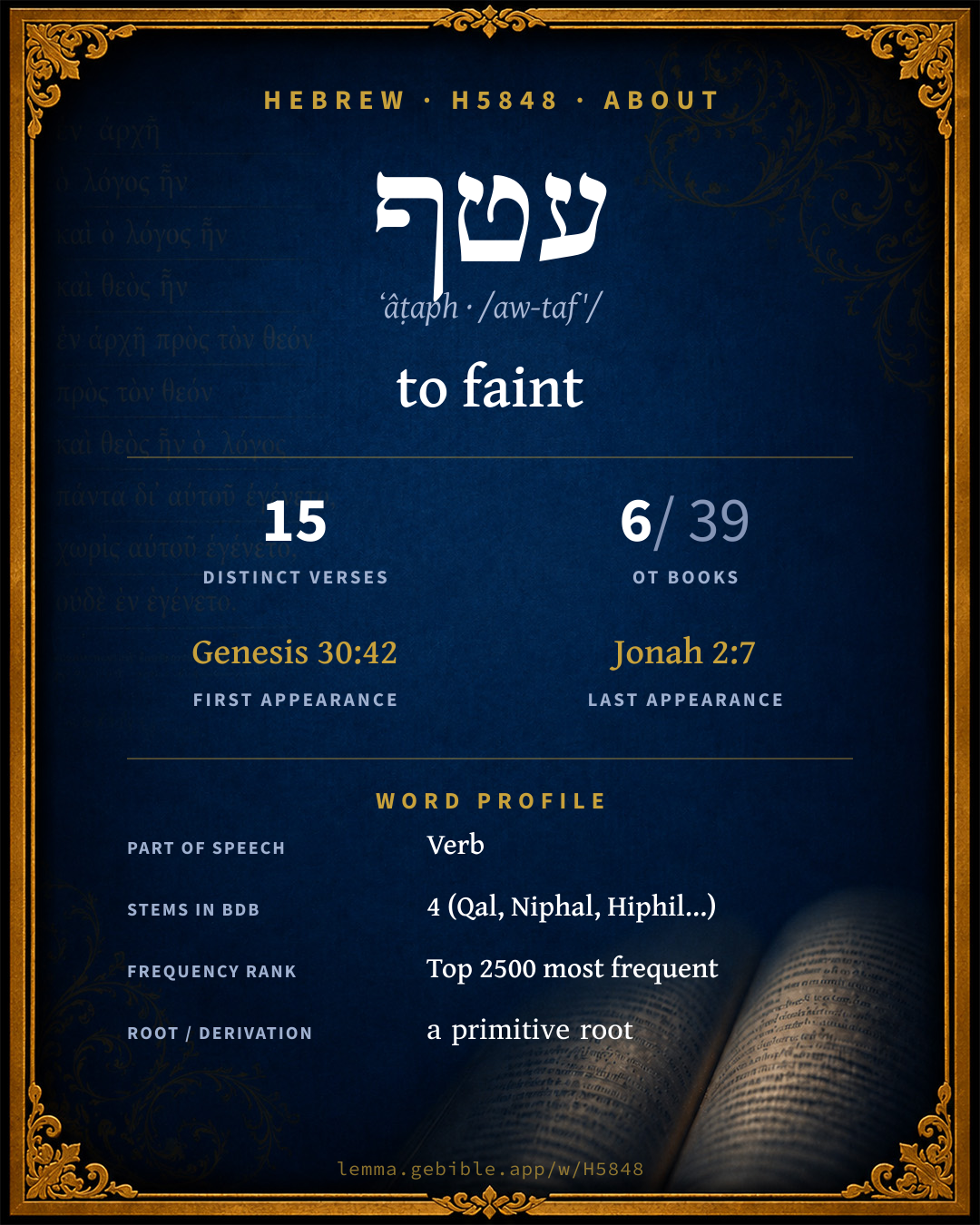
עָטַף
to faint
‘to faint’ is one of 3 main senses fuller range ↓
Full lexicon entry — Brown-Driver-Briggs (BDB)
From Brown-Driver-Briggs (BDB)
Where this word appears
See every Qal verb in the Hebrew Bible →
Grammar key — what these labels mean
Part of speech
- Verb
- An action or state-of-being word.
Stem
- Qal
- The basic, simple active stem — the plain form of the verb (“he wrote”). Here: ‘lit. be feeble’
- Hithpael
- The reflexive or reciprocal stem (the subject acts on itself).
- Hiphil
- The causative active stem (“he caused / brought about”).
- Niphal
- Usually the simple passive or reflexive of the Qal (“he was written”).
Form
- Imperfect
- An incomplete, ongoing, or future action (“he will / would write”).
- Infinitive Construct
- A bound verbal noun, frequently with prepositions (“to write / in writing”).
- Participle Passive
- A verbal adjective expressing action received (“written”).
- Sequential Imperfect
- An imperfect with prefixed waw — the standard past-narrative form (waw-consecutive imperfect).
State
- Absolute
- The independent form of a noun, not bound to a following word.
Person
- 3rd Person
- The one spoken about (“he / she / it / they”).
Gender
- Masculine
- Grammatically masculine.
- Feminine
- Grammatically feminine.
Number
- Singular
- One.
- Plural
- More than one (in Hebrew, generally three or more).
Grammatical forms 9 distinct
- Verb, Qal, Imperfect, 3rd Person, Masculine, Singular 4 times (25%)
- Verb, Hithpael, Infinitive Construct 3 times (19%)
- Verb, Qal, Participle Passive, Masculine, Plural, Absolute 2 times (13%)
- Verb, Hithpael, Imperfect, 3rd Person, Feminine, Singular 2 times (13%)
- Verb, Hiphil, Infinitive Construct 1 time (6%)
- Verb, Hithpael, Sequential Imperfect, 3rd Person, Feminine, Singular 1 time (6%)
- Verb, Niphal, Infinitive Construct 1 time (6%)
- Verb, Qal, Infinitive Construct 1 time (6%)
+1 more form (1 occurrence)
Parsed forms decoded from the imported morphology (morphhb / Westminster Leningrad Codex — WLC text public domain, morphhb tagging CC BY 4.0), counted across 16 parsed occurrences — not distinct verses.
Every verse where H5848 appears — 15 distinct verses across 6 books. Click any verse to open its interlinear word-by-word view. Verse text shown in the World English Bible for context — . Each verse’s Hebrew form is shown with its reference; the English is not keyword-highlighted, since the data carries no word-level English alignment. Use “Compare translations” on any verse to read it across multiple English versions. This concordance covers the Hebrew Bible; Septuagint (Greek Old Testament) occurrences are not indexed here.
Genesis 1 verse
Job 1 verse
Psalms 8 verses
- Psalms 61:2 בַּ/עֲטֹ֣ף prep + Qal inf.cs From the end of the earth, I will call to you, when my heart is overwhelmed. Lead me to the rock that is higher than I.
- Psalms 65:13 יַֽעַטְפוּ Qal impf 3mp The pastures are covered with flocks. The valleys also are clothed with grain. They shout for joy! They also sing.
- Psalms 73:6 יַעֲטָף Qal impf 3ms Therefore pride is like a chain around their neck. Violence covers them like a garment.
- Psalms 77:3 וְ/תִתְעַטֵּ֖ף conj + Hithpael impf 3fs I remember God, and I groan. I complain, and my spirit is overwhelmed. Selah.
- Psalms 102:1 יַעֲטֹ֑ף Qal impf 3ms Hear my prayer, Yahweh! Let my cry come to you.
- Psalms 107:5 תִּתְעַטָּֽף Hithpael impf 3fs Hungry and thirsty, Their soul fainted in them.
- Psalms 142:3 בְּ/הִתְעַטֵּ֬ף prep + Hithpael inf.cs When my spirit was overwhelmed within me, You knew my path. In the way in which I walk, They have hidden a snare for me.
- Psalms 143:4 וַ/תִּתְעַטֵּ֣ף conj + Hithpael wimpf 3fs Therefore my spirit is overwhelmed within me. My heart within me is desolate.
Isaiah 1 verse
Lamentations 3 verses
- Lamentations 2:11 בֵּֽ/עָטֵ֤ף prep + Niphal inf.cs My eyes do fail with tears, my heart is troubled; My liver is poured on the earth, because of the destruction of the daughter of my people, Because the young children and the infants swoon in the streets of the city.
- Lamentations 2:12 בְּ/הִֽתְעַטְּפָ֤/ם prep + Hithpael inf.cs + sfx pers 3mp They tell their mothers, Where is grain and wine? When they swoon as the wounded in the streets of the city, When their soul is poured out into their mothers' bosom.
- Lamentations 2:19 הָ/עֲטוּפִ֥ים ptcl def.art + Qal ptcp.pass mp Arise, cry out in the night, at the beginning of the watches; Pour out your heart like water before the face of the Lord: Lift up your hands toward him for the life of your young children, that faint for hunger at the head of every street.
Jonah 1 verse
About this entry
At a glance — auto-summarized from this page’s data, not written by a person. Every figure links to its source below. This summary describes the numbers; it doesn’t interpret them.
עטף — transliterated ʻâṭaph — is a Hebrew verb carrying the sense “to faint.” More than half of its appearances fall in Psalms. The Hebrew Bible uses it across 15 verses — uncommon. Debuting at Genesis 30:42, it then recurs through the corpus. As a verb its force shifts by stem, across 4 stems (Qal, Niphal, and more). Each statement above links to its evidence; the full detail follows below.
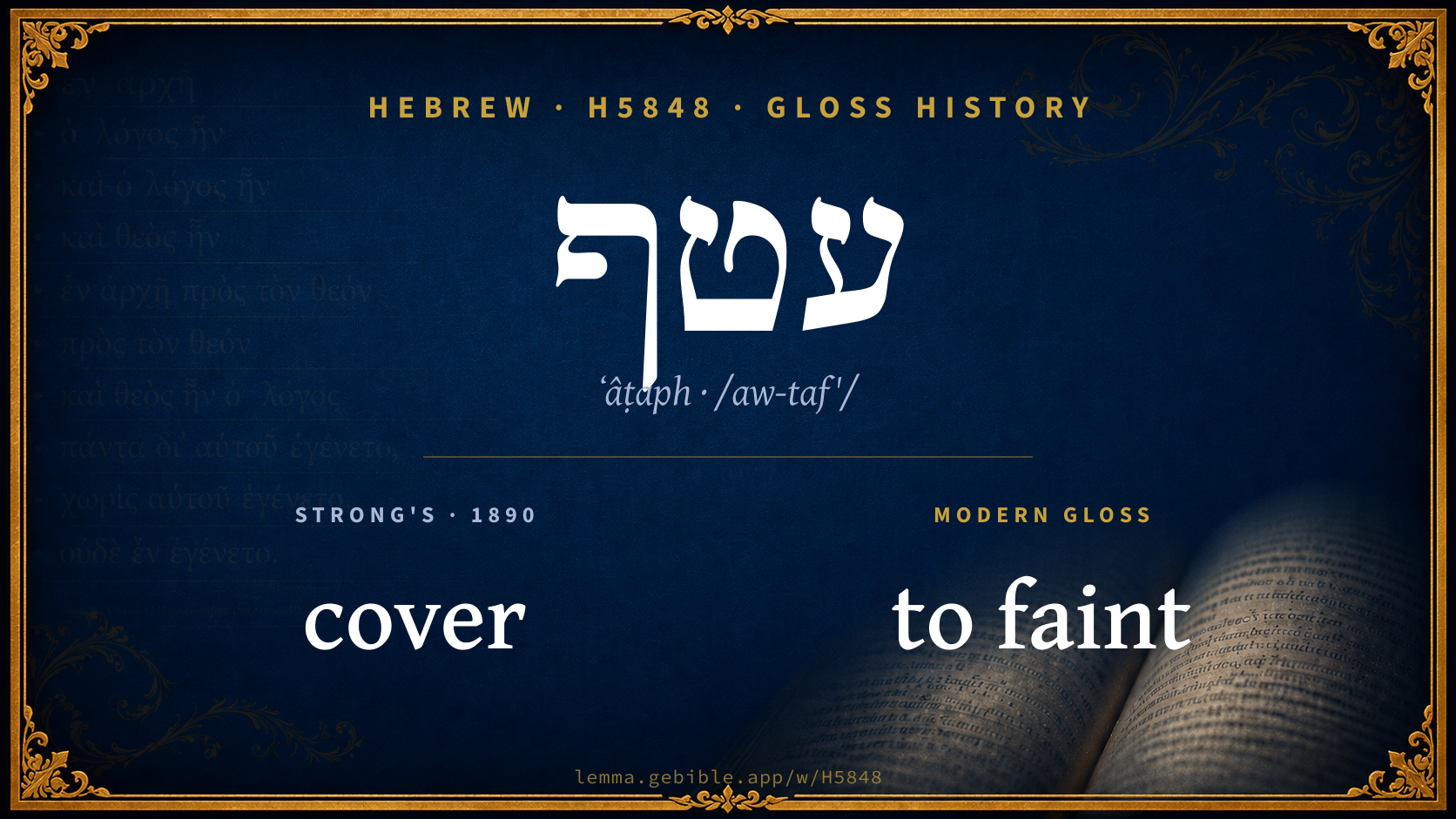
Gloss history
Strong's 1890 vs modern scholarship
About this word
Strong's H5848 catalogs a Hebrew word from the Hebrew Old Testament.
These counts are not copied from any lexicon or concordance. They are computed here, from the morphology-tagged Hebrew Old Testament. What Lemma adds →
- 15
- distinct verses
- The word appears in 15 distinct verses.
- 6 / 39
- OT books
- The word appears in 6 of 39 Old Testament books.
- #1,752
- by frequency
- Top 2500 most frequent Hebrew words (rank 1,752 of 8,640 Hebrew words by occurrence).
View all 15 occurrences in the concordance →
Most concentrated in
- Psalms 8 verses 53%
- Lamentations 3 verses 20%
- Genesis 1 verse 7%
By section of the Old Testament
By traditional corpus
Conventional, traditional groupings — biblical authorship is debated, so this is a traditional corpus grouping, not an authorship claim. Each share is this word’s portion of its verses in that division of the Hebrew canon. Each figure is a share of the word’s 15 distinct verses.
- Writings (Ketuvim) 12 verses · 80%
- Prophets (Nevi'im) 2 verses · 13%
- Torah (Pentateuch) 1 verse · 7%
How translations render this word
Counts come from each version’s own published word-to-Strong’s tagging or interlinear alignment — an approximate guide to how each version renders this word, not a word-level alignment the data otherwise carries. Because each total is that version’s own tagged count, the per-version totals vary from one another and need not match the appearance or distinct-verse counts above. These counts may also differ from a printed concordance because Lemma counts each distinctly tagged rendering and does not collapse phrase taggings into a single head-word total. This is a fixed set of word-tagged versions (KJV, ASV, BSB, ULT) and does not change with the reading translation you choose elsewhere. Each version’s license is shown beside its name below (and on Sources).
BDB lists this Strong’s number as 3 distinct words (homographs). Each count above pools all of them and is not split by sense — see the Senses section below. A low-frequency rendering may belong to a different one of those words, not the primary meaning.
- King James Version†: Fainted 2×, Was overwhelmed 2×
- American Standard Version†: Are covered over 1×, Faint 1×, Fainted 1×
- Berean Standard Bible†: Grows faint 2×
- unfoldingWord Literal Text†: When 5×, Fainted 2×, Faints 2×
King James Version Public Domain
Renders H5848 across 16† tagged occurrences — most commonly:
Plus 12 renderings that appear only once — usually multi-word phrases or single function words the recovered tagging swept in, not distinct renderings.
American Standard Version Public Domain
Renders H5848 across 15† tagged occurrences — most commonly:
Plus other, less common renderings.
Berean Standard Bible Public Domain
Renders H5848 across 16† tagged occurrences — most commonly:
Plus 14 renderings that appear only once — usually multi-word phrases or single function words the recovered tagging swept in, not distinct renderings.
unfoldingWord Literal Text CC BY-SA 4.0
Renders H5848 across 24† tagged occurrences — most commonly:
Plus 15 renderings that appear only once — usually multi-word phrases or single function words the recovered tagging swept in, not distinct renderings.
Senses in the full BDB
Hebrew verbs can shift meaning by stem (binyan): Qal is the basic action, Niphal is often passive or reflexive, Piel often intensifies or makes it factitive, and Hiphil is typically causative. The senses below are grouped under the stem BDB assigns to each. This entry also uses Hithpael (reflexive or reciprocal).
What do BDB’s symbols mean?
BDB uses these scholarly abbreviations:
| Symbol | Meaning |
|---|---|
| 𝔊 | the Septuagint (the ancient Greek translation, LXX) |
| 𝔙 | the Vulgate (the Latin translation) |
| 𝔖 | the Syriac version (the Peshitta) |
| 𝔗 | the Targum (the Aramaic translation) |
| ψ | the Psalms |
| √ | root (the underlying root or stem) |
| ‖ | parallel passage (a synonymous or contrasted parallel) |
| † | the dagger: every passage where the word occurs is cited |
The 4 senses and sub-senses the full Brown-Driver-Briggs lexicon distinguishes for this word, in lexicon order (not ranked by frequency), with BDB’s own verbatim wording and sub-sense lettering. Shown in Hebrew script with BDB’s own scholarly abbreviations. The condensed entry is in the Lexicon Entry tab. See also the Forms in the corpus table below.
עטף I turn aside
עטף II envelop oneself (Aramaism)
עטף III be feeble, faint
Qal
- lit. be feeble
Niphal
- . when infants faint
Hiphil
- . when the flock shewed feebleness
Hithpael
- . faint, faint away
Senses from the full Brown-Driver-Briggs lexicon (Brown, Driver, Briggs; Oxford 1906 — public domain), digitized via Sefaria, supplemented by the OpenScriptures HebrewLexicon (CC BY 4.0). Full attribution on Sources.
Word origin
I. [ עָטַף ] vb. turn aside;— Qal Jb 23:9
II. [ עָטַף ] vb. envelop oneself (Aramaism)
III. [ עָטַף ] vb. be feeble, faint
— Brown-Driver-Briggs (Oxford 1906, public domain), digitized via Sefaria, supplemented by the OpenScriptures HebrewLexicon (CC BY 4.0). See Sources.
Origin: a primitive root
Jastrow Dictionary
A second Hebrew/Aramaic lexicon for comparison, covering Aramaic and post-biblical (Talmudic, Targumic, Midrashic) usage that the biblical-Hebrew BDB does not. Matched by lemma rather than by Strong’s number, so a lemma may carry more than one Jastrow headword (shown separately below), and the entries cover usage well beyond the Bible.
עָטַף I
- of Arab. ʿaṭafa, a. ʿaṭaba) to be lax, hang down; trnsf. to droop, faint; to lag behind, be slow. Midr. Till. to Ps. LXI, 3 עד חיכן … עד שיַעֲטוֹף (ed. Bub. עד שיע׳ לבו) how long must a man remain in prayer? Until he (his heart) is faint. Midr. Till. to Ps. LXXIII, 6 ואין יעטוף אלא לשון לידה ed. Bub. (oth. ed. אלא ילוד) yaʿăṭof (ib.) has the meaning of (drooping) giving birth (by homiletical ref. to Gen. XXX, 42). Midr. Till. to Ps. CII, 1 ואין יעטוף אלא תפלה yaʿăṭof (ib.) means (exhaustion from) prayer (differ. in ed. Bub., v. עֲטִיפָה I. Gen. R. s. 24 (ref. to Is. LVII, 16) מהו יעטוף משלהי ליה what does yaʿăṭof mean? It (the wind) becomes wearied; Yalk. Kings 219; Y. Ber. IX, 13ᵈ top; a. e. e.g. Genesis 30:42
- to faint. Tanḥ. Hăaz. 8 נתע׳ רוח האב his father’s spirit fainted.
עָטַף II
- v. preced.) [to let hang over,] to wrap one’s self up, to put on an upper garment. Y. Ned. III, 38ᵃ bot. עתיד … לַעֲטוֹף טליתו וכ׳ wicked Esau (Rome) shall put on his cloak (for prayer, v. טַלִּית) and sit down among the righteous &c.—Part. pass. עָטוּף; pl. עֲטוּפִים, עֲטוּפִין. Num. R. s. 20 נראין ע׳ לשלום they appeared cloaked for peace, opp. מזויינין למלחמה in armor for war. Y. Ab. Zar. I, 40ᵃ bot. ע׳ ויושבין wrapped (in the judge’s cloak) and seated.
- same. Sabb. 10ᵃ משיִתְעַטְּפוּ הדיינין when the judges put their cloaks on. Ib. 31ᵃ נ׳ ויצא וכ׳ he (Hillel) wrapped himself up and came out to meet him. Keth. 66ᵇ נִתְעַטְּפָה בשערה she covered herself with her hair. Ber. 16ᵇ ותִתְעַטֵּף בחסידותיך clothe thyself in thy kindness; a. fr.
עֲטַף I
- Targ. Jer. XLIII, 12 וַעֲטַף Bxt. (ed. וירוקין). Targ. Ps. LXXXIV, 7 (Ms. Pa.). Ib. CIX, 29, v. עֲטֵי.—Part. pass. עָטִיף, עֲטִיף; pl. עֲטִיפִין; עֲטִיפָן. Targ. I Sam. XXVIII, 14. Targ. II Esth. I, 3.—M. Kat. 28ᵇ (in a funeral dirge) עְטוּף וכסו טורי וכ׳ wrap and cover yourselves (in festive garments), ye mountains, for he (the deceased) is &c.
- to put on, cover. Targ. Is. LXI, 10. Targ. Ps. LXXXIX, 46 עַטֵּיפְתָּ (ed. Wil. עִטַפְ׳ Pe.). Ib. LXXXIV, 7 (v. supra); a. e.—Part. pass. מְעַטַּף. Targ. Y. Lev. XIII, 45 (ed. Vien. מְעַטֵּף).
- , אִיעַטֵּף to cover one’s self. Targ. O. Lev. l. c. Targ. Y. I Gen. XXIV, 65. Ib. XXXVIII, 14 (ed. Vien. אַעַטְפַת Af., incorr.). Targ. Ps. CIV, 2; a. fr.—Sabb. 10ᵃ לביש ומתכסי ימִתְעַטֵּף וכ׳ dressed and put an upper garment on and covered his head with it and prayed. Ib. 119ᵃ מִיעַטֵּף וקאי וכ׳ (Rashi מתע׳) was wrapped (in his festive cloak) and stood (ready to receive the Sabbath); B. Kam. 32ᵇ top; a. fr.
*עֲטַף II
- (cmp. נטף) to float. Succ. 53ᵃ, v. infra.
- to cause to float; to drown. Ib. דעַטְּפַת עַטְּפוּךְ ודעַטְּפוּךְ יְעַטְפוּן Ms. M. (ed. דאטיפת אטפוך וכ׳), v. טוּף.
עָטָף
- ; pl. עֲטָפִין, v. עָטִיף.
עֲטַף
- , v. עִיטְפָא
A Dictionary of the Targumim, the Talmud Babli and Yerushalmi, and the Midrashic Literature (Marcus Jastrow; London, Luzac, 1903) — Public Domain. Digitized via Sefaria. Digitized via Sefaria. Full attribution on Sources.
Forms in the corpus
The 16 distinct written forms H5848 takes in the Hebrew Bible, most frequent first — each parse links to that stem’s occurrences in the concordance. Hebrew forms include their vowel points and cantillation, so a single lemma takes many written forms.
Same root — word family
Other BDB entries built from the same root as H5848, grouped by Strong’s listed origin. These share a root / origin per the lexicon — not necessarily a shared meaning. Each links to that word’s own entry.
Derived from this word
Compare all same-root words → They share a root, not necessarily a meaning.
Septuagint verse parallels
This word appears in 15 verses that also exist in the Greek Old Testament (Septuagint), out of the 15 Hebrew verses it occurs in. You can read those verses in Greek by switching the Old Testament edition to the Septuagint.
Read these verses in the Septuagint
This is a verse-level parallel only — the same verses exist in both the Hebrew and Greek Old Testaments. No word-level Hebrew↔Greek correspondence is claimed: the data carries no such alignment, so no Greek word is shown as this Hebrew word’s translation. Coverage is not total — the Septuagint omits the deuterocanon and renumbers the Psalms, so some Hebrew verses have no direct Greek parallel.