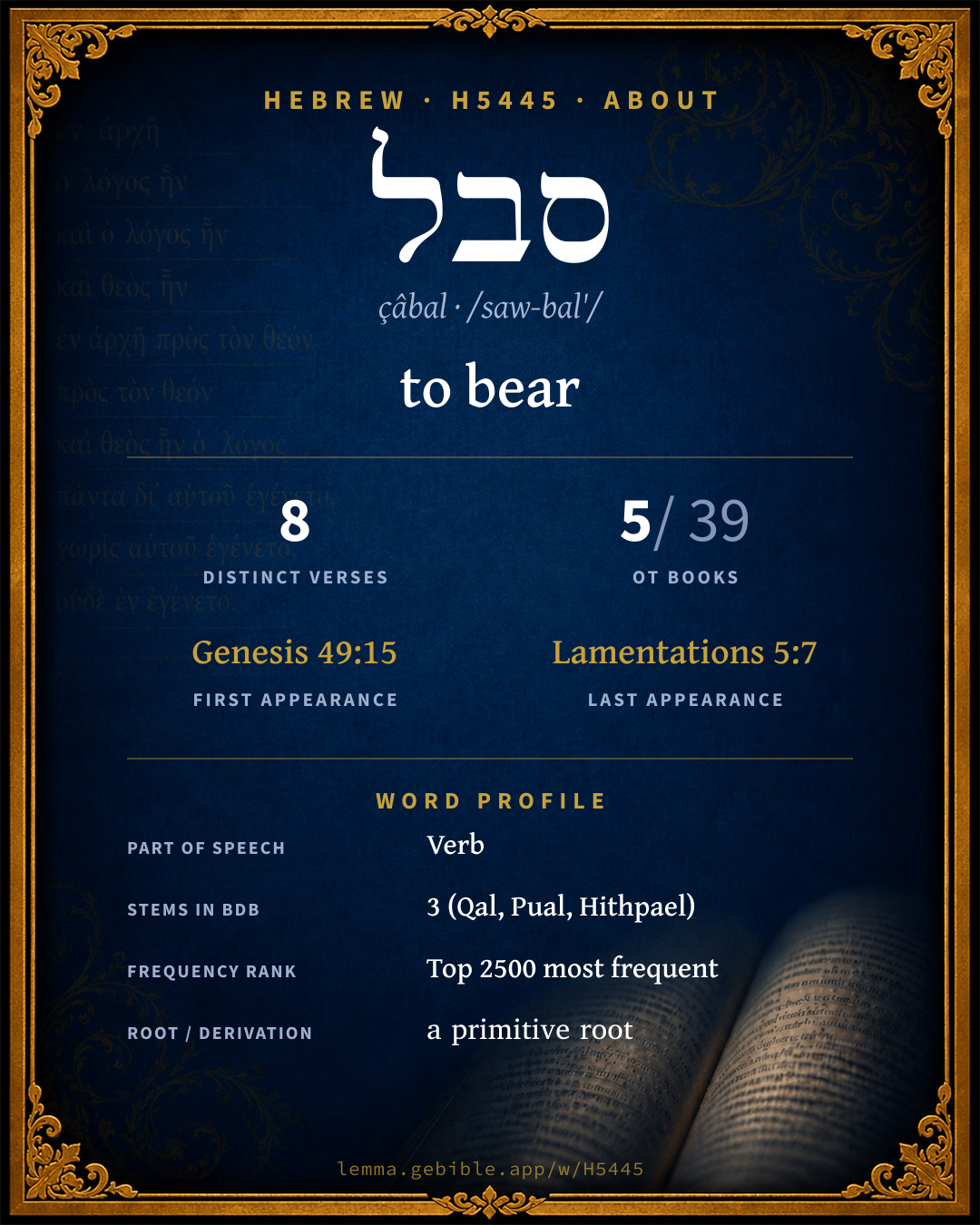
סָבַל
to bear
also: bear a load, drag oneself along fuller range ↓
Full lexicon entry — Brown-Driver-Briggs (BDB)
From Brown-Driver-Briggs (BDB)
Where this word appears
See every Qal verb in the Hebrew Bible →
Grammar key — what these labels mean
Part of speech
- Verb
- An action or state-of-being word.
Stem
- Qal
- The basic, simple active stem — the plain form of the verb (“he wrote”). Here: ‘bear a load’
- Hithpael
- The reflexive or reciprocal stem (the subject acts on itself).
- Pual
- The passive counterpart of the Piel.
Form
- Imperfect
- An incomplete, ongoing, or future action (“he will / would write”).
- Infinitive Construct
- A bound verbal noun, frequently with prepositions (“to write / in writing”).
- Participle Passive
- A verbal adjective expressing action received (“written”).
- Perfect
- A completed action or state — Hebrew marks aspect (completeness) more than strict tense (“he wrote”).
State
- Absolute
- The independent form of a noun, not bound to a following word.
Person
- 1st Person
- The speaker (“I / we”).
- 3rd Person
- The one spoken about (“he / she / it / they”).
Gender
- Common
- Either gender — not distinguished for this form.
- Masculine
- Grammatically masculine.
Number
- Singular
- One.
- Plural
- More than one (in Hebrew, generally three or more).
Grammatical forms
- Verb, Qal, Imperfect, 1st Person, Common, Singular 2 times (22%)
- Verb, Hithpael, Imperfect, 3rd Person, Masculine, Singular 1 time (11%)
- Verb, Qal, Infinitive Construct 1 time (11%)
- Verb, Pual, Participle Passive, Masculine, Plural, Absolute 1 time (11%)
- Verb, Qal, Imperfect, 3rd Person, Masculine, Plural 1 time (11%)
- Verb, Qal, Imperfect, 3rd Person, Masculine, Singular 1 time (11%)
- Verb, Qal, Perfect, 1st Person, Common, Plural 1 time (11%)
- Verb, Qal, Perfect, 3rd Person, Masculine, Singular 1 time (11%)
Parsed forms decoded from the imported morphology (morphhb / Westminster Leningrad Codex — WLC text public domain, morphhb tagging CC BY 4.0), counted across 9 parsed occurrences — not distinct verses.
Every verse where H5445 appears — 8 distinct verses across 5 books. Click any verse to open its interlinear word-by-word view. Verse text shown in the World English Bible for context — . Each verse’s Hebrew form is shown with its reference; the English is not keyword-highlighted, since the data carries no word-level English alignment. Use “Compare translations” on any verse to read it across multiple English versions. This concordance covers the Hebrew Bible; Septuagint (Greek Old Testament) occurrences are not indexed here.
Genesis 1 verse
Psalms 1 verse
Ecclesiastes 1 verse
Isaiah 4 verses
- Isaiah 46:4 אֶסְבֹּ֑ל אֶסְבֹּ֖ל Qal impf 1cs Qal impf 1cs and even to old age I am he, and even to gray hairs will I carry you. I have made, and I will bear; yes, I will carry, and will deliver.
- Isaiah 46:7 יִסְבְּלֻ֜/הוּ Qal impf 3mp + sfx pers 3ms They bear it on the shoulder, they carry it, and set it in its place, and it stands, from its place it shall not move: yes, one may cry to it, yet it can not answer, nor save him out of his trouble.
- Isaiah 53:4 סְבָלָ֑/ם Qal pf 3ms + sfx pers 3mp Surely he has borne our sickness, and carried our suffering; yet we considered him plagued, struck by God, and afflicted.
- Isaiah 53:11 יִסְבֹּֽל Qal impf 3ms He shall see of the travail of his soul, [and] shall be satisfied: by the knowledge of himself shall my righteous servant justify many; and he shall bear their iniquities.
Lamentations 1 verse
About this entry
At a glance — auto-summarized from this page’s data, not written by a person. Every figure links to its source below. This summary describes the numbers; it doesn’t interpret them.
סבל — transliterated çâbal — is a Hebrew verb carrying the sense “to bear.” More than half of its appearances fall in Isaiah. It appears 8 verses across 5 books of the Hebrew Bible, among its uncommon vocabulary. Debuting at Genesis 49:15, it then recurs through the corpus. As a verb its force shifts by stem, across 3 stems (Qal, Pual, and more). See the sense tree, 8-verse concordance, and the renderings breakdown below.
Gloss history
Strong's 1890 vs modern scholarship
About this word
Strong's H5445 catalogs a Hebrew word from the Hebrew Old Testament.
These counts are not copied from any lexicon or concordance. They are computed here, from the morphology-tagged Hebrew Old Testament. What Lemma adds →
- 8
- distinct verses
- The word appears in 8 distinct verses.
- 5 / 39
- OT books
- The word appears in 5 of 39 Old Testament books.
- #2,481
- by frequency
- Top 2500 most frequent Hebrew words (rank 2,481 of 8,640 Hebrew words by occurrence).
View all 8 occurrences in the concordance →
By section of the Old Testament
By traditional corpus
Conventional, traditional groupings — biblical authorship is debated, so this is a traditional corpus grouping, not an authorship claim. Each share is this word’s portion of its verses in that division of the Hebrew canon. Each figure is a share of the word’s 8 distinct verses.
- Prophets (Nevi'im) 4 verses · 50%
- Writings (Ketuvim) 3 verses · 38%
- Torah (Pentateuch) 1 verse · 13%
How translations render this word
Counts come from each version’s own published word-to-Strong’s tagging or interlinear alignment — an approximate guide to how each version renders this word, not a word-level alignment the data otherwise carries. Because each total is that version’s own tagged count, the per-version totals vary from one another and need not match the appearance or distinct-verse counts above. These counts may also differ from a printed concordance because Lemma counts each distinctly tagged rendering and does not collapse phrase taggings into a single head-word total. This is a fixed set of word-tagged versions (KJV, ASV, BSB, ULT) and does not change with the reading translation you choose elsewhere. Each version’s license is shown beside its name below (and on Sources).
- King James Version: Bear 1×, Carried 1×, He shall bear 1×
- American Standard Version: Are well laden 1×, Bear 1×, Carried 1×
- Berean Standard Bible: Bear 1×, Burden 1×, Carried 1×
- unfoldingWord Literal Text: Bear 2×, I will bear 2×, You 2×
King James Version Public Domain
Renders H5445 across 9 tagged occurrences — most commonly:
American Standard Version Public Domain
Renders H5445 across 9 tagged occurrences — most commonly:
Berean Standard Bible Public Domain
Renders H5445 across 9 tagged occurrences — most commonly:
unfoldingWord Literal Text CC BY-SA 4.0
Renders H5445 across 13 tagged occurrences — most commonly:
Plus 7 renderings that appear only once — usually multi-word phrases or single function words the recovered tagging swept in, not distinct renderings.
Senses in the full BDB
Hebrew verbs can shift meaning by stem (binyan): Qal is the basic action, Niphal is often passive or reflexive, Piel often intensifies or makes it factitive, and Hiphil is typically causative. The senses below are grouped under the stem BDB assigns to each. This entry also uses Pual (the passive of Piel) and Hithpael (reflexive or reciprocal).
What do BDB’s symbols mean?
BDB uses these scholarly abbreviations:
| Symbol | Meaning |
|---|---|
| 𝔊 | the Septuagint (the ancient Greek translation, LXX) |
| 𝔙 | the Vulgate (the Latin translation) |
| 𝔖 | the Syriac version (the Peshitta) |
| 𝔗 | the Targum (the Aramaic translation) |
| ψ | the Psalms |
| √ | root (the underlying root or stem) |
| ‖ | parallel passage (a synonymous or contrasted parallel) |
| † | the dagger: every passage where the word occurs is cited |
The 3 senses and sub-senses the full Brown-Driver-Briggs lexicon distinguishes for this word, in lexicon order (not ranked by frequency), with BDB’s own verbatim wording and sub-sense lettering. Shown in Hebrew script with BDB’s own scholarly abbreviations. The condensed entry is in the Lexicon Entry tab. See also the Forms in the corpus table below.
Qal
- bear a load
Pual
- . laden
Hithpael
- . drag oneself along
Senses from the full Brown-Driver-Briggs lexicon (Brown, Driver, Briggs; Oxford 1906 — public domain), digitized via Sefaria, supplemented by the OpenScriptures HebrewLexicon (CC BY 4.0). Full attribution on Sources.
Word origin
[ סָבַל ] vb. bear a heavy load
— Brown-Driver-Briggs (Oxford 1906, public domain), digitized via Sefaria, supplemented by the OpenScriptures HebrewLexicon (CC BY 4.0). See Sources.
Origin: a primitive root
Jastrow Dictionary
A second Hebrew/Aramaic lexicon for comparison, covering Aramaic and post-biblical (Talmudic, Targumic, Midrashic) usage that the biblical-Hebrew BDB does not. Matched by lemma rather than by Strong’s number, so a lemma may carry more than one Jastrow headword (shown separately below), and the entries cover usage well beyond the Bible.
סָבַל
- (b. h.) to carry a load; to sustain; to endure. Lev. R. s. 4, end הנפש הזו סוֹבֶלֶת … והקב"ה סוֹבֵל את עולמו the soul supports the body, and the Lord sustains his world; (Tanḥ. Ḥayé 3 משמרת … משמר). Pes. 113ᵇ ארבעה אין … סוֹבַלְתָּן there are four things which the mind (of man) cannot endure. Gen. R. s. 22 (ref. to Gen. IV, 13) לעליונים … אתה סובל ולפשעי אין אתה סובל thou bearest those on high and those below, and my trespass thou wilt not bear? Y. R. Hash. II, end, 58ᵇ (ref. to Ps. CXLIV, 14 אלופינו מסבלים) בשעה שהגדולים סוֹבְלִין את וכ׳ when the great bear the small (take care of them), there is no breach &c.; ib. בשעה שהקטנים סובלין וכ׳ when the small bear the great (respect their superiority), there is &c.; Yalk. Ps. 888; Ruth R. introd. (ושם). Ex. R. s. 5 סָבְלוּ מכות they endured maltreatment; a. fr.—Y. Peah I, 16ᵇ הפורק … ואיני סוֹבְלָהּ he who throws off the yoke, that is, he who says, there is a law, but I will not bear it. e.g. Genesis 4:13
- to load. Part. pass. מְסוּבָּל. Ber. 17ᵃ (ref. to Ps. l. c.) מְסוּבָּלִים במצות laden with good deeds; מס׳ בייסורים laden with pains. Yalk. Deut. 963 מסובלים כספם וכ׳ (Deut. R. s. 11 היו סובלים) carrying their silver and their gold; a. e.
סְבַל
- Targ. Y. Deut. XXXII, 11. Targ. Job XXI, 3. Targ. Y. II, Deut. XXIV, 15; a. fr.—Cant. R. to V, 14 למִיסְבַּל, v. סִבְנִי. Gen. R. s. 38 דסָבֵיל רוחא, v. רוּחָא; a. e.
- (v. סִבָּלוֹן) to send presents of betrothal. Kidd. 50ᵇ מְסַבְּלֵי והדר מקדשי where it is customary to send the presents before betrothal; a. e.
סַבָּל
- preced.) load-carrier. Y. B. Mets. X, end, 12ᶜ; (Bab. ib. 118ᵇ כַּתָּף). Kidd. 82ᵇ; Y. ib. IV, end, 66ᵈ; Tosef. ib. V, 15 (ed. Zuck. note). Tanḥ., ed. Bub., M’tsora 11 בריאים כסַבָּלוֹ של עולם as strong as he who carries the world; Yalk. Ps. 808.—Pl. סַבָּלִין. Kel. XXVIII, 9 כסת הס׳ the cushion which load-carriers wear on their heads.
A Dictionary of the Targumim, the Talmud Babli and Yerushalmi, and the Midrashic Literature (Marcus Jastrow; London, Luzac, 1903) — Public Domain. Digitized via Sefaria. Digitized via Sefaria. Full attribution on Sources.
Forms in the corpus
The 9 distinct written forms H5445 takes in the Hebrew Bible, most frequent first — each parse links to that stem’s occurrences in the concordance. Hebrew forms include their vowel points and cantillation, so a single lemma takes many written forms.
| Form | Parsing | Example | Uses |
|---|---|---|---|
| אֶסְבֹּ֑ל | Verb, Qal, Imperfect, 1st Person, Common, Singular | Isaiah 46:4 | 1 |
| אֶסְבֹּ֖ל | Verb, Qal, Imperfect, 1st Person, Common, Singular | Isaiah 46:4 | 1 |
| וְ/יִסְתַּבֵּ֣ל | Verb, Hithpael, Imperfect, 3rd Person, Masculine, Singular | Ecclesiastes 12:5 | 1 |
| יִסְבְּלֻ֜/הוּ | Verb, Qal, Imperfect, 3rd Person, Masculine, Plural | Isaiah 46:7 | 1 |
| יִסְבֹּֽל | Verb, Qal, Imperfect, 3rd Person, Masculine, Singular | Isaiah 53:11 | 1 |
| לִ/סְבֹּ֔ל | Verb, Qal, Infinitive Construct | Genesis 49:15 | 1 |
| מְֽסֻבָּ֫לִ֥ים | Verb, Pual, Participle Passive, Masculine, Plural, Absolute | Psalms 144:14 | 1 |
| סְבָלָ֑/ם | Verb, Qal, Perfect, 3rd Person, Masculine, Singular | Isaiah 53:4 | 1 |
| סָבָֽלְנוּ | Verb, Qal, Perfect, 1st Person, Common, Plural | Lamentations 5:7 | 1 |
Same root — word family
Other BDB entries built from the same root as H5445, grouped by Strong’s listed origin. These share a root / origin per the lexicon — not necessarily a shared meaning. Each links to that word’s own entry.
Derived from this word
Compare all same-root words → Showing 4 of 5 — not the complete family. They share a root, not necessarily a meaning.
Septuagint verse parallels
This word appears in 8 verses that also exist in the Greek Old Testament (Septuagint), out of the 8 Hebrew verses it occurs in. You can read those verses in Greek by switching the Old Testament edition to the Septuagint.
Read these verses in the Septuagint
This is a verse-level parallel only — the same verses exist in both the Hebrew and Greek Old Testaments. No word-level Hebrew↔Greek correspondence is claimed: the data carries no such alignment, so no Greek word is shown as this Hebrew word’s translation. Coverage is not total — the Septuagint omits the deuterocanon and renumbers the Psalms, so some Hebrew verses have no direct Greek parallel.