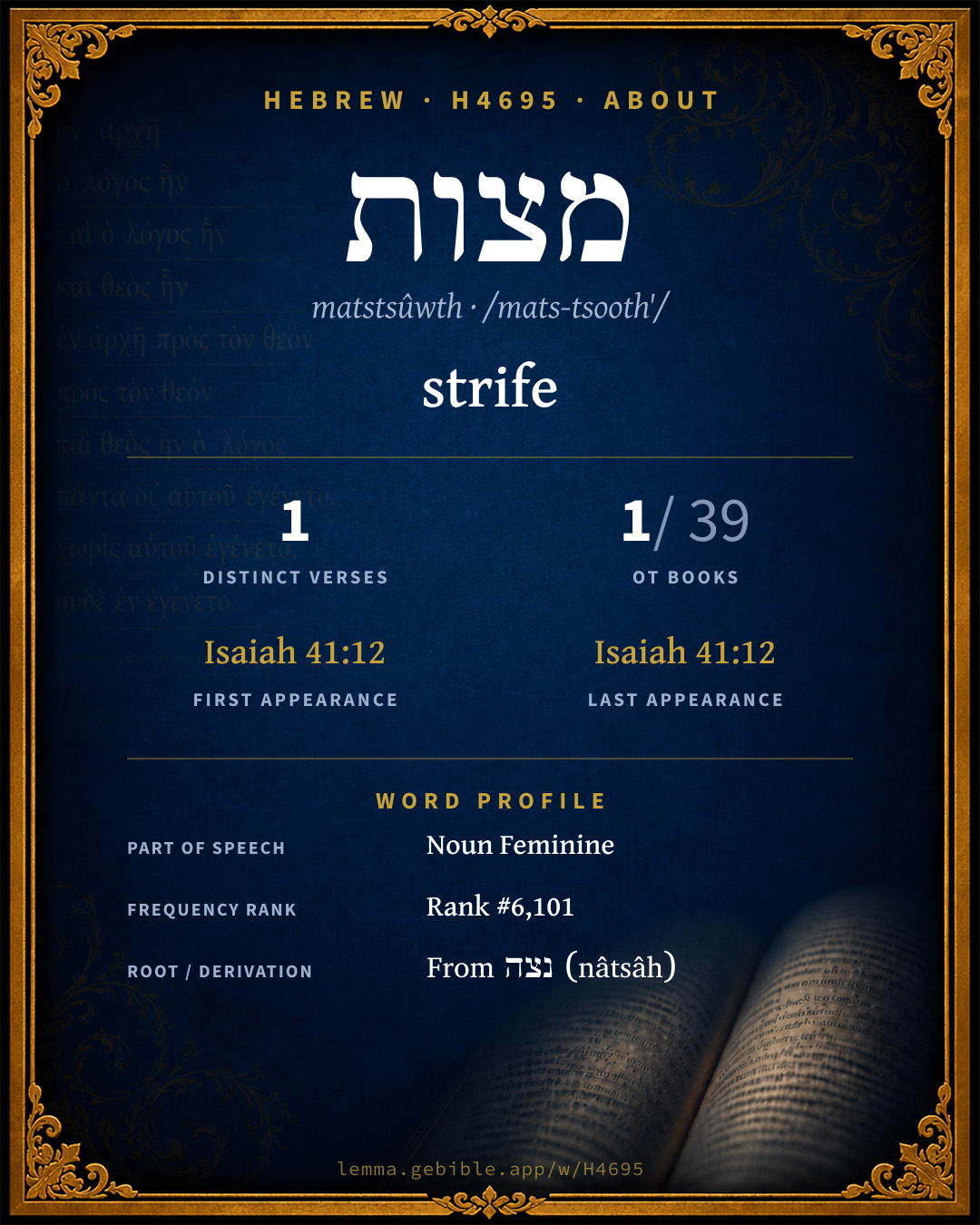
מַצּוּת
strife
Full lexicon entry — Brown-Driver-Briggs (BDB)
From Brown-Driver-Briggs (BDB)
Where this word appears
Grammar key — what these labels mean
Part of speech
- Noun
- A naming word — a person, place, thing, or idea.
Noun type
- Common
- A common noun — a general class of person, place, or thing (“king,” “city,” “water”), not a specific name.
State
- Construct
- A noun bound to a following noun in a possessive / “of” relationship (the construct chain).
Gender
- Feminine
- Grammatically feminine.
Number
- Singular
- One.
Every verse where H4695 appears — 1 distinct verse across 1 book. Click any verse to open its interlinear word-by-word view. Verse text shown in the World English Bible for context — . Each verse’s Hebrew form is shown with its reference; the English is not keyword-highlighted, since the data carries no word-level English alignment. Use “Compare translations” on any verse to read it across multiple English versions. This concordance covers the Hebrew Bible; Septuagint (Greek Old Testament) occurrences are not indexed here.
Isaiah 1 verse
About this entry
At a glance — auto-summarized from this page’s data, not written by a person. Every figure links to its source below. This summary describes the numbers; it doesn’t interpret them.
מצות (matstsûwth) is a Hebrew noun most often rendered “strife.” A scarce word — 1 verse in all of the Hebrew Bible. It clusters heavily in Isaiah, which alone accounts for 100% of its uses. Its lone occurrence is Isaiah 41:12. It clusters with נצה, מצה and נוצה under a shared root. The sections below give every sense, occurrence, and version rendering.
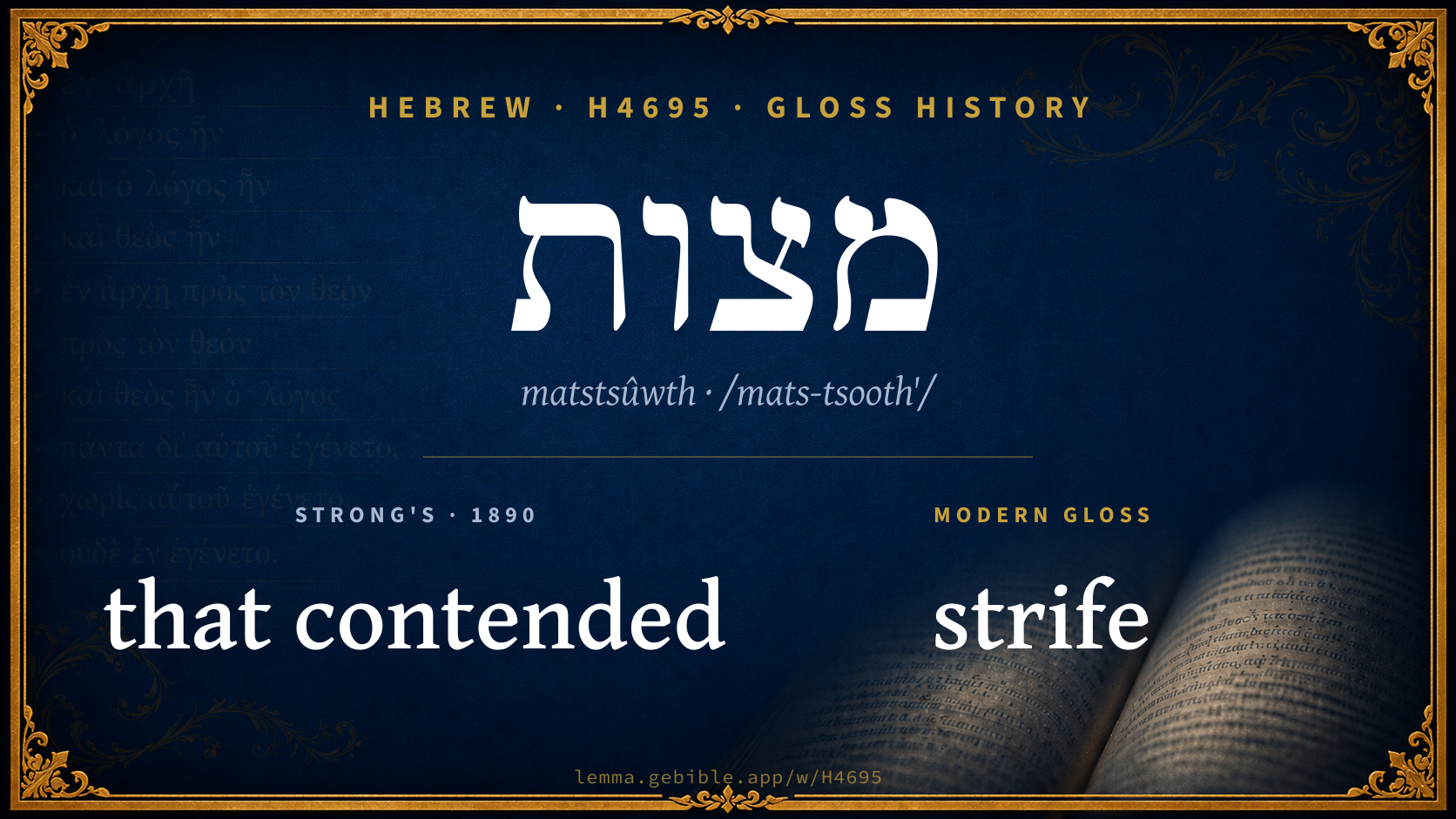
Gloss history
Strong's 1890 vs modern scholarship
About this word
Strong's H4695 catalogs a Hebrew word from the Hebrew Old Testament.
These counts are not copied from any lexicon or concordance. They are computed here, from the morphology-tagged Hebrew Old Testament. What Lemma adds →
- 1
- distinct verses
- The word appears in 1 distinct verse.
- 1 / 39
- OT books
- The word appears in 1 of 39 Old Testament books.
- #6,101
- by frequency
- Rank #6,101 (rank 6,101 of 8,640 Hebrew words by occurrence).
View all 1 occurrence in the concordance →
Most concentrated in
- Isaiah 1 verse 100%
By section of the Old Testament
By traditional corpus
Conventional, traditional groupings — biblical authorship is debated, so this is a traditional corpus grouping, not an authorship claim. Each share is this word’s portion of its verses in that division of the Hebrew canon. Each figure is a share of the word’s 1 distinct verse.
- Prophets (Nevi'im) 1 verse · 100%
How translations render this word
Counts come from each version’s own published word-to-Strong’s tagging or interlinear alignment — an approximate guide to how each version renders this word, not a word-level alignment the data otherwise carries. Because each total is that version’s own tagged count, the per-version totals vary from one another and need not match the appearance or distinct-verse counts above. These counts may also differ from a printed concordance because Lemma counts each distinctly tagged rendering and does not collapse phrase taggings into a single head-word total. This is a fixed set of word-tagged versions (KJV, ASV, BSB, ULT) and does not change with the reading translation you choose elsewhere. Each version’s license is shown beside its name below (and on Sources).
- King James Version: Contended 1×
- American Standard Version: Contend 1×
- Berean Standard Bible: not separately translated
- unfoldingWord Literal Text: Quarrel 1×
King James Version Public Domain
Renders H4695 across 1 tagged occurrence — most commonly:
American Standard Version Public Domain
Renders H4695 across 1 tagged occurrence — most commonly:
Berean Standard Bible Public Domain
Does not render H4695 with a distinct English word (not separately translated in its 1 tagged occurrence).
unfoldingWord Literal Text CC BY-SA 4.0
Renders H4695 across 1 tagged occurrence — most commonly:
Senses in BDB
The 1 sense BDB distinguishes for this word, in lexicon order (not ranked by frequency or importance). The full entry — with sub-senses — is in the Lexicon Entry tab.
- strife, contention
Word origin
[ מַצּוּת ] n.f. id. [ מַצָּה ];—only sf. Is 41:12
— Brown-Driver-Briggs (Oxford 1906, public domain), digitized via Sefaria, supplemented by the OpenScriptures HebrewLexicon (CC BY 4.0). See Sources.
Derived from נצה (nâtsâh) (H5327) — to struggle.
Jastrow Dictionary
A second Hebrew/Aramaic lexicon for comparison, covering Aramaic and post-biblical (Talmudic, Targumic, Midrashic) usage that the biblical-Hebrew BDB does not. Matched by lemma rather than by Strong’s number, so a lemma may carry more than one Jastrow headword (shown separately below), and the entries cover usage well beyond the Bible.
מַצָּה
- 1. [dry, pressed bread,] unleavened bread, esp. the bread served at the Passover meal. Pes. X, 3. Ib. 5 כל שלא אמר … פסח מ׳ וכ׳ whoever does not explain, at the meal, the following three ceremonies, has not done his duty, and these they are: the Passover sacrifice, the eating of matsah and the bitter herbs. Men. V, 1 כל המנחות באות מ׳ all meal offerings are offered in an unleavened condition, opp. חָמֵץ. Pes. 35ᵃ דברים הבאים … אדם יוצא בהן ידי חובתו במ׳ one performs his duty of eating matsah (on the first Passover night) with such things only as are capable of leavening (the five species of grain); a. fr.—Pl. מַצּוֹת. Mekh. Bo, s. 8 שומע אני כל מ׳ במשמע I might think anything unleavened is included (may be used for eating on the first Passover night); a. fr.
- 2. עו̇ר המ׳, or מ׳ a hide not tanned by a process of fermentation, untanned hide. Kel. XVII, 15. Gitt. 22ᵃ; Sabb. 79ᵃ שלשה עורות הן מ׳ וכ׳ there are three kinds of hides, matsah &c., v. דִּיפְתְּרָא. Ib. מ׳ כמשמעו וכ׳ m. is what its name implies, not salted and floured nor tanned with gall-nut.
מַצּוּת
- quarrel, wrangling. Snh. 74ᵃ; 79ᵃ; Keth. 33ᵃ (ref. to Ex. XXI, 22) במ׳ שבמיתה וכ׳ the text speaks of a fight with murderous intent; Ex. R. s. 1. Y. Naz. IX, end, 58ᵃ (ref. to Ex. l. c. a. 18) והלא היא מ׳ היא מריבה וכ׳ are not matsuth and m’ribah the same?; Y. Snh. IX, 27ᵃ bot.; Y. B. Kam. IV, 4ᶜ top. Gen. R. s. 50 (play on מַצּוֹת, Gen. XIX, 3) מ׳ גדולה וכ׳ a great dispute arose (between Lot and his wife) about the salt; Yalk. ib. 84. Pesik. Vattomer, p. 133ᵇ (ref. to נצו, Lam. IV, 15) לא גלו … בעלי מ׳ להקב"ה they did not go into exile until they had become contestants against the Lord. [Not to be confounded with מַצּוֹת, pl. of מַצָּה, a. מִצְוֹת, pl. of מִצְוָה.] e.g. Exodus 21:22
A Dictionary of the Targumim, the Talmud Babli and Yerushalmi, and the Midrashic Literature (Marcus Jastrow; London, Luzac, 1903) — Public Domain. Digitized via Sefaria. Digitized via Sefaria. Full attribution on Sources.
Same root — word family
Other BDB entries built from the same root as H4695, grouped by Strong’s listed origin. These share a root / origin per the lexicon — not necessarily a shared meaning. Each links to that word’s own entry.
Derives from
Shares the same root
Compare all same-root words → They share a root, not necessarily a meaning.
Septuagint verse parallels
This word appears in 1 verse that also exists in the Greek Old Testament (Septuagint), out of the 1 Hebrew verse it occurs in. You can read those verses in Greek by switching the Old Testament edition to the Septuagint.
Read these verses in the Septuagint
This is a verse-level parallel only — the same verses exist in both the Hebrew and Greek Old Testaments. No word-level Hebrew↔Greek correspondence is claimed: the data carries no such alignment, so no Greek word is shown as this Hebrew word’s translation. Coverage is not total — the Septuagint omits the deuterocanon and renumbers the Psalms, so some Hebrew verses have no direct Greek parallel.