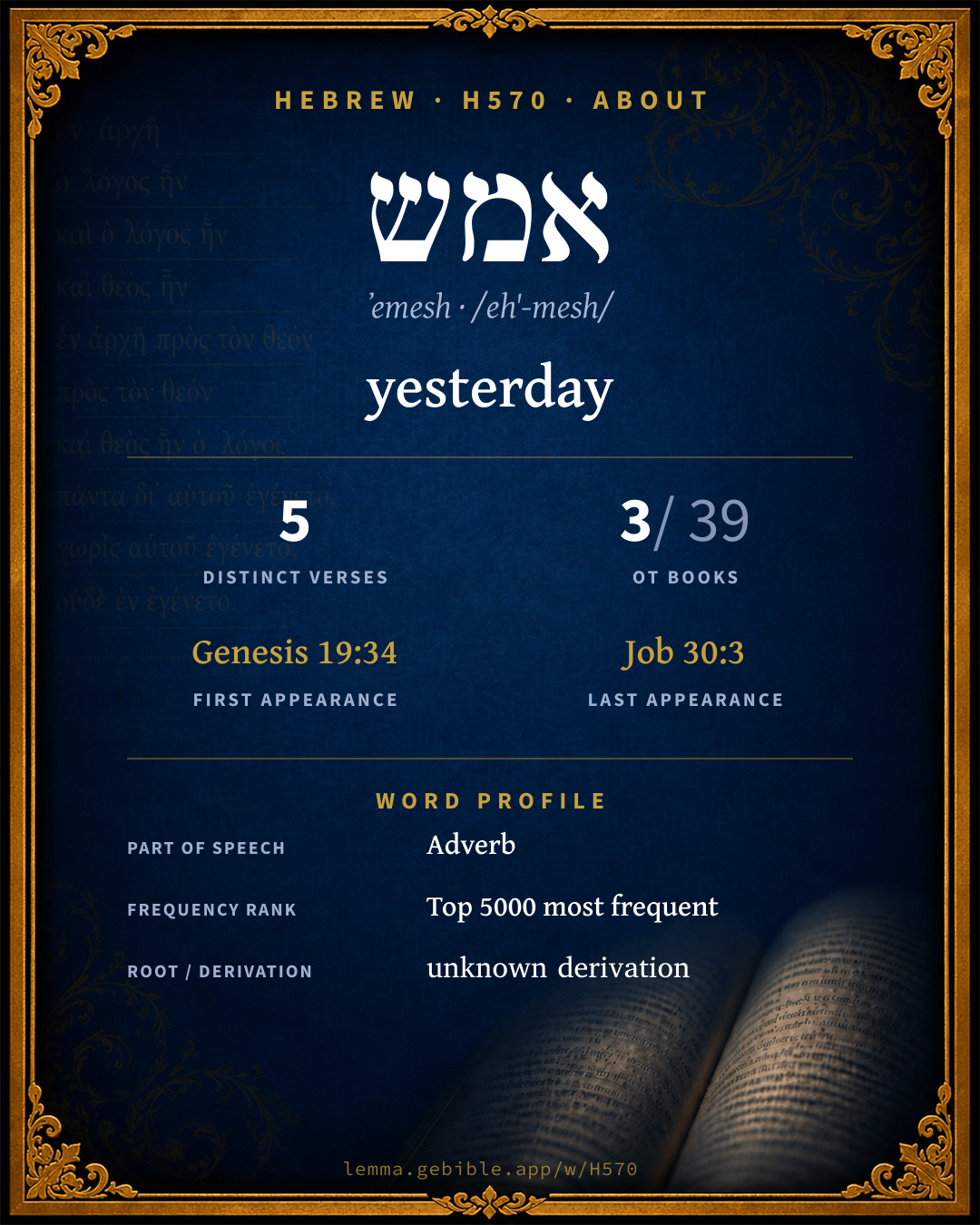
אֶ֫מֶשׁ
yesterday
‘yesterday’ is one of 2 main senses fuller range ↓
Full lexicon entry — Brown-Driver-Briggs (BDB)
From Brown-Driver-Briggs (BDB)
Where this word appears
Grammar key — what these labels mean
Part of speech
- Adverb
- A word that modifies a verb, adjective, or other adverb.
Every verse where H570 appears — 5 distinct verses across 3 books. Click any verse to open its interlinear word-by-word view. Verse text shown in the World English Bible for context — . Each verse’s Hebrew form is shown with its reference; the English is not keyword-highlighted, since the data carries no word-level English alignment. Use “Compare translations” on any verse to read it across multiple English versions. This concordance covers the Hebrew Bible; Septuagint (Greek Old Testament) occurrences are not indexed here.
Genesis 3 verses
- Genesis 19:34 אֶ֖מֶשׁ adv It came to pass on the next day, that the firstborn said to the younger, "Behold, I lay last night with my father. Let us make him drink wine again, tonight. You go in, and lie with him, that we may preserve our father's seed."
- Genesis 31:29 אֶ֣מֶשׁ adv It is in the power of my hand to hurt you, but the God of your father spoke to me last night, saying, 'Take heed to yourself that you don't speak to Jacob either good or bad.'
- Genesis 31:42 אָֽמֶשׁ adv Unless the God of my father, the God of Abraham, and the fear of Isaac, had been with me, surely now you would have sent me away empty. God has seen my affliction and the labor of my hands, and rebuked you last night."
2 Kings 1 verse
Job 1 verse
About this entry
At a glance — auto-summarized from this page’s data, not written by a person. Every figure links to its source below. This summary describes the numbers; it doesn’t interpret them.
“yesterday” is the headline sense of the Hebrew verb אמש (ʼemesh). The Hebrew Bible uses it only 5 verses. It clusters heavily in Genesis, which alone accounts for 60% of its uses. First canonically at Genesis 19:34, it enters the text early. Lexicons map it across 2 senses. The sections below give every sense, occurrence, and version rendering.
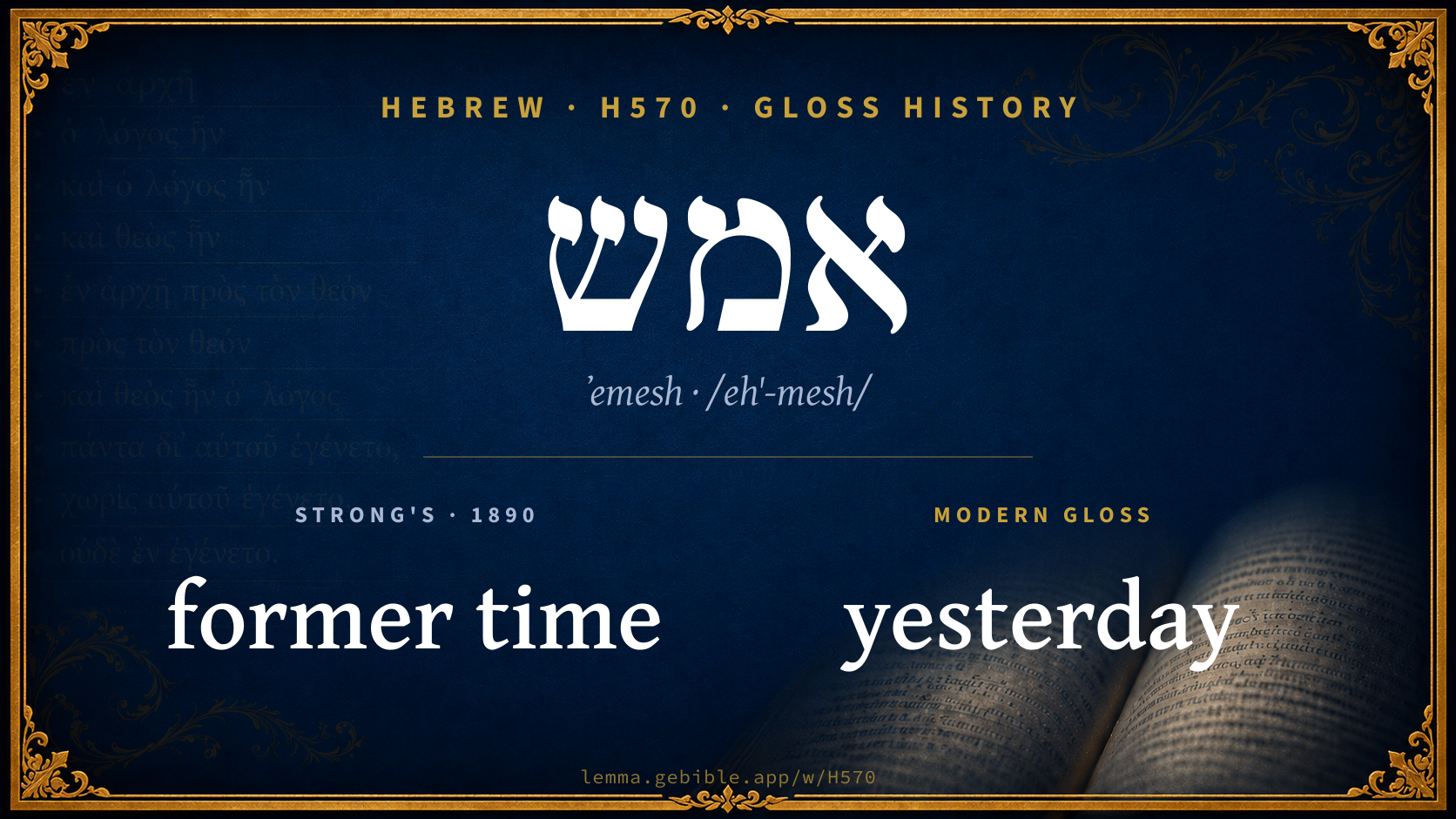
Gloss history
Strong's 1890 vs modern scholarship
About this word
Strong's H570 catalogs a Hebrew word from the Hebrew Old Testament.
These counts are not copied from any lexicon or concordance. They are computed here, from the morphology-tagged Hebrew Old Testament. What Lemma adds →
- 5
- distinct verses
- The word appears in 5 distinct verses.
- 3 / 39
- OT books
- The word appears in 3 of 39 Old Testament books.
- #3,337
- by frequency
- Top 5000 most frequent Hebrew words (rank 3,337 of 8,640 Hebrew words by occurrence).
View all 5 occurrences in the concordance →
By section of the Old Testament
By traditional corpus
Conventional, traditional groupings — biblical authorship is debated, so this is a traditional corpus grouping, not an authorship claim. Each share is this word’s portion of its verses in that division of the Hebrew canon. Each figure is a share of the word’s 5 distinct verses.
- Torah (Pentateuch) 3 verses · 60%
- Prophets (Nevi'im) 1 verse · 20%
- Writings (Ketuvim) 1 verse · 20%
How translations render this word
Counts come from each version’s own published word-to-Strong’s tagging or interlinear alignment — an approximate guide to how each version renders this word, not a word-level alignment the data otherwise carries. Because each total is that version’s own tagged count, the per-version totals vary from one another and need not match the appearance or distinct-verse counts above. These counts may also differ from a printed concordance because Lemma counts each distinctly tagged rendering and does not collapse phrase taggings into a single head-word total. This is a fixed set of word-tagged versions (KJV, ASV, BSB, ULT) and does not change with the reading translation you choose elsewhere. Each version’s license is shown beside its name below (and on Sources).
- King James Version: Yesternight 2×
- American Standard Version: Gloom 1×, I lay yesternight 1×, Thee yesternight 1×
- Berean Standard Bible: Last night 3×
- unfoldingWord Literal Text: Last night 3×, Yesterday 2×
King James Version Public Domain
Renders H570 across 5 tagged occurrences — most commonly:
Plus 3 renderings that appear only once — usually multi-word phrases or single function words the recovered tagging swept in, not distinct renderings.
American Standard Version Public Domain
Renders H570 across 5 tagged occurrences — most commonly:
Berean Standard Bible Public Domain
Renders H570 across 5 tagged occurrences — most commonly:
Plus 2 renderings that appear only once — usually multi-word phrases or single function words the recovered tagging swept in, not distinct renderings.
unfoldingWord Literal Text CC BY-SA 4.0
Renders H570 across 5 tagged occurrences — most commonly:
Senses in BDB
The 2 senses BDB distinguishes for this word, in lexicon order (not ranked by frequency or importance). The full entry — with sub-senses — is in the Lexicon Entry tab.
- yesterday, last night
- recently (figuratively)
Word origin
adv. yesterday (etym. dub.; MV after Fl De on Jb 30:3 cf. Sta§ 256 c der. from √ משׁה = Arabic مسا, whence مَسَآءٌ, evening; v. also in Thes, & cf. Assyrian mušu, night COTGloss, Ethiopic ምሴት but also Arabic أَمْسٌ = Assyrian amšatu, yesterday) = last night Gn 19:34; 31:29, 42 (אָ֑מֶשׁ); = recently 2 K 9:26.—Jb 30:3 א׳ שׁוֹאָה is difficult & uncertain Thes MV al. darkness, gloom of wasteness, so RV, but dub., cf. Di; G. Hoffm. reads אֵם שׁ׳ = the mother of (all) the ruined (said of the desert).
— Brown-Driver-Briggs (Oxford 1906, public domain), digitized via Sefaria, supplemented by the OpenScriptures HebrewLexicon (CC BY 4.0). See Sources.
Origin: unknown derivation
Jastrow Dictionary
A second Hebrew/Aramaic lexicon for comparison, covering Aramaic and post-biblical (Talmudic, Targumic, Midrashic) usage that the biblical-Hebrew BDB does not. Matched by lemma rather than by Strong’s number, so a lemma may carry more than one Jastrow headword (shown separately below), and the entries cover usage well beyond the Bible.
אֶמֶשׁ
- 1. twilight, evening, nightfall. Pesik. Vayhi p. 63ᵇ; Pesik. R. s. 17 מא׳ (ו)עד חצות from nightfall to midnight.
- 2. (adv.) this evening, last night. Meg. 3ᵃ, a. e. א׳ ביטלתם וכ׳ this evening you neglected the evening offering.—Snh. 40ᵇ א׳ הרגו last night he killed him. B. Mets. 60ᵃ שמרים של א׳ dregs of last night (yesterday), opp. to היום; a. fr.
A Dictionary of the Targumim, the Talmud Babli and Yerushalmi, and the Midrashic Literature (Marcus Jastrow; London, Luzac, 1903) — Public Domain. Digitized via Sefaria. Digitized via Sefaria. Full attribution on Sources.
Forms in the corpus
The 5 distinct written forms H570 takes in the Hebrew Bible, most frequent first — each parse links to that state’s occurrences in the concordance. Hebrew forms include their vowel points and cantillation, so a single lemma takes many written forms.
| Form | Parsing | Example | Uses |
|---|---|---|---|
| אֶ֖מֶשׁ | Adverb | Genesis 19:34 | 1 |
| אֶ֝֗מֶשׁ | Adverb | Job 30:3 | 1 |
| אֶ֣מֶשׁ | Adverb | Genesis 31:29 | 1 |
| אֶ֨מֶשׁ֙ | Adverb | 2 Kings 9:26 | 1 |
| אָֽמֶשׁ | Adverb | Genesis 31:42 | 1 |
Septuagint verse parallels
This word appears in 5 verses that also exist in the Greek Old Testament (Septuagint), out of the 5 Hebrew verses it occurs in. You can read those verses in Greek by switching the Old Testament edition to the Septuagint.
Read these verses in the Septuagint
This is a verse-level parallel only — the same verses exist in both the Hebrew and Greek Old Testaments. No word-level Hebrew↔Greek correspondence is claimed: the data carries no such alignment, so no Greek word is shown as this Hebrew word’s translation. Coverage is not total — the Septuagint omits the deuterocanon and renumbers the Psalms, so some Hebrew verses have no direct Greek parallel.