
2 Timothy 2:5

Greek (Tischendorf 8th ed.) 2 Timothy 2:5 appears in the Greek New Testament. The text above is from the Tischendorf 8th edition. Each word links to its Strong’s number and a concise gloss. Click any word for its full Thayer’s Greek Lexicon entry.
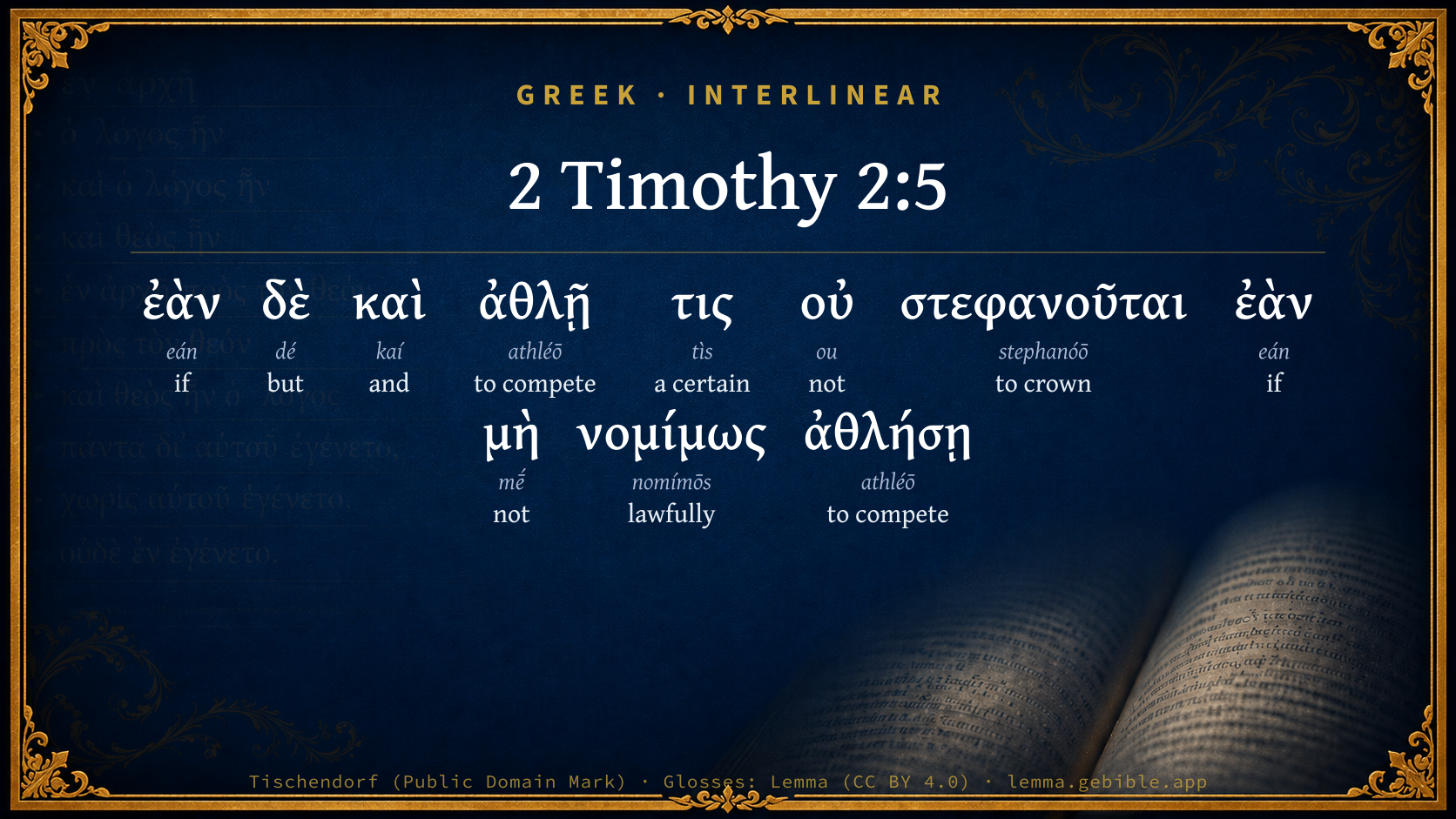
Download image
Cite this verse

2 Timothy 2:5 (World English Bible). Public Domain. Lemma interlinear Bible study tool, https://lemma.gebible.app/v/2-timothy/2/5.

Show BibTeX & RIS
BibTeX
RIS
English Translation
Also, if anyone competes in athletics, he isn't crowned unless he has competed by the rules.
World English Bible · Public Domain
Highlights
  • 2 first appearances in the Greek New Testament
Full analysis ↓
Download a study sheet

One document with this verse’s original text, its word-by-word gloss line, the meaning frame, cross-references with their text, attributed commentary, and full source and license credits — printable, and it pastes into notes with its structure intact.

This verse Autodidact and up

Study sheet (.html) Plain text (.txt)

A passage Seminary Student

Up to 50 verses in one chapter. A passage sheet keeps up to 6 commentary sources and 12 cross-references per verse, in the order this page ranks them, and says so on the sheet whenever that leaves anything out. Ask for a single verse and you get the Autodidact verse sheet above.

Everything on this page stays free to read, with no account — the sheet is a download of what is already on screen, not access to it.

Want to remove ads? Support Godless Engineer
Compare translations 3

The same verse in 3 English versions, stacked beneath the original-language interlinear above. Click any original word for its lexicon entry.

Each is an independent rendering of the whole verse — the interlinear is not word-aligned to these translations.

Highlighted words mark where these versions differ — a whole-verse word diff, not a word-by-word alignment.

  • World English Bible Public Domain
    Also, if anyone competes in athletics, he isn't crowned unless he has competed by the rules.
  • King James Version Public Domain
    And if a man also strive for masteries, yet is he not crowned, except he strive lawfully.
  • unfoldingWord Literal Text CC BY-SA 4.0
    But also, if anyone competes, he is not crowned if he has not competed lawfully.

unfoldingWord Literal Text — © unfoldingWord, licensed CC BY-SA 4.0. Word-aligned USFM3 via Door43 (git.door43.org/unfoldingWord/en_ult).

Versions to compare (up to 4)

3 of 4 selected

Show all 19 translations

Every available English version of this verse, each an independent rendering of the whole verse.

  • World English Bible Public Domain
    Also, if anyone competes in athletics, he isn't crowned unless he has competed by the rules.
  • Berean Standard Bible Public Domain
    Likewise, a competitor does not receive the crown unless he competes according to the rules.
  • Majority Standard Bible Public Domain
    Likewise, a competitor does not receive the crown unless he competes according to the rules.
  • King James Version Public Domain
    And if a man also strive for masteries, yet is he not crowned, except he strive lawfully.
  • American Standard Version (1901) Public Domain
    And if also a man contend in the games, he is not crowded, except he have contended lawfully.
  • Revised Version (1885) Public Domain
    And if also a man contend in the games, he is not crowned, except he have contended lawfully.
  • Geneva Bible (1599) Public Domain
    And if any man also striue for a Masterie, he is not crowned, except he striue as he ought to doe.
  • Douay-Rheims (1899) Public Domain
    For he also that striveth for the mastery, is not crowned, except he strive lawfully.
  • Young's Literal Translation Public Domain
    and if also any one may strive, he is not crowned, except he may strive lawfully;
  • Literal Standard Version CC BY-SA 4.0
    and if anyone also may strive, he is not crowned, except he may strive lawfully;
  • Unlocked Literal Bible CC BY-SA 4.0
    Also, if someone competes as an athlete, he is not crowned unless he competes by the rules.
  • unfoldingWord Literal Text CC BY-SA 4.0
    But also, if anyone competes, he is not crowned if he has not competed lawfully.
  • Darby Bible Public Domain
    And if also any one contend [in the games], he is not crowned unless he contend lawfully.
  • World Messianic Bible Public Domain
    Also, if anyone competes in athletics, he isn’t crowned unless he has competed by the rules.
  • Webster's Bible Public Domain
    And if a man also striveth for masteries, yet is he not crowned, except he striveth lawfully.
  • Free Bible Version CC BY-SA 4.0
    Similarly athletes who compete in the games don't win a prize if they don't keep to the rules.
  • Bible in Basic English Public Domain
    And if a man takes part in a competition he does not get the crown if he has not kept the rules.
  • Text-Critical English NT CC BY 4.0
    Similarly, an athlete is not crowned unless he competes according to the rules.
  • Tyndale New Testament (1534) Public Domain
    And though a man strive for a mastery yet ys he not crouned except he strive laufully.

Literal Standard Version (2020), Covenant Press — licensed CC BY-SA 4.0. Text via the HelloAO Bible API (eBible.org). Unlocked Literal Bible (unfoldingWord) — licensed CC BY-SA 4.0. Text via the HelloAO Bible API (eBible.org). unfoldingWord Literal Text — © unfoldingWord, licensed CC BY-SA 4.0. Word-aligned USFM3 via Door43 (git.door43.org/unfoldingWord/en_ult). Free Bible Version, Dr. Jonathan Gallagher — licensed CC BY-SA 4.0. Text via the HelloAO Bible API (eBible.org).

Word by word

More ways to search: Search by grammar → Find every occurrence → Compare this word →

Practice this passage: Drill this verse → Learn its vocabulary →

About this verse

These counts appear in no published source. They are computed here, from the morphology-tagged text and Lemma’s own curated glosses. What Lemma adds →

11
words
9
distinct lemmas
Pauline Epistles
section

Notable vocabulary

The rarest word here is ἀθλῇ to compete G118 — appearing just 2 times in the whole Greek New Testament.

First appearance in Scripture

These words make their first canonical appearance in the Greek New Testament here:
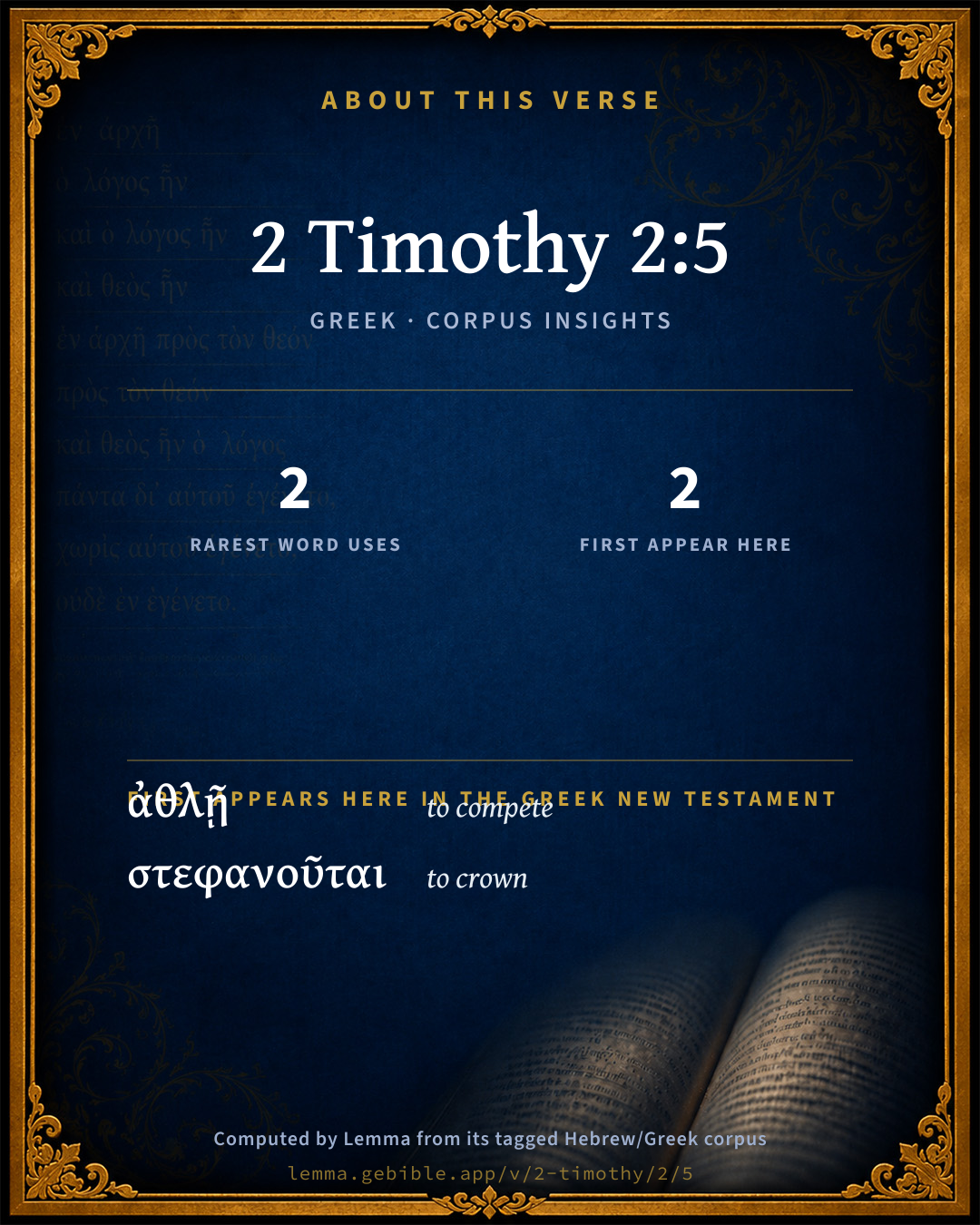
  • ἀθλῇ to compete G118
  • στεφανοῦται to crown G4737

Repetition

Words recur within this verse:

  • ἀθλῇ to compete G118 ×2
  • ἐὰν if G1437 ×2

Cross-references

14

Topical passages linked to 2 Timothy 2:5 in the Treasury of Scripture Knowledge — connected by theme and wording, ordered by reader-vote popularity; previews shown in the World English Bible.

  • 1 Corinthians 9:24–27 Don't you know that those who run in a race all run, but one receives the prize? Run like that, that you may win.
  • Revelation 3:11 I am coming quickly! Hold firmly that which you have, so that no one takes your crown.
  • 2 Timothy 4:7–8 I have fought the good fight. I have finished the course. I have kept the faith.
  • Colossians 1:29 for which I also labor, striving according to his working, which works in me mightily.
  • James 1:12 Blessed is the man who endures temptation, for when he has been approved, he will receive the crown of life, which the Lord promised to those who love him.
  • Luke 13:24 "Strive to enter in by the narrow door, for many, I tell you, will seek to enter in, and will not be able.
  • Philippians 1:15 Some indeed preach Christ even out of envy and strife, and some also out of good will.
  • Hebrews 2:7 You made him a little lower than the angels; You crowned him with glory and honor.
  • Revelation 2:10 Don't be afraid of the things which you are about to suffer. Behold, the devil is about to throw some of you into prison, that you may be tested; and you will have oppression for ten days. Be faithful to death, and I will give you the crown of life.
  • Hebrews 2:9 But we see him who has been made a little lower than the angels, Jesus, because of the suffering of death crowned with glory and honor, that by the grace of God he should taste of death for everyone.
  • Hebrews 12:4 You have not yet resisted to blood, striving against sin;
  • 1 Peter 5:4 When the chief Shepherd is revealed, you will receive the crown of glory that doesn't fade away.
  • Revelation 4:10 the twenty-four elders fall down before him who sits on the throne, and worship him who lives forever and ever, and throw their crowns before the throne, saying,
  • Revelation 4:4 Around the throne were twenty-four thrones. On the thrones were twenty-four elders sitting, dressed in white garments, with crowns of gold on their heads.

Cross-references courtesy of OpenBible.info (CC BY 4.0).

Commentary

Notes on 2 Timothy 2:5 from classic Christian and Jewish commentators (each source and its license shown beneath its notes). The classic Christian expositions comment on the surrounding passage and are grouped to its opening verse, so a note may address several verses; the Jewish commentaries on the Tanakh (Rashi and others) are per-verse, so they appear only where the commentator wrote on this verse.

Lemma curates 59 commentaries, every one of them public domain or Creative Commons licensed, each selected and text-cleaned for this edition rather than reprinted as found. About our sources →

The Biblical Illustrator

Joseph S. Exell

2Ti_2:5

Not crowned, except he strive lawfully.

Lawful striving

The athlete who competes in the games does not receive a crown, unless he has contended law fully, i.e., according to rule (νομίμως νόμος). Even if he seem to be victorious, he nevertheless is not crowned, because he has violated the well-known conditions. And what is the rule, what are the conditions of the Christians contest? If any man would come after Me, let him deny himself and take up his cross and follow Me. If we wish to share Christs victory, we must be ready to share His suffering. No cross, no crown. To try to withdraw oneself from all hardship and annoyance, to attempt to avoid all that is painful or disagreeable, is a violation of the rules of the arena. This, it would appear, Timothy was in some respects tempted to do; and timidity and despondency must not be allowed to get the upper hand. Not that what is painful, or distasteful, or unpopular, is necessarily right; but it is certainly not necessarily wrong; and to try to avoid everything that one dislikes is to ensure being fatally wrong. (A. Plummer, D. D.)

Lawful diet

The phrase lawfully which is found in precisely the same connection in Galen (Comm. in Hippocrates 1.15) was technical, half-medical, and half belonging to the training schools of athletes, and implied the observance of all rules of life prior to the contest as well as during it. Failure to keep to the appointed diet and discipline, no less than taking an unfair advantage at the time, excluded the competitor from his reward. (E. H. Plumptre, D. D.)

Regulations for athletic contests

The following were among the regulations of the athletic contests. Every candidate was required to be of pure Hellenic descent. He was disqualified by certain moral and political offences. He was obliged to take an oath that he had been ten months in training, and that he would violate none of the regulations. Bribery was punished by a fine. The candidate was obliged to practise again in the gymnasium immediately before the games, under the direction of judges or umpires, who were themselves required to be instructed for ten months in the details of the games. (Conybeare and Howson.)

Lawful striving

I. A Christian is a striver.

1. In the breast and forefront of this strife thou must contend with ignorance, which adversary, though his eyes be put out, and he be as blind as a mill-horse, yet his strength is like behemoths, his weapons Goliahs, his blows the batterings of a tearing cannon; for if this giant be not quelled, killed, he will lead you into mazes of error.

2. This monster being put to flight, you are to encounter with aged superstition.

3. Close after idolatry follows covetousness.

4. At the heels of every striver you shall have sloth and idleness.

II. Eternal life is called a crown. For the worth and excellency of it.

III. The lawful striver shall be crowned. (J. Barlow, D. D.)

The lawful strife

Man likes to choose his own way; but the gospel of our Lord Jesus Christ has marked out a way for him: hence one reason at least of his unwillingness to go along it. The text tells us that we must put off this perverseness of the old man, and put on all the obedience of the new man, following the direction which the Lord hath given. Mans will is to have no change of his ways, no sorrow for the past, no amendment (but he will not call it amendment) for the future. All this is too humbling to his pride, too much of a curb upon his self-will. But our Lords precept is repentance: you must come to Me, and receive that which I give along the road of repentance. The making repentance a step, and not a course, merely a gate of introduction, and not a road also of daily conduct, is one of the short cuts by which men think to arrive at the prize, without going through all the prescribed rules of the struggle. And not only must we bring our minds to submit to the rules which our Lord hath laid down, but also our hearts to understand them: indeed, we must first understand them before we can truly accept them. We cannot in any case effectually bind ourselves to a duty of which we know not the extent; we cannot be sure of accomplishing a thing of which we have not counted the cost. Now our blessed Lord bath set before us our course, both by example and precept. And what remains is to make up our minds to rise and follow. In His trials we have the model of our lawful strife. In His ascension unto glory we see the assurance of our crown. His flesh was crucified: so must we crucify the flesh. He rose again; even so we must rise again unto newness of life. He is seated in heaven: so we must set our affections on things above. The rules are plain; they cannot he confounded with the rules of strife for any worldly mastery. We see, then, what we have to contend against. It is a compliance with the course of a sinful world; a reluctance to change our course into one which is not in conformity with it, but even in a contrary direction. It is putting Gods end, indeed, before us, even the prospect of eternal life, but not using His means, but putting our own in their place, because we find them much more agreeable: it is, in short, the indulgence of our nature. (R. W. Evans, B. D.)

Lawful strife

We gather from this figure that in spiritual things there is a striving lawfully and a striving unlawfully, and that the prize is not necessarily given to him who wins the race, if he has not complied with certain rules laid down. I think, then, we may say that there are three distinct ways of striving.

1. There is an unlawful striving after unlawful objects.

2. An unlawful striving after lawful objects.

3. A lawful striving after lawful objects.

I. As what is right is often more clearly shown by holding up what is wrong, I shall attempt to describe what it is to strive unlawfully after unlawful objects.

1. To strive, then, after pre-eminence, to be a Diotrephes in a church (Joh_3:9).

2. All strife about vain and idle questions (2Ti_2:14).

3. To seek after a form of godliness, whilst secretly denying the power thereof, or to have a name to live when dead in sin.

4. To strive after fleshly holiness and creature perfection.

5. To seek to find an easier and smoother path than the strait gate and the narrow way.

II. But now I come to another kind of striving, which is unlawful striving after lawful objects. Now God has laid down in His word of truth three solemn rules, laws you may call them if you like, which constitute lawful striving.

1. The Holy Ghost must begin, carry on, and finish the inward work of grace.

2. The soul must be brought under His Divine teaching to be thoroughly stripped and emptied of all creature wisdom, strength, help, hope, and righteousness.

3. The glory of a Triune God must be the end and motive of all. Any departure from these three rules of striving makes a man strive unlawfully.

III. But we come now to the only striving which the Lord crowns--a lawful striving after lawful objects.

1. Now we will begin with the first rule, which is this, that the Holy Spirit must work in us all the power, wisdom, grace, faith, strength, and life, that we strive with.

2. The second rule of lawful striving is, that the runners in this race should have no strength. He giveth power to the faint, and to them that have no might He increaseth strength.

3. And this enables you to comply with the third rule of lawful strife--to give God all the glory. Surely you can take no glory to self, when self has been proved, and found wanting. Now these lawful strivers after lawful objects are crowned, and they only. This crown is twofold--a crown here and a crown hereafter, a crown of grace set on the heart below, and a crown of glory set on the head above. (J. C. Philpot.)

Lawful striving

(2Ti_2:5 with 1Co_9:25):--Let us glance first at--

I. The fact that the Christian life is a warfare, a running and a wrestling, a course of self-restraint, and of earnest labour and striving after a great end. Let us consider--

II. The manner of the strife. There are two words which describe this, both of which are significant. Lawfully is the one, and certainly--or to put the double negative as the apostle has it, not uncertainly--is the other; and the not as one that beateth the air is only an expletive, or repetition of that.

1. This lawfully requires that all our effort and striving should be in accordance with Divine rule. And this implies at least two things--

(1) That it should be preceded by our trust in Christ. Nothing we can do is acceptable or valuable until by faith in Christ we have been reconciled to God.

(2) In the efforts we put forth we are not to follow our own impulses or inclination, but to be directed by the will of Christ.

2. Certainly. The certainty is secured by the lawfulness. Those who are guided by Christs will are not in any doubt either as to what they ought to do, or as to the result of doing it. Let us notice--

III. The object of our effort and striving. The apostle defines this object in the words, I keep under my body, and bring it into subjection, and in this he but describes the warfare of the spirit against the flesh, or of the new man against the old, which is characteristic of the Christian life. And this leads me to notice in the fourth and last place--

IV. The motive of the apostles striving.

1. That he might not be a castaway. A castaway. Try to realise what that word means, if you would understand the full significance of the text, and the mighty force of the motive by which the apostle was actuated. A castaway. There was a picture so designated painted some years ago, and engravings of it were frequently met with. One of these you may have seen, and the remembrance of it will help you to a conception of what the apostle dreaded. In that picture a gaunt figure with unshaven head and unkempt hair, badly clad and hunger-stricken, is seen seated on a raft in the midst of a raging rainy sea, sheltering his face with his arm from the blinding drift, straining his hollow eyes to descry a sail in the far distance. He is the very picture of umnitigated, hopeless, unpitied misery. He is not only alone in the universe, but tile whole universe, so far as it is visible, seems to be against him. The sky frowns on him; the rain descends on his unsheltered head, tile wind smites him; the sea dashes over, and threatens to engulf him; hungry monsters of the deep are waiting to make him their prey. There is no ear to hear his cry, no eye to witness his miserable and forlorn plight, no hand to help him, no haven near, no friendly star gleaming through the darkness to show him where he is. He is left alone of men, cast out by the world, persecuted by the elements. The only thing that befriends him is the raft to which he clings. Now to be a castaway in the spiritual sense is worse even than that--unspeakably worse. The word is fraught with all kinds of imaginable and unimaginable horrors. To be rejected by the universe of being, to be despised and spurned, to be expelled from any circle into which it is desirable to enter, to be disowned by all the good, tormented by ell the bad, to see every door of hope closed, to find everything in the universe hostile, every force operating unfavourably, every object wearing a frown, no eye to pity, no hand to help, no car to hear, no voice to utter one consoling word, no means of mitigating, no friendly raft even to bear up amidst the engulfing misery! What conception can be more horrible than that?

2. Paul was not only actuated by the desire to escape being a castaway, but also by the desire to gain a crown. They do it, he says, of the competitors in the games, to obtain a corruptible crown, but we an incorruptible. (W. Landels, D. D.)

Law

As the chemist, the navigator, the naturalist attain their ends by means of law, which is beyond their power to alter, which they cannot change, but with which they can work in harmony, and by so doing produce definite results, so may we. (Shorthouse, John Inglesant.)

Obedience

If a boy at school is bidden to cipher, and chooses to write a copy instead, the goodness of the writing will not save him from censure. We must obey, whether we see the reason or not; for God knows best. (New Cyclopaedia of Illustrations.)

Conquest the condition of entrance into heaven

Many years ago the Turks and the Christians had a great battle, and the Christians were defeated, and with Stephen, their commander, they fled toward a fortress where the mother of the commander was staying. When the mother saw her son and his army flying in disgraceful retreat, she ordered the gates of the fortress to be closed against them, and the gates were dosed, and then the mother stood on the battlement and cried to her son, You cannot enter here except as a conqueror. Then the commander rallied his scattered troops, and resumed battle and won the day--twenty thousand scattering like flying chaff two hundred thousand. Ah! my friends, defeated in this battle with sin and death and hell, there is no joy, no reward, no triumph for you. Only shame and everlasting contempt. But for those who gained the victory through our Lord Jesus Christ the gates of the New Jerusalem are open, and you will have abundant entrance into the everlasting kingdom of our Lord. (T. De Witt Talmage.)

Obedience and freedom

The truest freedom is secured by the most implicit obedience. Those who profess themselves free in the sense of being superior to law do but make themselves the slaves of sin. It is in the observance of rule that we find the fullest scope for the development of our individuality and the improvement and elevation of all our natural powers. They soar highest, and act with the greatest vigour, and move with the greatest freedom, who keep themselves most completely subject to the restraints of law. Loyalty elevates. We are ensnared and deteriorated when we follow our own caprice; for the liberty which is lawless is essentially degrading. The worlds describe their brilliant course over the dark brow of night because of the force which binds them to their great centre; let that force be destroyed, and they are free to rush whithersoever the centrifugal force propels. Their movement may be swifter than the lightning, and their track more dazzling than its path, but it will soon end in darkness and destruction. And so it is with the mind and the law of duty which hinds it to God. The freedom which comes from the violation of that law is a freedom which, instead of securing its welfare and elevation, only lands it in deeper degradation and death. (W. Landels, D. D.)

The Biblical Illustrator, edited by Joseph S. Exell (c. 1880s–1900s) — public domain. Text from a community e-Sword module.

Meyer's Critical & Exegetical Commentary

Heinrich August Wilhelm Meyer

2Ti_2:5. A new thought is added, that the contender who wishes to be crowned must contend νομίμως.

ἐὰν δὲ καὶ ἀθλῇ τις] καί connects this thought with what precedes: if one, too, does not permit himself to be kept from the struggle by other occupations;[23] but the figure here is different from that we had in 2Ti_2:4, ἈΘΛΕῖΝ (ἍΠ. ΛΕΓ. in the N. T.) denoting the contest in running, to which the Christian calling is often compared; comp. 2Ti_4:7-8; 1Co_9:24-25.

Οὐ ΣΤΕΦΑΝΟῦΤΑΙ, ἘᾺΝ ΜῊ ΝΟΜΊΜΩς ἈΘΛΉΣῌ] The runner, in order to gain the prize, must in the contest adhere to its definite rules. Theodoret: ΚΑῚ Ἡ ἈΘΛΗΤΙΚῊ ΝΌΜΟΥς ἜΧΕΙ ΤΙΝᾺς, ΚΑΘʼ ΟὛς ΠΡΟΣΉΚΕΙ ΤΟῪς ἈΘΛΗΤᾺς ἈΓΩΝΊΖΕΣΘΑΙ· Ὁ ΔῈ ΠΑΡᾺ ΤΟΎΤΟΥς ΠΑΛΑΊΩΝ, ΤῶΝ ΣΤΕΦΆΝΩΝ ΔΙΑΜΑΡΤΆΝΕΙ. In this, too, according to 1Co_9:25, ἘΓΚΡΑΤΕΎΕΣΘΑΙ should be observed; comp. Galen, Comm. in Hippocr. i. 15: οἱ γυμνασταὶ καὶ οἱ νομίμως ἀθλοῦντες ἐπὶ μὲν τοῦ ἀρίστου τὸν ἄρτον μόνον ἐσθίουσι, ἐπὶ δὲ τοῦ δείπνου τὸ κρέας. The word ΝΟΜΊΜΩς occurs only here and in 1Ti_1:8.

The thought contained in it is this, that Timothy, in order to share in the reward, must conduct himself in his evangelic warfare according to the laws of his evangelic office.

[23] Hofmann denies this connection of thought, maintaining wrongly that καί could only have this meaning if the apostle had continued to use the same figure.

Meyer — Critical and Exegetical Commentary on the New Testament — English translation by Peter Christie, edited by Frederick Crombie (T&T Clark, 1880) — public domain. Text from a community e-Sword module.

Expositor's Greek Testament

ed. W. Robertson Nicoll

2Ti 2:5 . The sequence of images here the soldier, the athlete, the field-labourer affords an interesting illustration of repetition due to association of ideas. The soldier and the field-labourer are combined in 1Co 9:7-10 ; the athlete appears in 1Co 9:24 sqq . And the present passage has light thrown upon it from the earlier epistle, in which the various figures are more fully developed.

The connexion between the thought of the soldier and the athlete lies in the word νομίμως (see note on 1Ti 1:8 ); and the exact force of νομίμως will appear from a reference to 1Co 9:25 , “Every man that striveth in the games is temperate in all things”. No one can be said to comply with the rules of the contest who has not undergone the usual preliminary training. One illustration from those cited by Wetstein will suffice, that from Galen, comm. in Hippocr . i. 15: οἱ γυμνασταὶ καὶ οἱ νομίμως ἀθλοῦντες , ἐπὶ μὲν τοῦ ἀρίστου τὸν ἄρτον μόνον ἐσθίουσιν , ἐπὶ δὲ τοῦ δείπνου τὸ κρέας .

The Expositor's Greek Testament, edited by W. Robertson Nicoll (1897–1910) — public domain. Text from a community e-Sword module.

Geneva Bible (1599)

Geneva Bible translators

The third admonition: The ministry is like to a game or justing, wherein men strive for the victory, and no man is crowned unless he strive according to the laws which are prescribed, be they never so hard and painful.

Geneva Bible (1599) marginal notes — public domain. Text via Bolls.life.

Jamieson, Fausset & Brown

Robert Jamieson, A. R. Fausset & David Brown

And--"Moreover."

strive for masteries--"strive in the games" [ALFORD]; namely, the great national games of Greece.

yet is he not crowned, except--even though he gain the victory.

strive lawfully--observing all the conditions of both the contest (keeping within the bounds of the course and stript of his clothes) and the preparation for it, namely, as to self-denying diet, anointing, exercise, self-restraint, chastity, decorum, &c. (Co1 9:24-27).

Jamieson, Fausset & Brown — Commentary Critical and Explanatory on the Whole Bible (1871) — public domain (CC PDM 1.0). Text via the HelloAO Bible API.

Adam Clarke's Commentary

Verse 5. If a man also strive for masteries] εαν δε και αθλη τις. If a man contend in the public games-the Olympic or Isthmian games among the Greeks, so often alluded to and particularly explained in the notes on 1Co 9:24-26, to which the reader is referred for a full illustration of this verse.

Is he not crowned] Though he may have conquered, except he strive lawfully-unless he enter according to the rules of the athletae, and act as these direct. No man, however zealous he may have been, is to expect the Well done, good and faithful servant, from Jesus Christ, unless he have laboured in the word and doctrine, preached the truth as it is in Jesus, and built up the Church upon Him who is its only FOUNDATION.

Adam Clarke's Commentary on the Bible (1810–1826) — public domain. Text from a community e-Sword/MySword module.

John Calvin's Commentaries

5 And if any one strive He now speaks of perseverance, that no man may think that he has done enough when he has been engaged in one or two conflicts. He borrows a comparison from wrestlers, not one of whom obtains the prize till he has been victorious in the end. Thus he says:

“In a race all run, but one obtaineth the prize; run so that ye may obtain.” (1 Corinthians 9:24.)

If any man, therefore, wearied with the conflict, immediately withdraw from the arena to enjoy repose, he will be condemned for indolence instead of being crowned. Thus, because Christ wishes us to strive during our whole life, he who gives way in the middle of the course deprives himself of honor, even though he may have begun valiantly. To strive lawfully is to pursue the contest in such a manner and to such an extent as the law requires, that none may leave off before the time appointed.

John Calvin's Commentaries (1540-1563) — public domain. Text from the Calvin Translation Society English edition (1840s-50s) via the Christian Classics Ethereal Library (ccel.org). Calvin's coverage is partial (roughly two-thirds of the Bible); uncommented books and verses are honest gaps, never fabricated. The 19th-century editor's footnotes and remarks are omitted so the notes are faithfully Calvin's own voice.

Ellicott's Commentary for English Readers

(5) And if a man also strive for masteries.—More accurately translated, again, if a man strive in the games. Another picture is drawn, and the picture is, as before, a well-known one to all the dwellers in the great cities of the empire. An athlete is chosen to represent the professed servant of Christ, one of those who, after long and careful training, contends in the public games, then so popular, so entirely a part of the life of every city—in the games of wrestling or running, or in the chariot-racing, or in the hand-to-hand contests. Again, this one—as in the case of the soldier—if he aspired to victory and success, must “endure hardness.”

Except he strive lawfully.—“Lawfully”—i.e. according to the prescribed conditions of the contest. He must, of course, submit himself to the strict rules of the theatre where the games are held, and (for this is also included in the “lawfully”) must besides—if he hopes for a prize—go through all the long and severe training and discipline necessary before engaging in such a contest. Galen uses the same phrase, in the sense of complying with the recognised rules of training as regarding diet.

A Bible Commentary for English Readers, edited by Charles John Ellicott (1878–1897) — public domain. Text from a community e-Sword module.

The Cambridge Bible for Schools and Colleges

gen. ed. J. J. S. Perowne

5. And if a man also strive for masteries] The ‘also’ is placed by R.V. before ‘a man’ instead of after as A.V.; correctly, though awkwardly; as implying not that a man may perhaps beside soldiering also contend in the games, which is the proper inference from the position of ‘also’ in A.V., but that ‘there is first the case of a soldier, and there is also the case of an athlete.’ The verb, from which comes our ‘athlete,’ occurs here only in N.T., though the substantive in the derived sense of ‘conflict’ occurs in Heb_10:32, ‘a great conflict of sufferings.’ Render, and if again a man contend in the games. We have had the illustration from the race-course and its ‘games’ in 1Ti_6:12, and shall have it again lower down, ch. 2Ti_4:7. As Ephesians 6 is the chief soldier’s illustration, so 1Co_9:25 sqq. is the chief athlete’s, in St Paul. The foot-race is used very strikingly also, Heb_12:1. Cf. Appendix, K.

except he strive lawfully] Except he have kept the rules of the contest. ‘The six statues of Jupiter at Olympia were made from the fines levied on athletes who had not contended lawfully.’ Pausan. 2Ti_2:21. (Bp Wordsworth.) Among the rules of the Olympic games were the following; competitors had to prove to the judges that they were freemen, of pure Hellenic blood, not disfranchised, or convicted of sacrilege, and that they had gone through the ten months’ preparatory training; they, their fathers, brothers, and trainers had to take oath that they would be guilty of no misconduct in the contests; and they had then a month’s preliminary exercises in the gymnasium at Elis under the superintendence of the judges. The ‘games’ included longer and shorter foot-races for men and for boys, chariot-races, horse-races, wrestling, boxing; the pentathlon, a combination of leaping, flat-racing, discus-throwing, spear-throwing, and wrestling; and the pancration, a union of boxing and wrestling. ‘Without interruption for upwards of a thousand years the full moon after the summer solstice every fourth year witnessed the celebration of these games. b.c. 776–a.d. 394.’ Wordsworth, Greece, p. 315.

The Cambridge Bible for Schools and Colleges (gen. ed. J. J. S. Perowne; Cambridge University Press, 1878–1918) — public domain. Text from a community e-Sword module.

John Gill's Exposition

And if a man also strive for masteries,.... In the Olympic games, by running, wrestling, leaping, &c.

yet is he not crowned; with a corruptible, fading crown, a crown made of herbs and leaves of trees, as parsley, laurel, &c.

except he strive lawfully; according to the laws and rules fixed for those exercises; so no man that calls himself a Christian, minister, or any other, can expect the crown of life, the prize of the high calling of God, except he runs the race set before him, in the right way; looking to Christ, the mark, pressing through all difficulties, towards the prize, and holds on and out unto the end.

John Gill's Exposition of the Whole Bible (1746–1763) — public domain (CC PDM 1.0). Text via the HelloAO Bible API.

Trapp's Complete Commentary

John Trapp

5 And if a man also strive for masteries, yet is he not crowned, except he strive lawfully.

Ver. 5. Except we strive lawfully] Tam circa ciborum quam continentiae ac honestatis rationem, saith Cassianus, except for matter and manner he observe the laws of wrestling, both for preparation and execution. Aristotle saith, Not he that had a strong body, but he that ran well had the crown in the Olympic games; it was not he that had an athletic ability, but he that wrestled best, that get the garland.

John Trapp, A Commentary or Exposition upon All the Books of the Old and New Testament (1647–1656) — public domain. Text from a community e-Sword module.

Albert Barnes' Notes on the Bible

And if a man also strive for masteries - As in the Grecian games. See this favorite illustration of Paul explained in the notes at 1Co 9:24 ff.

Yet is he not crowned, except he strive lawfully - In conformity with the rules of the games. See Grotius, in loc. No one could obtain the prize unless he had complied with all the laws of the games, and had thus given to those with whom he contended, a fair opportunity to succeed. “In those contests, he who transgressed the rules in the least matter, not only failed of the prize, even though the apparent victor, but was sometimes disgraced and punished.” Pictorial Bible. So the apostle here represents the Christian minister as engaged in a struggle or conflict for the crown. He says that he could not hope to win it unless he should comply with all the laws by which it is conferred; unless he should subdue every improper propensity, and make an effort like that evinced by the combatants at the Olympic games; compare the notes at 1Co 9:26-27.

Albert Barnes' Notes on the Bible (1834–1885) — public domain. Text from a community e-Sword/MySword module.

Matthew Poole's English Annotations

And look as it is in the public games in use amongst you, where divers strive by wrestling, fighting, racing, where there is a crown proposed as the prize for those who are the conquerors in the game; they have not that crown set upon their heads, unless they keep to the laws of that game wherein they are exercised. So it is in the spiritual warfare, or contest; there is a far greater reward, even a crown of glory, proposed for such as overcome; but none shall have it, unless those who keep to the laws which God hath made for those who exercise themselves in that spiritual combat.

Matthew Poole's English Annotations on the Holy Bible (1683–1685) — public domain. Text from a community e-Sword/MySword module.

Whedon's Commentary on the Bible

Daniel D. Whedon

5. Crowned—Notes on 1Co_9:25.

Lawfully—This implies not only that he loses his crown by any unfairness, or violation of rule in the race, but by any such violation of the laws of diet and training as were necessary to his ability to win.

Daniel D. Whedon (gen. ed.), Commentary on the Old and New Testaments (1874–1909) — public domain. Text from a community e-Sword module.

The Pulpit Commentary

Also a man for a man also, A.V; contend in the games for strive for masteries, A.V; he is not for yet is he not, A.V; have contended for strive, A.V Contend in the games (ajqlh); only here in the New Testament, and not found in the LXX, but common in classical Greek. It means "to contend for aqlon" the prize, to be an "athlete." This is also the meaning of the A.V "strive for masteries." "To strive," means properly to contend with an antagonist, and "mastery" is an old English word for "superiority," "victory," or the like. Dryden has "mastership" in the same sense

When noble youths for mastership should strive, To quoit, to run, and steeds and chariots drive. (Ovid., "Met," bk. 1. )

Lawfully (nomimwv, as; (1Ti_1:8) according to the laws and usages of the games. So Timothy must conform to the laws of the Christian warfare, and not shrink from afflictions, if he would gain the great Christian prize.

The Pulpit Commentary (1880–1919), ed. H.D.M. Spence-Jones & Joseph S. Exell — public domain. Text from a community e-Sword module.

Fairbairn on Ezekiel, Jonah & the Pastoral Epistles

Patrick Fairbairn

Ver. 5. But (δὲ, introducing a fresh illustration—Winer, Gr. § 53, 7, b; not only so, but there is this further case) if any one also strive in the games—another good rendering of Scholfield’s, and decidedly preferable to that of the Authorized Version, “if a man strive for the masteries,” which is too general, and scarcely suggests to the mere English reader the specific kind of striving referred to. It is impossible, except by such a circumlocution, to give the force of the Greek ἀθλῇ. The Vulgate also had to take the same course—certat in agone. He is not crowned unless he have striven lawfully—adhering with whatever self-sacrifice to the prescribed rules. This alone entitles him, even if his striving have been such as to place him in the foremost rank, to obtain the crown of victory. The inference is plain: if so in the lower sphere, and with respect to a perishable distinction, how much more in regard to the great struggle between righteousness and sin, light and darkness in ourselves and in the world, which carries with it issues of eternal moment!

Patrick Fairbairn — An Exposition of Ezekiel (1851), Jonah (1849), and The Pastoral Epistles (1874) — public domain. Text from a community e-Sword module.

The People's New Testament

B. W. Johnson

5. And if a man also strive. In the various athletic games of the Greeks. Unless he complies with the regulations, no prize will be assigned to him in any contest. So one, striving for the Christian crown, must seek to please the Master.

B. W. Johnson's The People's New Testament with Notes (1889–1891) — public domain. Electronic text from the Christian Classics Ethereal Library (CCEL) ThML edition.

Cambridge Greek Testament for Schools and Colleges

5. b. THE EXAMPLE OF THE ATHLETE

5. ἐὰν δὲ καὶ ἀθλῇ τις κ.τ.λ., if any man, again, strive. in the games, &c. See the note on 1Ti 6:12 for the use of this metaphor in St Paul and in Philo. ἀθλεῖν does not occur elsewhere in the Greek Bible, but it is a classical word and is used by Philo in similar contexts.

οὐ στεφανοῦται. The word only occurs again in N.T. at Heb 2:7, but it is sufficiently common elsewhere. See 1Co 9:25; 2Ti 4:8, and notes on 1Ti 6:12.

ἐὰν μὴ νομίμως ἀθλήσῃ, unless he strive according to the rules. For νομίμως see on 1Ti 1:8. Unless the athlete submit to the rules, whether of preparatory discipline or those by which the actual contest is ordered, he cannot expect the crown. So Epictetus (who taught at Nicopolis about 95 A.D.) speaks of the need of bodily discipline, of eating ‘by rule,’ to him who would conquer in the Olympic games, applying the illustration as St Paul does here (Encheiridion xxix. b).

Cambridge Greek Testament for Schools and Colleges (Cambridge University Press, 1896; 21 vols, various authors incl. Carr, Maclear, Plummer, Farrar, Lumby, Moule, M. R. James, Simcox) — public domain. Text from a community e-Sword module.

Alford’s Greek Testament

Henry Alford

5.] The soldier must serve on condition of not dividing his service: now we have another instance of the same requirement: and in the conflicts of the arena there are certain laws, without the fulfilment of which no man can obtain the victory. But (the above is not the only example, but) if any one also (q. d. to give another instance) strive in the games (it is necessary to adopt a periphrasis for ἀθλῇ. That of E. V. ‘strive for masteries,’ is not definite enough, omitting all mention of the games, and by consequence not even suggesting them to the ordinary reader. The vulg. gives it ‘certat in agone:’ and Luth., merely kämpfet: so also Ostervald and Diodati: Scio,—‘lidia en los juegos publicos.’ The word ἀθλεῖν, in the best Attic writers, means ‘to work,’ ‘to endure,’ and ἀθλεύειν, ‘to contend in the games.’ (See however Ellic.’s note.) This usage belongs to later Greek: see Palm and Rost’s Lex.), he is not crowned (even in case of his gaining the victory? or is the word inclusive of all efforts made to get the crown,—‘he has no chance of the crown?’ rather the former, from ἀθλήσῃ below), unless he have striven (this seems to assume the getting of the victory) lawfully (according to the prescribed conditions (not merely of the contest, but of the preparation also, see Ellic). It is the usual phrase: so Galen, comm. in Hippocr. i. 15: οἱ γυμνασταὶ καὶ οἱ νομίμως ἀθλοῦντες, ἐπὶ μὲν τοῦ ἀρίστου τὸν ἄρτον μόνον ἐσθίουσιν, ἐπὶ δὲ τοῦ δείπνου τὸ κρέας: Arrian, Epict. iii. 10,—εἰ νομίμως ἤθλησας, εἰ ἔφαγες ὅσα δεῖ, εἰ ἐγυμνάσθης, εἰ τοῦ ἀλείπτου ἤκουσας (Wetst., where see more examples). Compare the parallel place, 1Co 9:24.—τί ἐστιν, ἐὰν μὴ νομίμως; οὐκ, ἐάν τις τὸν ἀγῶνα εἰσέλθῃ, ἀρκεῖ τοῦτο, οὐδὲ ἐὰν ἀλείψηται, οὐδὲ ἐὰν συμπλακῇ, ἀλλὰ ἂν μὴ πάντα τὸν τῆς ἀθλήσεως νόμον φυλάττῃ, καὶ τὸν ἐπὶ σιτίων, καὶ τὸν ἐπὶ σωφροσύνης καὶ σεμνότητος, καὶ τὸν ἐν παλαίστρᾳ, καὶ πάντα ἁπλῶς διέλθοι τὰ τοῖς ἀθληταῖς προσήκοντα, οὐδέποτε στεφανοῦται. Chrys.).

Henry Alford, The Greek Testament (1849–1861) — public domain. Text from a community e-Sword module.

International Critical Commentary

5. ἀθλῇ] cf. 1Ti 4:7-10. These two similes are expanded fully in Tertullian, ad Mart. c. 3.

νομίμως] will include both the training for the contest and the regulations for it; cf. Epict. iii. 10, ὁ θεός σοι λέγει ῾δός μοι ἀπόδειξιν εἰ νομίμως ἤθλησας, εἰ ἔφαγες ὅσα δεῖ, εἰ ἐγυμνάσθης, εἰ τοῦ ἀλείπτου ἤκουσας: Plut. Non posse suaviter viv., p. 1105. 1: ἀθληταὶ στέφανον οὐκ ἀγωνιζόμενοι λαμβάνουσι, ἀλλὰ ἀγωνισάμενοι καὶ νικήσαντες (Wetstein). As applied to the Christian minister the training is that of 1Ti 4:7; the regulations those of the law of Christ, especially those laid down here in10-12.

International Critical Commentary — older volumes (1896–1929), various authors — public domain. Text from a community e-Sword module.

Vincent's Word Studies in the New Testament

Marvin R. Vincent

Strive for masteries [αθλη] . N. T. o. o LXX Paul uses ajgwnizesqai (see 1Co 9:25), which appears also in 1Ti 4:10; 1Ti 6:12; 2Ti 4:7. For masteries is superfluous. Rev. contend in the games; but the meaning of the verb is not limited to that. It may mean to contend in battle; and the preceding reference to the soldier would seem to suggest that meaning here. The allusion to crowning is not decisive in favor of the Rev. rendering. Among the Rom. crowns were the highest distinction for service in war. The corona triumphalis of laurel was presented to a triumphant general; and the corona obsidionalis was awarded to a general by the army which he had saved from a siege or from a shameful capitulation. It was woven of grass which grew on the spot, and was also called corona graminea. The corona myrtea or ovatio, the crown of bay, was worn by the general who celebrated the lesser triumph or ovatio. The golden corona muralis, with embattled ornaments, was given for the storming of a wall; and the corona castrensis or vallaris, also of gold, and ornamented in imitation of palisades, was awarded to the soldier who first climbed the rampart of the enemy 's camp.

Is he not crowned [ου στεφανουται] . The verb only here and Heb 2:7, 9. For stefanov crown, see on Rev 2:9; Rev 4:4; 1Pe 5:4. Paul has stefanon labein, 1Co 9:25.

Lawfully [νομιμως] . Past o. See 1Ti 1:8. According to the law of military service which requires him to abandon all other pursuits. So the law of the ministerial office requires that the minister shall not entangle himself with secular pursuits. If he fulfills this requirement, he is not to trouble himself about his worldly maintenance, for it is right that he should draw his support from his ministerial labor : nay, he has the first right to its material fruits.

Marvin R. Vincent, Word Studies in the New Testament (1887–1900) — public domain. Text from a community e-Sword/MySword module.

Lesson kit

Teaching starters — assembled from the data on this page, not authored interpretation. Every prompt links to the verse data it draws on. Edit before teaching.

2 Timothy, in the Pauline Epistles, opens this verse with 11 words (9 distinct Greek lemmas). Its most distinctive word is athléō (“to compete”). A historical commentator’s framing appears above. Read the whole chapter for the surrounding context.

Discussion questions

  1. The word athléō carries the sense “to compete.” How does it shape the verse?
  2. 2 words make their first appearance in Scripture here. What does this debut establish?
  3. How does 1 Corinthians 9:24–27, which shares this passage’s theme, read alongside this verse?
  4. What does the repetition of “to compete” (2× in this one verse) do in this verse?
  5. These translations render this verse differently. What is at stake in choosing one wording over another?
  6. Compare how The Biblical Illustrator and Meyer's Critical & Exegetical Commentary read this verse. Where do they agree or differ?

Things to notice

  • 2 words make their first canonical appearance in Scripture here.
  • These translations choose different wording for 13 words in this verse.
  • “to compete” occurs 2× in this single verse.
  • 9 distinct Greek lemmas span 11 words in this verse.

Reading settings

Reading text

Shown beneath each verse's original-language words.

Old Testament
Old Testament edition

Read the OT as the Masoretic Hebrew (MT) or the Greek Septuagint (LXX).

English shown for the Greek Septuagint (in the Hebrew ↔ Greek comparison).

Comparing translations? Open the Compare panel on any verse page to stack up to four side by side.