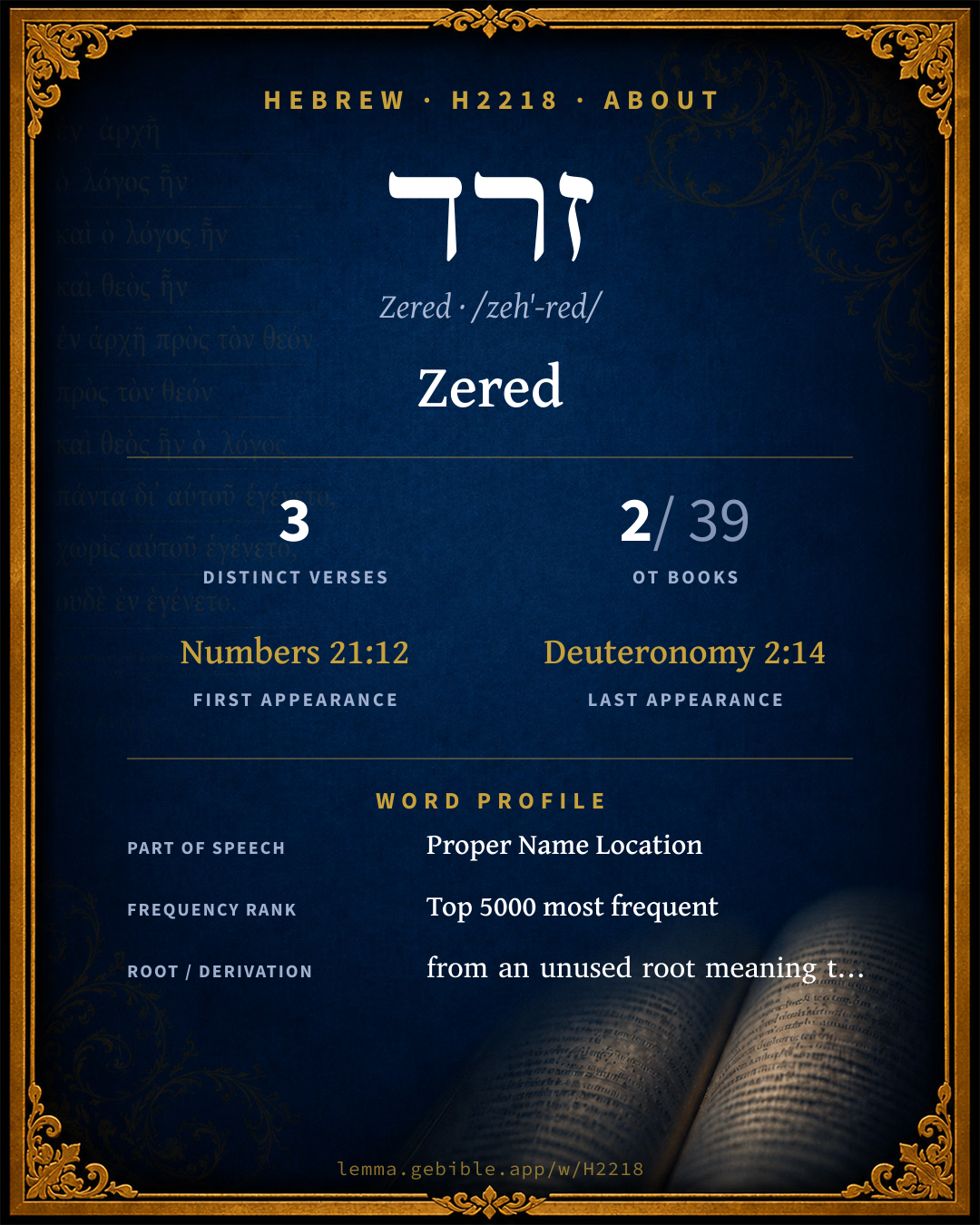
זֶ֫רֶד
Zered
BDB lists 2 entries for ‘Zered’ fuller range ↓
Full lexicon entry — Brown-Driver-Briggs (BDB)
From Brown-Driver-Briggs (BDB)
Where this word appears
Grammar key — what these labels mean
Part of speech
- Noun
- A naming word — a person, place, thing, or idea.
Noun type
- Proper
- A name of a specific person, place, or people (e.g. Abraham, Zion, Israel).
Every verse where H2218 appears — 3 distinct verses across 2 books. Click any verse to open its interlinear word-by-word view. Verse text shown in the World English Bible for context — . Each verse’s Hebrew form is shown with its reference; the English is not keyword-highlighted, since the data carries no word-level English alignment. Use “Compare translations” on any verse to read it across multiple English versions. This concordance covers the Hebrew Bible; Septuagint (Greek Old Testament) occurrences are not indexed here.
Numbers 1 verse
Deuteronomy 2 verses
- Deuteronomy 2:13 זָ֑רֶד זָֽרֶד n Proper n Proper Now rise up, and get you over the brook Zered. We went over the brook Zered.
- Deuteronomy 2:14 זֶ֔רֶד n Proper The days in which we came from Kadesh-barnea, until we were come over the brook Zered, were thirty-eight years; until all the generation of the men of war were consumed from the midst of the camp, as Yahweh swore to them.
About this entry
At a glance — auto-summarized from this page’s data, not written by a person. Every figure links to its source below. This summary describes the numbers; it doesn’t interpret them.
זרד — transliterated Zered — is a Hebrew name carrying the sense “Zered.” It is rare — just 3 verses in the entire Hebrew Bible. More than two-thirds of its appearances fall in Deuteronomy. Debuting at Numbers 21:12, it then recurs through the corpus. See 3-verse concordance and the renderings breakdown below.
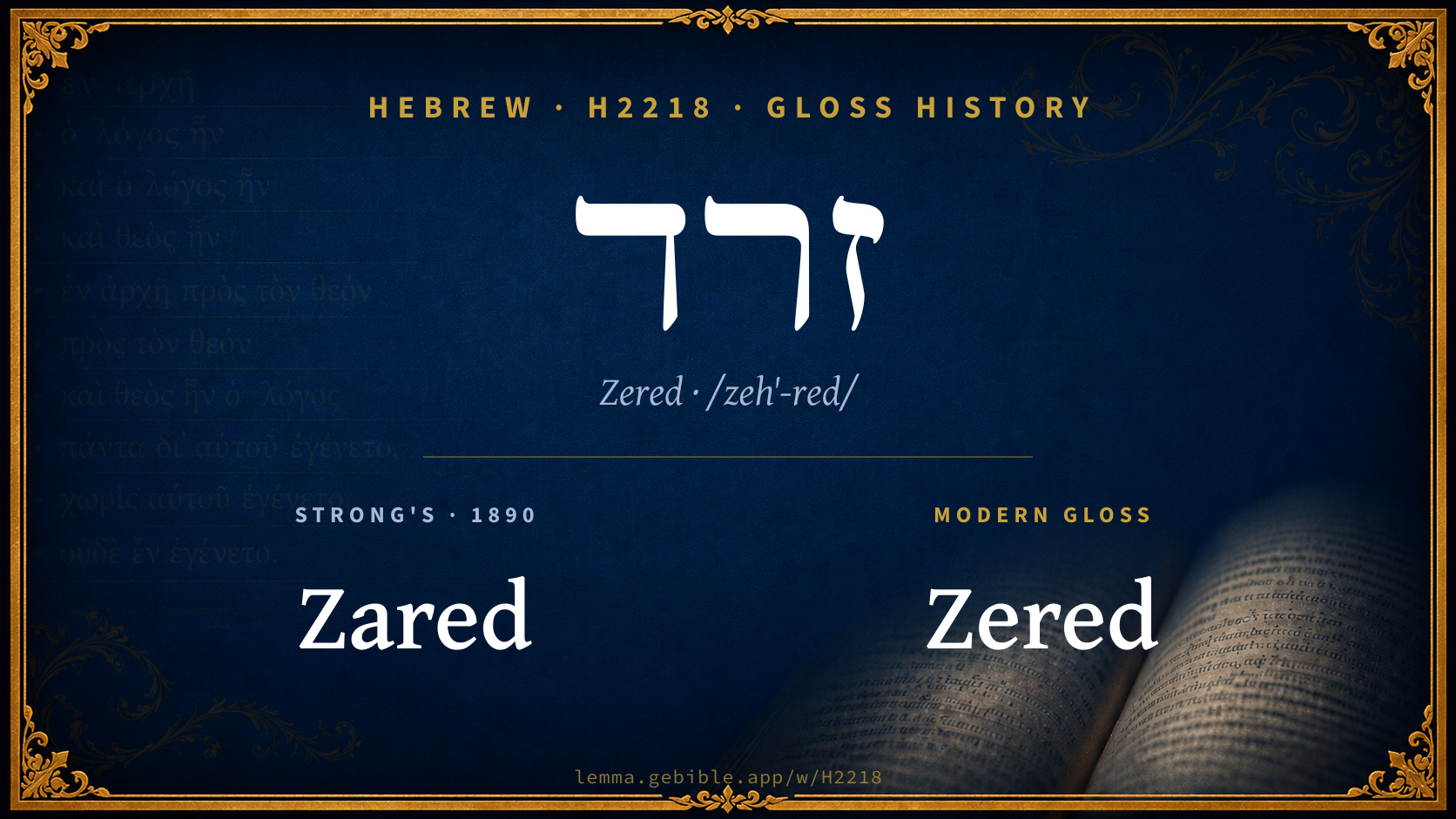
Gloss history
Strong's 1890 vs modern scholarship
About this word
Strong's H2218 catalogs a Hebrew word from the Hebrew Old Testament.
These counts are not copied from any lexicon or concordance. They are computed here, from the morphology-tagged Hebrew Old Testament. What Lemma adds →
- 3
- distinct verses
- The word appears in 3 distinct verses.
- 2 / 39
- OT books
- The word appears in 2 of 39 Old Testament books.
- #3,696
- by frequency
- Top 5000 most frequent Hebrew words (rank 3,696 of 8,640 Hebrew words by occurrence).
View all 3 occurrences in the concordance →
Most concentrated in
- Deuteronomy 2 verses 67%
- Numbers 1 verse 33%
By section of the Old Testament
By traditional corpus
Conventional, traditional groupings — biblical authorship is debated, so this is a traditional corpus grouping, not an authorship claim. Each share is this word’s portion of its verses in that division of the Hebrew canon. Each figure is a share of the word’s 3 distinct verses.
- Torah (Pentateuch) 3 verses · 100%
How translations render this word
Counts come from each version’s own published word-to-Strong’s tagging or interlinear alignment — an approximate guide to how each version renders this word, not a word-level alignment the data otherwise carries. Because each total is that version’s own tagged count, the per-version totals vary from one another and need not match the appearance or distinct-verse counts above. These counts may also differ from a printed concordance because Lemma counts each distinctly tagged rendering and does not collapse phrase taggings into a single head-word total. This is a fixed set of word-tagged versions (KJV, ASV, BSB, ULT) and does not change with the reading translation you choose elsewhere. Each version’s license is shown beside its name below (and on Sources).
- King James Version: Zered 3×
- American Standard Version: Zered 4×
- Berean Standard Bible: Zered 4×
- unfoldingWord Literal Text: Zered 4×
King James Version Public Domain
Renders H2218 across 4 tagged occurrences — most commonly:
Plus 1 rendering that appears only once — usually multi-word phrases or single function words the recovered tagging swept in, not distinct renderings.
American Standard Version Public Domain
Renders H2218 across 4 tagged occurrences — most commonly:
Berean Standard Bible Public Domain
Renders H2218 across 4 tagged occurrences — most commonly:
unfoldingWord Literal Text CC BY-SA 4.0
Renders H2218 across 4 tagged occurrences — most commonly:
Senses in BDB
The 2 senses BDB distinguishes for this word, in lexicon order (not ranked by frequency or importance). The full entry — with sub-senses — is in the Lexicon Entry tab.
- Zered = "osier brook"
- a river east of the Jordan, in the region of Moab and Edom, a source of the Arnon river
Word origin
n.pr.fl. (√ dub.; on form cf. LgBN77)—נַחַל זֶ֫רֶד Dt 2:13; נַחַל זָ֑רֶד Nu 21:12 (JE), Dt 2:13, 14; identification disputed; RobBR ii. 157 proposes Wadyel-Aḥsy (= נַחַל הָעֲרָבִים Is 15:7), between Moab & Edom; Sail Saʿîde (Kn), chief source of Arnon from SE. (Burckh Syrien, 635), or W. Kerak (Ges Ke Di); so also GASmGeog.557.
— Brown-Driver-Briggs (Oxford 1906, public domain), digitized via Sefaria, supplemented by the OpenScriptures HebrewLexicon (CC BY 4.0). See Sources.
Origin: from an unused root meaning to be exuberant in growth
Jastrow Dictionary
A second Hebrew/Aramaic lexicon for comparison, covering Aramaic and post-biblical (Talmudic, Targumic, Midrashic) usage that the biblical-Hebrew BDB does not. Matched by lemma rather than by Strong’s number, so a lemma may carry more than one Jastrow headword (shown separately below), and the entries cover usage well beyond the Bible.
זֶרֶד
- (v. זרז)
- 1. strength, alertness, valor. Yoma 47ᵃ (a metaphor in imitation of Prov. XXXI, 29) כל הנשים זֶ׳ זָרָדוּ וזֶ׳ אמי עלת׳ לגג Ar. (read עלה; ed. הנשים זרדו וז׳ אימא וכ׳ …; Ms. M. זֶרֶז זָרָזוּ אימא, insert וזֶ׳; Ms. M. 2 זריד זרדו וזֶ׳; v. Rabb. D. S. a. l. note) all women have done valiantly, but the valor of my mother excelled them all (a metaphor of careful maternity). e.g. Proverbs 31:29
- 2. (v. next w.) pl. זְרָדִים, זְרָרִין shoots, greens. Tosef. Sabb. IX (X), 16; Sabb. 103ᵃ המְזָרֵד ז׳ וכ׳ he who cuts greens, if for human food &c. Ib. XVIII, 2 (126ᵇ) חבילי ז׳ bundles of greens (young reeds &c., available for fodder); ib. 128ᵃ; Tosef. ib. XIV (XV), 10 זרדן ed. Zuck. (read זרדין, Var. דים …).—Esp. לולבי ז׳ the young sprouts of the service-tree, the interior of which is eaten as a relish. Shebi. VII, 5. Tosef. Sabb. VIII (IX), 9 לולבין וז׳ (corr. acc.); Tosef. Maas. Sh. I, 13; Tosef. Ukts. III, 9; Ukts. III, 4.
- 3. pr. n. (b. h.) Zered, name of a brook, נחלא דז׳. Targ. O. Num. XXI, 12; a. e.—Tosef. Shebi. IV, 11; Y. ib. VI, 36ᶜ; Sifré Deut. 51 דורד; Yalk. Deut. 874 נחלת דור (corr. acc.); v. Hildesh. Beitr. p. 66.
זָרַד
- (denom. of preced.) זָ׳ זֶרֶד (= עשה חיל) to do valiantly. Yoma 47ᵃ, v. preced.
- [to strengthen, accelerate growth; cmp. בְּרָא Af.,] to trim, nip shoots off. Sabb. XII, 2 המקרסם והמְזָרֵד he who cuts off dry twigs, or young shoots. Ib. 103ᵃ, v. preced. Ab. Zar. III, 10 (49ᵇ). Tosef. Sabb. IX (X), 16 וזֵרֵד ed. Zuck. (Var. וזירד).
A Dictionary of the Targumim, the Talmud Babli and Yerushalmi, and the Midrashic Literature (Marcus Jastrow; London, Luzac, 1903) — Public Domain. Digitized via Sefaria. Digitized via Sefaria. Full attribution on Sources.
Forms in the corpus
The 3 distinct written forms H2218 takes in the Hebrew Bible, most frequent first — each parse links to that state’s occurrences in the concordance. Hebrew forms include their vowel points and cantillation, so a single lemma takes many written forms.
| Form | Parsing | Example | Uses |
|---|---|---|---|
| זָֽרֶד | Noun, Proper | Deuteronomy 2:13 | 2 |
| זֶ֔רֶד | Noun, Proper | Deuteronomy 2:14 | 1 |
| זָ֑רֶד | Noun, Proper | Deuteronomy 2:13 | 1 |
Bible dictionary
Public-domain dictionary articles matched to this entry by name (Zered). A biblical name can be shared by more than one person or place, so an article may treat several.
Easton's Bible Dictionary · M. G. Easton, 1897
=Zared, luxuriance; willow bush, a brook or valley communicating with the Dead Sea near its southern extremity (Num. 21:12; Deut. 2:14). It is called the "brook of the willows" (Isa. 15:7) and the "river of the wilderness" (Amos 6:14). It has been identified with the Wady el-Aksy.
Smith's Bible Dictionary · William Smith, 1863
(osier brook), (2:13,14) or Za'red, (Numbers 21:12) a brook or valley running into the Dead Sea near its southeast corner, which Dr. Robinson with some probability suggests as identical with the Wady el-Ahsy . It lay between Moab and Edom and is the limit of the proper term of the Israelites' wandering. (2:14)
Classic public-domain reference works; full attribution on Sources.
Septuagint verse parallels
This word appears in 3 verses that also exist in the Greek Old Testament (Septuagint), out of the 3 Hebrew verses it occurs in. You can read those verses in Greek by switching the Old Testament edition to the Septuagint.
Read these verses in the Septuagint
This is a verse-level parallel only — the same verses exist in both the Hebrew and Greek Old Testaments. No word-level Hebrew↔Greek correspondence is claimed: the data carries no such alignment, so no Greek word is shown as this Hebrew word’s translation. Coverage is not total — the Septuagint omits the deuterocanon and renumbers the Psalms, so some Hebrew verses have no direct Greek parallel.