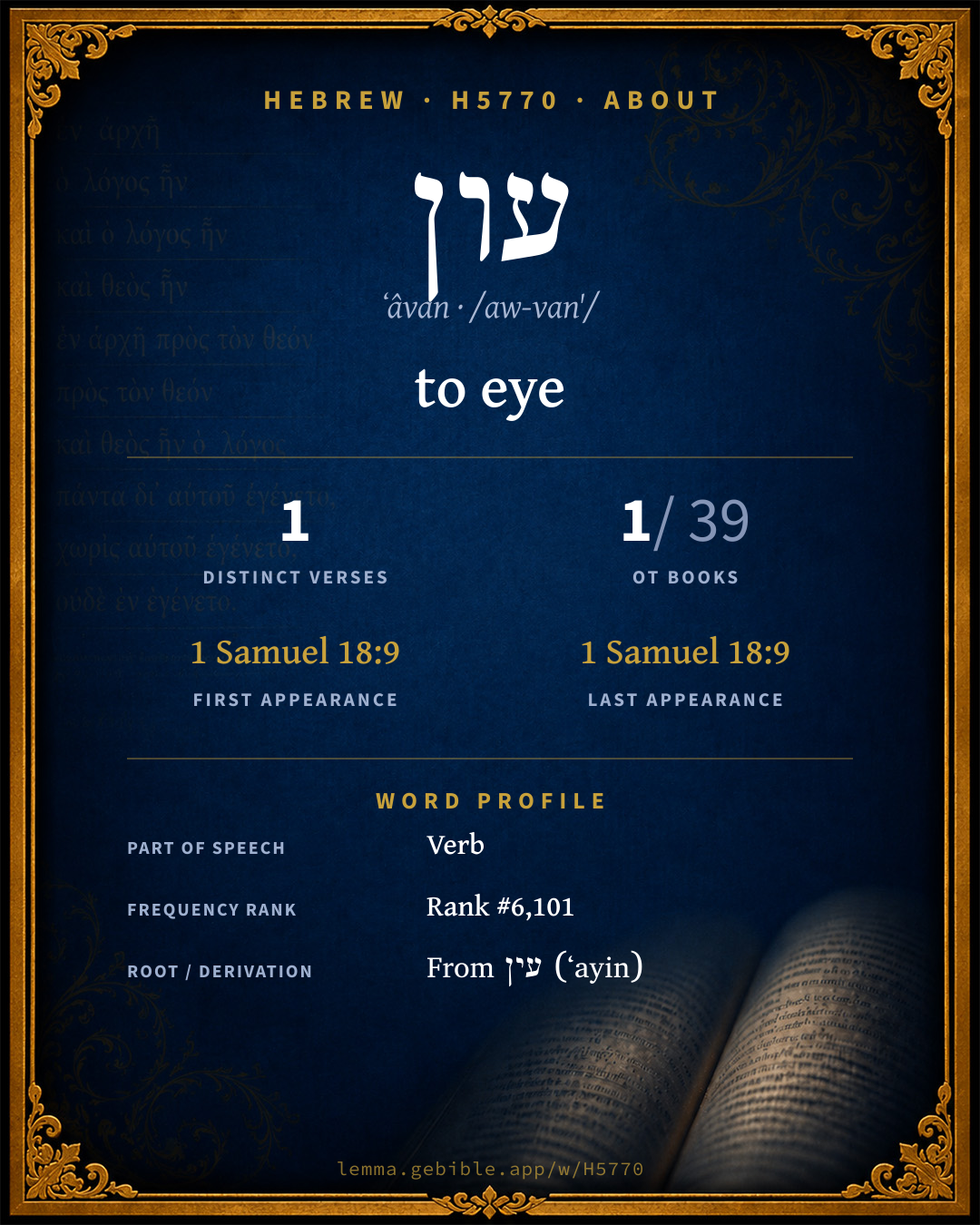
עִין
to eye
‘to eye’ is one of 2 main senses fuller range ↓
Full lexicon entry — Brown-Driver-Briggs (BDB)
From Brown-Driver-Briggs (BDB)
Where this word appears
Grammar key — what these labels mean
Part of speech
- Verb
- An action or state-of-being word.
Stem
- Qal
- The basic, simple active stem — the plain form of the verb (“he wrote”).
Form
- Participle Active
- A verbal adjective expressing ongoing or characteristic action (“writing / one who writes”).
State
- Absolute
- The independent form of a noun, not bound to a following word.
Gender
- Masculine
- Grammatically masculine.
Number
- Singular
- One.
Every verse where H5770 appears — 1 distinct verse across 1 book. Click any verse to open its interlinear word-by-word view. Verse text shown in the World English Bible for context — . Each verse’s Hebrew form is shown with its reference; the English is not keyword-highlighted, since the data carries no word-level English alignment. Use “Compare translations” on any verse to read it across multiple English versions. This concordance covers the Hebrew Bible; Septuagint (Greek Old Testament) occurrences are not indexed here.
1 Samuel 1 verse
About this entry
At a glance — auto-summarized from this page’s data, not written by a person. Every figure links to its source below. This summary describes the numbers; it doesn’t interpret them.
עון — transliterated ʻâvan — is a Hebrew verb carrying the sense “to eye.” It is rare — just 1 verse in the entire Hebrew Bible. Its uses cluster heavily in 1 Samuel (100% of all occurrences). Found nowhere else but 1 Samuel 18:9. Its lexical range runs to 2 senses. See the sense tree, 1-verse concordance, and the renderings breakdown below.
Gloss history
Strong's 1890 vs modern scholarship

About this word
Strong's H5770 catalogs a Hebrew word from the Hebrew Old Testament.
These counts are not copied from any lexicon or concordance. They are computed here, from the morphology-tagged Hebrew Old Testament. What Lemma adds →
- 1
- distinct verses
- The word appears in 1 distinct verse.
- 1 / 39
- OT books
- The word appears in 1 of 39 Old Testament books.
- #6,101
- by frequency
- Rank #6,101 (rank 6,101 of 8,640 Hebrew words by occurrence).
View all 1 occurrence in the concordance →
Most concentrated in
- 1 Samuel 1 verse 100%
By section of the Old Testament
By traditional corpus
Conventional, traditional groupings — biblical authorship is debated, so this is a traditional corpus grouping, not an authorship claim. Each share is this word’s portion of its verses in that division of the Hebrew canon. Each figure is a share of the word’s 1 distinct verse.
- Prophets (Nevi'im) 1 verse · 100%
How translations render this word
Counts come from each version’s own published word-to-Strong’s tagging or interlinear alignment — an approximate guide to how each version renders this word, not a word-level alignment the data otherwise carries. Because each total is that version’s own tagged count, the per-version totals vary from one another and need not match the appearance or distinct-verse counts above. These counts may also differ from a printed concordance because Lemma counts each distinctly tagged rendering and does not collapse phrase taggings into a single head-word total. This is a fixed set of word-tagged versions (KJV, ASV, BSB, ULT) and does not change with the reading translation you choose elsewhere. Each version’s license is shown beside its name below (and on Sources).
- King James Version: Eyed 1×
- American Standard Version: Eyed 1×
- unfoldingWord Literal Text: Was eyeing 1×
King James Version Public Domain
Renders H5770 across 1 tagged occurrence — most commonly:
American Standard Version Public Domain
Renders H5770 across 1 tagged occurrence — most commonly:
unfoldingWord Literal Text CC BY-SA 4.0
Renders H5770 across 1 tagged occurrence — most commonly:
Senses in BDB
The 2 senses BDB distinguishes for this word, in lexicon order (not ranked by frequency or importance). The full entry — with sub-senses — is in the Lexicon Entry tab.
- to eye, look at
- (Qal) to eye, look at
Word origin
[ עִין ] vb. denom. eye (enviously), look (askance) at;— Qal 1 S 18:9 Qr
— Brown-Driver-Briggs (Oxford 1906, public domain), digitized via Sefaria, supplemented by the OpenScriptures HebrewLexicon (CC BY 4.0). See Sources.
Derived from עין (ʻayin) (H5869) — eye.
Jastrow Dictionary
A second Hebrew/Aramaic lexicon for comparison, covering Aramaic and post-biblical (Talmudic, Targumic, Midrashic) usage that the biblical-Hebrew BDB does not. Matched by lemma rather than by Strong’s number, so a lemma may carry more than one Jastrow headword (shown separately below), and the entries cover usage well beyond the Bible.
עָוֹן
- 1. perversion, wrong. Deut. R. s. 3 לא חטא ולא ע׳ no sin or wrong. Sabb. 30ᵃ אותו ע׳ that sin (of David’s, against Uriah and Bathsheba); Snh. 107ᵃ מחול לי על אותו ע׳ כולו pardon me for that sin entirely. Sabb. 88ᵇ עֲוֹן גדי, v. כָּרַם. Snh. 44ᵇ אם יש בי ע׳ זה if I am guilty of that crime (for which I am to be put to death); a. fr.—ע׳ גליון, v. אָוֶן.—Pl. עֲוֹנוֹת, עֲווֹנוֹת. Ib. תהא … עֲווֹנוֹתַיי may my death be an atonement for all my wrong-doings. Ber. 5ᵇ מוחלין לו כל עֲוֹנוֹתָיו is forgiven all his sins. Yoma III, 8. Ib. 39ᵇ עְווֹנוֹתֵיהֶן של ישראל the sins of Israel; a. v. fr.
- 2. (sub. עוֹנֶשׁ) penalty. Yeb. 47ᵃ מודיעין אותו עֲוֹן לקט וכ׳ we acquaint him (the proselyte) with the consequences of a neglect of the laws concerning the share of the poor &c., v. עוֹנֶשׁ.—בַּעֲ׳ as a punishment for, in consequence of. Sabb. 32ᵇ בע׳ נדרים (sub. ביטול) as a punishment for the neglect of vows; בע׳ מזוזה for neglecting the law concerning the door-post inscription; בע׳ ביטול תורה for neglecting the study of the Law; בע׳ גילוי עריות for unchastity; a. fr.
עוּן
- to be round, curved; denom. עַיִן.
- (denom. of עַיִן)
- 1. to look in, read. Tanḥ. Ki Thissa 34 אסור … לעַיֵּין בתורה וכ׳ the interpreter must not look into the Torah (Hebrew text) and translate; (Pesik. R. s. 5 ליתן עיניו).
- 2. to look carefully; to search, investigate (cmp. דּוּק a. דִּקְדֵּק). B. Bath. 115ᵃ (ref. ובן אין לו, Num. XXVII, 8) עַיֵּין עליו (Ar. אַיֵּין) investigate his case (whether he has really no male issue); Yeb. 22ᵇ. Kidd. 4ᵃ (ref. to Lev. XXII, 13 וזרע אין לה) עיין לה; Yeb. 70ᵃ עיין עלה (Chald.). e.g. Numbers 27:8
- 3. to speculate, contemplate. Ber. 55ᵃ המאריך בתפלתו ומְעַיֵּין בה he who stays long in prayer and speculates on it (expecting its fulfillment as a reward for his lengthy prayer); Yalk. Prov. 950; Ber. 32ᵇ; a. e.
- 4. [to measure with the eye] to balance exactly, opp. הכריע (v. כָּרַע). B. Bath. 89ᵃ אין מְעַיְּינִין … במקום שמעיינין where it is customary to give overweight, you dare not sell by exact weight, and vice versa; a. e.—Part. pass. מְעוּיָּין a) (adv.) weighed exactly, even-balanced. Num. R. s. 16, end (ref. to עין בעין, Num. XIV, 14) הרי מאזנים מע׳ אתה וכ׳ behold the scales are evenly balanced, thou sayest …, and I say &c.; Deut. R. s. 5 הרי מדת הדין בכף מאזנים מע׳ judgment lies on evenly balanced scales. Tanḥ. Ki Thissa 34; Pesik. R. s. 5, beg. המאזניים מע׳ the claims on both sides are equal. Y. Snh. X, beg. 27ᶜ היה מע׳ if it (his sins and his merits) be even; Y. Peah I, 16ᵇ bot.; Y. Kidd. I, end, 61ᵈ מחציין (corr. acc.); Yalk. Ps. 784 כף מאזניים מע׳ [היה]; a. e.—b) having eyes (rings) or colors. Y. Kil. I, 27ᵃ, v. לְעוּנִים. e.g. Numbers 14:14
- (b. h.) [to contemplate; to augur;] to produce apparitions, to conjure. Snh. 65ᵇ, a. e. (interpret. מעונן, Deut. XVIII, 10) המעביר … על העין, v. זְכוּרוּ. Ib. (oth. interpret.) האוהז את העינים, v. אָחַז. Ib. (oth. interpret.; cmp. Pi.) המחשב עתים ושעות וכ׳ who calculates what times and hours are auspicious &c.; [Comment. on המחשב עתים explain עונן as denomin. of עוֹנָה I]; Tosef. Sabb. VII (VIII), 14 נותני עתים וכ׳. e.g. Deuteronomy 18:10
עוּן ²
- Pa. עֵיֵּין, עַיֵּן same,
- 1. to watch, guard. Targ. Y. II, Deut. XXXII, 10 עַיְּינֵי (Paeli).—B. Kam. 32ᵇ איבעי ליה עַיּוּנֵי (עַיּוּנֵיה) he ought to have been on his guard; Macc. 8ᵃ לעַיּיוּנֵיה.
- 2. to look out for, select. Targ. Job VIII, 17 יְעַיֵּין ed. Lag. (oth. ed. יְעוֹיִן).
- 3. to look into, meditate, study, speculate. M. Kat. 14ᵇ לעיוני בדיניה to study his case (not to decide it). Ib. אתו מצפרא ומְעַיְּינֵי בדיניה וכ׳ they meet in the morning and consider his case …, and then they come again at sunset &c. Ber. 25ᵃ עַיֵּין אי וכ׳ examine and see whether &c. Ib. 58ᵃ עד דמעייני ביה בדינא while they were arguing about him in court. Snh. 18ᵇ ומְעַיְּינִינָא וכ׳ and we argue on his case. Meg. 30ᵇ מְעַיְּינִינָן במילי דמתא we look into the affairs (the moral condition) of the town. Gitt. 60ᵃ; Tem. 14ᵇ מְעַיְּינֵי בספרא וכ׳ used to study the book of &c. R. Hash. 16ᵃ בחינה עיוני בעלמא היא ‘to probe’ (בחן) means merely to investigate (without decreeing). Ber. 55ᵃ דמְעַיּין בה when he thinks of his prayer (expecting its fulfilment), v. preced; a. fr.—[Pol. עוֹנֵן, v. עֲנַן.]
A Dictionary of the Targumim, the Talmud Babli and Yerushalmi, and the Midrashic Literature (Marcus Jastrow; London, Luzac, 1903) — Public Domain. Digitized via Sefaria. Digitized via Sefaria. Full attribution on Sources.
Same root — word family
Other BDB entries built from the same root as H5770, grouped by Strong’s listed origin. These share a root / origin per the lexicon — not necessarily a shared meaning. Each links to that word’s own entry.
Derives from
Shares the same root
Proper names from this root
People and places named from this root — a name, not an additional meaning of the word.
- עין ʻAyin H5871 Ain
- עין גדי ʻÊyn Gedîy H5872 En-gedi
- עין גנים ʻÊyn Gannîym H5873 En-gannim
- עיןדאר ʻÊyn-Dôʼr H5874 En-dor
- עין הקורא ʻÊyn haq-Qôwrêʼ H5875 En-hakkore
- עין חדה ʻÊyn Chaddâh H5876 En-haddah
- עין חצור ʻÊyn Châtsôwr H5877 En-hazor
- עין חרד ʻÊyn Chărôd H5878 En-harod
- עינים ʻÊynayim H5879 Enam
- עין משפט ʻÊyn Mishpâṭ H5880 En-mishpat
- עינן ʻÊynân H5881 Enan
- עין עגלים ʻÊyn ʻEglayim H5882 En-eglaim
- עין רגל ʻÊyn Rôgêl H5883 En-rogel
- עין רמון ʻÊyn Rimmôwn H5884 En-rimmon
- עין שמש ʻÊyn Shemesh H5885 En-shemesh
- עין תנים ʻÊyn Tannîym H5886 dragon well
- עין תפוח ʻÊyn Tappûwach H5887 En-tappuah
- ענים ʻÂnîym H6044 Anim
- ענם ʻÂnêm H6046 Anem
Compare all same-root words → Showing 4 of 23 — not the complete family. 19 of the same-root words are proper names (people or places). They share a root, not necessarily a meaning.
Septuagint verse parallels
This word appears in 1 verse that also exists in the Greek Old Testament (Septuagint), out of the 1 Hebrew verse it occurs in. You can read those verses in Greek by switching the Old Testament edition to the Septuagint.
Read these verses in the Septuagint
This is a verse-level parallel only — the same verses exist in both the Hebrew and Greek Old Testaments. No word-level Hebrew↔Greek correspondence is claimed: the data carries no such alignment, so no Greek word is shown as this Hebrew word’s translation. Coverage is not total — the Septuagint omits the deuterocanon and renumbers the Psalms, so some Hebrew verses have no direct Greek parallel.