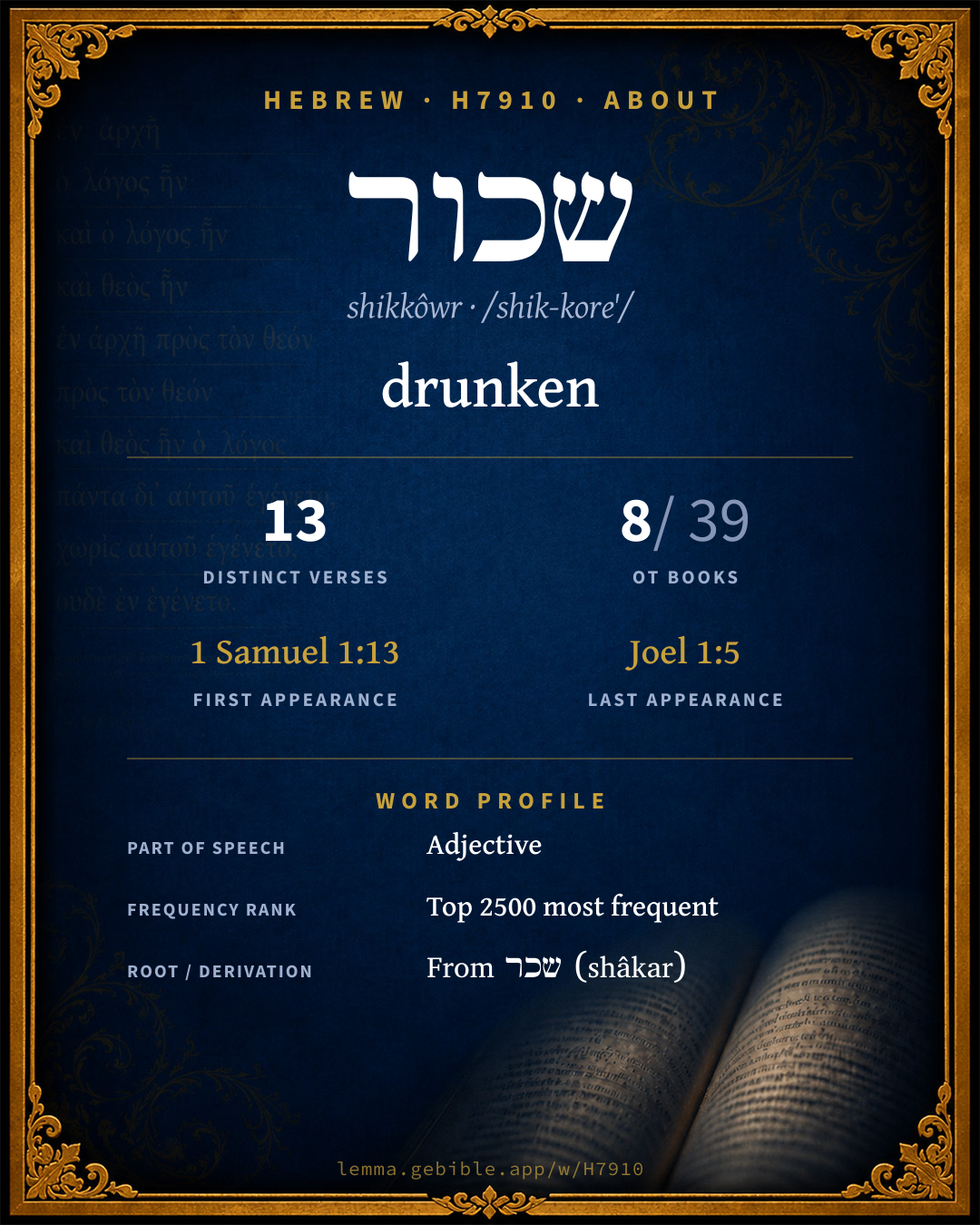
שִׁכֹּר
drunken
‘drunken’ is one of 2 main senses fuller range ↓
Full lexicon entry — Brown-Driver-Briggs (BDB)
From Brown-Driver-Briggs (BDB)
Where this word appears
See every Absolute-state word in the Hebrew Bible →
Grammar key — what these labels mean
Part of speech
- Adjective
- A word that describes or qualifies a noun.
State
- Absolute
- The independent form of a noun, not bound to a following word.
- Construct
- A noun bound to a following noun in a possessive / “of” relationship (the construct chain).
Gender
- Masculine
- Grammatically masculine.
- Feminine
- Grammatically feminine.
Number
- Singular
- One.
- Plural
- More than one (in Hebrew, generally three or more).
Grammatical forms
- Adjective, Adjective, Masculine, Singular, Absolute 9 times (69%)
- Adjective, Adjective, Masculine, Plural, Construct 2 times (15%)
- Adjective, Adjective, Masculine, Plural, Absolute 1 time (8%)
- Adjective, Adjective, Feminine, Singular, Absolute 1 time (8%)
Parsed forms decoded from the imported morphology (morphhb / Westminster Leningrad Codex — WLC text public domain, morphhb tagging CC BY 4.0), counted across 13 parsed occurrences — not distinct verses.
Every verse where H7910 appears — 13 distinct verses across 8 books. Click any verse to open its interlinear word-by-word view. Verse text shown in the World English Bible for context — . Each verse’s Hebrew form is shown with its reference; the English is not keyword-highlighted, since the data carries no word-level English alignment. Use “Compare translations” on any verse to read it across multiple English versions. This concordance covers the Hebrew Bible; Septuagint (Greek Old Testament) occurrences are not indexed here.
1 Samuel 2 verses
- 1 Samuel 1:13 לְ/שִׁכֹּרָֽה prep + Adjective Adjective fs Now Hannah, she spoke in her heart; only her lips moved, but her voice was not heard: therefore Eli thought she had been drunken.
- 1 Samuel 25:36 שִׁכֹּ֖ר adj Adjective ms Abigail came to Nabal; and, behold, he held a feast in his house, like the feast of a king; and Nabal's heart was merry within him, for he was very drunken: therefore she told him nothing, less or more, until the morning light.
1 Kings 2 verses
- 1 Kings 16:9 שִׁכּ֔וֹר adj Adjective ms His servant Zimri, captain of half his chariots, conspired against him. Now he was in Tirzah, drinking himself drunk in the house of Arza, who was over the household in Tirzah:
- 1 Kings 20:16 שִׁכּ֜וֹר adj Adjective ms They went out at noon. But Ben Hadad was drinking himself drunk in the pavilions, he and the kings, the thirty-two kings who helped him.
Job 1 verse
Psalms 1 verse
Proverbs 1 verse
Isaiah 4 verses
- Isaiah 19:14 שִׁכּ֖וֹר adj Adjective ms Yahweh has mixed a spirit of perverseness in the midst of her; and they have caused Egypt to go astray in every work of it, as a drunken man staggers in his vomit.
- Isaiah 24:20 כַּ/שִּׁכּ֔וֹר prep det + Adjective Adjective ms The earth shall stagger like a drunken man, and shall sway back and forth like a hammock; and the disobedience of it shall be heavy on it, and it shall fall, and not rise again.
- Isaiah 28:1 שִׁכֹּרֵ֣י adj Adjective mp cs Woe to the crown of pride of the drunkards of Ephraim, and to the fading flower of his glorious beauty, which is on the head of the fat valley of those who are overcome with wine!
- Isaiah 28:3 שִׁכּוֹרֵ֥י adj Adjective mp cs The crown of pride of the drunkards of Ephraim shall be trodden under foot:
Jeremiah 1 verse
Joel 1 verse
About this entry
At a glance — auto-summarized from this page’s data, not written by a person. Every figure links to its source below. This summary describes the numbers; it doesn’t interpret them.
שכור — transliterated shikkôwr — is a Hebrew adjective carrying the sense “drunken.” It first appears in 1 Samuel 1:13. The Hebrew Bible uses it across 13 verses — uncommon. More than a quarter of its appearances fall in Isaiah. Its lexical range runs to 2 senses. Each statement above links to its evidence; the full detail follows below.
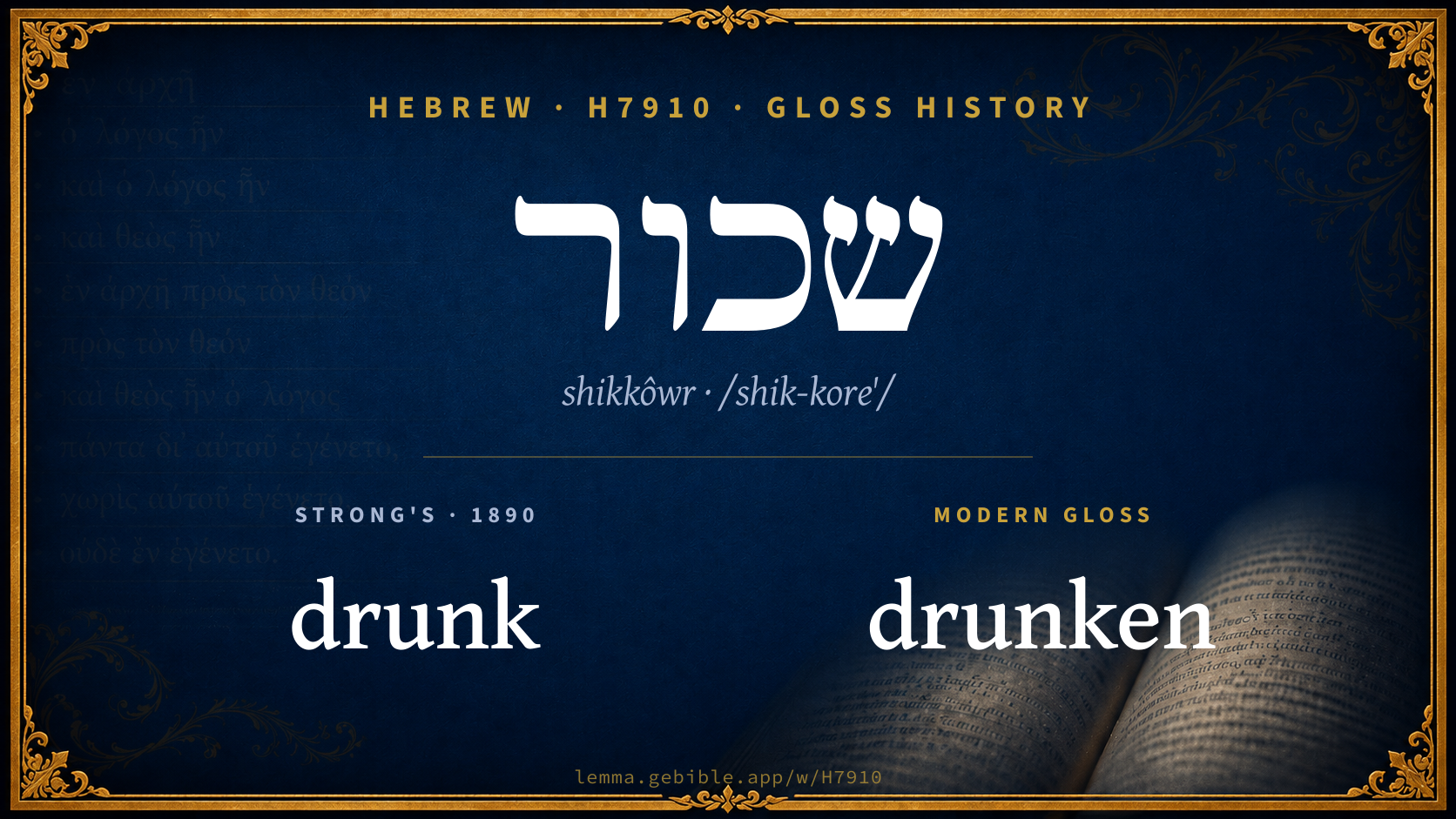
Gloss history
Strong's 1890 vs modern scholarship
About this word
Strong's H7910 catalogs a Hebrew word from the Hebrew Old Testament.
These counts are not copied from any lexicon or concordance. They are computed here, from the morphology-tagged Hebrew Old Testament. What Lemma adds →
- 13
- distinct verses
- The word appears in 13 distinct verses.
- 8 / 39
- OT books
- The word appears in 8 of 39 Old Testament books.
- #2,001
- by frequency
- Top 2500 most frequent Hebrew words (rank 2,001 of 8,640 Hebrew words by occurrence).
View all 13 occurrences in the concordance →
By section of the Old Testament
By traditional corpus
Conventional, traditional groupings — biblical authorship is debated, so this is a traditional corpus grouping, not an authorship claim. Each share is this word’s portion of its verses in that division of the Hebrew canon. Each figure is a share of the word’s 13 distinct verses.
- Prophets (Nevi'im) 10 verses · 77%
- Writings (Ketuvim) 3 verses · 23%
How translations render this word
Counts come from each version’s own published word-to-Strong’s tagging or interlinear alignment — an approximate guide to how each version renders this word, not a word-level alignment the data otherwise carries. Because each total is that version’s own tagged count, the per-version totals vary from one another and need not match the appearance or distinct-verse counts above. These counts may also differ from a printed concordance because Lemma counts each distinctly tagged rendering and does not collapse phrase taggings into a single head-word total. This is a fixed set of word-tagged versions (KJV, ASV, BSB, ULT) and does not change with the reading translation you choose elsewhere. Each version’s license is shown beside its name below (and on Sources).
- King James Version: Drunkards 2×, Himself drunk 2×
- American Standard Version: Drunkards 2×, Himself drunk 2×, Like a drunken man 2×
- Berean Standard Bible: Drunk 2×, Drunkard 2×, Drunkards 2×
- unfoldingWord Literal Text: Drunk 2×, Drunkard 2×, Drunkards of 2×
King James Version Public Domain
Renders H7910 across 13 tagged occurrences — most commonly:
Plus 9 renderings that appear only once — usually multi-word phrases or single function words the recovered tagging swept in, not distinct renderings.
American Standard Version Public Domain
Renders H7910 across 13 tagged occurrences — most commonly:
Plus 7 renderings that appear only once — usually multi-word phrases or single function words the recovered tagging swept in, not distinct renderings.
Berean Standard Bible Public Domain
Renders H7910 across 11 tagged occurrences — most commonly:
Plus 3 renderings that appear only once — usually multi-word phrases or single function words the recovered tagging swept in, not distinct renderings. Not rendered by a distinct English word in 2 further occurrences.
unfoldingWord Literal Text CC BY-SA 4.0
Renders H7910 across 14 tagged occurrences — most commonly:
Plus 6 renderings that appear only once — usually multi-word phrases or single function words the recovered tagging swept in, not distinct renderings.
Senses in BDB
The 2 senses BDB distinguishes for this word, in lexicon order (not ranked by frequency or importance). The full entry — with sub-senses — is in the Lexicon Entry tab.
- drunken
- drunkard, drunken one (substantive)
Word origin
adj. drunken (BaNB § 134 b);—abs. שִׁכֹּר 1 S 25:36, שִׁכּוֹר 1 K 16:9 +, f. שִׁכֹּרָה 1 S 1:13, pl. שִׁכּוֹרִים Jo 1:5, cstr. שִׁכֹּרֵי Is 28:1; 3;—drunken: 1 S 25:36, אִישׁ שׁ׳ Je 23:9, שֹׁתֶה שׁ׳ 1 K 16:9 drinking (and) drunken, 20:16; as subst. = drunken one, drunkard Is 28:1, 3 Pr 26:9, pl. Jo 1:5 (‖ שֹׁתֵי יַיִן); in sim. Is 19:14; Jb 12:25 ψ 107:27, and (of earth) Is 24:20; f. of drunken woman 1 S 1:13.
— Brown-Driver-Briggs (Oxford 1906, public domain), digitized via Sefaria, supplemented by the OpenScriptures HebrewLexicon (CC BY 4.0). See Sources.
Derived from שכר (shâkar) (H7937) — to be drunk.
Jastrow Dictionary
A second Hebrew/Aramaic lexicon for comparison, covering Aramaic and post-biblical (Talmudic, Targumic, Midrashic) usage that the biblical-Hebrew BDB does not. Matched by lemma rather than by Strong’s number, so a lemma may carry more than one Jastrow headword (shown separately below), and the entries cover usage well beyond the Bible.
שְׂכוֹר
- S’khor Bizzaé. Snh. 95ᵃ (Var. שכר); v., however, בִּזָּאֵי.
שִׁכּוֹר
- drunk, intoxicated. Erub. 64ᵃ ש׳ אל יתפלל an intoxicated person should not pray, contrad. to שתוי under the influence of wine. Ib. שתוי … ש׳ שאין וכ׳ shathuy is he who could speak before a king (who could collect his mind, if he were suddenly summoned to speak &c.), shikkor is he who could not &c. Ber. 31ᵇ ש׳ שמתפלל וכ׳ a drunk person that prays is like one worshipping an idol. Num. R. s. 10; Tanḥ. Sh’mini 11; a. fr.
A Dictionary of the Targumim, the Talmud Babli and Yerushalmi, and the Midrashic Literature (Marcus Jastrow; London, Luzac, 1903) — Public Domain. Digitized via Sefaria. Digitized via Sefaria. Full attribution on Sources.
Forms in the corpus
The 12 distinct written forms H7910 takes in the Hebrew Bible, most frequent first — each parse links to that state’s occurrences in the concordance. Hebrew forms include their vowel points and cantillation, so a single lemma takes many written forms.
| Form | Parsing | Example | Uses |
|---|---|---|---|
| שִׁכּ֔וֹר | Adjective, Adjective, Masculine, Singular, Absolute | 1 Kings 16:9 | 2 |
| כַּ/שִּׁכּ֑וֹר | Adjective, Adjective, Masculine, Singular, Absolute | Psalms 107:27 | 1 |
| כַּ/שִּׁכּ֔וֹר | Adjective, Adjective, Masculine, Singular, Absolute | Isaiah 24:20 | 1 |
| כַּ/שִּׁכּֽוֹר | Adjective, Adjective, Masculine, Singular, Absolute | Job 12:25 | 1 |
| לְ/שִׁכֹּרָֽה | Adjective, Adjective, Feminine, Singular, Absolute | 1 Samuel 1:13 | 1 |
| שִׁכּ֑וֹר | Adjective, Adjective, Masculine, Singular, Absolute | Proverbs 26:9 | 1 |
| שִׁכּ֖וֹר | Adjective, Adjective, Masculine, Singular, Absolute | Isaiah 19:14 | 1 |
| שִׁכּ֜וֹר | Adjective, Adjective, Masculine, Singular, Absolute | 1 Kings 20:16 | 1 |
| שִׁכֹּ֖ר | Adjective, Adjective, Masculine, Singular, Absolute | 1 Samuel 25:36 | 1 |
| שִׁכֹּרֵ֣י | Adjective, Adjective, Masculine, Plural, Construct | Isaiah 28:1 | 1 |
| שִׁכּוֹרִים֙ | Adjective, Adjective, Masculine, Plural, Absolute | Joel 1:5 | 1 |
| שִׁכּוֹרֵ֥י | Adjective, Adjective, Masculine, Plural, Construct | Isaiah 28:3 | 1 |
Same root — word family
Other BDB entries built from the same root as H7910, grouped by Strong’s listed origin. These share a root / origin per the lexicon — not necessarily a shared meaning. Each links to that word’s own entry.
Derives from
Shares the same root
Compare all same-root words → They share a root, not necessarily a meaning.
Septuagint verse parallels
This word appears in 12 verses that also exist in the Greek Old Testament (Septuagint), out of the 13 Hebrew verses it occurs in. You can read those verses in Greek by switching the Old Testament edition to the Septuagint.
Read these verses in the Septuagint
This is a verse-level parallel only — the same verses exist in both the Hebrew and Greek Old Testaments. No word-level Hebrew↔Greek correspondence is claimed: the data carries no such alignment, so no Greek word is shown as this Hebrew word’s translation. Coverage is not total — the Septuagint omits the deuterocanon and renumbers the Psalms, so some Hebrew verses have no direct Greek parallel.