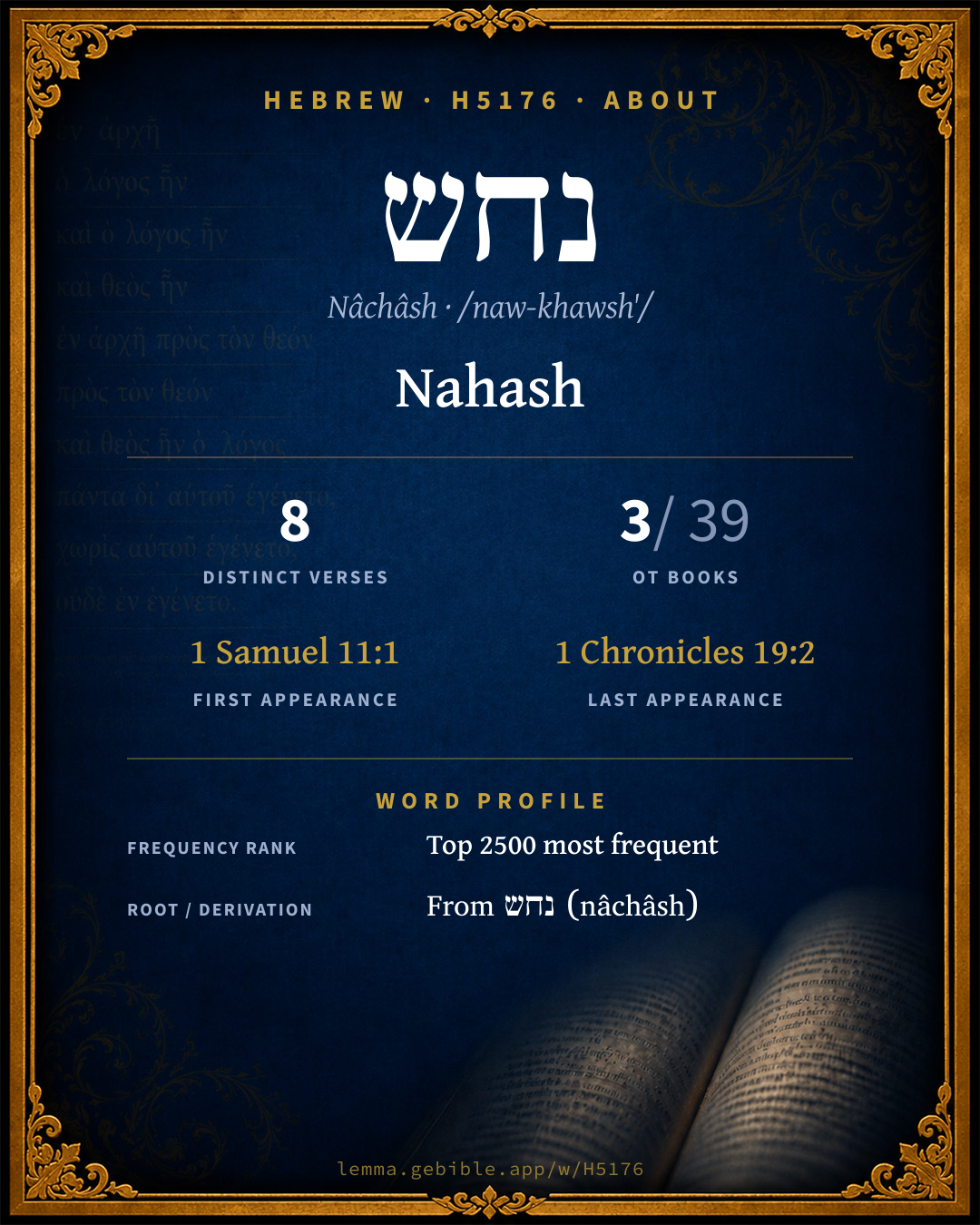
נָחָשׁ
Nahash
BDB lists 3 entries for ‘Nahash’ fuller range ↓
Full lexicon entry — Brown-Driver-Briggs (BDB)
From Brown-Driver-Briggs (BDB)
Where this word appears
Grammar key — what these labels mean
Part of speech
- Noun
- A naming word — a person, place, thing, or idea.
Noun type
- Proper
- A name of a specific person, place, or people (e.g. Abraham, Zion, Israel).
Every verse where H5176 appears — 8 distinct verses across 3 books. Click any verse to open its interlinear word-by-word view. Verse text shown in the World English Bible for context — . Each verse’s Hebrew form is shown with its reference; the English is not keyword-highlighted, since the data carries no word-level English alignment. Use “Compare translations” on any verse to read it across multiple English versions. This concordance covers the Hebrew Bible; Septuagint (Greek Old Testament) occurrences are not indexed here.
1 Samuel 3 verses
- 1 Samuel 11:1 נָחָשׁ֙ נָחָ֔שׁ n Proper n Proper Then Nahash the Ammonite came up, and encamped against Jabesh Gilead: and all the men of Jabesh said to Nahash, Make a covenant with us, and we will serve you.
- 1 Samuel 11:2 נָחָשׁ֙ n Proper Nahash the Ammonite said to them, On this condition will I make it with you, that all your right eyes be put out; and I will lay it for a reproach on all Israel.
- 1 Samuel 12:12 נָחָ֞שׁ n Proper When you saw that Nahash the king of the children of Ammon came against you, you said to me, No, but a king shall reign over us; when Yahweh your God was your king.
2 Samuel 3 verses
- 2 Samuel 10:2 נָחָ֗שׁ n Proper David said, I will show kindness to Hanun the son of Nahash, as his father shown kindness to me. So David sent by his servants to comfort him concerning his father. David's servants came into the land of the children of Ammon.
- 2 Samuel 17:25 נָחָ֔שׁ n Proper Absalom set Amasa over the host instead of Joab. Now Amasa was the son of a man, whose name was Ithra the Israelite, who went in to Abigail the daughter of Nahash, sister to Zeruiah, Joab's mother.
- 2 Samuel 17:27 נָחָ֜שׁ n Proper It happened, when David was come to Mahanaim, that Shobi the son of Nahash of Rabbah of the children of Ammon, and Machir the son of Ammiel of Lodebar, and Barzillai the Gileadite of Rogelim,
1 Chronicles 2 verses
- 1 Chronicles 19:1 נָחָ֖שׁ n Proper It happened after this, that Nahash the king of the children of Ammon died, and his son reigned in his place.
- 1 Chronicles 19:2 נָחָ֗שׁ n Proper David said, I will show kindness to Hanun the son of Nahash, because his father shown kindness to me. So David sent messengers to comfort him concerning his father. David's servants came into the land of the children of Ammon to Hanun, to comfort him.
About this entry
At a glance — auto-summarized from this page’s data, not written by a person. Every figure links to its source below. This summary describes the numbers; it doesn’t interpret them.
At its core, נחש (Nâchâsh) means “Nahash.” Scripture first uses it in 1 Samuel 11:1. It appears 8 verses across 3 books of the Hebrew Bible, among its uncommon vocabulary. The word gravitates to 1 Samuel (38%), then 2 Samuel and 1 Chronicles. Each statement above links to its evidence; the full detail follows below.
Gloss history
Strong's 1890 vs modern scholarship
About this word
Strong's H5176 catalogs a Hebrew word from the Hebrew Old Testament.
These counts are not copied from any lexicon or concordance. They are computed here, from the morphology-tagged Hebrew Old Testament. What Lemma adds →
- 8
- distinct verses
- The word appears in 8 distinct verses.
- 3 / 39
- OT books
- The word appears in 3 of 39 Old Testament books.
- #2,481
- by frequency
- Top 2500 most frequent Hebrew words (rank 2,481 of 8,640 Hebrew words by occurrence).
View all 8 occurrences in the concordance →
Most concentrated in
- 1 Samuel 3 verses 38%
- 2 Samuel 3 verses 38%
- 1 Chronicles 2 verses 25%
By section of the Old Testament
By traditional corpus
Conventional, traditional groupings — biblical authorship is debated, so this is a traditional corpus grouping, not an authorship claim. Each share is this word’s portion of its verses in that division of the Hebrew canon. Each figure is a share of the word’s 8 distinct verses.
- Prophets (Nevi'im) 6 verses · 75%
- Writings (Ketuvim) 2 verses · 25%
How translations render this word
Counts come from each version’s own published word-to-Strong’s tagging or interlinear alignment — an approximate guide to how each version renders this word, not a word-level alignment the data otherwise carries. Because each total is that version’s own tagged count, the per-version totals vary from one another and need not match the appearance or distinct-verse counts above. These counts may also differ from a printed concordance because Lemma counts each distinctly tagged rendering and does not collapse phrase taggings into a single head-word total. This is a fixed set of word-tagged versions (KJV, ASV, BSB, ULT) and does not change with the reading translation you choose elsewhere. Each version’s license is shown beside its name below (and on Sources).
BDB lists this Strong’s number as 2 distinct words (homographs). Each count above pools all of them and is not split by sense — see the Senses section below. A low-frequency rendering may belong to a different one of those words, not the primary meaning.
- King James Version†: Nahash 9×
- American Standard Version†: Nahash 9×
- Berean Standard Bible†: Nahash 8×
- unfoldingWord Literal Text†: Nahash 9×
King James Version Public Domain
Renders H5176 across 9† tagged occurrences — most commonly:
American Standard Version Public Domain
Renders H5176 across 9† tagged occurrences — most commonly:
Berean Standard Bible Public Domain
Renders H5176 across 9† tagged occurrences — most commonly:
Plus 1 rendering that appears only once — usually multi-word phrases or single function words the recovered tagging swept in, not distinct renderings.
unfoldingWord Literal Text CC BY-SA 4.0
Renders H5176 across 9† tagged occurrences — most commonly:
10 senses and sub-senses in the full BDB
What do BDB’s symbols mean?
BDB uses these scholarly abbreviations:
| Symbol | Meaning |
|---|---|
| 𝔊 | the Septuagint (the ancient Greek translation, LXX) |
| 𝔙 | the Vulgate (the Latin translation) |
| 𝔖 | the Syriac version (the Peshitta) |
| 𝔗 | the Targum (the Aramaic translation) |
| ψ | the Psalms |
| √ | root (the underlying root or stem) |
| ‖ | parallel passage (a synonymous or contrasted parallel) |
| † | the dagger: every passage where the word occurs is cited |
The 10 senses and sub-senses the full Brown-Driver-Briggs lexicon distinguishes for this word, in lexicon order (not ranked by frequency), with BDB’s own verbatim wording and sub-sense lettering. Shown in Hebrew script with BDB’s own scholarly abbreviations. The condensed entry is in the Lexicon Entry tab. See also the Forms in the corpus table below.
נחש I
- 1. serpent:
- a. as biting, Am 5:19 Ec 10:8, in spite of charm (לַחַשׁ) v 11 [cf. Ecclus 12:13], Je 8:17 (+ צִפְעֹנִים; fig. of enemies); so הַנְּחָשִׁים הַשְּׂרָפִים Nu 21:6 (deadly; JE; cf. JacobArab. Dicht. iv. 10 ff.), and sg. v 9, also (coll.) v 7 cf. נ׳ שָׂרָף Dt 8:15 (+ עַקְרָב); נ׳ fig. of oppressor, מִשֹּׁרֶשׁ נָחָשׁ יֵצֵא צֶפַע וּפִרְיוֹ שָׂרָף מְעוֹפֵף Is 14:29; fig. of Dan Gn 49:17 (poem in J; ‖ שְׁפִיפֹן); חֲמַת נ׳ ψ 58:5 (sim. of perniciousness of ungodly), cf. נ׳ 140:4; sim. of effect of wine Pr 23:32 (‖ צִפִעֹנִי). e.g. Amos 5:19
- b. rod becomes נ׳ Ex 4:3 (J), cf. 7:15 (E); דֶּרֶךְ נ׳ עֲלֵי צוּר Pr 30:19. e.g. Exodus 4:3
- c. נ׳ (appar.) as hissing Je 46:22 (in sim., cf. Gie); as eating dust Is 65:25 cf. Mi 7:17 (in sim.; v. also Gn 3:14). e.g. Jeremiah 46:22
- d. as crafty tempter Gn 3:1, 2, 4, 13, 14. e.g. Genesis 3:1
- 2. נ׳ (הַ)נְּחשֶׁת, bronze image of serpent Nu 21:9(×2) 2 K 18:4 (cf. נְחֻשְׁתָּן). e.g. Numbers 21:9
- 3. mythol. נ׳ בָּרִחַ Jb 26:13 fleeing serpent, of eclipse-dragon (cf. לִוְיָתָן 3:6); also לִוְיָתָן נ׳ בָּרִחַ … לִוְיָתָן נ׳ עֲקַלָּתוֹן Is 27:1 (symbol. of world-powers); נ׳ of sea-monster Am 9:3.—נ׳ c. vb. נָשַׁךְ bite Nu 21:6 + 8 times. On supernat. character of serpents in Arabic belief v. NöZeitschr. für Völkerpsychol. i (1860), 412–416 RSKinship 197; Sem i. 421 f., 2d ed. 442 WeSkizzen iii. 147; Arab. Heid. 2, 152 f. JacobArab. Dicht. iv. 5. e.g. Job 26:13
נחש II
- 1. king of Ammon 1 S 11:1(×2), 2; 12:12 2 S 10:2 1 Ch 19:1, 2; perhaps also 2 S 17:27; 𝔊 Ναας. e.g. 1 Samuel 11:1
- 2. father of Abigail and Zeruiah 2 S 17:25, si vera l.; 𝔊 Ναας, but 𝔊L Ιεσσαι (cf. 1 Ch 2:16); WeGesch. 2, 57 Anm. 1 Löhr defend נחשׁ; dub. WeSm HPS. e.g. 2 Samuel 17:25
- 3. giving name to a city עִיר נ׳ 1 Ch 4:12, 𝔊 πόλεως Ναας; 𝔊L Ηρναας. e.g. 1 Chronicles 4:12
Senses from the full Brown-Driver-Briggs lexicon (Brown, Driver, Briggs; Oxford 1906 — public domain), digitized via Sefaria, supplemented by the OpenScriptures HebrewLexicon (CC BY 4.0). Full attribution on Sources.
Word origin
n.m. Gn 3:1 serpent (NH id.; Arabic حَنَشٌ serpent, viper (Lane406 anything hunted) is cp. by LagM i. 230; BN 50, 188 BAES 48, but improb.; Arabic نَحِسَ v. sub [נָחַשׁ] infr.; on formation cf. LagBN 50);—abs. נ׳ Am 5:19 +; cstr. נְחָשׁ Nu 21:9 + 2 times; pl. נְחָשִׁים Nu 21:6 Je 8:17;—
— Brown-Driver-Briggs (Oxford 1906, public domain), digitized via Sefaria, supplemented by the OpenScriptures HebrewLexicon (CC BY 4.0). See Sources.
Derived from נחש (nâchâsh) (H5175) — serpent.
Jastrow Dictionary
A second Hebrew/Aramaic lexicon for comparison, covering Aramaic and post-biblical (Talmudic, Targumic, Midrashic) usage that the biblical-Hebrew BDB does not. Matched by lemma rather than by Strong’s number, so a lemma may carry more than one Jastrow headword (shown separately below), and the entries cover usage well beyond the Bible.
נָחַשׁ
- to whisper.
- to divine, to make action dependent on an omen, to augur. Tosef. Sabb. VII (VIII), 13 איזהו מְנַחֵשׁ וכ׳ a diviner (under the law, Lev. XIX, 26) is he who says, ‘my staff fell out of my hand’ (it portends evil) &c.; Snh. 65ᵇ. Ib. 66ᵃ כגון אלו המְנַחֲשִׁים בחולדה וכ׳ like those who divine (evil or luck) from a weasel, birds &c. Y. Sabb. VI, end, 8ᵈ כל המנחש סופו לבוא עליו if one believes in omens, what he fears will finally befall him (with ref. to לא נחש Num. XXIII, 23, changed into לו נחש); Ned. 32ᵃ כל המנחש לו נחש for him who believes in omens, the omen exists (will be realized). Ib. כל אדם שאינו מנ׳ he who rejects divination. Mekh. B’shall. s. 2 שמא יְנַחֲשׁוּ ויחזרו וכ׳ lest they consider it a bad omen and go back. Ib. וזקני מדין נִחֲשׁוּ וכ׳ and the Midianite elders considered (Balaam’s death) a bad omen and went home; a. fr.—Sifra Vayikra, Par. 9, ch. XIII (ref. to Lev. XVIII, 3) [read:] שלא תְנַחֵשׁ thou must not augur (v. however, נָקַר II). e.g. Leviticus 19:26
נְחַשׁ I
- , Pa. נַחֵישׁ, נָ׳ same. Targ. II Kings XXI, 6. Ib. XVII, 17 (ed. Wil. ונְחִישׁוּ Pe.); a. fr.—Ḥull. 95ᵇ דנָחֵישׁ because he had made his movements dependent on an omen. Yeb. 120ᵇ כיס … מְנַחֲשֵׁי אינשי וכ׳ as to purse and bag people are superstitious and do not lend them; a. e.
נְחַשׁ II
- , Af. אַנְחֵשׁ, הַנְחֵשׁ (denom. of נְחָשׁ) to use copper and plate it with silver, to plate. Pesik. Ekhah, p. 122ᵇ הַנְחֵשׁ ליה make it plated for him (in place of solid silver); Yalk. Is. 258 אכחיש, read: אַנְ׳.
נַחַשׁ
- divination from omen, superstition. Num. R. s. 20 בעל נ׳ a believer in omens. Ned. 32ᵃ, v. נָחַשׁ. Y. Sabb. VI, 8ᶜ bot. אע"פ שאין נ׳ יש סימן although you must not make them an omen, they are a sign (presage); Ḥull. 95ᵇ. Ib. כל נ׳ שאינו … אינו נ׳ an omen which is not proposed in the manner of Eliezer … (Gen. XXIV, 13, sq.) or of Jonathan (I Sam. XIV, 9, sq.) is not considered a divination (in the sense of Lev. XIX, 26); a. fr.—Pl. נְחָשִׁים. Tanḥ. Balak 4 בעל נ׳, v. supra. e.g. Genesis 24:13
נָחָשׁ
- 1. [the hissing,] serpent. Gen. R. s. 22 נ׳ הקדמוני the original serpent (the seducer of Eve). Gen. R. s. 20 נ׳ זה רשע בעל תשובות that serpent is wicked and skilled in arguments. Bekh. 8ᵃ נ׳ לשבע שנים וכ׳ a serpent’s pregnancy lasts seven years, and for that wicked animal I find no parallel (in the vegetable kingdom). Gen. R. s. 54 הנ׳ של בית the domestic serpent (harmless); a. fr.—Pl. נְחָשִׁים. Gen. R. s. 84 נ׳ ועקרבים snakes and scorpions; a. fr.
- 2. a pungent (poisonous) fluid in the leaves or in the stems of onions kept for a long time in the ground. Erub. 29ᵇ
- 3. a disease of the eye, v. חִלָּזוֹן. Bekh. VI, 2 חלזון נ׳ וכ׳, expl. ib. 38ᵇ as identical with חלזון; Tosef. ib. IV, 2; Sifra Emor ch. II, Par. 3.
נַחַשׁ ²
- Targ. Y. II, Num. XXIII, 23.— Snh. 19ᵃ נ׳ קא רמי להו (by saying to his comforters, ‘be comforted’) does he not cast an evil omen on them (that they would suffer bereavement)? Gen. R. s. 87, v. הָן; a. e.—Pl. נַחְשִׁין, נַחְשַׁיָּא, נְחָ׳. Targ. Num. l. c. (O. ed. Berl. נַחַשַׁ׳). Targ. O. ib. XXIV, 1. Targ. Y. Lev. XIX, 26; a. fr.
נְחָשׁ
- m. ch. = h. נְחוֹשֶׁת. Targ. Jer. XV, 20. Targ. Num. XXI, 9; a. fr.—Y. Kidd. I, 58ᵈ נ׳ יקיר נ׳ זליל copper rises and falls (silver being the standard), v. יֵקִּירָא. Esth. R. to I, 22 (ר׳ עזריה) מה דהדין קיתונא דנ׳ וכ׳ what purpose this copper vessels serves, an earthen vessel may serve as well; Lev. R. s. 12 (not נחשת); a. e.
A Dictionary of the Targumim, the Talmud Babli and Yerushalmi, and the Midrashic Literature (Marcus Jastrow; London, Luzac, 1903) — Public Domain. Digitized via Sefaria. Digitized via Sefaria. Full attribution on Sources.
Forms in the corpus
The 6 distinct written forms H5176 takes in the Hebrew Bible, most frequent first — each parse links to that state’s occurrences in the concordance. Hebrew forms include their vowel points and cantillation, so a single lemma takes many written forms.
| Form | Parsing | Example | Uses |
|---|---|---|---|
| נָחָ֔שׁ | Noun, Proper | 1 Samuel 11:1 | 2 |
| נָחָ֗שׁ | Noun, Proper | 1 Chronicles 19:2 | 2 |
| נָחָשׁ֙ | Noun, Proper | 1 Samuel 11:1 | 2 |
| נָחָ֖שׁ | Noun, Proper | 1 Chronicles 19:1 | 1 |
| נָחָ֜שׁ | Noun, Proper | 2 Samuel 17:27 | 1 |
| נָחָ֞שׁ | Noun, Proper | 1 Samuel 12:12 | 1 |
Bible dictionary
Public-domain dictionary articles matched to this entry by name (Nahash). A biblical name can be shared by more than one person or place, so an article may treat several.
Easton's Bible Dictionary · M. G. Easton, 1897
Serpent. (1.) King of the Ammonites in the time of Saul. The inhabitants of Jabesh-Gilead having been exposed to great danger from Nahash, sent messengers to Gibeah to inform Saul of their extremity. He promptly responded to the call, and gathering together an army he marched against Nahash. "And it came to pass that they which remained were scattered, so that two of them [the Ammonites] were not left together" (1 Sam. 11:1-11).
(2.) Another king of the Ammonites of the same name is mentioned, who showed kindness to David during his wanderings (2 Sam. 10:2). On his death David sent an embassy of sympathy to Hanun, his son and successor, at Rabbah Ammon, his capital. The grievous insult which was put upon these ambassadors led to a war against the Ammonites, who, with their allies the Syrians, were completely routed in a battle fought at "the entering in of the gate," probably of Medeba (2 Sam. 10:6-14). Again Hadarezer rallied the Syrian host, which was totally destroyed by the Israelite army under Joab in a decisive battle fought at Helam (2 Sam. 10:17), near to Hamath (1 Chr. 18:3). "So the Syrians feared to help the children of Ammon any more" (2 Sam. 10:19).
(3.) The father of Amasa, who was commander-in-chief of Abasolom's army (2 Sam. 17:25). Jesse's wife had apparently been first married to this man, to whom she bore Abigail and Zeruiah, who were thus David's sisters, but only on the mother's side (1 Chr. 2:16).
Smith's Bible Dictionary · William Smith, 1863
(serpent).
+ King of the Ammonites who dictated to the inhabitants of Jabesh-gilead that cruel alternative of the loss of their right eyes or slavery which roused the swift wrath of Saul, and caused the destruction of the Ammonite force. (1 Samuel 11:2-11) (B.C. 1092.) "Nahaph" would seem to have been the title of the king of the Ammonites rather than the name of an individual. Nahash the father of Hanun had rendered David some special and valuable service, which David was anxious for an opportunity of requiting. (2 Samuel 10:2) + A person mentioned once only-- (2 Samuel 17:25)--in stating the parentage of Amasa, the commander-in-chief of Absalom's army. Amasa is there said to have been the son of a certain Ithra by Abigail, "daughter of Nahash and sister to Zeruiah." (B.C. before 1023.)
Hitchcock's Bible Names Dictionary · Roswell D. Hitchcock, 1869
snake; serpent
Classic public-domain reference works; full attribution on Sources.
Septuagint verse parallels
This word appears in 8 verses that also exist in the Greek Old Testament (Septuagint), out of the 8 Hebrew verses it occurs in. You can read those verses in Greek by switching the Old Testament edition to the Septuagint.
Read these verses in the Septuagint
This is a verse-level parallel only — the same verses exist in both the Hebrew and Greek Old Testaments. No word-level Hebrew↔Greek correspondence is claimed: the data carries no such alignment, so no Greek word is shown as this Hebrew word’s translation. Coverage is not total — the Septuagint omits the deuterocanon and renumbers the Psalms, so some Hebrew verses have no direct Greek parallel.