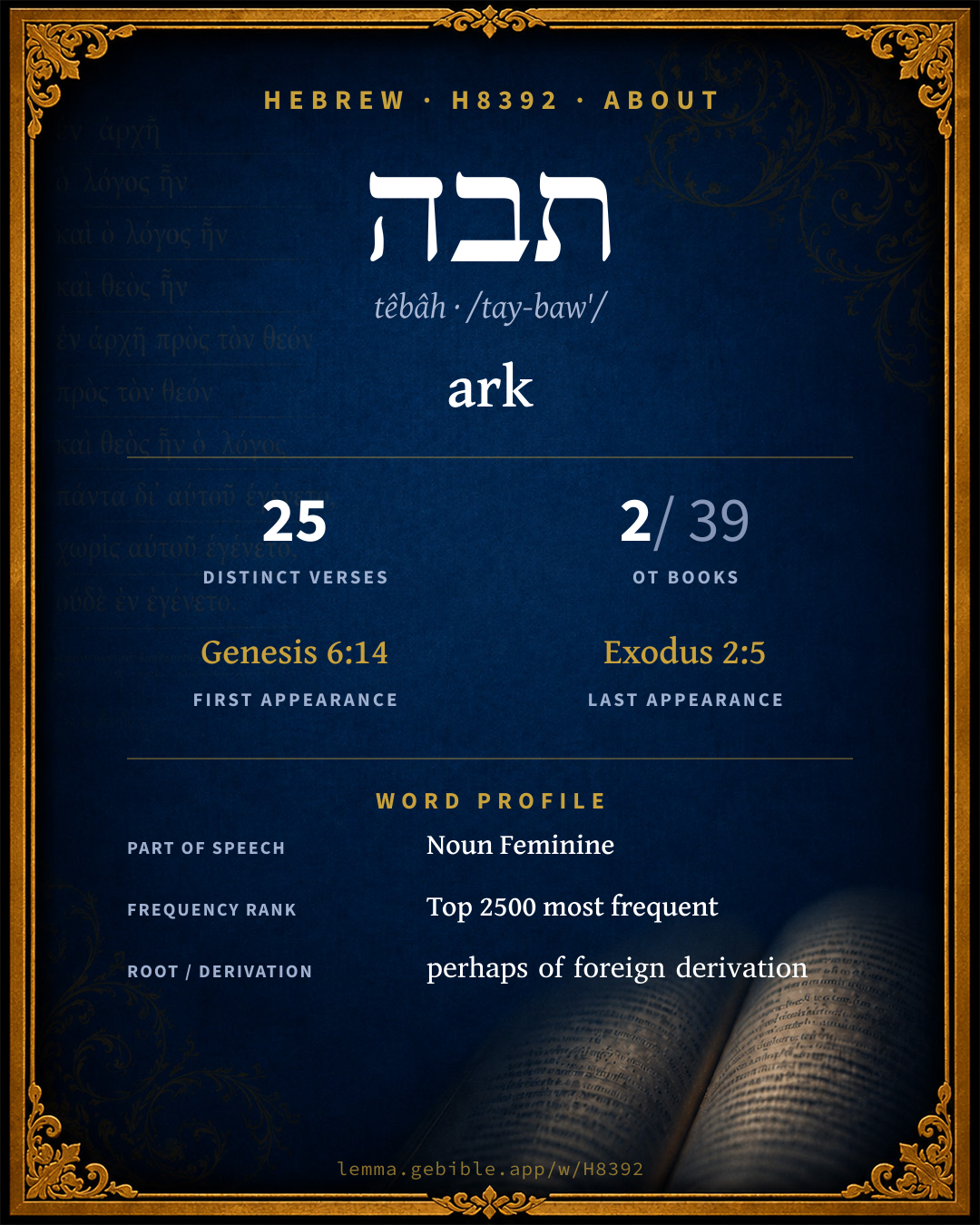
תֵּבָה
ark
‘ark’ is one of 3 main senses fuller range ↓
Full lexicon entry — Brown-Driver-Briggs (BDB)
From Brown-Driver-Briggs (BDB)
Where this word appears
See every Absolute-state word in the Hebrew Bible →
Grammar key — what these labels mean
Part of speech
- Noun
- A naming word — a person, place, thing, or idea.
Noun type
- Common
- A common noun — a general class of person, place, or thing (“king,” “city,” “water”), not a specific name.
State
- Absolute
- The independent form of a noun, not bound to a following word.
- Construct
- A noun bound to a following noun in a possessive / “of” relationship (the construct chain).
Gender
- Feminine
- Grammatically feminine.
Number
- Singular
- One.
23 verses where H8392 appears in the Absolute state in the Book of Genesis. Filtered view — show all forms. Click any verse to open its interlinear word-by-word view. Verse text shown in the World English Bible for context — . Each verse’s Hebrew form is shown with its reference; the English is not keyword-highlighted, since the data carries no word-level English alignment. Use “Compare translations” on any verse to read it across multiple English versions. This concordance covers the Hebrew Bible; Septuagint (Greek Old Testament) occurrences are not indexed here.
Genesis
- Genesis 6:14 תֵּבַ֣ת הַ/תֵּבָ֑ה n c fs cs ptcl def.art + n c fs Make an ark of gopher wood. You shall make rooms in the ark, and shall seal it inside and outside with pitch.
- Genesis 6:15 הַ/תֵּבָ֔ה ptcl def.art + n c fs This is how you shall make it. The length of the ark will be three hundred cubits, the breadth of it fifty cubits, and the height of it thirty cubits.
- Genesis 6:16 לַ/תֵּבָ֗ה הַ/תֵּבָ֖ה prep det + n c fs ptcl def.art + n c fs You shall make a roof in the ark, and to a cubit shall you finish it upward. You shall set the door of the ark in the side of it. You shall make it with lower, second, and third levels.
- Genesis 6:18 הַ/תֵּבָ֔ה ptcl def.art + n c fs But I will establish my covenant with you. You shall come into the ark, you, your sons, your wife, and your sons' wives with you.
- Genesis 6:19 הַ/תֵּבָ֖ה ptcl def.art + n c fs Of every living thing of all flesh, you shall bring two of every sort into the ark, to keep them alive with you. They shall be male and female.
- Genesis 7:1 הַ/תֵּבָ֑ה ptcl def.art + n c fs Yahweh said to Noah, "Come with all of your household into the ark, for I have seen your righteousness before me in this generation.
- Genesis 7:7 הַ/תֵּבָ֑ה ptcl def.art + n c fs Noah went into the ark with his sons, his wife, and his sons' wives, because of the waters of the flood.
- Genesis 7:9 הַ/תֵּבָ֖ה ptcl def.art + n c fs went by pairs to Noah into the ark, male and female, as God commanded Noah.
- Genesis 7:13 הַ/תֵּבָֽה ptcl def.art + n c fs In the same day Noah, and Shem, Ham, and Japheth, the sons of Noah, and Noah's wife, and the three wives of his sons with them, entered into the ark;
- Genesis 7:15 הַ/תֵּבָ֑ה ptcl def.art + n c fs They went to Noah into the ark, by pairs of all flesh with the breath of life in them.
- Genesis 7:17 הַ/תֵּבָ֔ה ptcl def.art + n c fs The flood was forty days on the earth. The waters increased, and lifted up the ark, and it was lifted up above the earth.
- Genesis 7:18 הַ/תֵּבָ֖ה ptcl def.art + n c fs The waters prevailed, and increased greatly on the earth; and the ark floated on the surface of the waters.
- Genesis 7:23 בַּ/תֵּבָֽה prep det + n c fs Every living thing was destroyed that was on the surface of the ground, including man, cattle, creeping things, and birds of the sky. They were destroyed from the earth. Only Noah was left, and those who were with him in the ark.
- Genesis 8:1 בַּ/תֵּבָ֑ה prep det + n c fs God remembered Noah, all the animals, and all the cattle that were with him in the ark; and God made a wind to pass over the earth. The waters subsided.
- Genesis 8:4 הַ/תֵּבָה֙ ptcl def.art + n c fs The ark rested in the seventh month, on the seventeenth day of the month, on Ararat's mountains.
- Genesis 8:6 הַ/תֵּבָ֖ה ptcl def.art + n c fs It happened at the end of forty days, that Noah opened the window of the ark which he had made,
- Genesis 8:9 הַ/תֵּבָ֔ה הַ/תֵּבָֽה ptcl def.art + n c fs ptcl def.art + n c fs but the dove found no place to rest her foot, and she returned to him into the ark; for the waters were on the surface of the whole earth. He put forth his hand, and took her, and brought her to him into the ark.
- Genesis 8:10 הַ/תֵּבָֽה ptcl def.art + n c fs He stayed yet another seven days; and again he sent forth the dove out of the ark.
- Genesis 8:13 הַ/תֵּבָ֔ה ptcl def.art + n c fs It happened in the six hundred first year, in the first month, the first day of the month, the waters were dried up from off the earth. Noah removed the covering of the ark, and looked. He saw that the surface of the ground was dried.
- Genesis 8:16 הַ/תֵּבָ֑ה ptcl def.art + n c fs "Go forth from the ark, you, and your wife, and your sons, and your sons' wives with you.
- Genesis 8:19 הַ/תֵּבָֽה ptcl def.art + n c fs Every animal, every creeping thing, and every bird, whatever moves on the earth, after their families, went forth out of the ark.
- Genesis 9:10 הַ/תֵּבָ֔ה ptcl def.art + n c fs and with every living creature that is with you: the birds, the cattle, and every animal of the earth with you. Of all that go out of the ark, even every animal of the earth.
- Genesis 9:18 הַ/תֵּבָ֔ה ptcl def.art + n c fs The sons of Noah who went forth from the ark were Shem, Ham, and Japheth. Ham is the father of Canaan.
About this entry
At a glance — auto-summarized from this page’s data, not written by a person. Every figure links to its source below. This summary describes the numbers; it doesn’t interpret them.
The Hebrew noun תבה centers on the idea of “ark.” The word gravitates to Genesis (92%), then Exodus. It turns up in 25 verses across 2 books, an uncommon footprint. Its earliest occurrence is Genesis 6:14. BDB distinguishes 3 senses for it. For the data behind this summary, explore the sense tree and the renderings breakdown below.
Gloss history
Strong's 1890 vs modern scholarship
About this word
Strong's H8392 catalogs a Hebrew word from the Hebrew Old Testament.
These counts are not copied from any lexicon or concordance. They are computed here, from the morphology-tagged Hebrew Old Testament. What Lemma adds →
- 25
- distinct verses
- The word appears in 25 distinct verses.
- 2 / 39
- OT books
- The word appears in 2 of 39 Old Testament books.
- #1,190
- by frequency
- Top 2500 most frequent Hebrew words (rank 1,190 of 8,640 Hebrew words by occurrence).
View all 25 occurrences in the concordance →
By traditional corpus
Conventional, traditional groupings — biblical authorship is debated, so this is a traditional corpus grouping, not an authorship claim. Each share is this word’s portion of its verses in that division of the Hebrew canon. Each figure is a share of the word’s 25 distinct verses.
- Torah (Pentateuch) 25 verses · 100%
How translations render this word
Counts come from each version’s own published word-to-Strong’s tagging or interlinear alignment — an approximate guide to how each version renders this word, not a word-level alignment the data otherwise carries. Because each total is that version’s own tagged count, the per-version totals vary from one another and need not match the appearance or distinct-verse counts above. These counts may also differ from a printed concordance because Lemma counts each distinctly tagged rendering and does not collapse phrase taggings into a single head-word total. This is a fixed set of word-tagged versions (KJV, ASV, BSB, ULT) and does not change with the reading translation you choose elsewhere. Each version’s license is shown beside its name below (and on Sources).
- King James Version: Ark 25×
- American Standard Version: Ark 20×, Were with him in the ark 2×
- Berean Standard Bible: Ark 26×, Basket 2×
- unfoldingWord Literal Text: Ark 27×
King James Version Public Domain
Renders H8392 across 28 tagged occurrences — most commonly:
Plus 3 renderings that appear only once — usually multi-word phrases or single function words the recovered tagging swept in, not distinct renderings.
American Standard Version Public Domain
Renders H8392 across 28 tagged occurrences — most commonly:
Plus 6 renderings that appear only once — usually multi-word phrases or single function words the recovered tagging swept in, not distinct renderings.
Berean Standard Bible Public Domain
Renders H8392 across 28 tagged occurrences — most commonly:
unfoldingWord Literal Text CC BY-SA 4.0
Renders H8392 across 28 tagged occurrences — most commonly:
Plus 1 rendering that appears only once — usually multi-word phrases or single function words the recovered tagging swept in, not distinct renderings.
Senses in BDB
The 3 senses BDB distinguishes for this word, in lexicon order (not ranked by frequency or importance). The full entry — with sub-senses — is in the Lexicon Entry tab.
- ark
- vessel which Noah built
- basket vessel in which Moses was placed
Word origin
תֵּבָה n.f. ark (prop. chest, box )
— Brown-Driver-Briggs (Oxford 1906, public domain), digitized via Sefaria, supplemented by the OpenScriptures HebrewLexicon (CC BY 4.0). See Sources.
Origin: perhaps of foreign derivation
Jastrow Dictionary
A second Hebrew/Aramaic lexicon for comparison, covering Aramaic and post-biblical (Talmudic, Targumic, Midrashic) usage that the biblical-Hebrew BDB does not. Matched by lemma rather than by Strong’s number, so a lemma may carry more than one Jastrow headword (shown separately below), and the entries cover usage well beyond the Bible.
תֵּבָה
- 1. ship, ark, chest. Gen. R. s. 31 (play on קנים, Gen. VI, 14) מה הקן … אף תֵּיבָתְךָ וכ׳ as birds (v. קֵן) make the leper clean, so does thy ark cleanse thee. Ib. על שם תֵּיבָתוֹ של נח (it is called t’biḳin) from the measures of Noah’s ark. Y. Erub. V, 22ᶜ bot. כיצד היו ישראל … כת׳ how did the Israelites march in the desert?… like a chest (forming a square), opp. כקורה like a beam (in columns). Men. 94ᵇ כמין ת׳ פרוצה (the shape of the show-bread was) that of an open chest (without a lid and with a level bottom), opp. כמין ספינה רוקדת like a rocking ship (with a curved bottom). Sifra M’tsorʿa, Zab., Par. 1, ch. II תֵּיבַת הבלנים the bathers’ chest. Tosef. Kel. B. Mets. X, 1, sq.; a. fr.—Pl. תֵּבוֹת, תֵּי׳. Midr. Till. to Ps. I היה צריך לעשות ת׳ הרבה he would have been obliged to build many arks. Y. Sot. VIII, beg. 22ᵇ שהיו עשויין ת׳ ת׳ they (the Egyptians) were arrayed in squares.—Esp. the chest in the synagogue containing the scrolls of the Pentateuch. Sot. 38ᵇ, v. פְּסַק. Taan. II, 1 מוציאין את הת׳ וכ׳ (at prayer meetings) they bring the chest out to the open place of the town, and put ashes of wood on the chest &c. Meg. III, 1 בני העיר … בה"כ לוקחין ת׳ ת׳ וכ׳ if the citizens of a township sell … a synagogue, they may buy (for the money) a book chest; if they sell a chest, they may buy book wrappers; a. fr.—עבר לפני הת׳, ירד לפני הת׳ to go before the chest, to act as reader of prayers. Ber. 34ᵃ שירד לפני הת׳ וכ׳ who recited the prayers in the presence of &c. Ib. V, 3 העובר לפני הת׳ וטעה וכ׳ if a reader makes a mistake (reads heretical formulas), another person must pass before the chest in his place. Ib. 4. Ib. 34ᵃ העובר לפני הת׳ צריך לסרב he that is asked to read the prayers &c., v. סָרַב. Taan. II, 2 מורידין לפני הת׳ וכ׳ we depute as reader (on fast days) an old man &c.; a. v. fr. e.g. Genesis 6:14
- 2. word. Men. 30ᵇ ת׳ בת שתי וכ׳ a word of two letters. Sabb. 104ᵃ they did not know הי באמצע ת׳ וכ׳ in which (of the two forms of the letters מנצפ"ך) were to be employed in the middle of a word, and which at the end; a. fr.—Pl. תֵּיבוֹת, תֵּיבִיּוֹת. Ḥull. 64ᵇ דפסק … ת׳ (v. Rabb. D. S. a. l. note 40) where the scribe divides them into two words; ib. 65ᵃ. Y. Meg. I, 71ᶜ bot. תיביות; a. e.
A Dictionary of the Targumim, the Talmud Babli and Yerushalmi, and the Midrashic Literature (Marcus Jastrow; London, Luzac, 1903) — Public Domain. Digitized via Sefaria. Digitized via Sefaria. Full attribution on Sources.
Forms in the corpus
The 10 distinct written forms H8392 takes in the Hebrew Bible, most frequent first — each parse links to that state’s occurrences in the concordance. Hebrew forms include their vowel points and cantillation, so a single lemma takes many written forms.
| Form | Parsing | Example | Uses |
|---|---|---|---|
| הַ/תֵּבָ֔ה | Noun, Common, Feminine, Singular, Absolute | Genesis 6:15 | 7 |
| הַ/תֵּבָ֑ה | Noun, Common, Feminine, Singular, Absolute | Genesis 6:14 | 5 |
| הַ/תֵּבָ֖ה | Noun, Common, Feminine, Singular, Absolute | Genesis 6:16 | 5 |
| הַ/תֵּבָֽה | Noun, Common, Feminine, Singular, Absolute | Genesis 7:13 | 4 |
| הַ/תֵּבָה֙ | Noun, Common, Feminine, Singular, Absolute | Exodus 2:5 | 2 |
| בַּ/תֵּבָ֑ה | Noun, Common, Feminine, Singular, Absolute | Genesis 8:1 | 1 |
| בַּ/תֵּבָֽה | Noun, Common, Feminine, Singular, Absolute | Genesis 7:23 | 1 |
| לַ/תֵּבָ֗ה | Noun, Common, Feminine, Singular, Absolute | Genesis 6:16 | 1 |
| תֵּ֣בַת | Noun, Common, Feminine, Singular, Construct | Exodus 2:3 | 1 |
| תֵּבַ֣ת | Noun, Common, Feminine, Singular, Construct | Genesis 6:14 | 1 |
Septuagint verse parallels
This word appears in 25 verses that also exist in the Greek Old Testament (Septuagint), out of the 25 Hebrew verses it occurs in. You can read those verses in Greek by switching the Old Testament edition to the Septuagint.
Read these verses in the Septuagint
This is a verse-level parallel only — the same verses exist in both the Hebrew and Greek Old Testaments. No word-level Hebrew↔Greek correspondence is claimed: the data carries no such alignment, so no Greek word is shown as this Hebrew word’s translation. Coverage is not total — the Septuagint omits the deuterocanon and renumbers the Psalms, so some Hebrew verses have no direct Greek parallel.