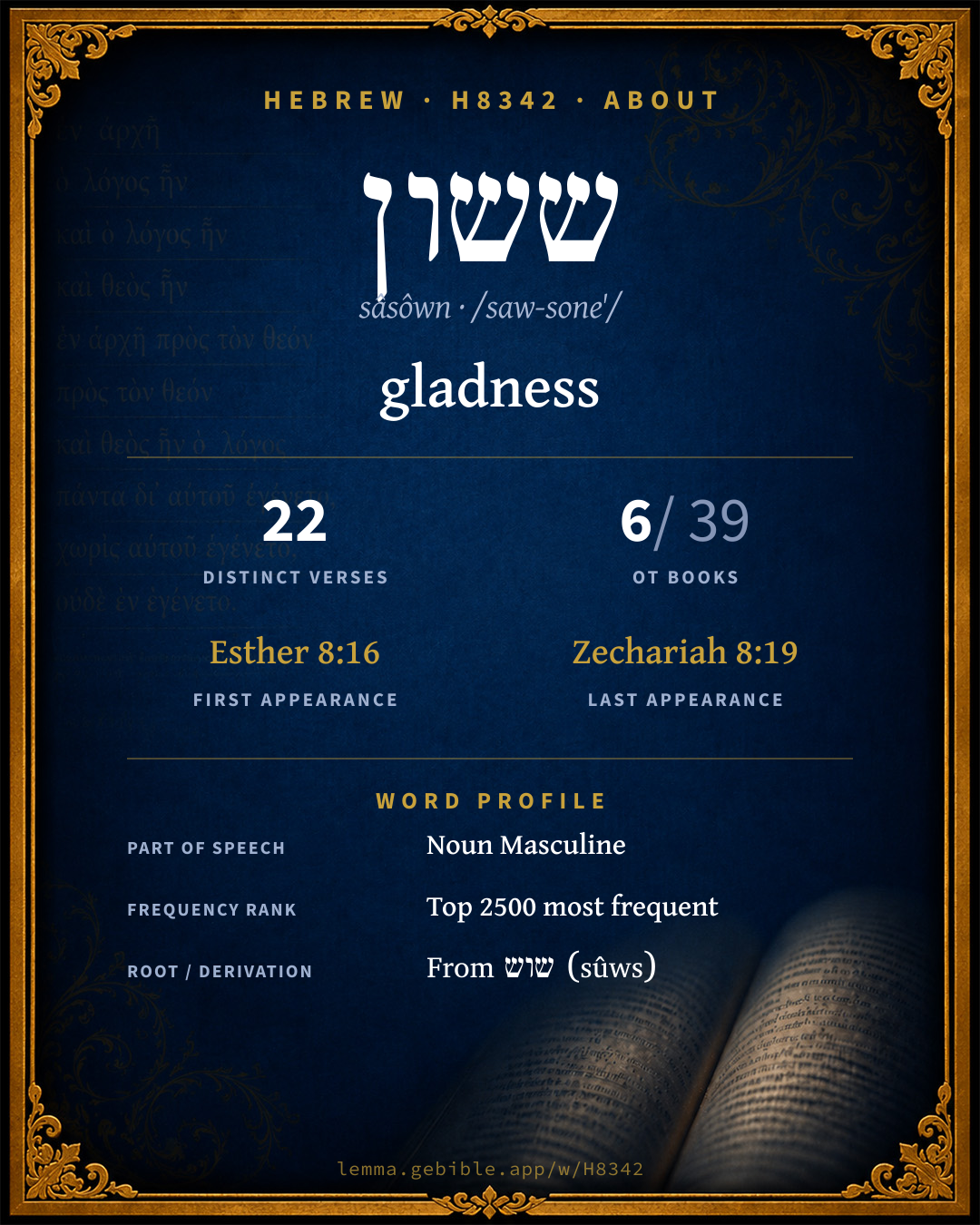
שָׂשׂוֹן
gladness
also: joy, exultation, rejoicing fuller range ↓
Full lexicon entry — Brown-Driver-Briggs (BDB)
From Brown-Driver-Briggs (BDB)
Where this word appears
See every Absolute-state word in the Hebrew Bible →
Grammar key — what these labels mean
Part of speech
- Noun
- A naming word — a person, place, thing, or idea.
Noun type
- Common
- A common noun — a general class of person, place, or thing (“king,” “city,” “water”), not a specific name.
State
- Absolute
- The independent form of a noun, not bound to a following word.
- Construct
- A noun bound to a following noun in a possessive / “of” relationship (the construct chain).
Gender
- Masculine
- Grammatically masculine.
Number
- Singular
- One.
20 distinct verses where H8342 appears in the Absolute state, across 6 books. Filtered view — show all forms. Click any verse to open its interlinear word-by-word view. Verse text shown in the World English Bible for context — . Each verse’s Hebrew form is shown with its reference; the English is not keyword-highlighted, since the data carries no word-level English alignment. Use “Compare translations” on any verse to read it across multiple English versions. This concordance covers the Hebrew Bible; Septuagint (Greek Old Testament) occurrences are not indexed here.
Esther 2 verses
- Esther 8:16 וְ/שָׂשֹׂ֖ן conj + n c ms The Jews had light and gladness, and joy and honor.
- Esther 8:17 וְ/שָׂשׂוֹן֙ conj + n c ms In every province, and in every city, wherever the king's commandment and his decree came, the Jews had gladness and joy, a feast and a good day. Many from among the peoples of the land became Jews; for the fear of the Jews was fallen on them.
Psalms 3 verses
- Psalms 45:7 שָׂשׂ֗וֹן n c ms You have loved righteousness, and hated wickedness. Therefore God, your God, has anointed you with the oil of gladness above your fellows.
- Psalms 51:8 שָׂשׂ֣וֹן n c ms Let me hear joy and gladness, That the bones which you have broken may rejoice.
- Psalms 105:43 בְ/שָׂשׂ֑וֹן prep + n c ms He brought forth his people with joy, His chosen with singing.
Isaiah 6 verses
- Isaiah 12:3 בְּ/שָׂשׂ֑וֹן prep + n c ms Therefore with joy you shall draw water out of the wells of salvation.
- Isaiah 22:13 שָׂשׂ֣וֹן n c ms and behold, joy and gladness, killing oxen and killing sheep, eating flesh and drinking wine: let us eat and drink, for tomorrow we shall die.
- Isaiah 35:10 שָׂשׂ֤וֹן n c ms and the ransomed of Yahweh shall return, and come with singing to Zion; and everlasting joy shall be on their heads: they shall obtain gladness and joy, and sorrow and sighing shall flee away.
- Isaiah 51:3 שָׂשׂ֤וֹן n c ms For Yahweh has comforted Zion; he has comforted all her waste places, and has made her wilderness like Eden, and her desert like the garden of Yahweh; joy and gladness shall be found therein, thanksgiving, and the voice of melody.
- Isaiah 51:11 שָׂשׂ֤וֹן n c ms The ransomed of Yahweh shall return, and come with singing to Zion; and everlasting joy shall be on their heads: they shall obtain gladness and joy; [and] sorrow and sighing shall flee away.
- Isaiah 61:3 שָׂשׂוֹן֙ n c ms to appoint to those who mourn in Zion, to give to them a garland for ashes, the oil of joy for mourning, the garment of praise for the spirit of heaviness; that they may be called trees of righteousness, the planting of Yahweh, that he may be glorified.
Jeremiah 7 verses
- Jeremiah 7:34 שָׂשׂוֹן֙ n c ms Then will I cause to cease from the cities of Judah, and from the streets of Jerusalem, the voice of mirth and the voice of gladness, the voice of the bridegroom and the voice of the bride; for the land shall become a waste.
- Jeremiah 15:16 לְ/שָׂשׂ֖וֹן prep + n c ms Your words were found, and I ate them; and your words were to me a joy and the rejoicing of my heart: for I am called by your name, Yahweh, God of hosts.
- Jeremiah 16:9 שָׂשׂוֹן֙ n c ms For thus says Yahweh of Hosts, the God of Israel: Behold, I will cause to cease out of this place, before your eyes and in your days, the voice of mirth and the voice of gladness, the voice of the bridegroom and the voice of the bride.
- Jeremiah 25:10 שָׂשׂוֹן֙ n c ms Moreover I will take from them the voice of mirth and the voice of gladness, the voice of the bridegroom and the voice of the bride, the sound of the millstones, and the light of the lamp.
- Jeremiah 31:13 לְ/שָׂשׂוֹן֙ prep + n c ms Then shall the virgin rejoice in the dance, and the young men and the old together; for I will turn their mourning into joy, and will comfort them, and make them rejoice from their sorrow.
- Jeremiah 33:9 שָׂשׂוֹן֙ n c ms [This city] shall be to me for a name of joy, for a praise and for a glory, before all the nations of the earth, which shall hear all the good that I do to them, and shall fear and tremble for all the good and for all the peace that I procure to it.
- Jeremiah 33:11 שָׂשׂ֞וֹן n c ms the voice of joy and the voice of gladness, the voice of the bridegroom and the voice of the bride, the voice of those who say, Give thanks to Yahweh of Hosts, for Yahweh is good, for his loving kindness endures forever; [and of them] who bring [sacrifices of] thanksgiving into the house of Yahweh. For I will cause the captivity of the land to return as at the first, says Yahweh.
Joel 1 verse
Zechariah 1 verse
About this entry
At a glance — auto-summarized from this page’s data, not written by a person. Every figure links to its source below. This summary describes the numbers; it doesn’t interpret them.
“gladness” is the headline sense of the Hebrew noun ששון (sâsôwn). First canonically at Esther 8:16, it enters the text early. The Hebrew Bible uses it across 22 verses — uncommon. More than a quarter of its appearances fall in Jeremiah. Not a single-sense word, it carries 2 senses, among them “joy”, “exultation”, and “rejoicing”. See the sense tree, 22-verse concordance, and the renderings breakdown below.
Gloss history
Strong's 1890 vs modern scholarship
About this word
Strong's H8342 catalogs a Hebrew word from the Hebrew Old Testament.
These counts are not copied from any lexicon or concordance. They are computed here, from the morphology-tagged Hebrew Old Testament. What Lemma adds →
- 22
- distinct verses
- The word appears in 22 distinct verses.
- 6 / 39
- OT books
- The word appears in 6 of 39 Old Testament books.
- #1,412
- by frequency
- Top 2500 most frequent Hebrew words (rank 1,412 of 8,640 Hebrew words by occurrence).
View all 22 occurrences in the concordance →
By section of the Old Testament
By traditional corpus
Conventional, traditional groupings — biblical authorship is debated, so this is a traditional corpus grouping, not an authorship claim. Each share is this word’s portion of its verses in that division of the Hebrew canon. Each figure is a share of the word’s 22 distinct verses.
- Prophets (Nevi'im) 15 verses · 68%
- Writings (Ketuvim) 7 verses · 32%
How translations render this word
Counts come from each version’s own published word-to-Strong’s tagging or interlinear alignment — an approximate guide to how each version renders this word, not a word-level alignment the data otherwise carries. Because each total is that version’s own tagged count, the per-version totals vary from one another and need not match the appearance or distinct-verse counts above. These counts may also differ from a printed concordance because Lemma counts each distinctly tagged rendering and does not collapse phrase taggings into a single head-word total. This is a fixed set of word-tagged versions (KJV, ASV, BSB, ULT) and does not change with the reading translation you choose elsewhere. Each version’s license is shown beside its name below (and on Sources).
- King James Version: Joy 11×, Gladness 4×, Mirth 3×
- American Standard Version: Joy 11×, Gladness 3×, Mirth 3×
- Berean Standard Bible: Joy 15×, Gladness 3×
- unfoldingWord Literal Text: Joy 12×, Gladness 2×, Joy of 2×
King James Version Public Domain
Renders H8342 across 22 tagged occurrences — most commonly:
Plus 4 renderings that appear only once — usually multi-word phrases or single function words the recovered tagging swept in, not distinct renderings.
American Standard Version Public Domain
Renders H8342 across 22 tagged occurrences — most commonly:
Plus 5 renderings that appear only once — usually multi-word phrases or single function words the recovered tagging swept in, not distinct renderings.
Berean Standard Bible Public Domain
Renders H8342 across 22 tagged occurrences — most commonly:
Plus 4 renderings that appear only once — usually multi-word phrases or single function words the recovered tagging swept in, not distinct renderings.
unfoldingWord Literal Text CC BY-SA 4.0
Renders H8342 across 19 tagged occurrences — most commonly:
Plus 1 rendering that appears only once — usually multi-word phrases or single function words the recovered tagging swept in, not distinct renderings.
Senses in BDB
The 2 senses BDB distinguishes for this word, in lexicon order (not ranked by frequency or importance). The full entry — with sub-senses — is in the Lexicon Entry tab.
- gladness, joy, exultation, rejoicing
- exultation, joy
Word origin
n.m. Is 51:3 exultation, rejoicing;—abs. שׂ׳ ψ 45:8 +, שָׂשׂן Est 8:16; cstr. שְׂשׂוֹן (Sta § 296 e) ψ 51:14; 119:111;—exultation, joy (especially in י׳’s favour), Jo 1:12; Is 12:3 ψ 51:14; 105:43; 119:111; שֶׁמֶן שׂ׳ (i.e. with which guests were anointed; fig.) ψ 45:8; Is 61:3 (opp. אֵבֶל); שֵׁם שׂ׳ Je 33:9 (‖ תְּהִלָּה; on text v. Gie AlbrZAW xvi (1896), 115); elsewhere ‖ שִׂמְחָה: Je 7:34; 15:16; 16:9; 25:10; 33:11; Is 22:13 (only here condemned as reckless, wanton), 35:10; 51:3, 11 Zc 8:19 ψ 51:10; Est 8:16, 17; ‖ שָׂמַח Je 31:13 (opp. אֵבֶל).
— Brown-Driver-Briggs (Oxford 1906, public domain), digitized via Sefaria, supplemented by the OpenScriptures HebrewLexicon (CC BY 4.0). See Sources.
Derived from שוש (sûws) (H7797) — to rejoice.
Forms in the corpus
The 15 distinct written forms H8342 takes in the Hebrew Bible, most frequent first — each parse links to that state’s occurrences in the concordance. Hebrew forms include their vowel points and cantillation, so a single lemma takes many written forms.
Same root — word family
Other BDB entries built from the same root as H8342, grouped by Strong’s listed origin. These share a root / origin per the lexicon — not necessarily a shared meaning. Each links to that word’s own entry.
Derives from
Shares the same root
Proper names from this root
People and places named from this root — a name, not an additional meaning of the word.
Compare all same-root words → Showing 4 of 5 — not the complete family. 1 of the same-root words is a proper name (a person or place). They share a root, not necessarily a meaning.
Septuagint verse parallels
This word appears in 20 verses that also exist in the Greek Old Testament (Septuagint), out of the 22 Hebrew verses it occurs in. You can read those verses in Greek by switching the Old Testament edition to the Septuagint.
Read these verses in the Septuagint
This is a verse-level parallel only — the same verses exist in both the Hebrew and Greek Old Testaments. No word-level Hebrew↔Greek correspondence is claimed: the data carries no such alignment, so no Greek word is shown as this Hebrew word’s translation. Coverage is not total — the Septuagint omits the deuterocanon and renumbers the Psalms, so some Hebrew verses have no direct Greek parallel.