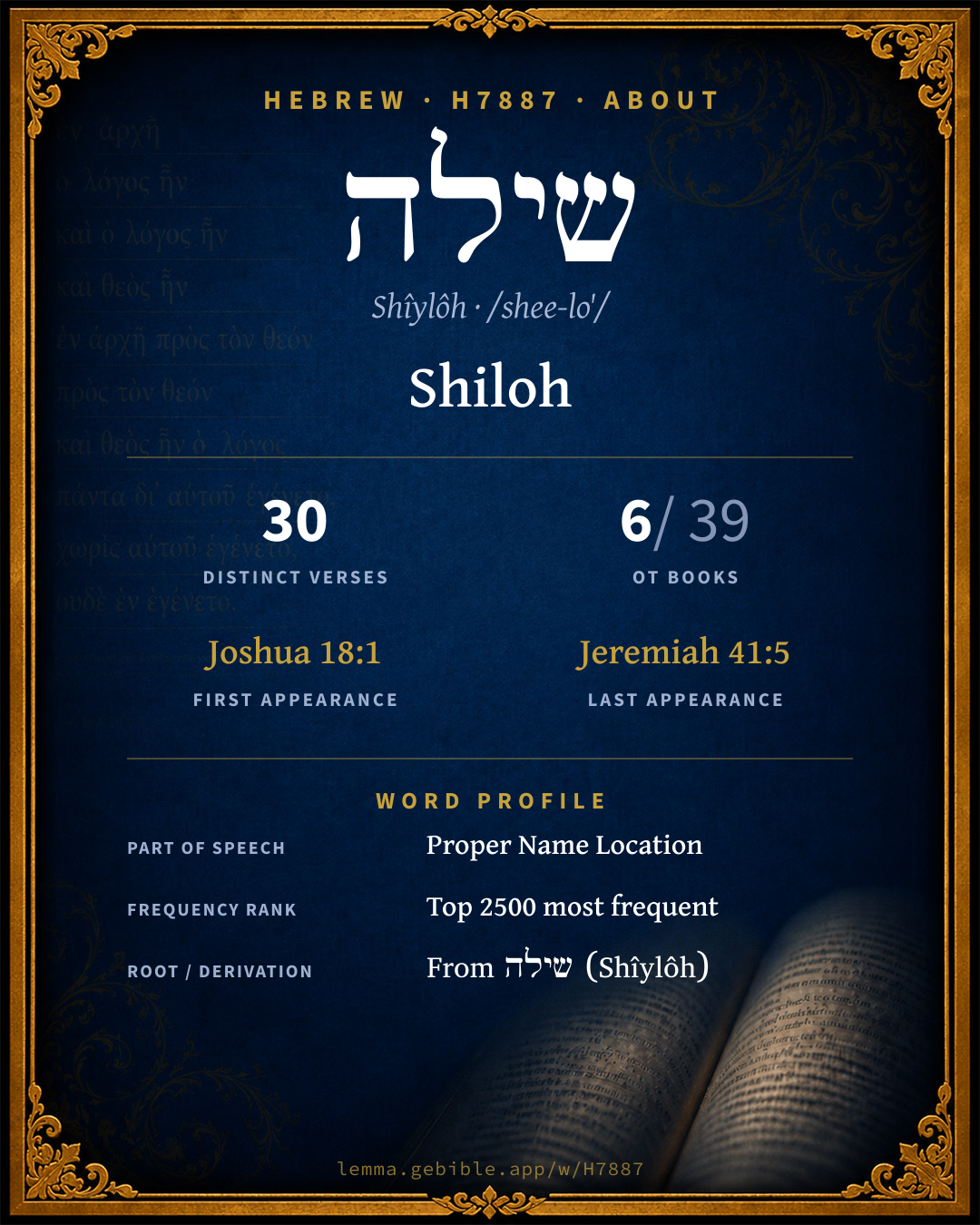
שִׁלוֹ
Shiloh
BDB lists 2 entries for ‘Shiloh’ fuller range ↓
Full lexicon entry — Brown-Driver-Briggs (BDB)
From Brown-Driver-Briggs (BDB)
Where this word appears
Grammar key — what these labels mean
Part of speech
- Noun
- A naming word — a person, place, thing, or idea.
Noun type
- Proper
- A name of a specific person, place, or people (e.g. Abraham, Zion, Israel).
Every verse where H7887 appears in the Book of 1 Kings — 3 distinct verses. Click any verse to open its interlinear word-by-word view. Verse text shown in the World English Bible for context — . Each verse’s Hebrew form is shown with its reference; the English is not keyword-highlighted, since the data carries no word-level English alignment. Use “Compare translations” on any verse to read it across multiple English versions. This concordance covers the Hebrew Bible; Septuagint (Greek Old Testament) occurrences are not indexed here.
1 Kings
- 1 Kings 2:27 בְּ/שִׁלֹֽה prep + n Proper So Solomon thrust out Abiathar from being priest to Yahweh, that he might fulfill the word of Yahweh, which he spoke concerning the house of Eli in Shiloh.
- 1 Kings 14:2 שִׁלֹ֗ה n Proper Jeroboam said to his wife, Please get up and disguise yourself, that you not be known to be the wife of Jeroboam; and get you to Shiloh: behold, there is Ahijah the prophet, who spoke concerning me that I should be king over this people.
- 1 Kings 14:4 שִׁלֹ֔ה n Proper Jeroboam's wife did so, and arose, and went to Shiloh, and came to the house of Ahijah. Now Ahijah could not see; for his eyes were set by reason of his age.
About this entry
At a glance — auto-summarized from this page’s data, not written by a person. Every figure links to its source below. This summary describes the numbers; it doesn’t interpret them.
At its core, שילה (Shîylôh) means “Shiloh.” It first appears in Joshua 18:1. Spanning 30 verses in 6 books, it ranks among the moderately common words of the Hebrew Bible. Its uses concentrate in 1 Samuel (30% of all occurrences). Each statement above links to its evidence; the full detail follows below.
Gloss history
Strong's 1890 vs modern scholarship
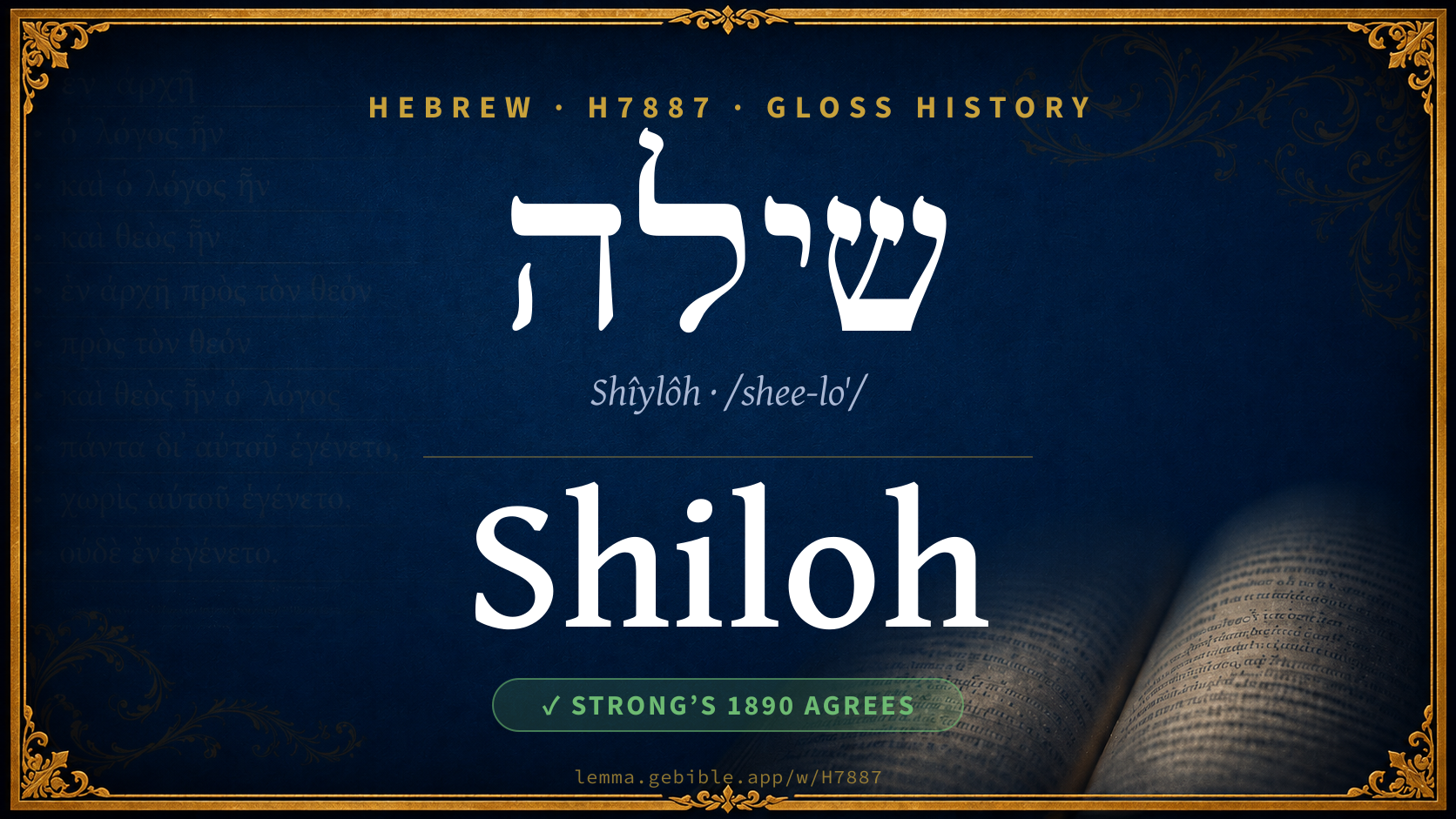
About this word
Strong's H7887 catalogs a Hebrew word from the Hebrew Old Testament.
These counts are not copied from any lexicon or concordance. They are computed here, from the morphology-tagged Hebrew Old Testament. What Lemma adds →
- 30
- distinct verses
- The word appears in 30 distinct verses.
- 6 / 39
- OT books
- The word appears in 6 of 39 Old Testament books.
- #1,086
- by frequency
- Top 2500 most frequent Hebrew words (rank 1,086 of 8,640 Hebrew words by occurrence).
View all 30 occurrences in the concordance →
By section of the Old Testament
By traditional corpus
Conventional, traditional groupings — biblical authorship is debated, so this is a traditional corpus grouping, not an authorship claim. Each share is this word’s portion of its verses in that division of the Hebrew canon. Each figure is a share of the word’s 30 distinct verses.
- Prophets (Nevi'im) 29 verses · 97%
- Writings (Ketuvim) 1 verse · 3%
How translations render this word
Counts come from each version’s own published word-to-Strong’s tagging or interlinear alignment — an approximate guide to how each version renders this word, not a word-level alignment the data otherwise carries. Because each total is that version’s own tagged count, the per-version totals vary from one another and need not match the appearance or distinct-verse counts above. These counts may also differ from a printed concordance because Lemma counts each distinctly tagged rendering and does not collapse phrase taggings into a single head-word total. This is a fixed set of word-tagged versions (KJV, ASV, BSB, ULT) and does not change with the reading translation you choose elsewhere. Each version’s license is shown beside its name below (and on Sources).
BDB lists this Strong’s number as 2 distinct words (homographs). Each count above pools all of them and is not split by sense — see the Senses section below. A low-frequency rendering may belong to a different one of those words, not the primary meaning.
- King James Version†: Shiloh 27×, Was in shiloh 2×
- American Standard Version†: Shiloh 25×, Was in shiloh 2×
- Berean Standard Bible†: Shiloh 29×, Like shiloh 2×
- unfoldingWord Literal Text†: Shiloh 27×, Like shiloh 2×
King James Version Public Domain
Renders H7887 across 32† tagged occurrences — most commonly:
Plus 3 renderings that appear only once — usually multi-word phrases or single function words the recovered tagging swept in, not distinct renderings.
American Standard Version Public Domain
Renders H7887 across 32† tagged occurrences — most commonly:
Plus 5 renderings that appear only once — usually multi-word phrases or single function words the recovered tagging swept in, not distinct renderings.
Berean Standard Bible Public Domain
Renders H7887 across 32† tagged occurrences — most commonly:
Plus 1 rendering that appears only once — usually multi-word phrases or single function words the recovered tagging swept in, not distinct renderings.
unfoldingWord Literal Text CC BY-SA 4.0
Renders H7887 across 31† tagged occurrences — most commonly:
Plus 2 renderings that appear only once — usually multi-word phrases or single function words the recovered tagging swept in, not distinct renderings.
Senses in BDB
The 2 senses BDB distinguishes for this word, in lexicon order (not ranked by frequency or importance). The full entry — with sub-senses — is in the Lexicon Entry tab.
- Shiloh = "place of rest"
- a city in Ephraim and temporary home of the Ark of the Covenant and the Tabernacle, the place where Samuel grew up
Word origin
n.pr.loc. (orig. שִׁלוֹן, v. adj.gent. (otherwise BaNB § 224 b), which also shews that √ שׁול, שׁיל, was posited when text of K was fixed, cf. Dr 2 S 15:12);—שִׁלוֹ Ju 21:19; 1 S 1:24; 3:21; 14:3; Je 7:14 (on destruction of S. v. We 2 S 8:17), 26:9; 41:5, מִשְׁכַּן שׁ׳ ψ 78:60; שִׁילוֹ Ju 21:21(×2); Je 7:12; שִׁלֹה Jos 18:1, 8, 9, 10; 19:51; 21:2; 22:9, 12 (all P or R), Ju 18:31; 21:12; 1 S 1:3, 9; 2:14; 3:21; 4:3, 4, 12; 1 K 2:27; 14:2, 4; Je 26:6 (var. שִׁלוֹ in all these [21 times] given by Gi as Qr).—Σηλωμ, Σηλω(ν).—Mod. Seilûn, c. 9½ m. NNE. of Bethel, BuhlG. 178 DrHast.DB shiloh. Also תַּאֲנַתשִׁלֹה; s. p. 1061.
— Brown-Driver-Briggs (Oxford 1906, public domain), digitized via Sefaria, supplemented by the OpenScriptures HebrewLexicon (CC BY 4.0). See Sources.
Derived from שילה (Shîylôh) (H7886) — tranquillity.
Jastrow Dictionary
A second Hebrew/Aramaic lexicon for comparison, covering Aramaic and post-biblical (Talmudic, Targumic, Midrashic) usage that the biblical-Hebrew BDB does not. Matched by lemma rather than by Strong’s number, so a lemma may carry more than one Jastrow headword (shown separately below), and the entries cover usage well beyond the Bible.
שִׁילֹה
- (b. h.)
- 1. pr. n. pl. Shilo, the seat of the Tabernacle after the conquest. Meg. 16ᵇ בכה על משכן ש׳ וכ׳ he (Benjamin) wept over the Tabernacle of Shiloh, which was to be in the dominion of Joseph &c.; Yalk. Gen. 152. Macc. 12ᵃ והוא … של ש׳ he (Joab) took hold of the altar of Shiloh, opp. to בית עולמים. Zeb. 61ᵇ; a. fr.—B. Bath. 75ᵇ אלף ושני ש׳ וכ׳ (Ar. שִׁילֵי pl.; Ms. M. אלף שתישל, v. Rabb. D. S. a. l. note) an area of one thousand and two times that of Shiloh built up with palaces (v. טִיטְרַפְלִיּוֹת); [Rashb. שיל"ה the numerical value of Shiloh = 345].
- 2. (interchanging with שילא) Shilo, (Shila), name of a fictitious town, v. יוֹחָנָא I. Gen. R. s. 40, beg. שילו; ib. s. 25, end; ib. s. 64, beg. שילא; Midr. Sam. ch. XXVIII שילה; Ruth R. to I, 1 שילא.
- 3. pr. n. m. Shilo, homiletical name of the King Messiah. Gen. R. s. 98 (ref. to Gen. XLIX, 10) עד … ש׳ זה מלך וכ׳ ‘until Sh. comes’, this means the King Messiah. Snh. 98ᵇ ש׳ שמו his (the Messiah’s) name will be Shiloh.—V. preced. e.g. Genesis 49:10
שלי
- Job XXVII, 8) to draw out, pull. Taan. 24ᵃ; Sabb. 107ᵇ השׁוֹלֶה דג וכ׳ he that takes a fish out of the water (on the Sabbath). Ḥull. 63ᵃ (expl. שָׁלָךְ, Lev. XI, 17) זה השולה דגים וכ׳ that is the bird that catches fish out of the sea. M. Kat. II, 3 ושולה פשתנו וכ׳ and may take his flax out of the pond. Yalk. Koh. 966 אדם שוקע … שולה ראשון if one sinks pots into his furnace, he takes out first what he has last put in; a. fr.—[Y. Maas. Sh. III, 53ᶜ top שולה, read: שורה, v. שָׁרָה.] e.g. Job 27:8
- same, esp. to draw wine (out of the pit). Ab. Zar. 56ᵃ; B. Mets. 92ᵇ היין … משׁיְשַׁלֶּה בחביות wine is subject to tithes …, when he fills it into kegs; Y. Ter. II, 41ᵇ bot. משישלה ומשיקפה (not משיקיפה) when he has filled and skimmed it; עד שלא שי׳ וכ׳ before he filled or skimmed it. Tosef. Maasr. I, 7 המקדיש … עד שלא שילה וקיפה מששילה וקיפה וכ׳ (ed. Zuck. שולה וקופה וכ׳, corr. acc.) if one dedicates the contents of a pit before he has drawn and skimmed the wine, and the Temple collector comes after he has done so &c.; a. e.
- to be pulled, drawn away. Gen. R. s. 22, beg. (ref. to Gen. IV, 1) ידע מאיזו שלוה נ׳ he knew from what happiness he was drawn away (through his wife). e.g. Genesis 4:1
A Dictionary of the Targumim, the Talmud Babli and Yerushalmi, and the Midrashic Literature (Marcus Jastrow; London, Luzac, 1903) — Public Domain. Digitized via Sefaria. Digitized via Sefaria. Full attribution on Sources.
Forms in the corpus
The 23 distinct written forms H7887 takes in the Hebrew Bible, most frequent first — each parse links to that state’s occurrences in the concordance. Hebrew forms include their vowel points and cantillation, so a single lemma takes many written forms.
| Form | Parsing | Example | Uses |
|---|---|---|---|
| שִׁלֹ֔ה | Noun, Proper | 1 Kings 14:4 | 5 |
| בְּ/שִׁלֹֽה | Noun, Proper | 1 Kings 2:27 | 4 |
| בְּ/שִׁל֖וֹ | Noun, Proper | 1 Samuel 3:21 | 2 |
| שִׁל֑וֹ | Noun, Proper | 1 Samuel 1:24 | 2 |
| בְ/שִׁלֹ֑ה | Noun, Proper | 1 Samuel 3:21 | 1 |
| בְ/שִׁלֹ֖ה | Noun, Proper | 1 Samuel 1:9 | 1 |
| בְּ/שִׁיל֔וֹ | Noun, Proper | Jeremiah 7:12 | 1 |
| בְּ/שִׁל֜וֹ | Noun, Proper | Judges 21:19 | 1 |
| בְּ/שִׁלֹ֑ה | Noun, Proper | 1 Samuel 1:3 | 1 |
| בְּ/שִׁלֹ֖ה | Noun, Proper | Joshua 18:10 | 1 |
| בְּ/שִׁלֹ֗ה | Noun, Proper | Joshua 21:2 | 1 |
| בְּ/שִׁלֹה֙ | Noun, Proper | Joshua 19:51 | 1 |
| כְּ/שִׁלֹ֑ה | Noun, Proper | Jeremiah 26:6 | 1 |
| כְּ/שִׁלוֹ֙ | Noun, Proper | Jeremiah 26:9 | 1 |
| לְ/שִׁלֽוֹ | Noun, Proper | Jeremiah 7:14 | 1 |
| מִ/שִּׁל֤וֹ | Noun, Proper | Jeremiah 41:5 | 1 |
| מִ/שִּׁלֹ֖ה | Noun, Proper | Joshua 22:9 | 1 |
| מִ/שִּׁלֹ֗ה | Noun, Proper | 1 Samuel 4:3 | 1 |
| שִׁיל֑וֹ | Noun, Proper | Judges 21:21 | 1 |
| שִׁילוֹ֮ | Noun, Proper | Judges 21:21 | 1 |
| שִׁלֹ֖ה | Noun, Proper | 1 Samuel 4:12 | 1 |
| שִׁלֹ֗ה | Noun, Proper | 1 Kings 14:2 | 1 |
| שִׁלֹֽה | Noun, Proper | Joshua 18:9 | 1 |
Same root — word family
Other BDB entries built from the same root as H7887, grouped by Strong’s listed origin. These share a root / origin per the lexicon — not necessarily a shared meaning. Each links to that word’s own entry.
Derives from
Proper names from this root
People and places named from this root — a name, not an additional meaning of the word.
Compare all same-root words → 1 of the same-root words is a proper name (a person or place). They share a root, not necessarily a meaning.
Bible dictionary
Public-domain dictionary articles matched to this entry by name (Shiloh). A biblical name can be shared by more than one person or place, so an article may treat several.
Easton's Bible Dictionary · M. G. Easton, 1897
Generally understood as denoting the Messiah, "the peaceful one," as the word signifies (Gen. 49:10). The Vulgate Version translates the word, "he who is to be sent," in allusion to the Messiah; the Revised Version, margin, "till he come to Shiloh;" and the LXX., "until that which is his shall come to Shiloh." It is most simple and natural to render the expression, as in the Authorized Version, "till Shiloh come," interpreting it as a proper name (comp. Isa. 9:6).
Shiloh, a place of rest, a city of Ephraim, "on the north side of Bethel," from which it is distant 10 miles (Judg. 21:19); the modern Seilun (the Arabic for Shiloh), a "mass of shapeless ruins." Here the tabernacle was set up after the Conquest (Josh. 18:1-10), where it remained during all the period of the judges till the ark fell into the hands of the Philistines. "No spot in Central Palestine could be more secluded than this early sanctuary, nothing more featureless than the landscape around; so featureless, indeed, the landscape and so secluded the spot that from the time of St. Jerome till its re-discovery by Dr. Robinson in 1838 the very site was forgotten and unknown." It is referred to by Jeremiah (7:12, 14; 26:4-9) five hundred years after its destruction.
Smith's Bible Dictionary · William Smith, 1863
(place of rest), a city of Ephraim. In (Judges 21:19) it is said that Shiloh is "on the north side of Bethel, on the east side of the highway that goeth up from Bethel to Shechem and on the south of Lebonah." In agreement with this the traveller of our own city, going north from Jerusalem, lodges the first night at Beitin, the ancient Bethel; the next day, at the distance of a few hours, turns aside to the right, in order to visit Seilun, the Arabic for Shiloh; and then passing through the narrow wady which brings him to the main road, leaves el-Lebban, the Lebonah of Scripture, on the left, as he pursues "the highway" to Nublus, the ancient Shechem. [Shechem] Shiloh was one of the earliest and most sacred of the Hebrew sanctuaries. The ark of the covenant, which had been kept at Gilgal during the progress of the conquest, (Joshua 17:1) seq., was removed thence on the subjugation of the country, and kept at Shiloh from the last days of Joshua to the time of Samuel. (Joshua 18:10; Judges 18:31; 1 Samuel 4:3) It was here the Hebrew conqueror divided among the tribes the portion of the west Jordan region which had not been already allotted. (Joshua 18:10; 19:51) In this distribution, or an earlier one, Shiloh fell within the limits of Ephraim. (Joshua 16:5) The ungodly conduct of the sons of Eli occasioned the loss of the ark of the covenant, which had been carried into battle against the Philistines, and Shiloh from that time sank into insignificance. It stands forth in the Jewish history as a striking example of the divine indignation. (Jeremiah 7:12)
In the Authorized Version of the Bible Shiloh is once used as the name of a person, in a very difficult passage, in (Genesis 49:10) "The sceptre shall not depart from Judah, nor a lawgiver from between his feet, until Shiloh come; and unto him shall the gathering of the people be." Supposing that the translation is correct, the meaning of the word is peaceable or pacific, and the allusion is either to Solomon, whose name has a similar signification, or to the expected Messiah, who in (Isaiah 9:6) is expressly called the Prince of Peace. [Messiah] Other interpretations, however, of the passage are given, one of which makes it refer to the city of this name. [See the following article] It might be translated "The sceptre shall not depart from Judah, nor the ruler's staff from between his feet, till he shall go to Shiloh." In this case the allusion would be to the primacy of Judah in war, (Judges 1:1,2; 20:18; Numbers 2:3; 10:14) which was to continue until the promised land was conquered and the ark of the covenant was solemnly deposited at Shiloh.
Hitchcock's Bible Names Dictionary · Roswell D. Hitchcock, 1869
sent
Classic public-domain reference works; full attribution on Sources.
Septuagint verse parallels
This word appears in 29 verses that also exist in the Greek Old Testament (Septuagint), out of the 30 Hebrew verses it occurs in. You can read those verses in Greek by switching the Old Testament edition to the Septuagint.
Read these verses in the Septuagint
This is a verse-level parallel only — the same verses exist in both the Hebrew and Greek Old Testaments. No word-level Hebrew↔Greek correspondence is claimed: the data carries no such alignment, so no Greek word is shown as this Hebrew word’s translation. Coverage is not total — the Septuagint omits the deuterocanon and renumbers the Psalms, so some Hebrew verses have no direct Greek parallel.