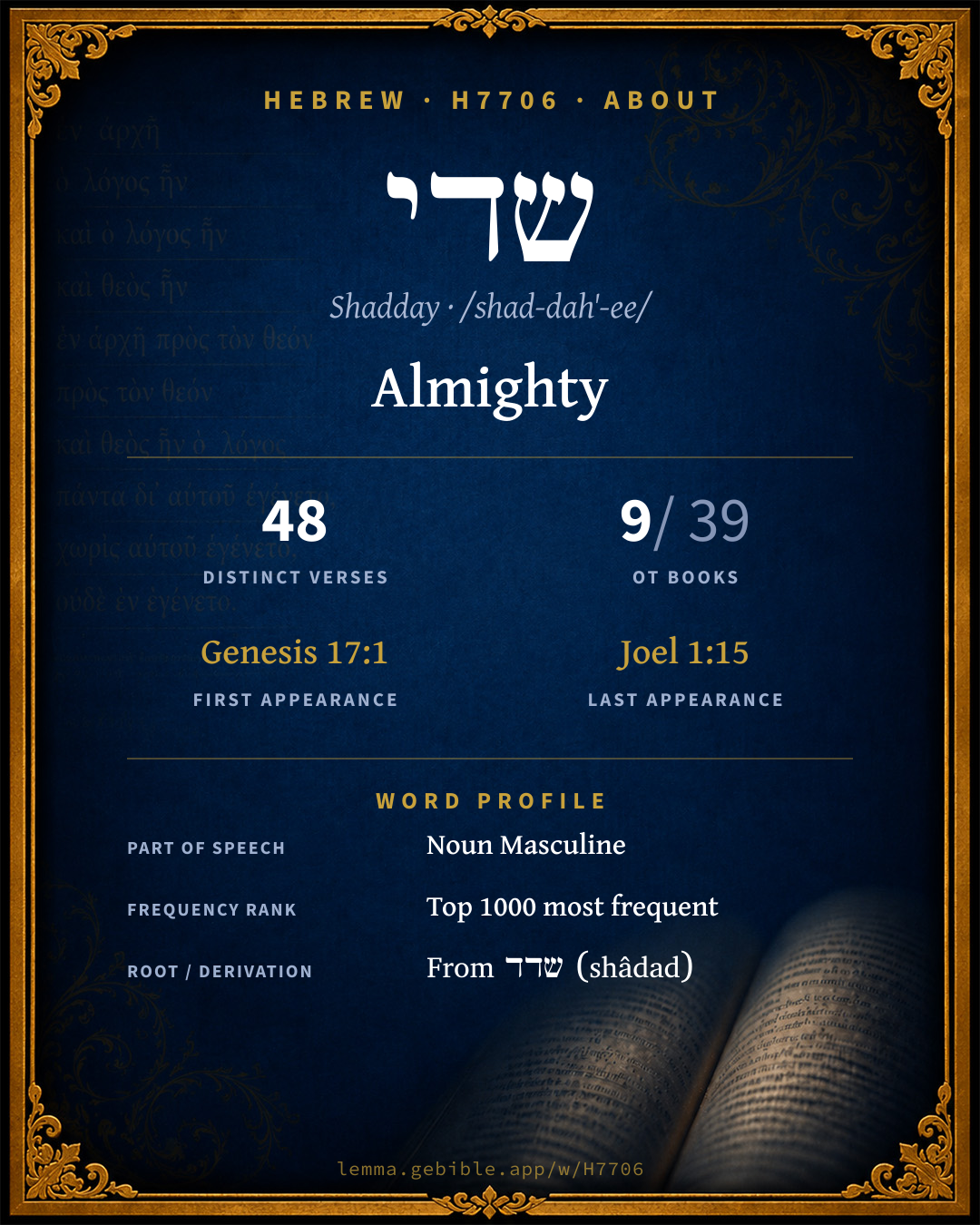
שַׁדַּי
Almighty
‘Almighty’ is one of 2 main senses fuller range ↓
Full lexicon entry — Brown-Driver-Briggs (BDB)
From Brown-Driver-Briggs (BDB)
Where this word appears
Grammar key — what these labels mean
Part of speech
- Noun
- A naming word — a person, place, thing, or idea.
Noun type
- Proper
- A name of a specific person, place, or people (e.g. Abraham, Zion, Israel).
Every verse where H7706 appears in the Book of Joel — 1 distinct verse. Click any verse to open its interlinear word-by-word view. Verse text shown in the World English Bible for context — . Each verse’s Hebrew form is shown with its reference; the English is not keyword-highlighted, since the data carries no word-level English alignment. Use “Compare translations” on any verse to read it across multiple English versions. This concordance covers the Hebrew Bible; Septuagint (Greek Old Testament) occurrences are not indexed here.
Joel
About this entry
At a glance — auto-summarized from this page’s data, not written by a person. Every figure links to its source below. This summary describes the numbers; it doesn’t interpret them.
שדי — transliterated Shadday — is a Hebrew name carrying the sense “Almighty.” Its uses cluster heavily in Job (65% of all occurrences). Spanning 48 verses in 9 books, it ranks among the moderately common words of the Hebrew Bible. Debuting at Genesis 17:1, it then recurs through the corpus. Each statement above links to its evidence; the full detail follows below.
Gloss history
Strong's 1890 vs modern scholarship
About this word
Strong's H7706 catalogs a Hebrew word from the Hebrew Old Testament.
These counts are not copied from any lexicon or concordance. They are computed here, from the morphology-tagged Hebrew Old Testament. What Lemma adds →
- 48
- distinct verses
- The word appears in 48 distinct verses.
- 9 / 39
- OT books
- The word appears in 9 of 39 Old Testament books.
- #767
- by frequency
- Top 1000 most frequent Hebrew words (rank 767 of 8,640 Hebrew words by occurrence).
View all 48 occurrences in the concordance →
By section of the Old Testament
By traditional corpus
Conventional, traditional groupings — biblical authorship is debated, so this is a traditional corpus grouping, not an authorship claim. Each share is this word’s portion of its verses in that division of the Hebrew canon. Each figure is a share of the word’s 48 distinct verses.
- Writings (Ketuvim) 35 verses · 73%
- Torah (Pentateuch) 9 verses · 19%
- Prophets (Nevi'im) 4 verses · 8%
How translations render this word
Counts come from each version’s own published word-to-Strong’s tagging or interlinear alignment — an approximate guide to how each version renders this word, not a word-level alignment the data otherwise carries. Because each total is that version’s own tagged count, the per-version totals vary from one another and need not match the appearance or distinct-verse counts above. These counts may also differ from a printed concordance because Lemma counts each distinctly tagged rendering and does not collapse phrase taggings into a single head-word total. This is a fixed set of word-tagged versions (KJV, ASV, BSB, ULT) and does not change with the reading translation you choose elsewhere. Each version’s license is shown beside its name below (and on Sources).
BDB lists this Strong’s number as 2 distinct words (homographs). Each count above pools all of them and is not split by sense — see the Senses section below. A low-frequency rendering may belong to a different one of those words, not the primary meaning.
- King James Version†: Almighty 35×, Will the almighty 2×
- American Standard Version†: Almighty 32×, I am god almighty 2×
- Berean Standard Bible†: Almighty 42×, Does the almighty 2×
- unfoldingWord Literal Text†: Almighty 42×, Shaddai 5×
King James Version Public Domain
Renders H7706 across 48† tagged occurrences — most commonly:
Plus 11 renderings that appear only once — usually multi-word phrases or single function words the recovered tagging swept in, not distinct renderings.
American Standard Version Public Domain
Renders H7706 across 47† tagged occurrences — most commonly:
Plus 13 renderings that appear only once — usually multi-word phrases or single function words the recovered tagging swept in, not distinct renderings.
Berean Standard Bible Public Domain
Renders H7706 across 48† tagged occurrences — most commonly:
Plus 4 renderings that appear only once — usually multi-word phrases or single function words the recovered tagging swept in, not distinct renderings.
unfoldingWord Literal Text CC BY-SA 4.0
Renders H7706 across 48† tagged occurrences — most commonly:
Plus 1 rendering that appears only once — usually multi-word phrases or single function words the recovered tagging swept in, not distinct renderings.
Senses in the full BDB
What do BDB’s symbols mean?
BDB uses these scholarly abbreviations:
| Symbol | Meaning |
|---|---|
| 𝔊 | the Septuagint (the ancient Greek translation, LXX) |
| 𝔙 | the Vulgate (the Latin translation) |
| 𝔖 | the Syriac version (the Peshitta) |
| 𝔗 | the Targum (the Aramaic translation) |
| ψ | the Psalms |
| √ | root (the underlying root or stem) |
| ‖ | parallel passage (a synonymous or contrasted parallel) |
| † | the dagger: every passage where the word occurs is cited |
The 2 senses and sub-senses the full Brown-Driver-Briggs lexicon distinguishes for this word, in lexicon order (not ranked by frequency), with BDB’s own verbatim wording and sub-sense lettering. Shown in Hebrew script with BDB’s own scholarly abbreviations. The condensed entry is in the Lexicon Entry tab. See also the Forms in the corpus table below.
- 1. שַׁדַּי Nu 24:4, 16 (JE, poem), and so as archaism Ru 1:20, 21 ψ 68:15; 91:1 Jo 1:15 = Is 13:6; Ez 1:24 (del. Co); especially Jb 5:17 + 30 times Jb (+ 19:29 Ew Di, reading שׁ׳ for שׁדין). e.g. Numbers 24:4
- 2. אֵל שַׁדַּי Gn 49:25 (poem; so read for אֵת שׁ׳, v. Sam. 𝔊 𝔖 Saad, Heb. Codd.), and so, as archaism, divine name of patriarchs in P, Gn 17:1; 28:3; 35:11; 48:3; Ex 6:3; Gn 43:14 (RP); so Ez 10:5 (del. Co; but 𝔊 Σαδδαι). e.g. Genesis 49:25
Senses from the full Brown-Driver-Briggs lexicon (Brown, Driver, Briggs; Oxford 1906 — public domain), digitized via Sefaria, supplemented by the OpenScriptures HebrewLexicon (CC BY 4.0). Full attribution on Sources.
Word origin
I. v. infr. אַשְׁדוֹד v. p. 78; > here, Thes al.
II. n.m. dei (etym. dub. (1) Aq Sym Theod ἱκανός; Rabb שֶׁ־ + דַּי (self-)sufficient, no moderns. (2)= almighty, √ שׁדד + י = Thes De Di Sta, or √ שׁדה = שׁדד, n. intens. Ew§ 155 c, but שׁדד (q.v.) is deal violently not simply mightily; cf. 𝔊 παντοκράτωρ 14 (15) times (but in Pent. אל שׁ׳ is ὁ Θεός μου, σου, etc.), 𝔙 mostly omnipotens. (3) שֵׁדַי (v. שֵׁד) my sovereign lord, ‖ אֲדֹנָי, בעלי NöSBA 1880, 775; ZMG xlii (1888), 481; HoffmPh. Inscr. 53; used of foreign deities (Dt 32:17), and so discredited (cf. בַּעַל).—> other conj., e.g. RSOTJC, 424 √ שׁדה pour forth (God as rain-giver); DlPr 96 sq. Assyrian šadûʾ, high, ilu šadûʾa, CheComm. Is ii. 148, or šadû, mountain, also in n.pr.; v. further Dr Gn 404 ff.);—
— Brown-Driver-Briggs (Oxford 1906, public domain), digitized via Sefaria, supplemented by the OpenScriptures HebrewLexicon (CC BY 4.0). See Sources.
Derived from שדד (shâdad) (H7703) — to devastate.
Jastrow Dictionary
A second Hebrew/Aramaic lexicon for comparison, covering Aramaic and post-biblical (Talmudic, Targumic, Midrashic) usage that the biblical-Hebrew BDB does not. Matched by lemma rather than by Strong’s number, so a lemma may carry more than one Jastrow headword (shown separately below), and the entries cover usage well beyond the Bible.
שַׁד
- , v. Ges. Thes. s. v.) female breast. Tosef. Sot. IV, 3 (ref. to לשד, Num. XI, 8) מה שד זה עיקר וכ׳ ed. Zuck. (Var. דד) as the breast is essential for the child and everything else is of secondary import, so was the manna &c.; מה שד זה אם יונק וכ׳ as the breast does not harm the child, even if it suck it an entire day &c.; Yoma 75ᵃ מה שד זה תינוק וכ׳ as the child finds in the breast all tastes &c.—Du. שָׁדַיִם; pl. constr. שְׁדֵי. Gen. R. s. 42; Yalk. ib. 72, v. preced. Tanḥ. Sh’moth 25 והיונקים כחלב משרי אמם and the sucklings found in the manna a taste like that of the milk from their mothers’ breast (ref. to Num. l. c.). Ber. 3ᵃ. Sot. 30ᵇ; a. fr. e.g. Numbers 11:8
שַׁדַּי
- (b. h.) Almighty. Targ. Gen. XVII, 1. Targ. Ruth I, 20; a. fr.—Gen. R. s. 46 (homiletic etymology, ref. to Gen. XVII, 1) אני הוא שאמרתי … דַּי it is I who said to my world …, ‘it is enough’. Succ. 5ᵃ (ref. to Job XXVI, 9) שפירש ש׳ מזיו וכ׳ the Almighty separated himself from the splendor of his residence, with his cloud over him; a. e. e.g. Genesis 17:1
שְׁדֵי
- (v. אֲדִי, נְדֵי II)
- 1. to swing, throw, cast, shoot; to sprinkle, pour. Targ. O. Ex. XV, 21 ed. Lsb. a. oth. (ed. רמא). Targ. Job XXXVIII, 6 (h. text ירה). Targ. Ps. XCI, 5 (v. שַׁדְיָא II). Targ. I Sam. XX, 20. Targ. Lev. IV, 12 מֵישַׁד (infin.; h. text שֶׁפֶךְ); ib. 18 יֵישׁוֹד (fr. אֲשַׁד). Targ. Koh. II, 8 מרזבין דשַׁדְיָן וכ׳ (not דשרין) gutters discharging tepid, and gutters discharging hot waters (h. text שדה ושדות). Targ. Ps. LXXIX, 3. Ib. LXII, 9 (ed. Wil. שרו, corr. acc.). Targ. Lam. II, 4; a. fr.—B. Kam. 92ᵇ לא תִשְׁדֵּי וכ׳, v. בֵּירָא. Nidd. 31ᵃ ושְׁדִי בשרא וכ׳, v. נְפַץ. Gitt. 57ᵇ אִישְׁדֵּי לך וכ׳ I will throw down a ring for thee, and thou bow down &c. Ib. 69ᵇ ונִישְׁדֵּי מיא וכ׳ and let him pour water on it. Ib. ולִישְׁדֵּי ליה וכ׳ and let him sprinkle it &c. Snh. 30ᵇ, a. e. ש׳ ביה נרגא, v. נַרְגָּא; a. fr.
- 2. to cast the spindle, to spin. Keth. 72ᵇ שַׁדְיָא פילכה, v. פִּלְכָא. Gitt. 69ᵇ דשַׁדְתֵּיה דומה (fr. שוד or שדד), v. דּוּמָה I. Succ. 16ᵃ מִשְׁדָּא, v. אַשְׁלָא; a. e.
- same, to cast, pour, shed. Targ. II Sam. XVI, 13. Targ. I Chr. XXII, 8; a. e.
- same. Targ. O. Ex. XV, 4 ed. Berl. (oth. ed. Pe.); Y. I ib. שַׁדָּא (h. text ירה).—[Targ. Prov. XIII, 12 מְשַׁדֵּי ed. Wil., read מְשָׁרֵי, v. שְׁרֶי.]
- 1. to be cast, poured out; to be shot. Targ. Jer. XXII, 19. Targ. Lam. IV, 1. Targ. Y. Num. XXXV, 33 (O. אִתָּשַׁד, v. אֲשַׁד). Targ. O. Ex. XIX, 13. Targ. Jer. XII, 9; a. e.—Nidd. 48ᵇ, v. infra.
- 2. to be cast about, reel. Targ. Is. XXIV, 20 (h. text נוע).—V. אִשְׁתְּדָיוּתָא.
- 3. (v. דָּאָה) to hover, fly. Targ. O. Deut. XXVIII, 49 (h. text דאה). Targ. Jer. XLVIII, 40. Targ. Hab. I, 8. Targ. Is. VI, 6 (ed. Lag. a. Ar. אשתוי, corr. acc.). e.g. Habakkuk 1:8
- 4. denom. of שַׁד) to be a full developed breast. Nidd. 48ᵇ אִשְׁתַּדּוּ (oth. opin. in Rashi: to be poured out, emptied, dried up), v. כְּרַף; [Ar. אשתדור, Var. אשתרור, v. שְׁדַר II, a. שְׁרַר].
A Dictionary of the Targumim, the Talmud Babli and Yerushalmi, and the Midrashic Literature (Marcus Jastrow; London, Luzac, 1903) — Public Domain. Digitized via Sefaria. Digitized via Sefaria. Full attribution on Sources.
Forms in the corpus
The 19 distinct written forms H7706 takes in the Hebrew Bible, most frequent first — each parse links to that state’s occurrences in the concordance. Hebrew forms include their vowel points and cantillation, so a single lemma takes many written forms.
| Form | Parsing | Example | Uses |
|---|---|---|---|
| שַׁדַּ֣י | Noun, Proper | Job 6:14 | 12 |
| שַׁ֝דַּ֗י | Noun, Proper | Job 5:17 | 7 |
| שַׁדַּי֙ | Noun, Proper | Ezekiel 1:24 | 6 |
| וְ֝/שַׁדַּ֗י | Noun, Proper | Job 23:16 | 4 |
| מִ/שַּׁדַּ֥י | Noun, Proper | Isaiah 13:6 | 2 |
| שַׁ֭דַּי | Noun, Proper | Job 22:23 | 2 |
| שַׁדַּ֛י | Noun, Proper | Genesis 48:3 | 2 |
| שַׁדַּ֥י | Noun, Proper | Job 21:15 | 2 |
| וְ/שַׁדַּ֖י | Noun, Proper | Ruth 1:21 | 1 |
| וְ/שַׁדַּ֥י | Noun, Proper | Job 34:10 | 1 |
| לְ֭/שַׁדַּי | Noun, Proper | Job 22:3 | 1 |
| מִ/שַׁדַּ֥י | Noun, Proper | Joel 1:15 | 1 |
| מִ֭/שַּׁדַּי | Noun, Proper | Job 24:1 | 1 |
| שַׁדַּ֓י | Noun, Proper | Psalms 68:14 | 1 |
| שַׁדַּ֔י | Noun, Proper | Genesis 17:1 | 1 |
| שַׁדַּ֖י | Noun, Proper | Ezekiel 10:5 | 1 |
| שַׁדַּ֗י | Noun, Proper | Genesis 43:14 | 1 |
| שַׁדַּ֡י | Noun, Proper | Job 6:4 | 1 |
| שַׁדָּ֑י | Noun, Proper | Exodus 6:3 | 1 |
Same root — word family
Other BDB entries built from the same root as H7706, grouped by Strong’s listed origin. These share a root / origin per the lexicon — not necessarily a shared meaning. Each links to that word’s own entry.
Derives from
Shares the same root
Proper names from this root
People and places named from this root — a name, not an additional meaning of the word.
Compare all same-root words → 1 of the same-root words is a proper name (a person or place). They share a root, not necessarily a meaning.
Septuagint verse parallels
This word appears in 48 verses that also exist in the Greek Old Testament (Septuagint), out of the 48 Hebrew verses it occurs in. You can read those verses in Greek by switching the Old Testament edition to the Septuagint.
Read these verses in the Septuagint
- Genesis 17:1
- Exodus 6:3
- Numbers 24:4
- Ruth 1:20
- Job 5:17
- Psalms 68:14
- Isaiah 13:6
- Ezekiel 1:24
- Joel 1:15
This is a verse-level parallel only — the same verses exist in both the Hebrew and Greek Old Testaments. No word-level Hebrew↔Greek correspondence is claimed: the data carries no such alignment, so no Greek word is shown as this Hebrew word’s translation. Coverage is not total — the Septuagint omits the deuterocanon and renumbers the Psalms, so some Hebrew verses have no direct Greek parallel.