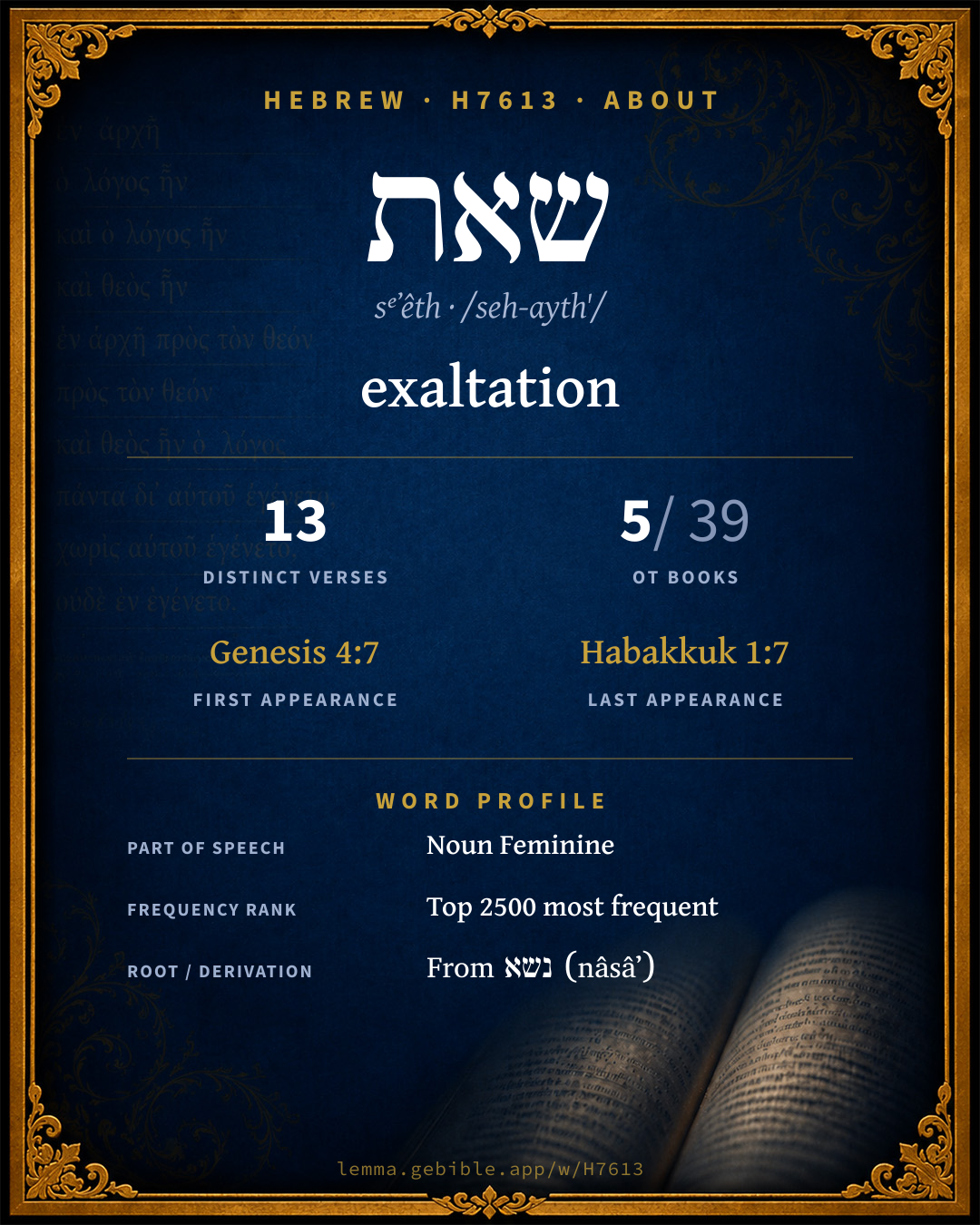
שְׂאֵת
exaltation
also: elevation, dignity, swelling, uprising fuller range ↓
Full lexicon entry — Brown-Driver-Briggs (BDB)
From Brown-Driver-Briggs (BDB)
Where this word appears
See every Absolute-state word in the Hebrew Bible →
Grammar key — what these labels mean
Part of speech
- Noun
- A naming word — a person, place, thing, or idea.
Noun type
- Common
- A common noun — a general class of person, place, or thing (“king,” “city,” “water”), not a specific name.
State
- Absolute
- The independent form of a noun, not bound to a following word.
- Construct
- A noun bound to a following noun in a possessive / “of” relationship (the construct chain).
Gender
- Feminine
- Grammatically feminine.
Number
- Singular
- One.
Every verse where H7613 appears in the Book of Leviticus — 6 distinct verses. Click any verse to open its interlinear word-by-word view. Verse text shown in the World English Bible for context — . Each verse’s Hebrew form is shown with its reference; the English is not keyword-highlighted, since the data carries no word-level English alignment. Use “Compare translations” on any verse to read it across multiple English versions. This concordance covers the Hebrew Bible; Septuagint (Greek Old Testament) occurrences are not indexed here.
Leviticus
- Leviticus 13:2 שְׂאֵ֤ת n c fs "When a man shall have a rising in his body's skin, or a scab, or a bright spot, and it becomes in the skin of his body the plague of leprosy, then he shall be brought to Aaron the priest, or to one of his sons the priests:
- Leviticus 13:10 שְׂאֵת בַּ/שְׂאֵֽת n c fs cs prep det + n c fs and the priest shall examine him. Behold, if there is a white rising in the skin, and it has turned the hair white, and there is raw flesh in the rising,
- Leviticus 13:19 שְׂאֵ֣ת n c fs and in the place of the boil there is a white rising, or a bright spot, reddish-white, then it shall be shown to the priest;
- Leviticus 13:28 שְׂאֵ֥ת n c fs cs If the bright spot stays in its place, and hasn't spread in the skin, but is faded, it is the swelling from the burn, and the priest shall pronounce him clean; for it is the scar from the burn.
- Leviticus 13:43 שְׂאֵת n c fs cs Then the priest shall examine him; and, behold, if the rising of the plague is reddish-white in his bald head, or in his bald forehead, like the appearance of leprosy in the skin of the flesh,
- Leviticus 14:56 וְ/לַ/שְׂאֵ֥ת conj + prep det + n c fs and for a rising, and for a scab, and for a bright spot;
About this entry
At a glance — auto-summarized from this page’s data, not written by a person. Every figure links to its source below. This summary describes the numbers; it doesn’t interpret them.
The Hebrew noun שאת centers on the idea of “exaltation.” Beyond “exaltation” it also covers “elevation”, “dignity”, and “swelling” — see its full sense range. It appears 13 verses across 5 books of the Hebrew Bible, among its uncommon vocabulary. The word gravitates to Leviticus (46%), then Job and Genesis. Its earliest occurrence is Genesis 4:7. Dig into 13-verse concordance and the renderings breakdown below.
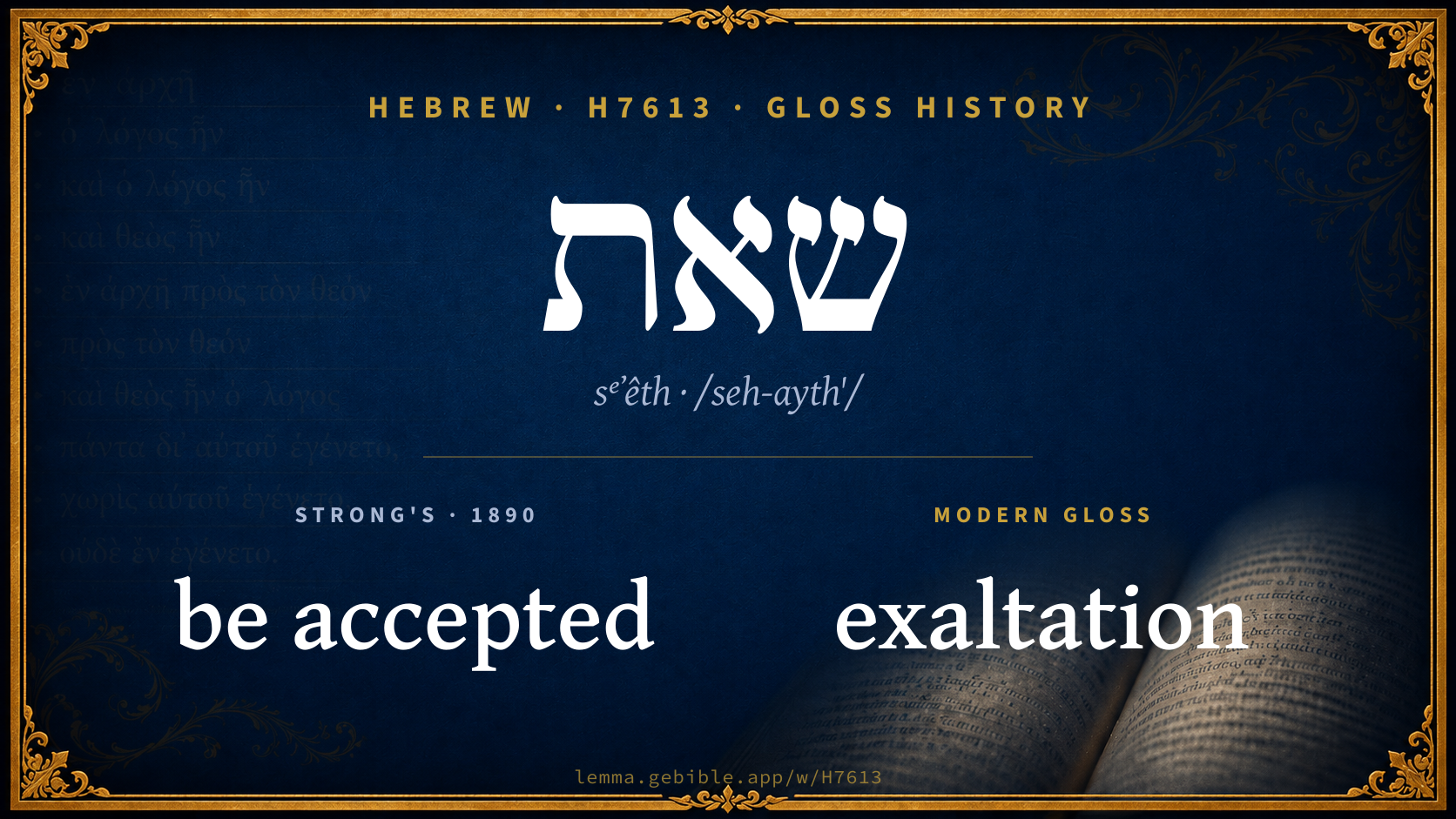
Gloss history
Strong's 1890 vs modern scholarship
About this word
Strong's H7613 catalogs a Hebrew word from the Hebrew Old Testament.
These counts are not copied from any lexicon or concordance. They are computed here, from the morphology-tagged Hebrew Old Testament. What Lemma adds →
- 13
- distinct verses
- The word appears in 13 distinct verses.
- 5 / 39
- OT books
- The word appears in 5 of 39 Old Testament books.
- #1,910
- by frequency
- Top 2500 most frequent Hebrew words (rank 1,910 of 8,640 Hebrew words by occurrence).
View all 13 occurrences in the concordance →
By section of the Old Testament
By traditional corpus
Conventional, traditional groupings — biblical authorship is debated, so this is a traditional corpus grouping, not an authorship claim. Each share is this word’s portion of its verses in that division of the Hebrew canon. Each figure is a share of the word’s 13 distinct verses.
- Torah (Pentateuch) 8 verses · 62%
- Writings (Ketuvim) 4 verses · 31%
- Prophets (Nevi'im) 1 verse · 8%
How translations render this word
Counts come from each version’s own published word-to-Strong’s tagging or interlinear alignment — an approximate guide to how each version renders this word, not a word-level alignment the data otherwise carries. Because each total is that version’s own tagged count, the per-version totals vary from one another and need not match the appearance or distinct-verse counts above. These counts may also differ from a printed concordance because Lemma counts each distinctly tagged rendering and does not collapse phrase taggings into a single head-word total. This is a fixed set of word-tagged versions (KJV, ASV, BSB, ULT) and does not change with the reading translation you choose elsewhere. Each version’s license is shown beside its name below (and on Sources).
- King James Version: Rising 4×, Behold if the rising 2×, Dignity 2×
- American Standard Version: Rising 4×, Dignity 3×
- Berean Standard Bible: Swelling 6×
- unfoldingWord Literal Text: Swelling 4×, A 2×, Majesty 2×
King James Version Public Domain
Renders H7613 across 14 tagged occurrences — most commonly:
Plus 6 renderings that appear only once — usually multi-word phrases or single function words the recovered tagging swept in, not distinct renderings.
American Standard Version Public Domain
Renders H7613 across 14 tagged occurrences — most commonly:
Plus 7 renderings that appear only once — usually multi-word phrases or single function words the recovered tagging swept in, not distinct renderings.
Berean Standard Bible Public Domain
Renders H7613 across 14 tagged occurrences — most commonly:
Plus 8 renderings that appear only once — usually multi-word phrases or single function words the recovered tagging swept in, not distinct renderings.
unfoldingWord Literal Text CC BY-SA 4.0
Renders H7613 across 17 tagged occurrences — most commonly:
Plus 9 renderings that appear only once — usually multi-word phrases or single function words the recovered tagging swept in, not distinct renderings.
Senses in the full BDB
What do BDB’s symbols mean?
BDB uses these scholarly abbreviations:
| Symbol | Meaning |
|---|---|
| 𝔊 | the Septuagint (the ancient Greek translation, LXX) |
| 𝔙 | the Vulgate (the Latin translation) |
| 𝔖 | the Syriac version (the Peshitta) |
| 𝔗 | the Targum (the Aramaic translation) |
| ψ | the Psalms |
| √ | root (the underlying root or stem) |
| ‖ | parallel passage (a synonymous or contrasted parallel) |
| † | the dagger: every passage where the word occurs is cited |
The 4 senses and sub-senses the full Brown-Driver-Briggs lexicon distinguishes for this word, in lexicon order (not ranked by frequency), with BDB’s own verbatim wording and sub-sense lettering. Shown in Hebrew script with BDB’s own scholarly abbreviations. The condensed entry is in the Lexicon Entry tab. See also the Forms in the corpus table below.
- 1. dignity Gn 49:3 (dignity of first-born), ψ 62:5, of Chaldeans Hb 1:7; of God, his exaltation, loftiness Jb 13:11; 31:23. e.g. Genesis 49:3
- 2. swelling, eruption, בְּעוֹר בָּשָׂר Lv 13:2 (+ סַפַּחַת, בַּהֶרֶת), cf. 14:56 (+ id.); also 13:10(×2), 19, 28, שׂ׳ הַנֶּגַע v 43 (all P). e.g. Leviticus 13:2
- 3. uprising, Jb 41:17 at his uprising the mighty are in dread. e.g. Job 41:17
- 4. Gn 4:7 is dub.;—is there not acceptance? 𝔖 𝔙 al.; forgiveness 𝔗 Holz al.; uplifting of countenance, cheerfulness, Ew De Ke Di Kau. e.g. Genesis 4:7
Senses from the full Brown-Driver-Briggs lexicon (Brown, Driver, Briggs; Oxford 1906 — public domain), digitized via Sefaria, supplemented by the OpenScriptures HebrewLexicon (CC BY 4.0). Full attribution on Sources.
Word origin
n.f. 1. exaltation, dignity. 2. swelling. 3. uprising;—שׂ׳ abs. Gn 4:7 +, cstr. Lv 13:28 +; sf. שְׂאֵתוֹ Jb 13:11 +; (מִ)שֵּׂתוֹ 41:17;—
— Brown-Driver-Briggs (Oxford 1906, public domain), digitized via Sefaria, supplemented by the OpenScriptures HebrewLexicon (CC BY 4.0). See Sources.
Derived from נשא (nâsâʼ) (H5375) — to lift.
Jastrow Dictionary
A second Hebrew/Aramaic lexicon for comparison, covering Aramaic and post-biblical (Talmudic, Targumic, Midrashic) usage that the biblical-Hebrew BDB does not. Matched by lemma rather than by Strong’s number, so a lemma may carry more than one Jastrow headword (shown separately below), and the entries cover usage well beyond the Bible.
אִתְ־
- formative prefix of the Ithpa., Ithpe. and Ithpo., and corresponding nouns; in Talmud mostly אִיתְ־; cmp. אִסְ־ a. אִיסְ־. [For words not to be found here v. sub. אִיתְ־, a. vice versa.]
אַתְּ
- c. (b. h. אַתְּ f.; contr. of אנת) thou. Targ. Gen. III, 11; a. fr.—Y. Snh. I, 19ᵃ top ואת מר הכן and thou sayest so?—[In Talmudic argumentation (אתה) את אומר; Chald. את אמר, את מר thou sayest, את צווח ליה thou callest it, frequently applied to Scripture texts as though addressing an opponent.] Lev. R. s. 10, end ואת אומר אל פתח וכ׳ and yet the Scripture says, ‘To the entrance of the Tabernacle’! i.e. how is this possible?—Y. Pes. V, 32ᶜ את מר והיה לאבק Scripture says ‘And it shall turn into dust’.—Y. Kil. VIII, 31ᵇ top הן דאת אמר לא אמרה למה את אמר, [add the respective bibl. verses after each אמר a. read אמרת for אמרה] there where it reads, ‘thou shalt not’ &c. (Lev. XIX, 19), the text gives no reason why; therefore it is repeated (Deut. XXII, 9 adding the reason); a. fr.—[דאת אמר contr. דַּתְּ מַר q. v.]—Pl. (תּוּן) אַתּוּן, (אַתּוּ) m. אַתֵּין f. ye. Targ. Ps. CXIV, 6 דאתון Ms. (omitted in ed., and third person). Targ. Is. III, 14. Targ. Ezek. XIII, 20; a. fr.—Y. Snh. VI, 23ᵈ top ומה תון בעון (read בעתון) and what is it ye want? Y. Keth. XII, 35ᵃ אתון אמרתון ye said so; a. fr.—Snh. 109ᵃ דאַתּוּ גנבי (v. Rashi a. l., Ms. דגנבי אית בכו, v. Rabb. D. S. a. l. note) that ye are thieves. V. אַתָּה, אַנְתְּ. e.g. Leviticus 19:19
אָת
- c. (= b. h. אוֹת; fr. תאה, or תאו, sec. r. of אה or או; as to reject. of radical ו or ה, cmp. אב, אח &c.) sign, type; letter (v. אוֹת II). Targ. Ex. XIII, 16; a. fr.—Targ. Is. VII, 11; a. fr.—Pl. אָתִין, אָתַיָּא. Targ. Gen. I, 14. Targ. Ps. LXXIV, 4; a. e.—אַתְוָון, אַתְיָין, אַתְוָותָא, אַתְוָאן, (אָתָן) אַתְיָיתָא. Targ. Ps. l. c. Targ. O. Num. II, 2 ed. Berl. אַתְיַן, Var. אָתְיָן, אַתְוָון; Y. אתוון (v. Berl. Targ. O. II, p. 39); a. fr.—Koh. R. to I, 13 ה׳ אתואן five letters of acrostics.—אַתְוָיֵי (אַתְוֵוי, אִיתְוֵי). Num. R. s. 13, end א׳ דידין וכ׳ the letters composing the one word (קערת) are the same as those composing the other (קרעת).
אֵת
- [essence], a particle of the objective case, but also used as a noun, the thing (which) (cmp. Koh. IV, 3, v. אוֹת III). Ohol. II, 4 את ש … עליו that upon which … Zeb. 72ᵇ; Bets. 3ᵇ את שדרכו למנות שנינו we read (Orl. III, 7) that which it is customary to count singly, opp. כל שדרכו וכ׳ whatever is sometimes counted singly; a. fr.—Ber. I, 1 קורין את שמע we read the Sh’ma’, a. v. fr.—[The fact that את as a particle of the objective case may be dispensed with, and that את (fr. אתת to join) may have the meaning of with, gave rise to a method of Biblical interpretation by which, wherever את occurs in the Bible, esp. in laws, an amplification by implication is looked for.] Pes. 22ᵇ את לרבות וכ׳ the word eth (Deut. X, 20 [with] the Lord thy God thou shalt fear [some one else] intimates that we must pay reverence to the scholars next to God. Ib. ואידך את לא דריש and as to the other authority (that differs)? He does not interpret eth (as having a particular meaning); a. fr.—Pl. אֵתִים, אֵתִין the word eth occurring in Scripture, as a substratum for interpretation. Ib. היה דורש כל א׳ וכ׳ used to interpret every eth in the Law; a. fr. Num. R. s. 10 זו אחת מג׳ א׳ וכ׳ this is one of the three eths &c. e.g. Ecclesiastes 4:3
שְׂאֵת
- swelling, sore. Sifra Thazr., Neg., ch. I. Neg. I, 1Neg. I, 1; a. e.
A Dictionary of the Targumim, the Talmud Babli and Yerushalmi, and the Midrashic Literature (Marcus Jastrow; London, Luzac, 1903) — Public Domain. Digitized via Sefaria. Digitized via Sefaria. Full attribution on Sources.
Forms in the corpus
The 13 distinct written forms H7613 takes in the Hebrew Bible, most frequent first — each parse links to that state’s occurrences in the concordance. Hebrew forms include their vowel points and cantillation, so a single lemma takes many written forms.
| Form | Parsing | Example | Uses |
|---|---|---|---|
| שְׂאֵת | Noun, Common, Feminine, Singular, Construct | Leviticus 13:10 | 2 |
| בַּ/שְׂאֵֽת | Noun, Common, Feminine, Singular, Absolute | Leviticus 13:10 | 1 |
| וְ/לַ/שְׂאֵ֥ת | Noun, Common, Feminine, Singular, Absolute | Leviticus 14:56 | 1 |
| וּ/שְׂאֵת֖/וֹ | Noun, Common, Feminine, Singular, Construct | Habakkuk 1:7 | 1 |
| וּ֝/מִ/שְּׂאֵת֗/וֹ | Noun, Common, Feminine, Singular, Construct | Job 31:23 | 1 |
| מִ/שְּׂאֵת֨/וֹ | Noun, Common, Feminine, Singular, Construct | Psalms 62:4 | 1 |
| מִ֭/שֵּׂת/וֹ | Noun, Common, Feminine, Singular, Construct | Job 41:25 | 1 |
| שְׂ֭אֵת/וֹ | Noun, Common, Feminine, Singular, Construct | Job 13:11 | 1 |
| שְׂאֵ֔ת | Noun, Common, Feminine, Singular, Absolute | Genesis 4:7 | 1 |
| שְׂאֵ֖ת | Noun, Common, Feminine, Singular, Absolute | Genesis 49:3 | 1 |
| שְׂאֵ֣ת | Noun, Common, Feminine, Singular, Absolute | Leviticus 13:19 | 1 |
| שְׂאֵ֤ת | Noun, Common, Feminine, Singular, Absolute | Leviticus 13:2 | 1 |
| שְׂאֵ֥ת | Noun, Common, Feminine, Singular, Construct | Leviticus 13:28 | 1 |
Same root — word family
Other BDB entries built from the same root as H7613, grouped by Strong’s listed origin. These share a root / origin per the lexicon — not necessarily a shared meaning. Each links to that word’s own entry.
Derives from
Shares the same root
- משא massâʼ H4853 burden
- משא massôʼ H4856 partiality
- משאה massâʼâh H4858 uplifting
- משאת masʼêth H4864 burden
- מתנשא mithnassêʼ H4984 to exalt oneself
- נשא nᵉsâʼ H5376 to lift
- נשאת nissêʼth H5379 portion
- נשואה nᵉsûwʼâh H5385 load
- נשיא nâsîyʼ H5387 chief
- שוא sôwʼ H7721 rising
Proper names from this root
People and places named from this root — a name, not an additional meaning of the word.
Compare all same-root words → Showing 4 of 13 — not the complete family. 1 of the same-root words is a proper name (a person or place). They share a root, not necessarily a meaning.
Septuagint verse parallels
This word appears in 13 verses that also exist in the Greek Old Testament (Septuagint), out of the 13 Hebrew verses it occurs in. You can read those verses in Greek by switching the Old Testament edition to the Septuagint.
Read these verses in the Septuagint
This is a verse-level parallel only — the same verses exist in both the Hebrew and Greek Old Testaments. No word-level Hebrew↔Greek correspondence is claimed: the data carries no such alignment, so no Greek word is shown as this Hebrew word’s translation. Coverage is not total — the Septuagint omits the deuterocanon and renumbers the Psalms, so some Hebrew verses have no direct Greek parallel.