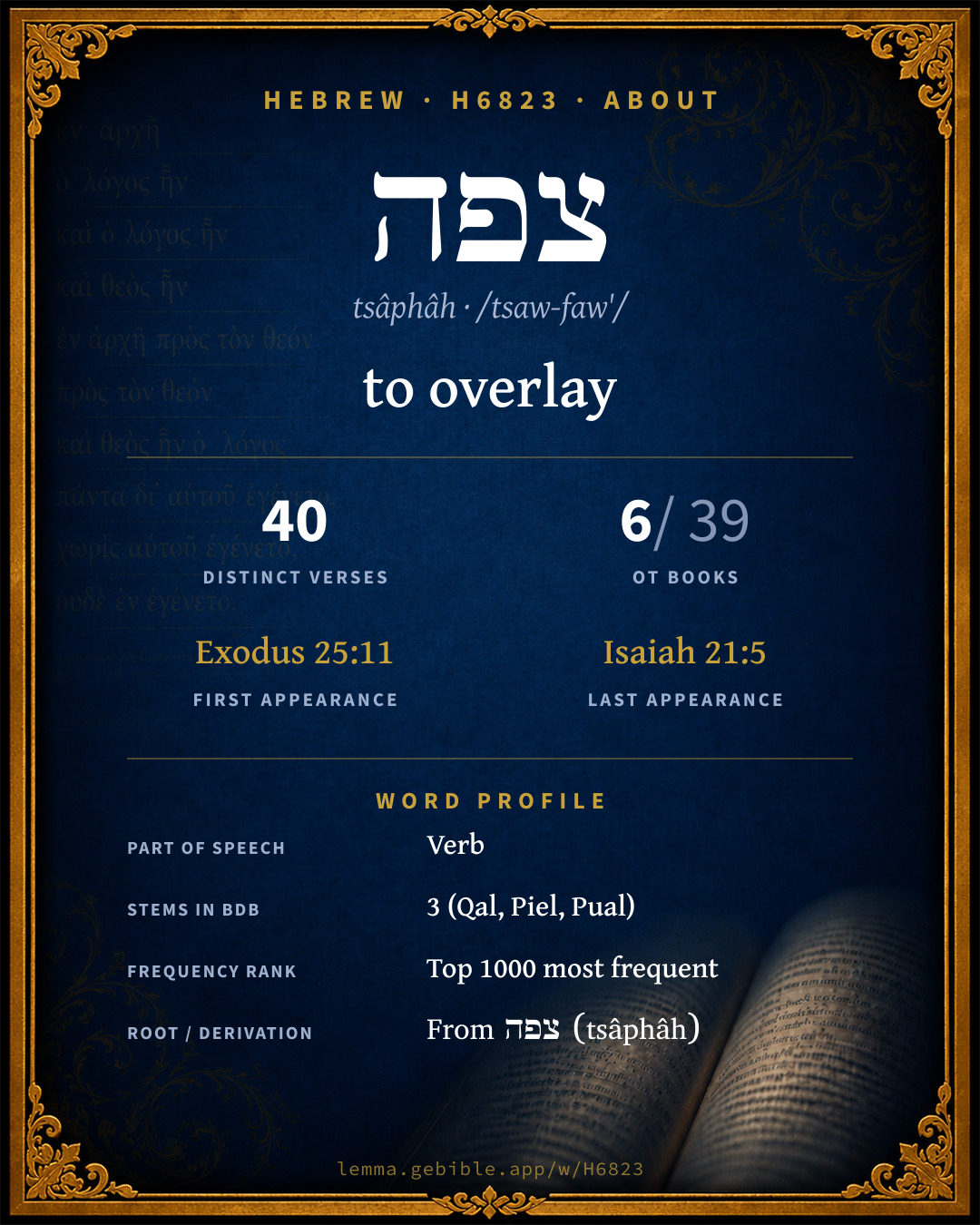
צָפָה
to overlay
‘to overlay’ is one of 3 main senses fuller range ↓
Full lexicon entry — Brown-Driver-Briggs (BDB)
From Brown-Driver-Briggs (BDB)
Where this word appears
Grammar key — what these labels mean
Part of speech
- Verb
- An action or state-of-being word.
Stem
- Piel
- An intensive or resultative active stem. Here: ‘overlay’
- Pual
- The passive counterpart of the Piel.
- Qal
- The basic, simple active stem — the plain form of the verb (“he wrote”).
Form
- Sequential Imperfect
- An imperfect with prefixed waw — the standard past-narrative form (waw-consecutive imperfect).
- Sequential Perfect
- A perfect with prefixed waw continuing a preceding imperfect or command (waw-consecutive perfect).
- Perfect
- A completed action or state — Hebrew marks aspect (completeness) more than strict tense (“he wrote”).
- Participle Passive
- A verbal adjective expressing action received (“written”).
- Imperfect
- An incomplete, ongoing, or future action (“he will / would write”).
- Infinitive Absolute
- An unbound verbal noun, often intensifying or standing in for a finite verb.
State
- Absolute
- The independent form of a noun, not bound to a following word.
Person
- 3rd Person
- The one spoken about (“he / she / it / they”).
- 2nd Person
- The one addressed (“you”).
Gender
- Masculine
- Grammatically masculine.
Number
- Singular
- One.
- Plural
- More than one (in Hebrew, generally three or more).
Every verse where H6823 appears in the Book of Proverbs — 1 distinct verse. Click any verse to open its interlinear word-by-word view. Verse text shown in the World English Bible for context — . Each verse’s Hebrew form is shown with its reference; the English is not keyword-highlighted, since the data carries no word-level English alignment. Use “Compare translations” on any verse to read it across multiple English versions. This concordance covers the Hebrew Bible; Septuagint (Greek Old Testament) occurrences are not indexed here.
Proverbs
About this entry
At a glance — auto-summarized from this page’s data, not written by a person. Every figure links to its source below. This summary describes the numbers; it doesn’t interpret them.
The Hebrew verb צפה centers on the idea of “to overlay.” The word gravitates to Exodus (57%), then 1 Kings and 2 Chronicles. It appears 40 verses across 6 books of the Hebrew Bible, among its moderately common vocabulary. Its earliest occurrence is Exodus 25:11. Across 3 stems, its meaning turns on the binyan (Qal, Piel). Dig into 40-verse concordance and the renderings breakdown below.
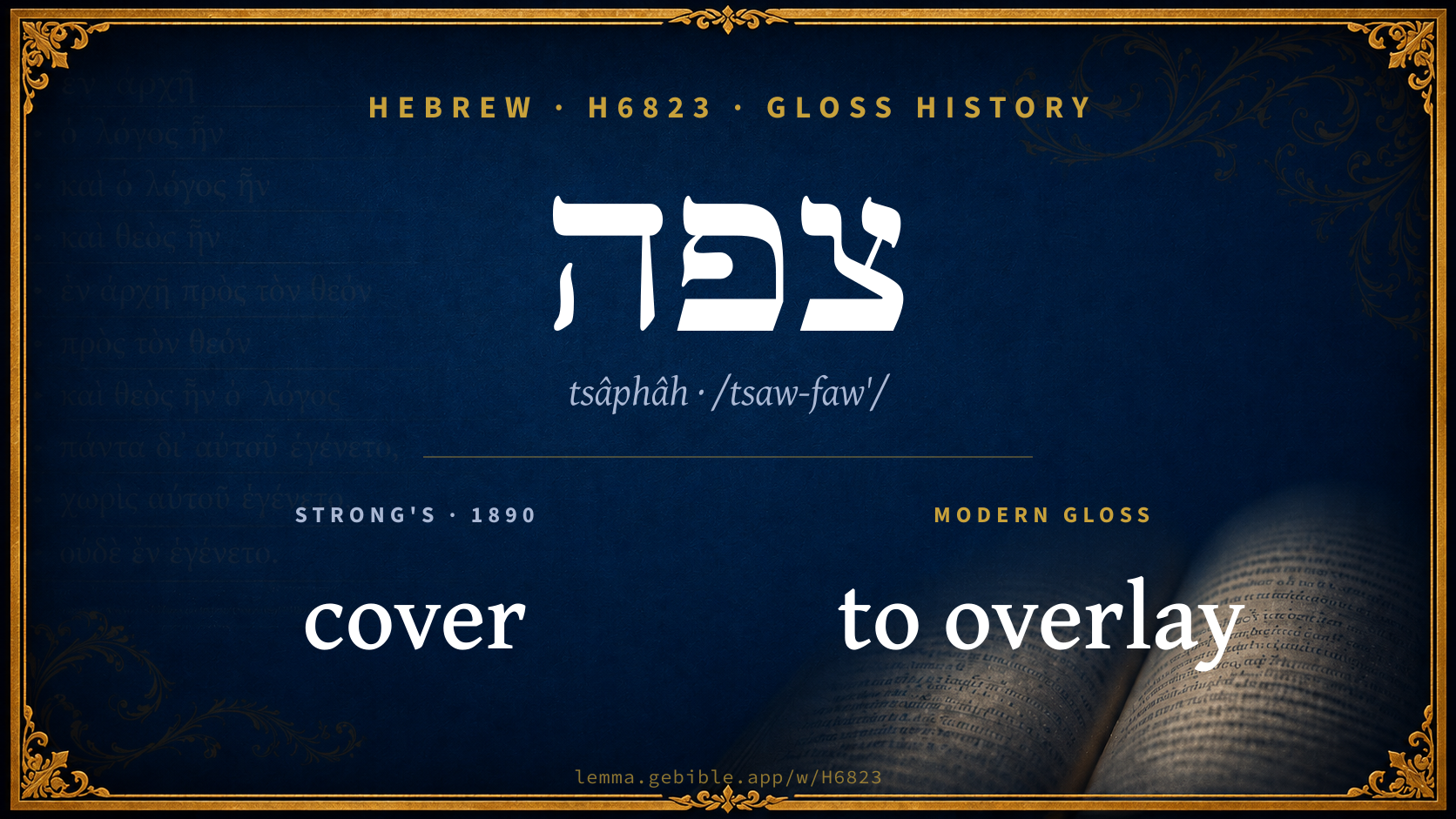
Gloss history
Strong's 1890 vs modern scholarship
About this word
Strong's H6823 catalogs a Hebrew word from the Hebrew Old Testament.
These counts are not copied from any lexicon or concordance. They are computed here, from the morphology-tagged Hebrew Old Testament. What Lemma adds →
- 40
- distinct verses
- The word appears in 40 distinct verses.
- 6 / 39
- OT books
- The word appears in 6 of 39 Old Testament books.
- #783
- by frequency
- Top 1000 most frequent Hebrew words (rank 783 of 8,640 Hebrew words by occurrence).
View all 40 occurrences in the concordance →
Most concentrated in
- Exodus 23 verses 57%
- 1 Kings 9 verses 23%
- 2 Chronicles 5 verses 13%
By section of the Old Testament
By traditional corpus
Conventional, traditional groupings — biblical authorship is debated, so this is a traditional corpus grouping, not an authorship claim. Each share is this word’s portion of its verses in that division of the Hebrew canon. Each figure is a share of the word’s 40 distinct verses.
- Torah (Pentateuch) 23 verses · 57%
- Prophets (Nevi'im) 11 verses · 28%
- Writings (Ketuvim) 6 verses · 15%
How translations render this word
Counts come from each version’s own published word-to-Strong’s tagging or interlinear alignment — an approximate guide to how each version renders this word, not a word-level alignment the data otherwise carries. Because each total is that version’s own tagged count, the per-version totals vary from one another and need not match the appearance or distinct-verse counts above. These counts may also differ from a printed concordance because Lemma counts each distinctly tagged rendering and does not collapse phrase taggings into a single head-word total. This is a fixed set of word-tagged versions (KJV, ASV, BSB, ULT) and does not change with the reading translation you choose elsewhere. Each version’s license is shown beside its name below (and on Sources).
BDB lists this Strong’s number as 4 distinct words (homographs). Each count above pools all of them and is not split by sense — see the Senses section below. A low-frequency rendering may belong to a different one of those words, not the primary meaning.
- King James Version†: Overlaid 12×, He overlaid 11×, Thou shalt overlay 5×
- American Standard Version†: Overlaid 13×, He overlaid 12×, Overlay 5×
- Berean Standard Bible†: He overlaid 12×, Overlay 11×, Overlaid 8×
- unfoldingWord Literal Text†: He overlaid 15×, You shall overlay 7×, He overlaid it 5×
King James Version Public Domain
Renders H6823 across 46† tagged occurrences — most commonly:
Plus 10 renderings that appear only once — usually multi-word phrases or single function words the recovered tagging swept in, not distinct renderings.
American Standard Version Public Domain
Renders H6823 across 46† tagged occurrences — most commonly:
Plus 8 renderings that appear only once — usually multi-word phrases or single function words the recovered tagging swept in, not distinct renderings.
Berean Standard Bible Public Domain
Renders H6823 across 45† tagged occurrences — most commonly:
Plus 8 renderings that appear only once — usually multi-word phrases or single function words the recovered tagging swept in, not distinct renderings. Not rendered by a distinct English word in 2 further occurrences.
unfoldingWord Literal Text CC BY-SA 4.0
Renders H6823 across 51† tagged occurrences — most commonly:
Plus 10 renderings that appear only once — usually multi-word phrases or single function words the recovered tagging swept in, not distinct renderings.
Senses in the full BDB
Hebrew verbs can shift meaning by stem (binyan): Qal is the basic action, Niphal is often passive or reflexive, Piel often intensifies or makes it factitive, and Hiphil is typically causative. The senses below are grouped under the stem BDB assigns to each. This entry also uses Pual (the passive of Piel).
What do BDB’s symbols mean?
BDB uses these scholarly abbreviations:
| Symbol | Meaning |
|---|---|
| 𝔊 | the Septuagint (the ancient Greek translation, LXX) |
| 𝔙 | the Vulgate (the Latin translation) |
| 𝔖 | the Syriac version (the Peshitta) |
| 𝔗 | the Targum (the Aramaic translation) |
| ψ | the Psalms |
| √ | root (the underlying root or stem) |
| ‖ | parallel passage (a synonymous or contrasted parallel) |
| † | the dagger: every passage where the word occurs is cited |
The 5 senses and sub-senses the full Brown-Driver-Briggs lexicon distinguishes for this word, in lexicon order (not ranked by frequency), with BDB’s own verbatim wording and sub-sense lettering. Shown in Hebrew script with BDB’s own scholarly abbreviations. The condensed entry is in the Lexicon Entry tab. See also the Forms in the corpus table below.
צפה I out-flow
צפה II look out or about, spy, keep watch (NH id., Pi. hope
Qal
- Impf. 3 ms. juss. יִ֫צֶף בֵּינִי וּבֵינֶ֑ךָ Gn 31:49 (J) may י׳ keep watch between me and thee (that the covenant be kept = א׳ עֵד וגו׳ v 50); 3 fpl. עֵינָיו בַּגּוֹיִם תִּצְפֶּי֑נָה ψ 66:7 his eyes keep watch upon the nations; Pt. act. צוֹפֶה רָשָׁע לַצַּדִּיק ψ 37:32 a wicked man spieth upon the righteous; Ct 7:5 the town which looketh toward (פְּנֵי) Damascus; f. צוֹפִיָּה Pr 31:27 she keepeth watch of (c. acc.); pl. עֵינֵי י׳ צֹפוֹת רָעִים וְטוֹבִים Pr 15:3; elsewhere as subst. watchman, abs. צֹפֶה 2 S 13:34 +; pl. צֹפִים 1 S 14:16; +, sf. צֹפָיו Is 56:10 Qr (Kt צפו), צֹפַיִךְ Is 52:8;—1 S 14:16 2 S 13:34 + 8 times SK, Ez 33:2, 6(×2); Is 52:8, so in שְׂדֵה צֹפִים Nu 23:14 (JE); fig. of prophets Ho 9:8; Je 6:17; Ez 3:17; 33:7; Is 56:10;—צוֹפִים 1 S 1:1 v. צוּפִי; Pt. pass. צָפוּ (Codd. and Qr צָפוּי), Jb 15:22 spied out (and brought) to (אֱלֵי) the sword (Ew Bi PerlesAnal. 29 צָפוּן cf. Di Bu). e.g. Genesis 31:49
Piel
- Pf. I pl. צִפִּינוּ La 4:17; Impf. 1 s. אֲצַפֶּה Mi 7:7 +; Imv. ms. צַפֵּה Na 2:2, fs. צַפִּי Je 48:19; Pt. מְצַפֶּה 1 S 4:13; Is 21:6; pl. sf. מְצַפֶּיךָ Mi 7:4;—watch (closely), אֶל־דֶּרֶךְ עִמְדִי וְצ׳ Je 48:19, צ׳־דֶרֶךְ Na 2:2; + אֶל of person expected La 4:17; fig. אֲצַפֶּה בְּי׳ Mi 7:7; abs. lit. 1 S 4:13; fig. Hb 2:1 I will look forth, to see (לִרְאוֹת) what he will say; ψ 5:4 I will look out (expectantly); pt. as n. = watchman Is 21:6; Mi 7:4. e.g. Lamentations 4:17
צפה III lay out, lay over (NH Pi. = BH)
Qal
- Inf. abs. הַצָּפִית צָפֹה Is 21:5 they lay out the rug! or the like, so most moderns, v. צָפִית. e.g. Isaiah 21:5
Piel
- overlay, plate: Pf. 3 ms. צִפָּה 1 K 6:15 +; 2 ms. וְצִפִּיתָ֫ Ex 25:11 +; Impf. 3 ms. וַיְצַף 1 K 6:20 +, sf. וַיְצַפֵּהוּ v 20 +; 2 ms. תְּצַפֶּה Ex 26:29; 3 mpl. וַיְצַפּוּ 2 Ch 3:10, etc.;—overlay, especially plate sthg. with metal (gold, bronze), usually 2 acc.: 1 K 6:20(×2) + 6 times 1 K 6, + 10:18, ‖ 2 Ch 3:4, 10; 4:9; 9:17; Ex 25:11, 13 + 24 times Ex 25–38 (all P); overlay, stud with precious stones, 2 acc. 2 Ch 3:6; also plate, acc. mater. om., 1 K 6:15; 2 K 18:16; Ex 25:11; 38:28; acc. dir. obj. om. 1 K 6:32, 35; c. acc. + ב mater. v 15 overlaid the floor of the house with timbers. e.g. 1 Kings 6:15
Pual
- Pt. מְצֻפֶּה Pr 26:23 impure silver (Toy) laid over (עַל) a sherd; pl. מְצֻפִּים זָהָב Ex 26:32, pillars overlaid with gold. e.g. Proverbs 26:23
Senses from the full Brown-Driver-Briggs lexicon (Brown, Driver, Briggs; Oxford 1906 — public domain), digitized via Sefaria, supplemented by the OpenScriptures HebrewLexicon (CC BY 4.0). Full attribution on Sources.
Word origin
I. n.f. out-flow;—sf. צָפָֽתְךָ Ez 32:6 thine outflow (flowing blood), Co Bthl Toy Krae.
III. vb. look out or about, spy, keep watch (NH id., Pi. hope; Ethiopic ሰፈወ: iii. 2 hope);—
IV. vb. lay out, lay over (NH Pi. = BH);—
— Brown-Driver-Briggs (Oxford 1906, public domain), digitized via Sefaria, supplemented by the OpenScriptures HebrewLexicon (CC BY 4.0). See Sources.
Derived from צפה (tsâphâh) (H6822) — to keep watch.
Jastrow Dictionary
A second Hebrew/Aramaic lexicon for comparison, covering Aramaic and post-biblical (Talmudic, Targumic, Midrashic) usage that the biblical-Hebrew BDB does not. Matched by lemma rather than by Strong’s number, so a lemma may carry more than one Jastrow headword (shown separately below), and the entries cover usage well beyond the Bible.
צָפָה
- part. f. of צוּף; v. צָף
צָפָה ²
- to look, v. צפי.
צפי
- [to shine; cmp. צוּץ,] to look, esp. to look into distances of space or time; to foresee; to have a vision. Gitt. 58ᵃ, v. צָפְנַת. Meg. 24ᵇ הרבה צָפוּ למרכבה וכ׳ Ms. M. (ed. צִפּוּ לדרוש במ׳, v. Rabb. D. S. a. l. note) many looked out for the Merkabah (v. מֶרְכָּבָה), and never lived to see it; (ed. hoped to be able to preach on the Merkabah; Tosef. ib. III (IV), 28 הרבה דרשו במ׳). Gen. R. s. 79 צ׳ … ברוח הקדש וכ׳ R. S. b. Y. saw by means of the spirit of holiness (inspiration) &c.; Y. Shebi. IX, 38ᵈ; Koh. R. to X, 8; Pesik. Vayhi, p. 90ᵃ. Sot. 12ᵇ (ref. to והמצפצפים Is. VIII, 19) צוֹפִין ואינן … צופין they see (have a vision) and know not what they see. Tosef. Pes. II (III), 12 [belonging to 13] איזהוּ צוֹפֶה הרואה וכ׳ who is called a tsofeh (a pilgrim that sees Jerusalem)? He who sees it and never loses it out of sight again. Meg. 14ᵃ (expl. הרמתים צופים, I Sam. I, 1) שתי רמות שצוֹפוֹת זו את זו two heights that look at each other; a. fr.—[Num. R. s. 19, a. e. צופים, v. צָף.]—V. צוֹפֶה, צוֹפִים.—Part. pass. צָפוּי a) seen, foreseen. Ab. III, 15 הכל צ׳ והרשות וכ׳ everything is foreseen (every deed of man is observed by God before whom there is no distance of space or time), but freedom of will is granted. Tanḥ. Sh’laḥ 5 שהיה צ׳ לפני וכ׳ it was foreseen before the Lord that they would come &c. Ib. 9 שהכל צ׳ וכ׳ (omit היה) for every event is foreseen by the Lord; a. fr.—b) bright, perspicuous. Tanḥ. Ḥuck. 8 צְפוּיִם, v. צָף. e.g. Isaiah 8:19
- 1. to look forward to, wait, hope. Ber. 57ᵇ יְצַפֶּה לחסידות may hope to attain piety. Pes. 50ᵇ המְצַפֶּה לשכר אשתו he who looks forward to (is dependent on) his wife’s earnings. Bets. 32ᵇ המצפה לשלחן חבירו who depends on his neighbor’s table. Ib. המצפה על שולחן וכ׳ (corr. acc.) Ruth. R. introd. (ref. to Ez. XIII, 4) מה שועל הזה מצפה בחורבות וכ׳ as the fox in the ruins looks out, when he sees men pass by, which way to flee &c.; Yalk. Ez. 352 יושב ומצעה (corr. acc.). Gen. R. s. 74 אביך מצפה לך אמך מְצַפָּה לך thy (dead) father looks forward to thy coming, thy mother &c.; a. fr. e.g. Ezekiel 13:4
- 2. to cover with shining plate, to overlay. R. Hash. 27ᵃ צִיפָּהוּ זהב וכ׳ if he overlaid the Shofar at the place where the mouth is applied; Y. ib. III, 58ᵈ; a. fr.—Part. pass. מְצוּפֶּה, f. מְצוּפָּה &c. Ib. III, 3 ופיו מצ׳ זהב and its mouthpiece was covered with gold. Kel. XI, 4; 6. Ḥag. III, 8 מפני שהן מְצוּפִּין because they (the altars) are overlaid (with gold or copper); a. fr.
A Dictionary of the Targumim, the Talmud Babli and Yerushalmi, and the Midrashic Literature (Marcus Jastrow; London, Luzac, 1903) — Public Domain. Digitized via Sefaria. Digitized via Sefaria. Full attribution on Sources.
Forms in the corpus
The 23 distinct written forms H6823 takes in the Hebrew Bible, most frequent first — each parse links to that stem’s occurrences in the concordance. Hebrew forms include their vowel points and cantillation, so a single lemma takes many written forms.
Same root — word family
Other BDB entries built from the same root as H6823, grouped by Strong’s listed origin. These share a root / origin per the lexicon — not necessarily a shared meaning. Each links to that word’s own entry.
Derives from
Shares the same root
Derived from this word
Proper names from this root
People and places named from this root — a name, not an additional meaning of the word.
- צפו Tsᵉphôw H6825 Zepho
- צפיון Tsiphyôwn H6837 Ziphion
- צפים Tsôphîym H6839 Zophim
- צפת Tsᵉphath H6857 Zephath
Compare all same-root words → Showing 4 of 11 — not the complete family. 4 of the same-root words are proper names (people or places). They share a root, not necessarily a meaning.
Septuagint verse parallels
This word appears in 37 verses that also exist in the Greek Old Testament (Septuagint), out of the 40 Hebrew verses it occurs in. You can read those verses in Greek by switching the Old Testament edition to the Septuagint.
Read these verses in the Septuagint
This is a verse-level parallel only — the same verses exist in both the Hebrew and Greek Old Testaments. No word-level Hebrew↔Greek correspondence is claimed: the data carries no such alignment, so no Greek word is shown as this Hebrew word’s translation. Coverage is not total — the Septuagint omits the deuterocanon and renumbers the Psalms, so some Hebrew verses have no direct Greek parallel.