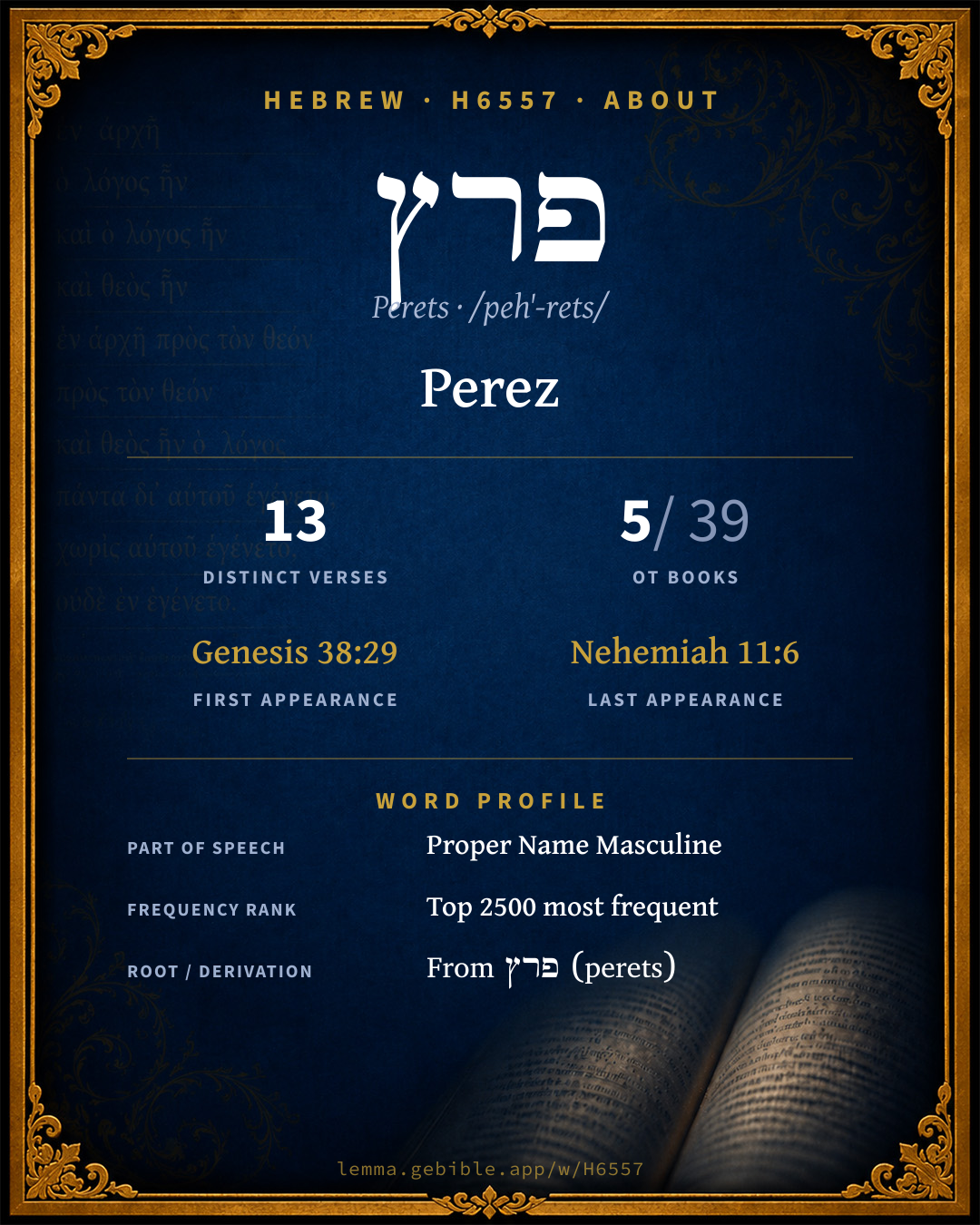
פֶּ֫רֶץ
Perez
BDB lists 2 entries for ‘Perez’ fuller range ↓
Full lexicon entry — Brown-Driver-Briggs (BDB)
From Brown-Driver-Briggs (BDB)
Where this word appears
Grammar key — what these labels mean
Part of speech
- Noun
- A naming word — a person, place, thing, or idea.
Noun type
- Proper
- A name of a specific person, place, or people (e.g. Abraham, Zion, Israel).
Every verse where H6557 appears in the Book of 1 Chronicles — 5 distinct verses. Click any verse to open its interlinear word-by-word view. Verse text shown in the World English Bible for context — . Each verse’s Hebrew form is shown with its reference; the English is not keyword-highlighted, since the data carries no word-level English alignment. Use “Compare translations” on any verse to read it across multiple English versions. This concordance covers the Hebrew Bible; Septuagint (Greek Old Testament) occurrences are not indexed here.
1 Chronicles
- 1 Chronicles 2:4 פֶּ֣רֶץ n Proper Tamar his daughter-in-law bore him Perez and Zerah. All the sons of Judah were five.
- 1 Chronicles 2:5 פֶ֖רֶץ n Proper The sons of Perez: Hezron, and Hamul.
- 1 Chronicles 4:1 פֶּ֧רֶץ n Proper The sons of Judah: Perez, Hezron, and Carmi, and Hur, and Shobal.
- 1 Chronicles 9:4 פֶ֖רֶץ n Proper Uthai the son of Ammihud, the son of Omri, the son of Imri, the son of Bani, of the children of Perez the son of Judah.
- 1 Chronicles 27:3 פֶ֗רֶץ n Proper [He was] of the children of Perez, the chief of all the captains of the host for the first month.
About this entry
At a glance — auto-summarized from this page’s data, not written by a person. Every figure links to its source below. This summary describes the numbers; it doesn’t interpret them.
At its core, פרץ (Perets) means “Perez.” Scripture first uses it in Genesis 38:29. With 13 verses in 5 books, it is an uncommon word in the Hebrew Bible. Its uses concentrate in 1 Chronicles (38% of all occurrences). Dig into 13-verse concordance and the renderings breakdown below.
Gloss history
Strong's 1890 vs modern scholarship
About this word
Strong's H6557 catalogs a Hebrew word from the Hebrew Old Testament.
These counts are not copied from any lexicon or concordance. They are computed here, from the morphology-tagged Hebrew Old Testament. What Lemma adds →
- 13
- distinct verses
- The word appears in 13 distinct verses.
- 5 / 39
- OT books
- The word appears in 5 of 39 Old Testament books.
- #1,836
- by frequency
- Top 2500 most frequent Hebrew words (rank 1,836 of 8,640 Hebrew words by occurrence).
View all 13 occurrences in the concordance →
Most concentrated in
- 1 Chronicles 5 verses 38%
- Genesis 2 verses 15%
- Numbers 2 verses 15%
By section of the Old Testament
By traditional corpus
Conventional, traditional groupings — biblical authorship is debated, so this is a traditional corpus grouping, not an authorship claim. Each share is this word’s portion of its verses in that division of the Hebrew canon. Each figure is a share of the word’s 13 distinct verses.
- Writings (Ketuvim) 9 verses · 69%
- Torah (Pentateuch) 4 verses · 31%
How translations render this word
Counts come from each version’s own published word-to-Strong’s tagging or interlinear alignment — an approximate guide to how each version renders this word, not a word-level alignment the data otherwise carries. Because each total is that version’s own tagged count, the per-version totals vary from one another and need not match the appearance or distinct-verse counts above. These counts may also differ from a printed concordance because Lemma counts each distinctly tagged rendering and does not collapse phrase taggings into a single head-word total. This is a fixed set of word-tagged versions (KJV, ASV, BSB, ULT) and does not change with the reading translation you choose elsewhere. Each version’s license is shown beside its name below (and on Sources).
BDB lists this Strong’s number as 2 distinct words (homographs). Each count above pools all of them and is not split by sense — see the Senses section below. A low-frequency rendering may belong to a different one of those words, not the primary meaning.
- King James Version†: Pharez 12×, Perez 3×
- American Standard Version†: Perez 15×
- Berean Standard Bible†: Perez 15×
- unfoldingWord Literal Text†: Perez 15×
King James Version Public Domain
Renders H6557 across 15† tagged occurrences — most commonly:
American Standard Version Public Domain
Renders H6557 across 15† tagged occurrences — most commonly:
Berean Standard Bible Public Domain
Renders H6557 across 15† tagged occurrences — most commonly:
unfoldingWord Literal Text CC BY-SA 4.0
Renders H6557 across 15† tagged occurrences — most commonly:
8 senses and sub-senses in the full BDB
What do BDB’s symbols mean?
BDB uses these scholarly abbreviations:
| Symbol | Meaning |
|---|---|
| 𝔊 | the Septuagint (the ancient Greek translation, LXX) |
| 𝔙 | the Vulgate (the Latin translation) |
| 𝔖 | the Syriac version (the Peshitta) |
| 𝔗 | the Targum (the Aramaic translation) |
| ψ | the Psalms |
| √ | root (the underlying root or stem) |
| ‖ | parallel passage (a synonymous or contrasted parallel) |
| † | the dagger: every passage where the word occurs is cited |
The 8 senses and sub-senses the full Brown-Driver-Briggs lexicon distinguishes for this word, in lexicon order (not ranked by frequency), with BDB’s own verbatim wording and sub-sense lettering. Shown in Hebrew script with BDB’s own scholarly abbreviations. The condensed entry is in the Lexicon Entry tab. See also the Forms in the corpus table below.
פרץ I
- 1. bursting forth, outburst, of water 2 S 5:20 = 1 Ch 14:11; from womb Gn 38:29 (J). e.g. 2 Samuel 5:20
- 2. breach in wall Am 4:3; 1 K 11:27; Ne 6:1 ψ 144:14; Jb 30:14; so (c. גָּדַר, i.e. repair) Am 9:11; Is 58:12; fig. of effort to avert calamity, עָלָה בַּפְּרָצוֹה Ez 13:5 (‖ גָּדַר), עָמַד בַּפֶּרֶץ 22:30 (‖ id.), cf. ψ 106:23, by instruction and (especially) intercession. e.g. Amos 4:3
- 3. broken wall, פ׳ נֹפֵל Is 30:13. e.g. Isaiah 30:13
- 4. fig. of outburst of י׳’s wrath, acc. cogn. c. פָּרַץ 2 S 6:8 = 1 Ch 13:11; Jb 16:14 (פֶרֶץ עַל־פְנֵי־פָ֑רֶץ); עָשָׂה פ׳ בְּ Ju 21:15. e.g. 2 Samuel 6:8
פרץ II
- 1. m. son of Judah and Tamar, Φαρες;—פ׳ Gn 46:12 +, פָּ֑רֶץ 38:29 + 3 times;—Gn 38:29; 46:12(×2); Nu 26:20, 21; Ru 4:12, 18(×2); 1 Ch 2:4, 5; 4:1; 9:4; 27:3; Ne 11:4, 6. e.g. Genesis 46:12
- 2. loc. in
- a. פ׳ עֻזָּה near Jerus. 2 S 6:8 = 2 Ch 13:11. e.g. 2 Samuel 6:8
- b. הַר פְּרָצִים Is 28:21, perhaps = בַּעַל פ׳ q.v. p. 128.—cf. רִמֹּן פָּ֑רֶץ. e.g. Isaiah 28:21
Senses from the full Brown-Driver-Briggs lexicon (Brown, Driver, Briggs; Oxford 1906 — public domain), digitized via Sefaria, supplemented by the OpenScriptures HebrewLexicon (CC BY 4.0). Full attribution on Sources.
Word origin
n.m. Jb 30:14 bursting forth, breach; abs. פ׳ Ju 21:15 +, פָּ֑רֶץ Gn 38:29 +; cstr. פֶּרֶץ 2 S 5:20 +; pl. פְּרָצִים Am 4:3 +, פְּרָצוֹת Ez 13:5, sf. פִּרְצֵיהֶן Am 9:11 (פְּרָצֶיהָ We Now);—
— Brown-Driver-Briggs (Oxford 1906, public domain), digitized via Sefaria, supplemented by the OpenScriptures HebrewLexicon (CC BY 4.0). See Sources.
Derived from פרץ (perets) (H6556) — breach.
Jastrow Dictionary
A second Hebrew/Aramaic lexicon for comparison, covering Aramaic and post-biblical (Talmudic, Targumic, Midrashic) usage that the biblical-Hebrew BDB does not. Matched by lemma rather than by Strong’s number, so a lemma may carry more than one Jastrow headword (shown separately below), and the entries cover usage well beyond the Bible.
פָּרַץ
- (b. h.)
- 1. to break through, make a breach, invade. Pes. 56ᵃ פּוֹרְצִין פרצות וכ׳ made breaches in the fences of their gardens &c.; (Tosef. ib. II (III), 21 פותחין גינותיהם וכ׳); Men. 71ᵃ. Ber. 63ᵃ כבר גדרת … יכול לִפְרוֹץ having once fenced in, thou canst not tear down, i.e. having once approved, you cannot now find fault. Y. Snh. I, 19ᶜ top, v. פּוּץ. Gen. R. s. 85 (ref. to Gen. XXXVIII, 29) כל הפּוֹרְצִים ממך וכ׳ all conquerors shall rise from thee (Judah). Yalk. Mic. 551 פָּרַצְתִּי גדרו של עולם מפני יעקב I broke down the fence of the world (reversed the natural order of things) for the sake of Jacob (making his cattle extremely fecund); ולע"ל אני פורץ אותו לבניו and in the days to come I shall do so to his children. B. Kam. 60ᵇ מלך פּוֹרֵץ … דרך the king may break through fences to pave a way for his army. Koh. R. to IX, 11 (ref. to Job I, 10) פ׳ גדרו של עולם וכ׳ his cattle reversed the order of things &c. Y. Ab. Zar. II, 41ᵃ top לא פָרַצְתָּ גדירן וכ׳ thou hast not torn down the fence of the scholars (not transgressed their law); Gen. R. s. 79, v. גָּדֵיר. Lev. R. s. 26, v. גֶּדֶר I; a. fr.—Part. pass. פָּרוּץ; f. פְּרוּצָה; pl. פְּרוּצִים, פְּרוּצִין; פְּרוּצוֹת. Kil. IV, 4 העומד מרובה על הפ׳ the unimpaired portion of the fence is larger than the ruined part, v. עָמַד II. Y. Sabb. X, 12ᶜ top קופה פ׳ a bin which has been broken into (some of the contents of which has been taken); a. fr.—[Peah VII, 1 בצד הפרוצה Y. ed., v. פִּרְצָה.] e.g. Genesis 38:29
- 2. (sub. גדר) to be lawless, unrestrained, dissolute. Y. Keth. I, 25ᵃ bot. שלא יִפְרְצוּ … בזימה in order that the daughters of Israel be not made heedless of chaste conduct (v. infra); a. e.—Part. pass. as ab. dissolute, bold. Ib. מפני פ׳ אחד because there might be one dissolute man (who may go to the expense of marriage for the sake of his gratification, with the intention of charging his bride with faithlessness afterwards). Cant. R. to IV, 12 לא נמצא בהן אחד פ׳ בעיוה not one of them was of immoral conduct; Lev. R. s. 32 פְּרוּץ ערוה. Gitt. 46ᵃ שלא יהו בנות … פ׳ וכ׳ that the daughters of Israel may not be loose in moral conduct or in vows (v. supra). Gen. R. s. 70 (ref. to Gen. XXIX, 21) אפי׳ אדם פ׳ אינו וכ׳ even the most shameless man would not use such language. Sot. 7ᵃ אבל פ׳ but if they are known to be of dissolute habits, opp. כשרין. Keth. 2ᵇ, sq. משום פ׳ on account of loose women, opp. צנועות; a. fr. e.g. Genesis 29:21
- 3. to spread, increase. Sabb. 13ᵃ; Tosef. ib. I, 14 עד היכן פָּרְצָה טהרה וכ׳ how far the observance of levitical cleanness has spread in Israel!; a. e.
- 1. to be broken through, torn down. Tosef. Kil. III, 3 מחיצת הכרם שנִפְרְצָה if the partition of a vineyard has come down; גדרה ונ׳ if he repaired it, and it came down again. Erub. IX, 2 חצר גדולה שנפרצה לקטנה if the partition between a large court and a smaller one has been broken into. Yalk. Ez. 352 a good shepherd שנ׳ גדר צאנו the fold of whose flock was broken into; (Ruth R. introd. שנפלה). גדר Tanḥ. Bal. 13 ראה שישראל נִפְרָצִים שם he (Balak) saw that the Israelites would be broken into (sustain a great loss) there; Num. R. s. 20 שיש פרצים (corr. acc.). Ab. d’R. N. ch. V ונִפְרְצוּ וכ׳, v. פִּרְצָה; a. fr.
- 2. to be unrestrained, dissolute. Tanḥ. Vayera 9 לפי שנפרצו מעשיהם בזנות because their doings were unrestrained in matters of sexual morality; a. e.
- 3. to be spread, increased. Gen. R. s. 73 (ref. to Gen. XXX, 43) נִפְרְצָה לו פרצה מעין וכ׳ an (abnormal) increase of wealth was granted to him similar to that expected in the days to come (v. Yalk. Mic. l. c.); Yalk. Gen. 130; Yalk. Koh. 989; a. e. e.g. Genesis 30:43
- 4. to be broken off, severed. Succ. III, 1 נפרצו עליו if its leaves are severed (and only kept together by a band), v. פָּרַד.
- (denom. of פָּרִיץ) to be defiant. Tosef. Macc. V (IV), 13 אפי׳ עומד ומַפְרִיץ וכ׳ even if he stands up defiantly (saying, he did not mind more lashes), you dare not add &c.
- to become dissolute, be unrestrained, licentious. Y. Sabb. III, 6ᵃ bot. שלא תִתְפָּרֵץ that she may not assume immoral habits; ib. שלא יִתְפָּרְצוּ that people may not be unrestrained; Y. Bets. II, 61ᶜ
פְּרַץ
- 1. to break through, open &c. Targ. II Kings XIV, 13. Targ. II Esth. III, 8; a. e.—[Targ. Prov. XXV, 28 תריצה Var. ed. Lag., corrected by Bxt. פריצה, read תריעא.]
- 2. to be reckless, sport. Taan. 24ᵇ הוו קא פַרְצֵי בריפתא were recklessly sporting with bread (throwing pieces of bread to one another).
פֶּרֶץ
- m. (b. h.), v. פִּרְצָה
A Dictionary of the Targumim, the Talmud Babli and Yerushalmi, and the Midrashic Literature (Marcus Jastrow; London, Luzac, 1903) — Public Domain. Digitized via Sefaria. Digitized via Sefaria. Full attribution on Sources.
Forms in the corpus
The 13 distinct written forms H6557 takes in the Hebrew Bible, most frequent first — each parse links to that state’s occurrences in the concordance. Hebrew forms include their vowel points and cantillation, so a single lemma takes many written forms.
| Form | Parsing | Example | Uses |
|---|---|---|---|
| פֶ֖רֶץ | Noun, Proper | Genesis 46:12 | 3 |
| וָ/פֶ֣רֶץ | Noun, Proper | Genesis 46:12 | 1 |
| לְ/פֶ֕רֶץ | Noun, Proper | Numbers 26:20 | 1 |
| פֶ֔רֶץ | Noun, Proper | Numbers 26:21 | 1 |
| פֶ֕רֶץ | Noun, Proper | Nehemiah 11:6 | 1 |
| פֶ֗רֶץ | Noun, Proper | 1 Chronicles 27:3 | 1 |
| פָֽרֶץ | Noun, Proper | Nehemiah 11:4 | 1 |
| פֶּ֔רֶץ | Noun, Proper | Ruth 4:12 | 1 |
| פֶּ֖רֶץ | Noun, Proper | Ruth 4:18 | 1 |
| פֶּ֣רֶץ | Noun, Proper | 1 Chronicles 2:4 | 1 |
| פֶּ֧רֶץ | Noun, Proper | 1 Chronicles 4:1 | 1 |
| פָּ֔רֶץ | Noun, Proper | Ruth 4:18 | 1 |
| פָּֽרֶץ | Noun, Proper | Genesis 38:29 | 1 |
Same root — word family
Other BDB entries built from the same root as H6557, grouped by Strong’s listed origin. These share a root / origin per the lexicon — not necessarily a shared meaning. Each links to that word’s own entry.
Derives from
Proper names from this root
People and places named from this root — a name, not an additional meaning of the word.
- פרצים pᵉrâtsîym H6559 Perazim
- פרץ עזא Perets ʻUzzâʼ H6560 Perez-uzza
- Φαρες Pháres G5329 Perez
- פרצי Partsîy H6558 Pharzites
Compare all same-root words → Showing 4 of 6 — not the complete family. 4 of the same-root words are proper names (people or places). They share a root, not necessarily a meaning.
Bible dictionary
Public-domain dictionary articles matched to this entry by name (Perez). A biblical name can be shared by more than one person or place, so an article may treat several.
Easton's Bible Dictionary · M. G. Easton, 1897
=Pharez, (q.v.), breach, the son of Judah (Neh. 11:4). "The chief of all the captains of the host for the first month" in the reign of David was taken from his family (1 Chr. 27:3). Four hundred and sixty-eight of his "sons" came back from captivity with Zerubbabel, who himself was one of them (1 Chr. 9:4; Neh. 11:6).
Smith's Bible Dictionary · William Smith, 1863
(breach). The "children of Perez," or Pharez, the son of Judah, appear to have been a family of importance for many centuries. (1 Chronicles 27:3; Nehemiah 11:4,6)
Hitchcock's Bible Names Dictionary · Roswell D. Hitchcock, 1869
divided
Classic public-domain reference works; full attribution on Sources.
Septuagint verse parallels
This word appears in 11 verses that also exist in the Greek Old Testament (Septuagint), out of the 13 Hebrew verses it occurs in. You can read those verses in Greek by switching the Old Testament edition to the Septuagint.
Read these verses in the Septuagint
This is a verse-level parallel only — the same verses exist in both the Hebrew and Greek Old Testaments. No word-level Hebrew↔Greek correspondence is claimed: the data carries no such alignment, so no Greek word is shown as this Hebrew word’s translation. Coverage is not total — the Septuagint omits the deuterocanon and renumbers the Psalms, so some Hebrew verses have no direct Greek parallel.