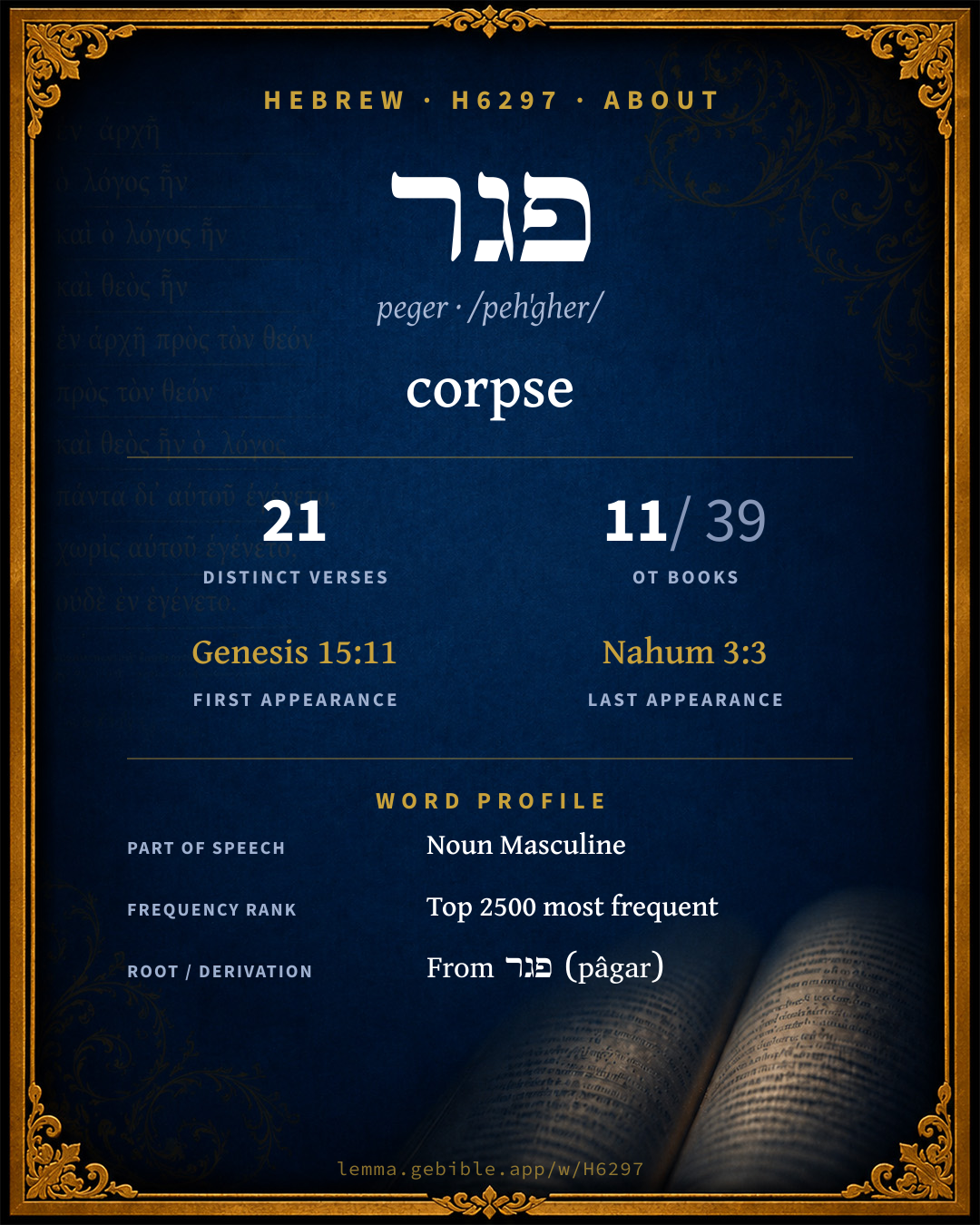
פֶּ֫גֶר
corpse
also: carcass, monument, stela fuller range ↓
Full lexicon entry — Brown-Driver-Briggs (BDB)
From Brown-Driver-Briggs (BDB)
Where this word appears
Grammar key — what these labels mean
Part of speech
- Noun
- A naming word — a person, place, thing, or idea.
Noun type
- Common
- A common noun — a general class of person, place, or thing (“king,” “city,” “water”), not a specific name.
State
- Construct
- A noun bound to a following noun in a possessive / “of” relationship (the construct chain).
- Absolute
- The independent form of a noun, not bound to a following word.
Gender
- Masculine
- Grammatically masculine.
Number
- Plural
- More than one (in Hebrew, generally three or more).
- Singular
- One.
Every verse where H6297 appears in the Book of 2 Kings — 1 distinct verse. Click any verse to open its interlinear word-by-word view. Verse text shown in the World English Bible for context — . Each verse’s Hebrew form is shown with its reference; the English is not keyword-highlighted, since the data carries no word-level English alignment. Use “Compare translations” on any verse to read it across multiple English versions. This concordance covers the Hebrew Bible; Septuagint (Greek Old Testament) occurrences are not indexed here.
2 Kings
About this entry
At a glance — auto-summarized from this page’s data, not written by a person. Every figure links to its source below. This summary describes the numbers; it doesn’t interpret them.
At its core, פגר (peger) means “corpse.” Older and newer Bibles part ways — “carcases” in the King James Version, “bodies” (Berean Standard Bible) and “corpses” (unfoldingWord Literal Text) in modern versions. See the renderings breakdown. It turns up in 21 verses across 11 books, an uncommon footprint. Scripture first uses it in Genesis 15:11. Not a single-sense word: its full sense range also takes in “carcass”, “monument”, and “stela”. Dig into 21-verse concordance and the renderings breakdown below.
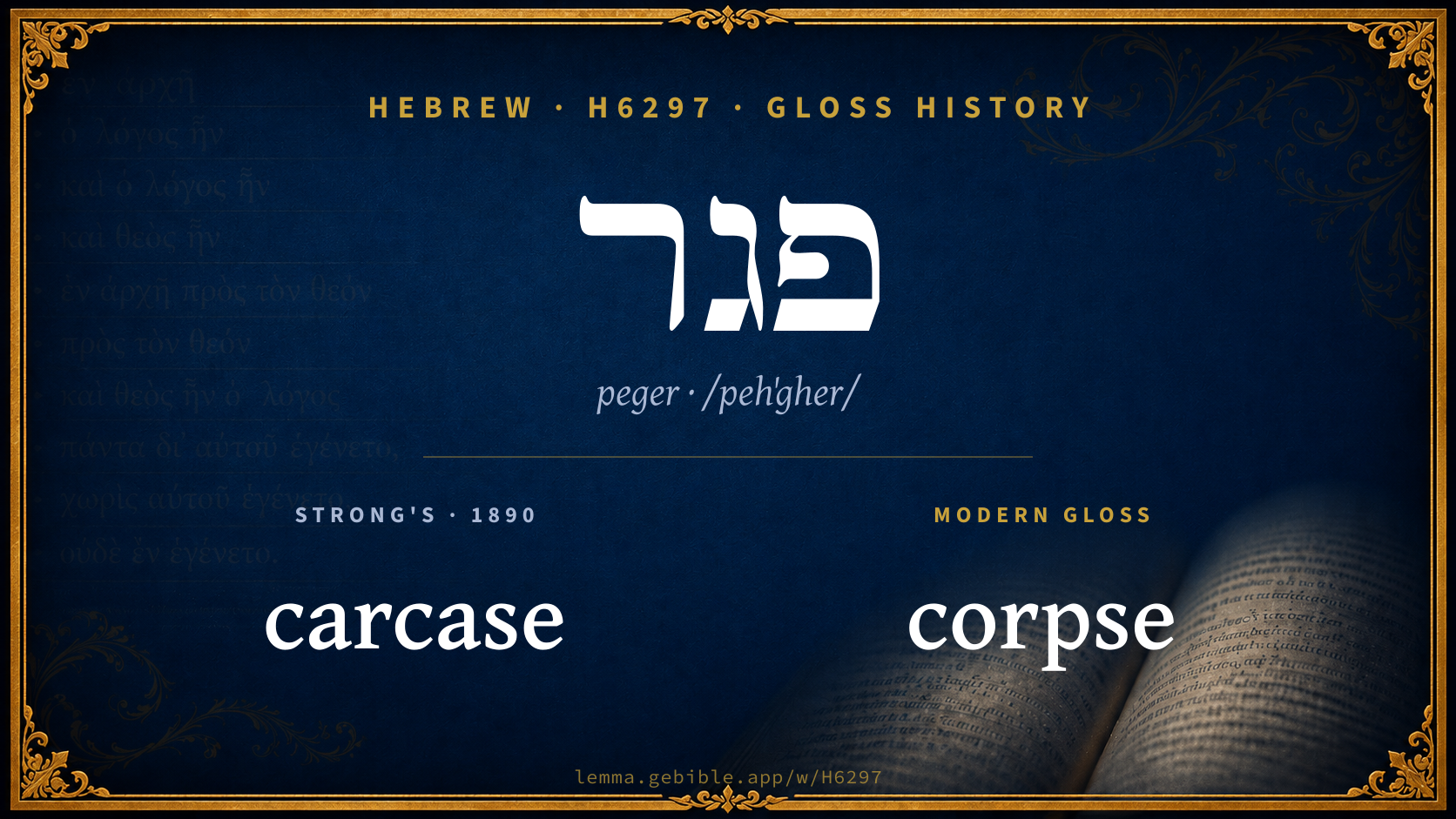
Gloss history
Strong's 1890 vs modern scholarship
About this word
Strong's H6297 catalogs a Hebrew word from the Hebrew Old Testament.
These counts are not copied from any lexicon or concordance. They are computed here, from the morphology-tagged Hebrew Old Testament. What Lemma adds →
- 21
- distinct verses
- The word appears in 21 distinct verses.
- 11 / 39
- OT books
- The word appears in 11 of 39 Old Testament books.
- #1,412
- by frequency
- Top 2500 most frequent Hebrew words (rank 1,412 of 8,640 Hebrew words by occurrence).
View all 21 occurrences in the concordance →
By section of the Old Testament
By traditional corpus
Conventional, traditional groupings — biblical authorship is debated, so this is a traditional corpus grouping, not an authorship claim. Each share is this word’s portion of its verses in that division of the Hebrew canon. Each figure is a share of the word’s 21 distinct verses.
- Prophets (Nevi'im) 14 verses · 67%
- Torah (Pentateuch) 5 verses · 24%
- Writings (Ketuvim) 2 verses · 10%
How translations render this word
Counts come from each version’s own published word-to-Strong’s tagging or interlinear alignment — an approximate guide to how each version renders this word, not a word-level alignment the data otherwise carries. Because each total is that version’s own tagged count, the per-version totals vary from one another and need not match the appearance or distinct-verse counts above. These counts may also differ from a printed concordance because Lemma counts each distinctly tagged rendering and does not collapse phrase taggings into a single head-word total. This is a fixed set of word-tagged versions (KJV, ASV, BSB, ULT) and does not change with the reading translation you choose elsewhere. Each version’s license is shown beside its name below (and on Sources).
- King James Version: Carcases 9×, Dead bodies 4×, Corpses 2×
- American Standard Version: Dead bodies 11×, Bodies 2×, Were all dead bodies 2×
- Berean Standard Bible: Bodies 6×, Corpses 6×, Carcasses 2×
- unfoldingWord Literal Text: Corpses 11×, And 2×, Corpses of 2×
King James Version Public Domain
Renders H6297 across 22 tagged occurrences — most commonly:
Plus 7 renderings that appear only once — usually multi-word phrases or single function words the recovered tagging swept in, not distinct renderings.
American Standard Version Public Domain
Renders H6297 across 23 tagged occurrences — most commonly:
Plus 8 renderings that appear only once — usually multi-word phrases or single function words the recovered tagging swept in, not distinct renderings.
Berean Standard Bible Public Domain
Renders H6297 across 22 tagged occurrences — most commonly:
Plus 6 renderings that appear only once — usually multi-word phrases or single function words the recovered tagging swept in, not distinct renderings.
unfoldingWord Literal Text CC BY-SA 4.0
Renders H6297 across 25 tagged occurrences — most commonly:
Plus 8 renderings that appear only once — usually multi-word phrases or single function words the recovered tagging swept in, not distinct renderings.
Senses in the full BDB
What do BDB’s symbols mean?
BDB uses these scholarly abbreviations:
| Symbol | Meaning |
|---|---|
| 𝔊 | the Septuagint (the ancient Greek translation, LXX) |
| 𝔙 | the Vulgate (the Latin translation) |
| 𝔖 | the Syriac version (the Peshitta) |
| 𝔗 | the Targum (the Aramaic translation) |
| ψ | the Psalms |
| √ | root (the underlying root or stem) |
| ‖ | parallel passage (a synonymous or contrasted parallel) |
| † | the dagger: every passage where the word occurs is cited |
The 2 senses and sub-senses the full Brown-Driver-Briggs lexicon distinguishes for this word, in lexicon order (not ranked by frequency), with BDB’s own verbatim wording and sub-sense lettering. Shown in Hebrew script with BDB’s own scholarly abbreviations. The condensed entry is in the Lexicon Entry tab. See also the Forms in the corpus table below.
- 1. of men, sg. Is 14:19; usually pl. 34:3; 66:24 Je 31:40; 33:5; 41:9 Ez 6:5; 43:7, 9 Lv 26:30 Nu 14:29, 32, 33 2 Ch 20:24,—v 25 read prob. בְגָדִים, so 𝔊 (?), 𝔙 Be Krochm Kau Kit;—פְּגָרִים מֵתִים 2 K 19:35 = Is 37:36; sg. coll. 1 S 17:46, רַב־הַפֶּגֶר Am 8:3, כֹּבֶד־פ׳ Na 3:3; fig. of idols פִּגְרֵי גִּלּוּלֵיכֶם Lv 26:30. e.g. Isaiah 14:19
- 2. of animals Gn 15:11. e.g. Genesis 15:11
Senses from the full Brown-Driver-Briggs lexicon (Brown, Driver, Briggs; Oxford 1906 — public domain), digitized via Sefaria, supplemented by the OpenScriptures HebrewLexicon (CC BY 4.0). Full attribution on Sources.
Word origin
n.m. Is 14:19 corpse, carcass;—abs. פ׳ Is 14:19 +, פָּ֑גֶר Na 3:3; cstr. פֶּגֶר 1 S 17:46; pl. פְּגָרִים 2 K 19:35 +; cstr. פִּגְרֵי Je 33:5; sf. פִּגְרֵיכֶם Lv 26:30 +, etc.;—
— Brown-Driver-Briggs (Oxford 1906, public domain), digitized via Sefaria, supplemented by the OpenScriptures HebrewLexicon (CC BY 4.0). See Sources.
Derived from פגר (pâgar) (H6296) — to faint.
Jastrow Dictionary
A second Hebrew/Aramaic lexicon for comparison, covering Aramaic and post-biblical (Talmudic, Targumic, Midrashic) usage that the biblical-Hebrew BDB does not. Matched by lemma rather than by Strong’s number, so a lemma may carry more than one Jastrow headword (shown separately below), and the entries cover usage well beyond the Bible.
פָּגַר
- , Pi. פִּיגֵּר (cmp. פגם, בגר, פכר) to split, break up, destroy. Midr. Till. to Ps. XI, 3 אם הצדיקים שהשתיתו … ופִיגְּרוּ אותם וכ׳ when the wicked come and destroy the righteous that have established thy world &c.; Yalk. ib. 653 אם השיתין … עמדו רשעים ופִגְּרוּם וכ׳ if the wicked have risen and destroyed the foundations (of the Temple) which face the deep (v. שִׁית). Midr. Till. to Ps. LXXIX ופיגרו את בניך (ed. Bub. והרגו). Midr. Till. to Ps. X והצדיקים … ופגרו אותן and the righteous in whom thou didst find pleasure, the enemies haven risen and destroyed them; a. e.
פְּגַר I
- Pa. פַּגֵּר same, to break up, destroy; to break through. Targ. Is. XIV, 17. Targ. O. Ex. XXIII, 24.—Ib. XIX, 21; 24; a. fr.—Part. pass. מְפַגַּר; f. מְפַגְּרָא; pl. מְפַגְּרִין, מְפַגְּרֵי; מפַגּרָתָא. Targ. I Kings XVIII, 30. Targ. Ez. XXXVI, 35.—Pesik. Zakhor, p. 26ᵃ (expl. ערו, Ps. CXXXVII, 7) פַּגְּרוּ פַּגְּרוּ destroy, destroy ye!; ib. ʿĂniya, p. 135ᵃ פַּגָּארוּ פַּגָּארוּ; (Pesik. R. s. 32 תברו); Midr. Till. to Ps. l. c.; Lam. R. to V, 1.—Lev. R. s. 19 (expl. נמהרי לב) מפגרי לבא those crushed at heart (with ref. to ימהרו, Nah. II, 6). e.g. Psalms 137:7
- to wound, bruise. Nidd. 66ᵃ אַפְגּוּרֵי מַפְגְּרָא לה, v. בְּגַר.
- to be destroyed, broken. Targ. Lam. II, 8 (h. text אמללו). Targ. Ez. XXX, 4; a. fr.
פְּגַר II
- Pi.) to be lax, faint (cmp. פּוּג).
- 1. to relax, take vacation, be idle. Sabb. 129ᵇ יומא דמְפַגְּרֵי ביה רבנן a day on which the teachers took a hotiday.
- 2. to cause to relax. Keth. 103ᵇ ור׳ סבר לא אֲפַגְּרֵיה and Rabbi thought, I will not cause him to relax (in his charitable work, by appointing him a member of the college; or ‘I will not wear him out’, overburden him).
- to take vacation, absent one’s self. Ib. 111ᵇ אי׳ … ולא אתא he (the teacher) took a three days’ vacation and did not come (to school). Ib. אמאי אִיפַּגְּרַת why did you absent yourself?
- to be indifferent, neglectful. Gen. R. s. 94 מאי טעמא א׳ מר why have you become indifferent (towards me)?
פַּגָּר
- (פָּגַר; cmp. Syr. בגר repagulum, P. Sm. 448) bit. Tosef. Kel. B. Mets. IV, 7 (some ed. פרומביא).
פֶּגֶר
- v. פְּגַר II) lax, decaying, corpse.—Pl. פְּגָרִים. Gen. R. s. 44 (ref. to Gen. XV, 11) לכשיעשו בניך פ׳ בלא וכ׳ when thy children are lax bodies, without sinews and bones (bare of good deeds and character), thy merit shall stand by them. Y. Sot. V, 20ᶜ top ראו פִיגְרֵי … וכולם פ׳ מתים וכ׳ they saw the bodies of sinful men …, and all of them were dead bodies cast out at the shore; a. e. e.g. Genesis 15:11
פְּגַר III
- Targ. Is. XIV, 19; a. e.—Trnsf. (contemptuously) body. Targ. Prov. X, 13 (h. text גֵּו).—Pl. פִּגְרִין, פִּגְרַיָּא. Targ. Lev. XXVI, 30 (O. ed. Berl. פַּ׳; v. Berl. Targ. O. II, p. 39). Targ. O. Gen. XV, 11 ed. Bon. (ed. Berl. a. oth. פַּלְגַּיָּא; Ms. II פִּגְלַיָּא, ed. Vien. פַּגְלַ׳, v. פגל). Targ. Y. II, Deut. I, 1 פִּיגְ׳; a. e.
A Dictionary of the Targumim, the Talmud Babli and Yerushalmi, and the Midrashic Literature (Marcus Jastrow; London, Luzac, 1903) — Public Domain. Digitized via Sefaria. Digitized via Sefaria. Full attribution on Sources.
Forms in the corpus
The 20 distinct written forms H6297 takes in the Hebrew Bible, most frequent first — each parse links to that state’s occurrences in the concordance. Hebrew forms include their vowel points and cantillation, so a single lemma takes many written forms.
Septuagint verse parallels
This word appears in 20 verses that also exist in the Greek Old Testament (Septuagint), out of the 21 Hebrew verses it occurs in. You can read those verses in Greek by switching the Old Testament edition to the Septuagint.
Read these verses in the Septuagint
- Genesis 15:11
- Leviticus 26:30
- Numbers 14:29
- 2 Kings 19:35
- 2 Chronicles 20:24
- Isaiah 14:19
- Jeremiah 31:40
- Ezekiel 6:5
- Amos 8:3
- Nahum 3:3
This is a verse-level parallel only — the same verses exist in both the Hebrew and Greek Old Testaments. No word-level Hebrew↔Greek correspondence is claimed: the data carries no such alignment, so no Greek word is shown as this Hebrew word’s translation. Coverage is not total — the Septuagint omits the deuterocanon and renumbers the Psalms, so some Hebrew verses have no direct Greek parallel.