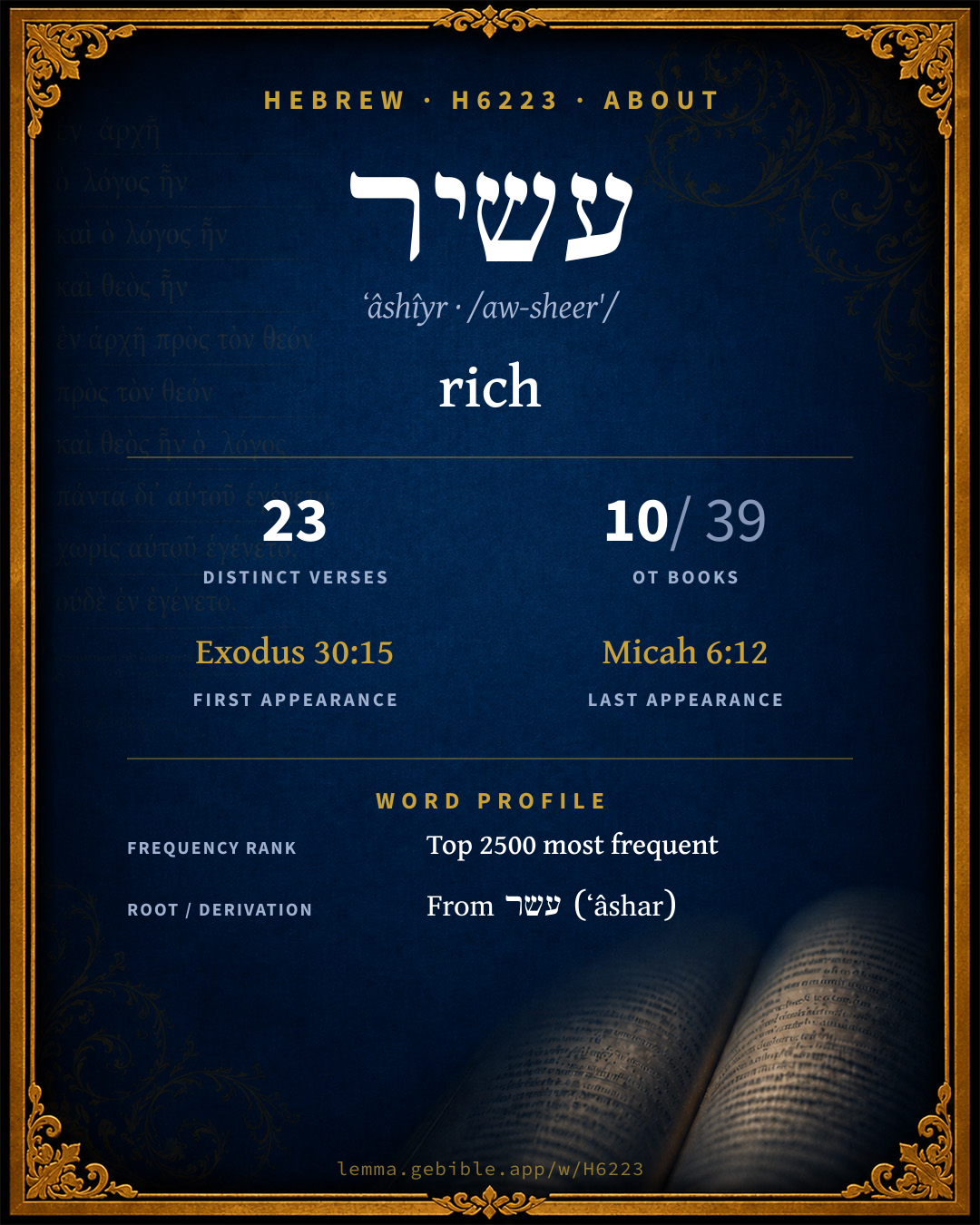
עָשִׁיר
rich
‘rich’ is one of 2 main senses fuller range ↓
Full lexicon entry — Brown-Driver-Briggs (BDB)
From Brown-Driver-Briggs (BDB)
Where this word appears
See every Absolute-state word in the Hebrew Bible →
Grammar key — what these labels mean
Part of speech
- Adjective
- A word that describes or qualifies a noun.
State
- Absolute
- The independent form of a noun, not bound to a following word.
- Construct
- A noun bound to a following noun in a possessive / “of” relationship (the construct chain).
Gender
- Masculine
- Grammatically masculine.
Number
- Singular
- One.
- Plural
- More than one (in Hebrew, generally three or more).
21 distinct verses where H6223 appears in the Absolute state, across 9 books. Filtered view — show all forms. Click any verse to open its interlinear word-by-word view. Verse text shown in the World English Bible for context — . Each verse’s Hebrew form is shown with its reference; the English is not keyword-highlighted, since the data carries no word-level English alignment. Use “Compare translations” on any verse to read it across multiple English versions. This concordance covers the Hebrew Bible; Septuagint (Greek Old Testament) occurrences are not indexed here.
Exodus 1 verse
Ruth 1 verse
2 Samuel 3 verses
- 2 Samuel 12:1 עָשִׁ֖יר adj Adjective ms Yahweh sent Nathan to David. He came to him, and said to him, "There were two men in one city; the one rich, and the other poor.
- 2 Samuel 12:2 לְ/עָשִׁ֗יר prep + Adjective Adjective ms The rich man had very many flocks and herds,
- 2 Samuel 12:4 הֶֽ/עָשִׁיר֒ ptcl def.art + Adjective Adjective ms A traveler came to the rich man, and he spared to take of his own flock and of his own herd, to dress for the wayfaring man who had come to him, but took the poor man's lamb, and dressed it for the man who had come to him."
Job 1 verse
Psalms 1 verse
Proverbs 9 verses
- Proverbs 10:15 עָ֭שִׁיר adj Adjective ms The rich man's wealth is his strong city. The destruction of the poor is their poverty.
- Proverbs 14:20 עָשִׁ֣יר adj Adjective ms The poor person is shunned even by his own neighbor, But the rich person has many friends.
- Proverbs 18:11 עָ֭שִׁיר adj Adjective ms The rich man's wealth is his strong city, Like an unscalable wall in his own imagination.
- Proverbs 18:23 וְ֝/עָשִׁ֗יר conj + Adjective Adjective ms The poor plead for mercy, But the rich answer harshly.
- Proverbs 22:2 עָשִׁ֣יר adj Adjective ms The rich and the poor have this in common: Yahweh is the maker of them all.
- Proverbs 22:7 עָ֭שִׁיר adj Adjective ms The rich rule over the poor. The borrower is servant to the lender.
- Proverbs 22:16 לְ֝/עָשִׁ֗יר prep + Adjective Adjective ms Whoever oppresses the poor for his own increase and whoever gives to the rich, Both come to poverty.
- Proverbs 28:6 עָשִֽׁיר adj Adjective ms Better is the poor who walks in his integrity, Than he who is perverse in his ways, and he is rich.
- Proverbs 28:11 עָשִׁ֑יר adj Adjective ms The rich man is wise in his own eyes; But the poor who has understanding sees through him.
Ecclesiastes 3 verses
- Ecclesiastes 5:12 לֶֽ/עָשִׁ֔יר prep det + Adjective Adjective ms The sleep of a laboring man is sweet, whether he eats little or much; but the abundance of the rich will not allow him to sleep.
- Ecclesiastes 10:6 וַ/עֲשִׁירִ֖ים conj + Adjective Adjective mp Folly is set in great dignity, and the rich sit in a low place.
- Ecclesiastes 10:20 עָשִׁ֑יר adj Adjective ms Don't curse the king, no, not in your thoughts; And don't curse the rich in your bedchamber: For a bird of the sky may carry your voice, And that which has wings may tell the matter.
Isaiah 1 verse
Jeremiah 1 verse
About this entry
At a glance — auto-summarized from this page’s data, not written by a person. Every figure links to its source below. This summary describes the numbers; it doesn’t interpret them.
עשיר (ʻâshîyr) is a Hebrew word most often rendered “rich.” It first appears in Exodus 30:15. It turns up in 23 verses across 10 books, an uncommon footprint. It concentrates in Proverbs, which alone accounts for 39% of its uses. Its lexical range runs to 2 senses. For the data behind this summary, explore the sense tree and the renderings breakdown below.
Gloss history
Strong's 1890 vs modern scholarship
About this word
Strong's H6223 catalogs a Hebrew word from the Hebrew Old Testament.
These counts are not copied from any lexicon or concordance. They are computed here, from the morphology-tagged Hebrew Old Testament. What Lemma adds →
- 23
- distinct verses
- The word appears in 23 distinct verses.
- 10 / 39
- OT books
- The word appears in 10 of 39 Old Testament books.
- #1,368
- by frequency
- Top 2500 most frequent Hebrew words (rank 1,368 of 8,640 Hebrew words by occurrence).
View all 23 occurrences in the concordance →
Most concentrated in
- Proverbs 9 verses 39%
- 2 Samuel 3 verses 13%
- Ecclesiastes 3 verses 13%
By section of the Old Testament
By traditional corpus
Conventional, traditional groupings — biblical authorship is debated, so this is a traditional corpus grouping, not an authorship claim. Each share is this word’s portion of its verses in that division of the Hebrew canon. Each figure is a share of the word’s 23 distinct verses.
- Writings (Ketuvim) 16 verses · 70%
- Prophets (Nevi'im) 6 verses · 26%
- Torah (Pentateuch) 1 verse · 4%
How translations render this word
Counts come from each version’s own published word-to-Strong’s tagging or interlinear alignment — an approximate guide to how each version renders this word, not a word-level alignment the data otherwise carries. Because each total is that version’s own tagged count, the per-version totals vary from one another and need not match the appearance or distinct-verse counts above. These counts may also differ from a printed concordance because Lemma counts each distinctly tagged rendering and does not collapse phrase taggings into a single head-word total. This is a fixed set of word-tagged versions (KJV, ASV, BSB, ULT) and does not change with the reading translation you choose elsewhere. Each version’s license is shown beside its name below (and on Sources).
- King James Version: Rich 17×, Rich man's 2×
- American Standard Version: Rich 16×, Rich man 2×
- Berean Standard Bible: Rich 14×, Rich man 4×
- unfoldingWord Literal Text: Rich 13×, Rich one 6×, One 2×
King James Version Public Domain
Renders H6223 across 23 tagged occurrences — most commonly:
Plus 4 renderings that appear only once — usually multi-word phrases or single function words the recovered tagging swept in, not distinct renderings.
American Standard Version Public Domain
Renders H6223 across 23 tagged occurrences — most commonly:
Plus 5 renderings that appear only once — usually multi-word phrases or single function words the recovered tagging swept in, not distinct renderings.
Berean Standard Bible Public Domain
Renders H6223 across 23 tagged occurrences — most commonly:
Plus 5 renderings that appear only once — usually multi-word phrases or single function words the recovered tagging swept in, not distinct renderings.
unfoldingWord Literal Text CC BY-SA 4.0
Renders H6223 across 27 tagged occurrences — most commonly:
Plus 6 renderings that appear only once — usually multi-word phrases or single function words the recovered tagging swept in, not distinct renderings.
Senses in BDB
The 2 senses BDB distinguishes for this word, in lexicon order (not ranked by frequency or importance). The full entry — with sub-senses — is in the Lexicon Entry tab.
- rich, wealthy (adjective)
- the rich, the wealthy, rich man (noun)
Word origin
adj. et n. rich;—abs. ע׳ Ex 30:15 + 19 times; pl. abs. עֲשִׁירִים Ec 10:6; cstr. עֲשִׁירֵי ψ 45:13; sf. עֲשִׁירֶיהָ Mi 6:12;—adj.m. 2 S 12:1, 4 (opp. רָאשׁ), Ru 3:10 (opp. דַּל); usually n.m. the rich, opp. דִּל Pr 10:15 + 3 times; opp. רָשׁ 2 S 12:2; Pr 14:20 + 4 times; opp. אֶבְיוֹן ψ 49:3; alone Je 9:22 Mi 6:12 + 5 times, + עֲשִׁירֵי עָם ψ 45:13; ע׳ Is 53:9 is prob. crpt., cf. ‖ רְשָׁעִים; Bö Ry Di-Kit עֹשֵׂי רַע; Krochm Gr CheHpt conj. רְשָׁעִים for ע׳, and פֹּשְׁעִים for ר׳.
— Brown-Driver-Briggs (Oxford 1906, public domain), digitized via Sefaria, supplemented by the OpenScriptures HebrewLexicon (CC BY 4.0). See Sources.
Derived from עשר (ʻâshar) (H6238) — to become rich.
Jastrow Dictionary
A second Hebrew/Aramaic lexicon for comparison, covering Aramaic and post-biblical (Talmudic, Targumic, Midrashic) usage that the biblical-Hebrew BDB does not. Matched by lemma rather than by Strong’s number, so a lemma may carry more than one Jastrow headword (shown separately below), and the entries cover usage well beyond the Bible.
עָשִׁיר
- substantial, wealthy; rich man. Sabb. 25ᵇ איזהו ע׳ כל שיש לו נחת רוח בעשרו who is rich? He who finds satisfaction in his wealth; Ab. IV, 1; Tam. 32ᵃ. Deut. R. s. 2 (ref. to Prov. XVIII, 23) עֲשִׁירוֹ של עולם the rich One (Owner) of the world. Ib. אדם אם יהא לו קרוב ע׳ וכ׳ if a man’s relative is rich, he owns him, and if poor, he disowns him. Pes. 113ᵃ ע׳ המעשר וכ׳ a rich man who gives away the tenth portion of his income in secret. Ib. 113ᵇ (four are unbearable) דל גאה וע׳ פכחש וכ׳ a poor man that is proud, a rich man that flatters &c.; a. v. fr.—Pl. עֵשִׁירִים, עְשִׁירִין. Erub. 86ᵃ רבי מכבד ע׳ Rabbi paid honor to the rich (for the sake of their charitable mission, ref. to Ps. LXI, 8, v. יָשַׁב). Yoma 35ᵇ רבי … מחייב את הע׳ the example of R. El. b. Ḥarsum condemns the rich (who neglect the law on account of their business occupations). Men. 86ᵃ, a. e. וסימניך ע׳ מקמצין and thy mnemonical sign (v. סִימָן) be: the rich are economical (Rabbi favored the economical practice); a. fr.—Fem. עֲשִׁירָה. Y. Shek. III, end, 47ᶜ; Tosef. Shek. II, 4; a. e.—Pl. עֲשִׁירוֹת. Tanḥ. Toldôth 9 ע׳ הן נאות וכ׳ they are rich, they are handsome &c. e.g. Proverbs 18:23
עשיר
- , Targ. Prov. XIV, 2 Var., v. עָשִׁיק I.
A Dictionary of the Targumim, the Talmud Babli and Yerushalmi, and the Midrashic Literature (Marcus Jastrow; London, Luzac, 1903) — Public Domain. Digitized via Sefaria. Digitized via Sefaria. Full attribution on Sources.
Forms in the corpus
The 15 distinct written forms H6223 takes in the Hebrew Bible, most frequent first — each parse links to that state’s occurrences in the concordance. Hebrew forms include their vowel points and cantillation, so a single lemma takes many written forms.
Same root — word family
Other BDB entries built from the same root as H6223, grouped by Strong’s listed origin. These share a root / origin per the lexicon — not necessarily a shared meaning. Each links to that word’s own entry.
Derives from
Shares the same root
Compare all same-root words → Showing 4 of 5 — not the complete family. They share a root, not necessarily a meaning.
Septuagint verse parallels
This word appears in 22 verses that also exist in the Greek Old Testament (Septuagint), out of the 23 Hebrew verses it occurs in. You can read those verses in Greek by switching the Old Testament edition to the Septuagint.
Read these verses in the Septuagint
- Exodus 30:15
- Ruth 3:10
- 2 Samuel 12:1
- Job 27:19
- Psalms 45:12
- Proverbs 10:15
- Ecclesiastes 5:12
- Isaiah 53:9
- Jeremiah 9:23
- Micah 6:12
This is a verse-level parallel only — the same verses exist in both the Hebrew and Greek Old Testaments. No word-level Hebrew↔Greek correspondence is claimed: the data carries no such alignment, so no Greek word is shown as this Hebrew word’s translation. Coverage is not total — the Septuagint omits the deuterocanon and renumbers the Psalms, so some Hebrew verses have no direct Greek parallel.