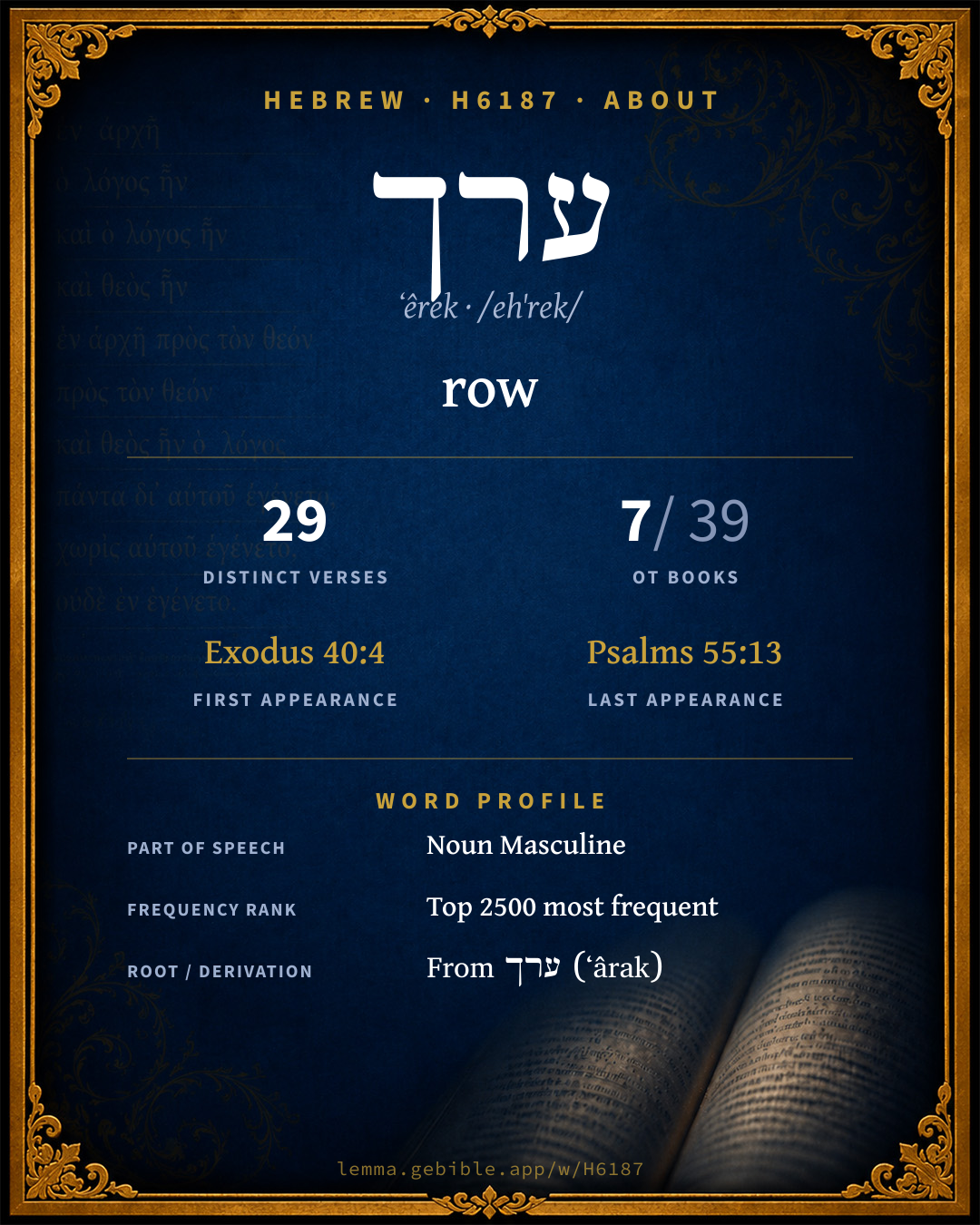
עֵ֫רֶךְ
row
also: order, estimate, layer, pile fuller range ↓
Full lexicon entry — Brown-Driver-Briggs (BDB)
From Brown-Driver-Briggs (BDB)
Where this word appears
Grammar key — what these labels mean
Part of speech
- Noun
- A naming word — a person, place, thing, or idea.
Noun type
- Common
- A common noun — a general class of person, place, or thing (“king,” “city,” “water”), not a specific name.
State
- Construct
- A noun bound to a following noun in a possessive / “of” relationship (the construct chain).
Gender
- Masculine
- Grammatically masculine.
Number
- Singular
- One.
Every verse where H6187 appears in the Book of Judges — 1 distinct verse. Click any verse to open its interlinear word-by-word view. Verse text shown in the World English Bible for context — . Each verse’s Hebrew form is shown with its reference; the English is not keyword-highlighted, since the data carries no word-level English alignment. Use “Compare translations” on any verse to read it across multiple English versions. This concordance covers the Hebrew Bible; Septuagint (Greek Old Testament) occurrences are not indexed here.
Judges
About this entry
At a glance — auto-summarized from this page’s data, not written by a person. Every figure links to its source below. This summary describes the numbers; it doesn’t interpret them.
The Hebrew noun ערך centers on the idea of “row.” Leviticus dominates its distribution — 20 of 29 verses. The Hebrew Bible uses it across 29 verses — moderately common. Beyond “row” it also covers “order”, “estimate”, and “layer” — see its full sense range. Where the King James Version says “estimation,” newer translations reach for “valuation” (Berean Standard Bible); the renderings breakdown has the detail. For the data behind this summary, explore the sense tree and the renderings breakdown below.
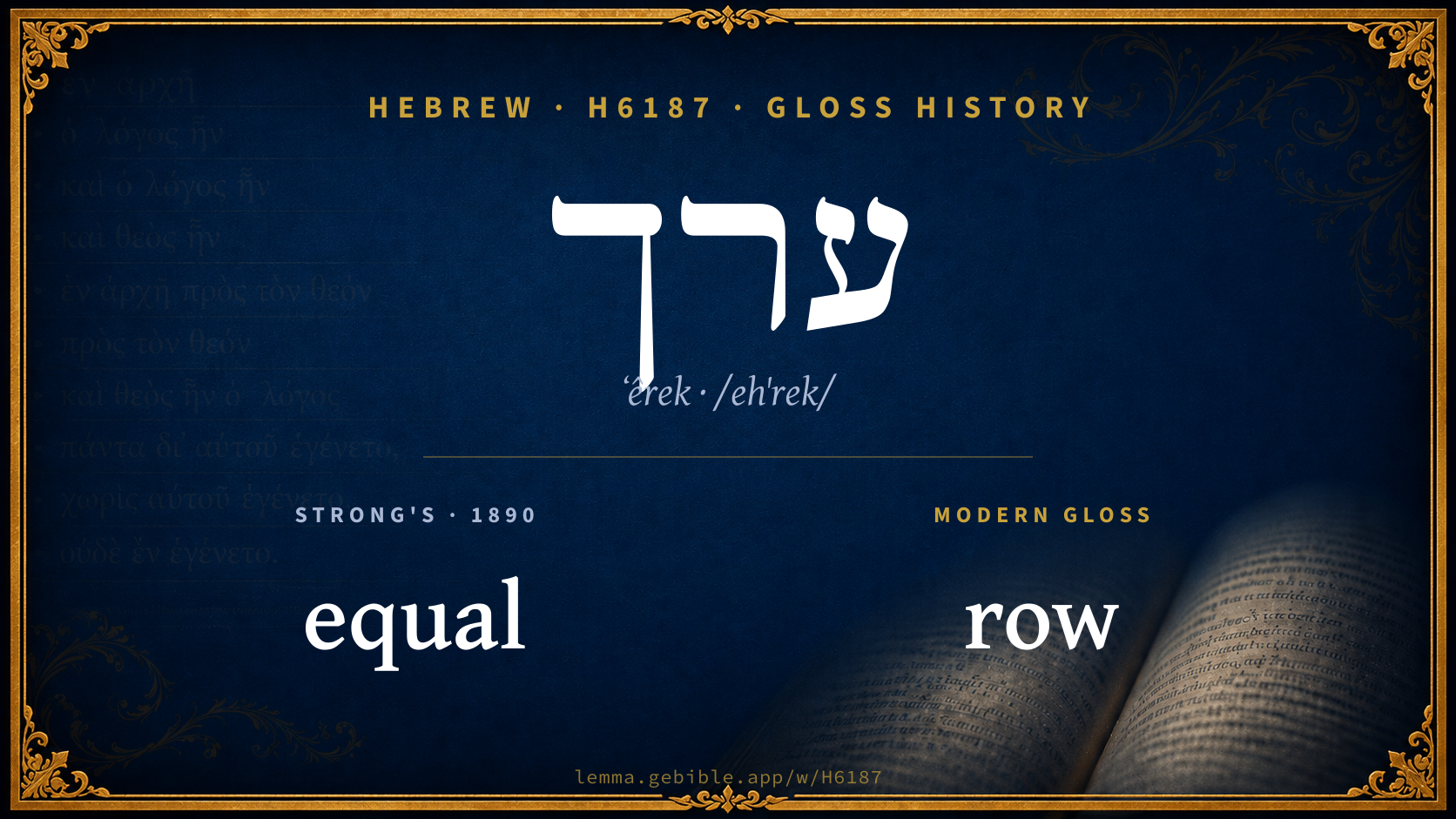
Gloss history
Strong's 1890 vs modern scholarship
About this word
Strong's H6187 catalogs a Hebrew word from the Hebrew Old Testament.
These counts are not copied from any lexicon or concordance. They are computed here, from the morphology-tagged Hebrew Old Testament. What Lemma adds →
- 29
- distinct verses
- The word appears in 29 distinct verses.
- 7 / 39
- OT books
- The word appears in 7 of 39 Old Testament books.
- #1,064
- by frequency
- Top 2500 most frequent Hebrew words (rank 1,064 of 8,640 Hebrew words by occurrence).
View all 29 occurrences in the concordance →
By section of the Old Testament
By traditional corpus
Conventional, traditional groupings — biblical authorship is debated, so this is a traditional corpus grouping, not an authorship claim. Each share is this word’s portion of its verses in that division of the Hebrew canon. Each figure is a share of the word’s 29 distinct verses.
- Torah (Pentateuch) 23 verses · 79%
- Prophets (Nevi'im) 3 verses · 10%
- Writings (Ketuvim) 3 verses · 10%
How translations render this word
Counts come from each version’s own published word-to-Strong’s tagging or interlinear alignment — an approximate guide to how each version renders this word, not a word-level alignment the data otherwise carries. Because each total is that version’s own tagged count, the per-version totals vary from one another and need not match the appearance or distinct-verse counts above. These counts may also differ from a printed concordance because Lemma counts each distinctly tagged rendering and does not collapse phrase taggings into a single head-word total. This is a fixed set of word-tagged versions (KJV, ASV, BSB, ULT) and does not change with the reading translation you choose elsewhere. Each version’s license is shown beside its name below (and on Sources).
- King James Version: Estimation 17×, According to thine estimation 2×, According to thy estimation 2×
- American Standard Version: Estimation 12×, According to thy estimation 5×, According to thine estimation 2×
- Berean Standard Bible: Valuation 10×, According to your valuation 4×, Proper value 3×
- unfoldingWord Literal Text: Valuation 22×, According to your valuation 2×, Valuation of 2×
King James Version Public Domain
Renders H6187 across 33 tagged occurrences — most commonly:
Plus 12 renderings that appear only once — usually multi-word phrases or single function words the recovered tagging swept in, not distinct renderings.
American Standard Version Public Domain
Renders H6187 across 33 tagged occurrences — most commonly:
Plus 14 renderings that appear only once — usually multi-word phrases or single function words the recovered tagging swept in, not distinct renderings.
Berean Standard Bible Public Domain
Renders H6187 across 29 tagged occurrences — most commonly:
Plus 8 renderings that appear only once — usually multi-word phrases or single function words the recovered tagging swept in, not distinct renderings. Not rendered by a distinct English word in 4 further occurrences.
unfoldingWord Literal Text CC BY-SA 4.0
Renders H6187 across 34 tagged occurrences — most commonly:
Plus 8 renderings that appear only once — usually multi-word phrases or single function words the recovered tagging swept in, not distinct renderings.
Senses in the full BDB
What do BDB’s symbols mean?
BDB uses these scholarly abbreviations:
| Symbol | Meaning |
|---|---|
| 𝔊 | the Septuagint (the ancient Greek translation, LXX) |
| 𝔙 | the Vulgate (the Latin translation) |
| 𝔖 | the Syriac version (the Peshitta) |
| 𝔗 | the Targum (the Aramaic translation) |
| ψ | the Psalms |
| √ | root (the underlying root or stem) |
| ‖ | parallel passage (a synonymous or contrasted parallel) |
| † | the dagger: every passage where the word occurs is cited |
The 2 senses and sub-senses the full Brown-Driver-Briggs lexicon distinguishes for this word, in lexicon order (not ranked by frequency), with BDB’s own verbatim wording and sub-sense lettering. Shown in Hebrew script with BDB’s own scholarly abbreviations. The condensed entry is in the Lexicon Entry tab. See also the Forms in the corpus table below.
- 1. order, row, ע׳ בְּגָדִים Ju 17:10 a (complete) suit of clothes (laid out in order), 𝔊B στολὴν ἱματίων; ע׳ לֶחֶם Ex 40:23 i.e. loaves arranged in a row, so ע׳ alone v 4 (P); עֶרְכּוֹ Jb 41:4 his symmetry (v. חִין sub חנן). e.g. Judges 17:10
- 2. estimate, valuation, made by ordering, classifying: אִישׁ כְּעֶרְכּוֹ 2 K 23:35; in 12:5 read עֵרֶךְ (for MT עוֹבֵר) money of a man’s valuation 𝔊 Benz Kit, and prob. del. כֶּסֶף נַפְשׁוֹת עֶרְכּוֹ (? כ׳ עֶרֶךְ נ׳ Kit) as gloss (StaZAW v (1885), 288 f.); כְּעֶרְכִּי ψ 55:14 a man according to my valuation, fig. for my equal; elsewhere P, of priest’s valuation of trespass-offering Lv 5:15, 18, 25, vows, and redemption-money 27:2, 3(×2), 4 + 17 times 27 (כֶּסֶף עֶרְכְּךָ v 15, 19, מִכְסַת הָעֶרְכְּךָ v 23 [del. הָ], cf. v 23b [del. id.]), Nu 18:16.—Jb 28:13 read דַּרְכָּהּ 𝔊 Di al. e.g. 2 Kings 23:35
Senses from the full Brown-Driver-Briggs lexicon (Brown, Driver, Briggs; Oxford 1906 — public domain), digitized via Sefaria, supplemented by the OpenScriptures HebrewLexicon (CC BY 4.0). Full attribution on Sources.
Word origin
n.m. Lv 27; 25 order, row, estimate;—cstr. ע׳ Ju 17:10; Ex 40:23; sf. עֶרְכִּי ψ 55:14, עֶרְכְּךָ Lv 5:15 +, etc.;—
— Brown-Driver-Briggs (Oxford 1906, public domain), digitized via Sefaria, supplemented by the OpenScriptures HebrewLexicon (CC BY 4.0). See Sources.
Derived from ערך (ʻârak) (H6186) — to arrange.
Jastrow Dictionary
A second Hebrew/Aramaic lexicon for comparison, covering Aramaic and post-biblical (Talmudic, Targumic, Midrashic) usage that the biblical-Hebrew BDB does not. Matched by lemma rather than by Strong’s number, so a lemma may carry more than one Jastrow headword (shown separately below), and the entries cover usage well beyond the Bible.
עָרַךְ
- (b. h.) [to connect, join,]
- 1. (b. h.) to range, arrange, place in order. Y. Yoma II, end, 40ᵃ (ref. to Lev. I, 8, a. 12) כהן אחד עוֹרֵךְ וכ׳ one priest places two limbs on the altar &c.; Sifra Vayikra, N’dab., Par. 4, ch. VI. Gen. R. s. 78 יש בי כח לעֲרוֹךְ תפלה (Yalk. ib. 133 לסדר) I have strength to offer prayer; יש בי כח לערוך מלחמה I have strength to give battle. Yalk. l. c. וע׳ מלחמה כנגדו gave him battle. Tanḥ. B’ḥuck. 6 ואֶעֱרוֹךְ לפניכם שלחן I will set a table before you (in the hereafter), v. infra. Ned. 20ᵇ עָרַכְתִּי לו שלחן והפכו I prepared a table for him, but he upset it (euphem. for unnatural gratification); a. e. [In Talm. mostly סדר.]—עוֹרְכֵי הדיינין (= עורכי דין לפני הדיינין) those who arrange arguments before the judges, pleaders, advocates, who advise their clients what to say or not to say before court. Ab. I, 8 אל תעש עצמך כע׳ הד׳ do not make thyself to be like legal advisers, i.e. be careful as judge not to suggest an advice to one of the litigants; Y. B. Bath. IX, 17ᵃ top כעֹרְכֵי; Y. Keth. IV, 29ᵃ bot. אל תעש עצמך כע׳ הד׳ שלא לגלות וכ׳ do not make thyself to be like &c., that is, you must not reveal to an individual his case (how to argue). Bab. Keth. 52ᵇ; 86ᵃ עשינו עצמינו כע׳ ד׳ we have made ourselves to be like &c. (I ought not to have suggested an advice).—Part. pass. עָרוּךְ; f. עְרוּכָה &c. Sabb. 119ᵇ וכשבא לביתו ומצא נר דלוק ושלחן ע׳ וכ׳ when he comes home and finds the lamp lighted, the table set and the couch spread, the good angel says &c.; a. e.—2) (cmp. Syr. ערך, P. Sm. 2990) to work dough (contrad. to לוּשׁ); to roll, shape &c. Pes. III, 4 אחת לשה ואחת עוֹרֶכֶת וכ׳ one woman kneads, another works and shapes the dough, and a third one bakes. Ab. Zar. IV, 9 לא לשין ולא עוֹרְכִין עמו you must not knead nor work and shape dough with him. Neg. II, 4 כעוֹרֶכֶת in the position of a woman working dough; a. fr.—Part. pass. as ab. Erub. 54ᵃ (ref. to ערוכה וכ׳, II Sam. XXIII, 5) אם ע׳ … משתמרת וכ׳ if the Law is worked into thy two hundred and forty-eight limbs, it will be preserved &c. Midr. Till. to Ps. XIV [read:] פת לושה ופת ע׳ kneaded (common) bread and well-worked bread; Yalk. ib. 662 עריכה (corr. acc.). e.g. Leviticus 1:8
- [to place side by side; cmp. נָקַשׁ Hif.] to compare; to value; esp. (v. Lev. XXVII, 2-13) to dedicate the value of a person or of an animal unfit for the altar. Arakh. I, 1 הכל מַעֲרִיכִין ונֶעֱרָכִין all persons are fit to dedicate or to be the subjects of dedication. Ib. נֶעֱרָךְ אבל לא מַעֲרִיךְ may be the subject of dedication, but cannot dedicate (his vow is invalid). Ib. VI, 5 המעריך את עצמו he who dedicates his own value. Tanḥ. l. c. [read:] אתם מעריכין לפני את נפשותיכם … מעריכת גיהנם you value before me your lives, and I shall save you from the range of Gehenna (v. עֲרִיכָה), and set &c. (v. supra); a. fr. e.g. Leviticus 27:2
- to be the subject of valuation, to be valued. Arakh. I, 1, a. fr., v. supra. Ib. II, 1 אין נערכין Var., v. עֵרֶךְ.
עֲרַךְ
- , to work, knead. Targ. Is. XLI, 25 דעָרֵיךְ (h. text ירמס).—Men. 56ᵃ דע׳ הוא ואפה הוא when he himself kneaded and baked; דעריך חבריה וכ׳ when his neighbor kneaded and gave it to him, and he baked. Y. Shebu. VI, 37ᵃ bot. אזלת מֵיעֲרוֹךְ גבי חבירתה she went to knead her bread at her neighbor’s.—Part. pass. עָרִיךְ, pl. עֲרִיכִין Ib.ᵇ top אשכחון … ע׳ גו עיגולא they found the two denars (that were missed) worked into the cake.
- to be worked in. Ib.ᵃ bot. אִיעַרְכוּ גו עיגולא, v. supra.
עֵרֶךְ
- preced.)
- 1. order, arrangement. Ned. 22ᵇ שעֶרְכָּהּ של ארץ ישראל הוא because it (the Book of Joshua) contains the arrangement of the Land of Israel.—Pl. עֲרָכִים, constr. עֶרְכֵי. Cant. R. to VI, 4; Pesik. Vayhi, p. 7ᵃ sq. שש ע׳ המשנה, v. מִשְׁנָה.—ע׳ המלחמה order of battle, arrangements proclaimed before the battle (v. מַעַרְכִים). Y. Sot. VIII, beg. 22ᵇ (ref. to Mish. ib. VIII, 6) אבל בע׳ המ׳ מספקין וכ׳ but in connection with the proclamation of the regulations of battle (the Mishnah says only), ‘they have to supply water &c.’ Ib. אף בע׳ המ׳ כן the same is the case with ordinances of battle (they must be proclaimed in Hebrew). Bab. Sot. 43ᵇ אין חוזרין עליו מע׳ המ׳ they are not entitled to leave the army on that account. Ib. 44ᵇ; Men. 36ᵃ; a. e.
- 2. valuation, assessment, value of a person or animal dedicated to the sanctuary; vow of value. Arakh. 7ᵇ ואמר עֶרְכִּי עלי if he says, I vow my own value. Ib. IV, 1 הע׳ בזמן הע׳ the valuation is regulated by the time of the vow (irrespective of the value at the time of paying the vow); ib. 4 נותן כזמן הע׳ he pays according to the value at the time of the vow. Ib. נותן ע׳ זקן he pays the value of an old man (Lev. XXVII, 7); ע׳ ילד the value of a child (ib. 6); a. fr.—Pl. עֲרָכִים, עֲרָכִין. Ib. II, 1 אין בע׳ וכ׳ (Var. נֶעֱרָכִין, v. עָרַךְ) in vows of value nothing is valued at less than a Selʿa &c.; ib. 7ᵇ כל ע׳ שאתה מעריך וכ׳ all values which you assess shall be no less than &c. Ib. IV, 1 והע׳ בנערך the vows of value are regulated by the condition of the person whose value is vowed. Ib. III, 1 יש בע׳ להקל וכ׳ in the laws regulating the dedication of values there is a lenient and a rigorous side. Ib. 2ᵃ, a. e. כל שישנו בדמים ישנו בע׳ … אינו בע׳ he whose person has a value, can vow the value of a person or an animal, but he whose person has no value cannot. Kerith. 13ᵇ דמין וע׳, v. דָּמִים. Tanḥ. B’ḥuck. 6 פרשת ע׳ the section treating of vows of value. Ib. בזכות הע׳ אני מציל וכ׳ as a reward for your offerings of values, I will save you &c.; a. fr.—ʿĂrakhin, name of a treatise of Mishnah, Tosefta and Talmud Babli, of the Order of Kodashim.—[ערכין, Gitt. 44ᵃ Ar., v. עַרְכִי.] e.g. Leviticus 27:7
A Dictionary of the Targumim, the Talmud Babli and Yerushalmi, and the Midrashic Literature (Marcus Jastrow; London, Luzac, 1903) — Public Domain. Digitized via Sefaria. Digitized via Sefaria. Full attribution on Sources.
Forms in the corpus
The 24 distinct written forms H6187 takes in the Hebrew Bible, most frequent first — each parse links to that state’s occurrences in the concordance. Hebrew forms include their vowel points and cantillation, so a single lemma takes many written forms.
| Form | Parsing | Example | Uses |
|---|---|---|---|
| בְּ/עֶרְכְּ/ךָ֥ | Noun, Common, Masculine, Singular, Construct | Leviticus 5:18 | 3 |
| עֶרְכְּ/ךָ֔ | Noun, Common, Masculine, Singular, Construct | Leviticus 27:6 | 3 |
| עֶרְכְּ/ךָ֛ | Noun, Common, Masculine, Singular, Construct | Leviticus 27:5 | 3 |
| עֶרְכּ֑/וֹ | Noun, Common, Masculine, Singular, Construct | Exodus 40:4 | 2 |
| עֶרְכְּ/ךָ֖ | Noun, Common, Masculine, Singular, Construct | Leviticus 27:4 | 2 |
| עֶרְכְּ/ךָ֙ | Noun, Common, Masculine, Singular, Construct | Leviticus 27:3 | 2 |
| בְ/עֶרְכֶּ֔/ךָ | Noun, Common, Masculine, Singular, Construct | Leviticus 27:27 | 1 |
| בְּ/עֶ֨רְכְּ/ךָ֔ | Noun, Common, Masculine, Singular, Construct | Numbers 18:16 | 1 |
| בְּ/עֶרְכְּ/ךָ֛ | Noun, Common, Masculine, Singular, Construct | Leviticus 5:15 | 1 |
| בְּ/עֶרְכֶּֽ/ךָ | Noun, Common, Masculine, Singular, Construct | Leviticus 27:27 | 1 |
| הָ/עֶרְכְּ/ךָ֙ | Noun, Common, Masculine, Singular, Construct | Leviticus 27:23 | 1 |
| הָֽ/עֶרְכְּ/ךָ֔ | Noun, Common, Masculine, Singular, Construct | Leviticus 27:23 | 1 |
| וְ/עֵ֥רֶךְ | Noun, Common, Masculine, Singular, Construct | Judges 17:10 | 1 |
| כְּ/עֶרְכּ֗/וֹ | Noun, Common, Masculine, Singular, Construct | 2 Kings 23:35 | 1 |
| כְּ/עֶרְכְּ/ךָ֖ | Noun, Common, Masculine, Singular, Construct | Leviticus 27:17 | 1 |
| כְּ/עֶרְכְּ/ךָ֥ | Noun, Common, Masculine, Singular, Construct | Leviticus 27:12 | 1 |
| כְּ/עֶרְכִּ֑/י | Noun, Common, Masculine, Singular, Construct | Psalms 55:13 | 1 |
| מֵֽ/עֶרְכֶּ֔/ךָ | Noun, Common, Masculine, Singular, Construct | Leviticus 27:8 | 1 |
| מֵֽ/עֶרְכֶּֽ/ךָ | Noun, Common, Masculine, Singular, Construct | Leviticus 27:18 | 1 |
| עֵ֥רֶךְ | Noun, Common, Masculine, Singular, Construct | Exodus 40:23 | 1 |
| עֶרְכְּ/ךָ֗ | Noun, Common, Masculine, Singular, Construct | Leviticus 27:3 | 1 |
| עֶרְכֶּֽ/ךָ | Noun, Common, Masculine, Singular, Construct | Leviticus 27:13 | 1 |
| עֶרְכָּ֑/הּ | Noun, Common, Masculine, Singular, Construct | Job 28:13 | 1 |
| עֶרְכּֽ/וֹ | Noun, Common, Masculine, Singular, Construct | Job 41:12 | 1 |
Same root — word family
Other BDB entries built from the same root as H6187, grouped by Strong’s listed origin. These share a root / origin per the lexicon — not necessarily a shared meaning. Each links to that word’s own entry.
Derives from
Shares the same root
Compare all same-root words → They share a root, not necessarily a meaning.
Septuagint verse parallels
This word appears in 29 verses that also exist in the Greek Old Testament (Septuagint), out of the 29 Hebrew verses it occurs in. You can read those verses in Greek by switching the Old Testament edition to the Septuagint.
Read these verses in the Septuagint
This is a verse-level parallel only — the same verses exist in both the Hebrew and Greek Old Testaments. No word-level Hebrew↔Greek correspondence is claimed: the data carries no such alignment, so no Greek word is shown as this Hebrew word’s translation. Coverage is not total — the Septuagint omits the deuterocanon and renumbers the Psalms, so some Hebrew verses have no direct Greek parallel.